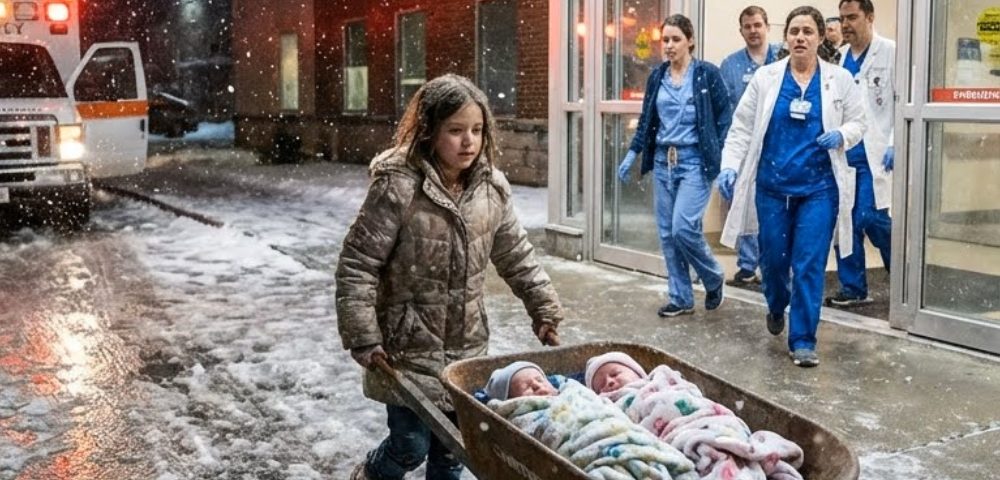
After more than eight kilometers , she arrived at the regional hospital. Her legs were trembling. She pushed the wheelbarrow to the emergency room entrance and shouted at the top of her lungs. Nurses and patients froze at the sight: an exhausted little girl, two babies purple with cold, and tears streaming down her face.
“My mom… she won’t wake up,” Lucia repeated. “Please, help them.”
The doctors acted immediately. The twins were taken to the neonatal unit in critical condition due to dehydration and hypothermia . A doctor called emergency services to send an ambulance to Carmen’s house. Meanwhile, Lucía sat in a chair, a blanket over her shoulders, staring at the automatic
Thirty minutes later, a doctor emerged from the neonatal ICU, his face tense. He walked over to Lucía, knelt down to her level, and uttered a sentence that silenced the entire hallway…
“Lucía, we need you to be very brave,” said Dr. Andrés Navarro , his voice composed. “Your little siblings are alive, but very fragile. And your mother… is very ill.”
The girl didn’t cry. She nodded slowly, as if she had already accepted that possibility during the long walk. What she didn’t know was that, thanks to her decision, time was still on her side .
The ambulance arrived at Carmen’s house and rushed her to the hospital.
She had a severe postpartum infection and had gone days without medical attention. Every hour counted. In the operating room, doctors fought to stabilize her, while in the neonatal unit, the twins were connected to incubators, feeding tubes, and monitors.
Lucía was taken to social services. There, for the first time in days, she ate something hot. A nurse, Rosa , sat beside her and asked how she had managed to get there. When she heard the whole story, Rosa had to leave the room to weep silently.
The news spread quickly through the hospital. Doctors, orderlies, administrative staff… everyone was talking about the girl with the wheelbarrow. A local journalist covering another story overheard the tale and asked permission to tell it. The hospital agreed, protecting the girl’s identity.
That same night, neighbors from the town began to arrive. They brought clothes, powdered milk, and blankets. An elderly woman offered to stay with Lucía while Carmen was hospitalized. The hospital director arranged for urgent social assistance.
After 36 critical hours , Carmen woke up. The first thing she asked was about her children. When they told her they were alive thanks to Lucía, she burst into tears. She asked to see her daughter. The reunion, with Lucía hugging her mother, who was covered in tubes, left everyone speechless.
The twins began to improve slowly. Every small improvement was celebrated as a victory. Lucía visited the incubator every day, speaking to them in a low voice, telling them how she had brought them “in her special car.”
A week later, Dr. Andrés gathered the staff and the family to deliver the news: all three would survive . It wasn’t an inexplicable miracle; it was the direct result of the courage, logic, and love of a little girl who decided to act when no one else could.
A month later, Carmen and her three children left the hospital together. They had no riches, no fame, no easy life waiting for them. But something had changed forever: they were no longer alone .
The town council arranged decent housing for her. A local NGO helped with food and medical follow-up. Lucía returned to school, shy at first, not understanding why the adults looked at her with such admiration. To her, she hadn’t done anything extraordinary. She had only pushed a wheelbarrow because her siblings needed her.
The hospital placed a small, discreet plaque in the emergency room hallway.
It didn’t say “heroine,” nor did it include her full name. Just a simple phrase:
“Sometimes, the greatest courage comes in the smallest steps.”
Carmen, still recovering, shared her story at a community center. Not to seek pity, but to remind everyone of something essential: the importance of access to medical care, early intervention, and not ignoring warning signs . She also spoke about Lucía, not as a perfect child, but as a real girl who was afraid, who got tired, who doubted herself… and yet kept going.
Today, Mateo and Samuel are growing up healthy. Lucía dreams of becoming a nurse “to help babies.” No one knows what the future holds for them, but everyone knows one thing: this family exists thanks to a decision made in time.
And now, this story comes to you.
If this story touched your heart, please share it . You never know who might need a reminder that asking for help in time saves lives.
Leave us a comment:
 What would you have done in Lucía’s place?
Do you think we, as a society, provide enough support to vulnerable families?
Your opinion matters. Because real stories like this aren’t just read… they’re continued with awareness, empathy, and action .