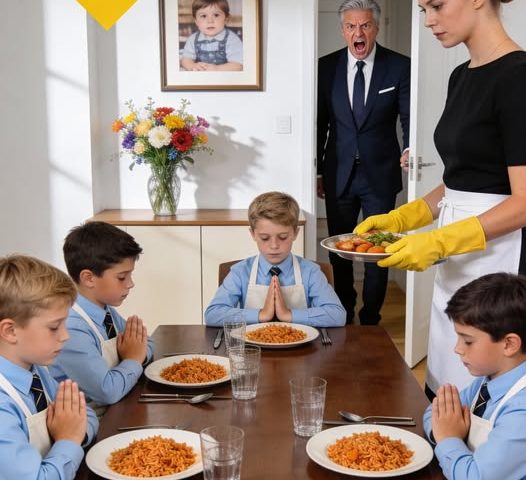
THE MILLIONAIRE COMES HOME EARLY
A billionaire arrived home at lunchtime three hours earlier than usual. The keys slipped from Alejandro de la Vega’s hand and clattered onto the marble floor—yet inside the mansion, no one reacted. He stood at the dining room threshold, frozen, blood running cold and hot at the same time.
Five years after his wife Lucía’s funeral, the imported mahogany table had been untouched—until now.

FOUR LITTLE BOYS AT HIS FORBIDDEN TABLE
Elena, the young housemaid in a crisp blue-and-white uniform, wasn’t polishing silver or dusting. She was sitting at the table, calmly feeding four identical little boys—around four years old—wearing patched, makeshift clothing.
Their eyes tracked her spoon like it was the most precious thing in the world. The meal wasn’t luxury—just simple yellow rice—yet the boys stared at it as if it were gold.
Elena murmured softly, “Open wide, my little birds.”
Then, gently: “Eat slowly. Today there’s enough for everyone.”
She was wearing bright yellow cleaning gloves—hands meant for scrubbing floors—yet she used them with a tenderness so maternal it made Alejandro’s throat tighten.

THE SHOCK OF RECOGNITION
Alejandro should have stormed in, demanded answers, thrown everyone out.
Instead, he couldn’t move.
The boys’ profiles—one turning to laugh, lamp light catching his face—hit Alejandro like a time-warped mirror. The nose. The smile. The expression. The familiarity was terrifying.
The mansion was a fortress. No one entered without permission. Yet here were four children eating at his table like hidden royalty—alive, real, laughing softly in a house that had been silent for years.

ELENA SEES HIM FIRST
The faint creak of Alejandro’s Italian shoes was nothing… but Elena reacted like it was thunder. She turned, color draining from her face.
The boys sensed her fear at once and looked toward the doorway in perfect unison.
Alejandro couldn’t breathe. Up close, the resemblance wasn’t “similar.”
It was identical.

“WHO ARE THESE CHILDREN?”
Elena jumped up, instinctively stepping in front of the boys with her arms spread wide—protective, fierce.
Alejandro marched forward, rage beginning to replace shock. His voice shook the room:
“What does this mean, Elena?”
The boys clustered behind her, trembling. Elena’s voice trembled too, but she held her ground:
“They’re not strangers, sir.”
Alejandro demanded, “Whose children are they? Are they yours?”
Elena tried a weak lie—“My nephews.”
Alejandro’s eyes flicked to the boys’ shirts. One wore a fabric pattern Alejandro recognized from clothing he’d thrown away.
He said coldly, “Why are they dressed in my old clothes?”

THE BIRTHMARK
Alejandro reached for the bravest boy’s arm. Elena warned, low and sharp: “Don’t touch them.”
But Alejandro ignored her.
And then he saw it: a birthmark on the child’s forearm—exactly where Alejandro had his own. A mark passed down in his family line.
His knees nearly gave out. He searched the other boys’ faces, their features, their expressions. The truth pressed in like a wall.
Alejandro whispered, voice rough: “Look at me, Elena. Tell me the truth.”
One of the boys pointed at Alejandro with innocent certainty:
“You look like the photo.”
Alejandro went still. “What photo?”
The boy answered brightly, unaware of the earthquake he’d caused:
“The photo Elena shows us before we sleep. She says you’re good… just busy.”
Then the child asked the question that broke the room:
“Are you my dad?”

“YES. THEY’RE YOUR CHILDREN.”
Elena’s face collapsed into tears. She nodded slowly.
“Yes, sir,” she whispered. “They’re your children… all four.”
Alejandro staggered back, denial flaring into fury and grief.
“That’s impossible,” he choked out. “I buried them. I have death certificates. I have graves.”
Elena’s voice shook: “I’m telling you what’s real.”
Then she pulled a worn locket from beneath her uniform.
“If you don’t believe me… believe this.”
Alejandro recognized it instantly—it was Lucía’s. A unique piece from Italy. Inside was a tiny photo of him and Lucía, smiling. On the other side, engraved:
“For my four miracles.”
Alejandro’s legs finally gave. He dropped to his knees in his expensive suit, staring at the boys like he was seeing life return to a place he’d buried.

WHERE ELENA FOUND THEM
Alejandro forced the words out: “How?”
Elena told him the truth. Six months earlier, after work, she’d heard crying near dumpsters behind a restaurant. She found the four boys huddled together, weak and starving. She spent her entire week’s pay on a taxi and brought them to her small servant room inside the mansion—because she didn’t believe they would survive another night outside.
She admitted she’d fed them what she could afford—cheap rice colored yellow to make it feel “special.”
“If it looks like gold,” she said softly, “it gives them hope.”
Alejandro stared at the bowls like they were a confession carved into porcelain. This “poor” meal had kept his children alive.
A small voice piped up—one boy pushing his plate toward Alejandro:
“Sir… do you want some? Elena puts magic powder. It’s good.”
And Alejandro—who had everything—ate from his child’s plate with shaking hands.
THE REAL VILLAIN WALKS IN
The moment of fragile peace shattered with the roar of a car outside. Heels clicked fast on marble. Elena turned pale. The boys stiffened.
One whispered, trembling: “It’s her.”
A sharp voice rang from the hallway: “Alejandro!”
Doña Bernarda—Alejandro’s mother—appeared in designer clothes and jewels. She stopped when she saw the scene: Elena, the yellow rice, Alejandro with a spoon, and four identical boys.
Her face didn’t show surprise.
It showed guilt and terror.
She stammered, “No… it can’t be… I made sure…”
Alejandro’s voice turned lethal-calm:
“You made sure of what, Mother?”
THE TRUTH AND THE WAR
In that moment, Alejandro understood: the “deaths,” the closed coffins, the paperwork—Bernarda had controlled everything.
He confronted her, and her mask cracked. She tried to claim Elena was a criminal and the boys were “nobody,” but her own fear betrayed her.
The situation spiraled into chaos—shouting, threats, panic—until security removed Bernarda from the house. Alejandro ordered, “Get her out.”
Inside, the children shook. Elena held them close. Alejandro knelt beside them and promised, voice breaking:
“No one will ever hurt you again. No one.”
A NEW HOME INSIDE THE SAME HOUSE
Alejandro made a decision on the spot: the boys would move into the main wing—the rooms he’d prepared years ago and never used.
He ordered warm baths, clean clothes, and real food. Elena guided the process like someone who already knew the boys’ fears and needs.
Later, when one boy tried to hide food “for later,” Alejandro crouched to their level and said firmly:
“You will never have to hide food again. Never.”
Then he turned to Elena and said the words that changed her life:
“Sit with us.”
Elena tried to refuse—rules, status, habit—until Alejandro cut her off:
“Those rules left with my mother.”
And then: “You’re family.”
THE COUNTERATTACK
The next morning, the intercom buzzed. Security sounded panicked:
“Sir… the police are at the gate. Social workers too. They have a court order.”
A false report: kidnapping, unsafe conditions. Bernarda had struck back.
Alejandro stepped forward like a wall and told Elena, “Say nothing. I’ll speak.”
At the gate, Bernarda played the victim. The police tried to follow “protocol.” Alejandro fought for 24 hours to secure an emergency DNA test.
Then, in a move no one expected, he told Elena, voice absolute:
“We’re getting married. Today.”
Elena panicked—status, reputation, scandal—until Alejandro said, “Do you think I care what strangers think while my children are in danger?”
She agreed—on one condition:
“Don’t make me a paper shield. Promise you won’t discard me after the storm.”
Alejandro answered without hesitation:
“You have my word.”
DNA CONFIRMS, AND ALEJANDRO CHOOSES PEACE
The rushed test confirmed it: 99.9%—the boys were his children.
His lawyer also uncovered evidence that Bernarda had paid to falsify the deaths and move the babies away.
But Alejandro made a shocking decision: he refused to let the children’s future be defined by a public scandal. He cut Bernarda off, exiled her from the family and the company—and protected the boys from a lifetime of being “the headline.”
He looked at Elena and said quietly:
“Now we build the future. And I need you.”
Elena’s confession came out like a whisper:
“I stayed… because I saw your pain. And because I loved you—long before I found them.”
ONE YEAR LATER: THE “GOLD RICE” RETURNS
A year later, the mansion wasn’t a tomb anymore. It was loud. Messy. Alive. The boys ran through the garden, stronger, laughing freely—no fear in their bodies.
Elena brought out a steaming bowl of bright yellow rice and the boys shouted together:
“Gold rice!”
Alejandro kissed Elena’s cheek and asked softly, “Why rice today?”
Elena smiled: “They asked for it. So they never forget.”
At the table, Alejandro raised his glass:
“To Elena… who taught me that real gold isn’t in the bank.”
The family ate, laughed, and the mansion finally became what money could never buy on its own:
a home.