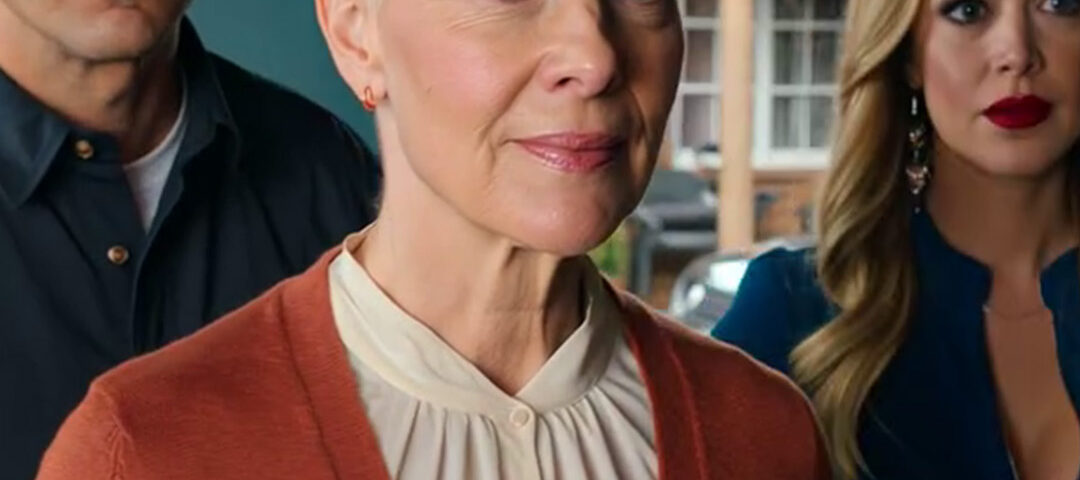
“We heard you bought a luxury villa in the Alps. We came to live with you and make peace,” my daughter‑in‑law declared at my door, pushing her luggage past the threshold.
I didn’t block them. I just stood there, one hand still damp from the stems of wildflowers I’d been arranging in a chipped mason jar, listening to the echo of her words in my mountain sanctuary.
“Make peace,” I repeated silently.
Behind them, the late‑model black sedan idled in the gravel driveway, its engine purring with the smug confidence of money—American money, old Nashville‑suburb money that had always looked down on my working‑class life. The car’s sleek shape looked absurd against the backdrop of the Swiss Alps, all jagged peaks and evergreen forests and a sky so clear it hurt to look at.
I’d been living here for three years now, running Haven Springs Recovery Center out of what had once been a modest lodge. I’d traded the flat gray skies of Ohio and the fluorescent lights of American hospital corridors for crystal air and mountain silence. The U.S. flag I kept neatly folded in a shadow box in my bedroom—my little piece of home—was one of the few reminders left of the life I’d walked away from.
A few minutes earlier, I’d been alone in the main hall, arranging wild lupines and alpine daisies into a mismatched collection of mason jars and old glass soda bottles I’d hauled all the way from a flea market back in Colorado on my last trip home. The afternoon had been peaceful, the kind of quiet you never get in American suburbia anymore—no leaf blowers, no delivery trucks, no sirens. Just the whisper of wind through the pines and the distant rush of a glacier‑fed river.
Then I heard the car.
The engine sound rose up through the narrow valley like a blade, sharp and unwelcome. I paused, my hands still gripping the stems of purple lupines, and listened as the vehicle climbed the winding gravel road toward my sanctuary.
No one was expected today.
The women staying at the center had gone down to the small Swiss town below for their weekly therapy session with Dr. Keller, the local psychiatrist who’d become part of our extended family. Saturday afternoons were usually mine—my time to tend the flowers, check supplies, make strong American coffee in the battered stainless‑steel percolator I’d brought from my kitchen in Nashville, and breathe in mountain air without interruption.
At fifty‑nine, after thirty‑seven years as a nurse in American hospitals—from a tiny county ER in rural Kentucky to a busy urban trauma center in Denver—I had finally learned the value of solitude.
The engine grew louder. Closer.
Through the tall windows that framed the main hall like a postcard, I caught a glimpse of a sleek black sedan making its way up the final curve of the road. It did not belong to any of our donors or the local social workers who sometimes visited. My stomach tightened with an inexplicable dread.
Something about that car, about the way it moved with such presumptuous confidence, set every nerve in my body on edge. It looked like it had rolled straight out of an American luxury dealership along I‑65 in Tennessee and somehow gotten lost in the Swiss Alps.
I set down the flowers and smoothed my cotton dress—the same powder‑blue one I had worn to my divorce proceedings fifteen years ago in a courthouse outside Nashville. It felt appropriate somehow, like armor for whatever battle was about to unfold.
The car doors slammed shut with expensive‑sounding thuds.
Two sets of footsteps crunched across the gravel, moving with purpose toward my front door. I recognized the rhythm of that walk before I even saw their faces. Preston’s measured stride—the one he’d inherited from his father—and beside it, the sharp, staccato click of designer heels that could only belong to his wife, Evangeline.
My son and my daughter‑in‑law had found me.
The doorbell chimed its gentle melody—the same soft tune that had welcomed broken women seeking refuge these past three years. How ironic that it now announced the arrival of the two people I had spent four years trying to escape.
I took a deep breath, tasting the lavender‑scented air of my haven, and walked to the door. My hand hesitated on the brass handle for just a moment.
I could pretend I wasn’t home.
I could slip out the back entrance, cut through the pines, and disappear onto the mountain trails like I had once vanished into the endless highways of the American Midwest, driving from Tennessee to Colorado with everything I owned stuffed in the back of an aging Ford.
But no.
I was done running from Preston and his wife. Done cowering. Done being the convenient target for their cruelty.
I opened the door.
“Hello, Mother,” Preston said.
His voice carried that familiar blend of condescension and false warmth that had always made my skin crawl. At thirty‑four, he had grown into a perfect replica of his father—tall, imposing, with steel‑gray eyes that never seemed to see me as anything more than an inconvenience.
Beside him, Evangeline stood like a porcelain doll come to life. All sharp angles and calculated beauty. Her platinum‑blonde hair was pulled back into a severe, glossy knot that probably had a French name, and her red lips curved into what might have been a smile if there had been any warmth behind it.
“Annette,” she said, my name dripping from her tongue like poison.
She never called me Mom or Mother. From the beginning of her marriage to Preston, she had made it abundantly clear that she considered me beneath such familial courtesy.
“We heard you bought a luxury villa in the Alps,” Evangeline continued, her eyes already scanning past me into the house with obvious approval. “We came to live with you and make peace.”
Before I could respond, before I could even process the audacity of her words, they were moving.
Preston hefted two large designer suitcases from behind him, while Evangeline pushed past me into the entryway, her heels clicking against the hardwood floors like the countdown to an execution.
“Make peace,” I echoed under my breath.
The irony wasn’t lost on me.
For four years I had tried to make peace. I had endured their snide comments about my modest apartment back in the States, their criticism of my career choices, their constant implications that I was a burden on their perfect lives. I had smiled through dinner parties in their Nashville subdivision where Evangeline introduced me as “Preston’s mother—the one who never quite figured things out.”
I had bitten my tongue when they forgot my birthday, ignored my calls, and treated me like an embarrassing relative they were obligated to tolerate.
And now, now that I had finally found something good for myself, thousands of miles from the cul‑de‑sacs and strip malls of American suburbia, they wanted to make peace.
“Don’t just stand there, Mother,” Preston said, maneuvering his suitcases through the doorway. “Help us with the luggage. This mountain air must be making you slow.”
I stepped aside, not because I wanted to help them, but because I was too stunned to do anything else.
They moved through my sanctuary like conquistadors claiming new territory, their expensive clothes and entitled attitudes as out of place as wolves in a flower garden.
Preston wheeled his suitcase toward the main hall, Evangeline close behind him, her sharp eyes cataloging everything she saw.
I watched them go, my heart hammering against my ribs, and wondered if this was how deer felt in the seconds before the hunter pulled the trigger.
They reached the archway that led into the main hall—the heart of my sanctuary—where I had spent countless hours listening to women share their stories of survival and healing.
Preston stepped through first, his mouth already opening to make some cutting remark about my decorating choices or the simplicity of the furnishings, but the words died in his throat.
Evangeline, following half a step behind, froze mid‑stride. Her perfectly composed mask slipped for just an instant, revealing something that might have been confusion or shock.
They stood there in the archway, statue‑still, staring at the wall that dominated the main hall.
The wall I had covered with photographs.
Dozens and dozens of them, arranged in careful rows like a gallery of love.
But these weren’t the photos they expected to see.
They weren’t pictures of Preston’s childhood or family vacations to Florida, no shots of him in a Little League uniform or standing under an American flag in front of our old ranch house outside Knoxville. No forced smiles from holiday gatherings in their perfectly staged living room.
These were photos of my real family.
The women who had come through these doors seeking shelter and had found a mother instead.
Maria, the young single mother who had arrived six months ago with nothing but the clothes on her back and a baby in her arms. Sarah, the grandmother who had been financially abused by her own children until she had nothing left but debt and shame. Rebecca, the middle‑aged teacher whose husband had controlled every aspect of her life for twenty years before she found the courage to leave.
They were all there on my wall—laughing around the kitchen table, working in the garden, celebrating birthdays and small victories.
In every photo, I stood among them, my arm around a shoulder, my face bright with genuine joy.
These were the faces of the family I had chosen, the daughters of my heart who had chosen me in return.
“What…” Evangeline whispered, her voice tight with something between confusion and disgust. “What is this?”
Preston turned to look at me, his gray eyes sharp with suspicion.
“Mother, who are these people?”
I stepped into the hall behind them, my spine straightening with each step. For the first time in years, I felt powerful in their presence.
This was my space. My sanctuary. My home.
“Those are my daughters,” I said simply.
The words hung in the air between us like a challenge.
Preston’s face darkened. Evangeline’s perfectly plucked eyebrows drew together in a frown.
“Your daughters?” Preston repeated, his voice rising with indignation. “What the hell is that supposed to mean? I’m your only child.”
I looked at him—really looked at him—and saw not the little boy I had once rocked to sleep in a tiny Ohio apartment, not the toddler I’d pushed on swings at the park while other moms in faded jeans and baseball caps traded stories about soccer practice and school fundraisers.
I saw a stranger wearing my son’s face. A man who had never once, in all his thirty‑four years, looked at me with the love and gratitude I saw in the eyes of the women on my wall.
“You’re my son,” I said quietly. “But you haven’t been my child for a very long time.”
Evangeline sucked in a sharp breath.
“How dare you?” she hissed. “How dare you replace your own family with these…these strangers?”
But I wasn’t listening to her anymore.
I was looking at the wall—at all those beautiful faces—and remembering why I had come here. Why I had left behind everything familiar and comfortable in America to build something new in this faraway valley.
I had come here to save myself.
And in doing so, I had learned to save others.
Preston and Evangeline could bring their suitcases and their demands and their toxic sense of entitlement. They could try to colonize my sanctuary the way they had colonized my life for so many years.
But they couldn’t take away what I had found here.
They couldn’t destroy the family I had chosen, the love I had earned, the peace I had fought for.
Not anymore.
“I think,” I said, my voice steady and calm, “we need to talk.”
The silence that followed was deafening.
Preston stood rigid in the center of my main hall, his expensive suit looking absurdly formal against the backdrop of handmade quilts, thrift‑store lamps, and wildflower arrangements in old Mason jars.
Evangeline had positioned herself near the stone fireplace, one manicured hand resting on the mantle as if she were claiming ownership of the space.
“Talk about what, exactly?” Evangeline’s voice cut through the quiet like broken glass. “About how you’ve been living some fantasy life up here while completely ignoring your real family?”
I felt that familiar tightness in my chest—the same sensation I had experienced countless times during their visits back in Nashville. The feeling of being small, wrong, somehow deficient in ways I could never quite identify or correct.
But this time, something was different.
This time I was standing in my own sanctuary, surrounded by the evidence of the life I had built, the love I had earned.
“My real family,” I repeated slowly, tasting the words. “Tell me, Preston—when was the last time you called me? Not because you needed something, not because it was a holiday, but just because you wanted to hear my voice?”
Preston’s jaw tightened.
“I don’t have time for emotional manipulation, Mother,” he snapped. “Evangeline and I have had a difficult year. My business has been struggling, and we thought it would be good for all of us to spend some time together.”
“Struggling,” I said softly, the pieces beginning to fall into place. “Is that what you call it?”
Evangeline shot Preston a warning look, but he was already talking, his words tumbling out with the careless confidence of someone who had never been truly denied anything in his life.
“The real estate market has been brutal,” he said. “We’ve had to make some adjustments—downsize the house, let the housekeeper go. It’s been stressful. When we heard you had bought this place, we thought it was perfect timing.”
Perfect timing.
I almost laughed.
They had ignored me for four years, treated me like an embarrassment, made it clear that my presence in their lives was barely tolerated. And now, when they needed something, they showed up with suitcases and talk of “making peace.”
“How did you find me?” I asked.
“Your old neighbor,” Evangeline said with obvious satisfaction. “Mrs. Chen. She was very chatty about your sudden windfall. A villa in the Swiss Alps,” she added, sweeping her gaze across the hall. “Very impressive for someone who spent her life working as a nurse.”
The way she said nurse made it sound like a dirty word, as if caring for people, healing them, helping them through their darkest moments in underfunded American hospitals was somehow beneath consideration.
It was the same tone she had always used when referring to my career, my choices, my life.
“I worked as a nurse for thirty‑seven years,” I said quietly. “I saved lives. I held hands with dying patients so they wouldn’t be alone. I helped bring new life into the world. I’m proud of that work.”
“Of course you are,” Evangeline replied, her voice dripping with condescension. “And now you get to play house with all these random women. How fulfilling for you.”
She gestured dismissively at the photographs covering the wall.
In one frame, Maria beamed at the camera while holding her six‑month‑old daughter. In another, Sarah knelt in the garden, her hands dirty with soil, her face bright with accomplishment.
Every picture told a story of healing, of women finding their strength again after being broken by people who were supposed to love them.
“They’re not random women,” I said, my voice growing stronger. “They’re survivors. They’ve been through hell, and they’re rebuilding their lives—just like I was rebuilding mine.”
“Was rebuilding,” Preston repeated, catching the past tense immediately. “What does that mean?”
I looked at him—this man who shared my DNA but felt completely foreign to me—and made a decision.
They had barged into my sanctuary demanding answers. They wanted the truth.
They could have it.
“It means I’m done rebuilding,” I said. “I’ve built something beautiful here—something meaningful. Something that has nothing to do with either of you.”
Preston’s face flushed red.
“What the hell is that supposed to mean?”
“It means that for four years, I’ve been learning what it feels like to be appreciated,” I said. “To be needed—not for my money or my willingness to absorb abuse, but for who I am.
“These women see me as a source of strength, of wisdom, of comfort. They call me when they’re scared. They ask my advice when they’re confused. They celebrate with me when they have good news.”
I turned back to the photographs, my heart swelling with love for every face I saw.
“Maria was nineteen when she got here,” I continued. “Pregnant and homeless because her parents kicked her out for refusing to marry the man who assaulted her. She didn’t speak English very well and she was terrified of everything. I taught her to cook American food—meatloaf, pot roast, Fourth of July potato salad—even here in this little Swiss town. I helped her practice her English, held her hand during labor when her daughter was born. She calls me Abuela now. Grandmother.”
Evangeline rolled her eyes.
“How touching,” she said. “But I don’t see what any of this has to do with us.”
“I wasn’t finished,” I said calmly. “Sarah’s children stole her retirement money and then dumped her in a state nursing home when she couldn’t afford her mortgage anymore. She was suicidal when she arrived here. Now she runs our garden program and teaches the younger women about financial literacy so they never have to depend on anyone the way she depended on her kids.”
“Mother, this is all very interesting,” Preston interrupted, his voice tight. “But I don’t see what it has to do with us. We’re here to reconnect as a family.”
“Reconnect,” I repeated. “When were we ever connected, Preston? Really connected? Not just sharing a last name or showing up for obligatory holidays, but actually connected?”
He opened his mouth to answer, but nothing came out.
The silence stretched between us, filled with the weight of all the years we had spent being strangers to each other.
“You want to know the truth?” I said at last. “The truth is that you and your wife have treated me like garbage for years. You’ve made it clear that I embarrass you, that my life is somehow lacking, that I’m a burden you’re forced to carry.
“And I accepted it. I told myself that family was family, that blood mattered more than how you treated me.”
My voice was rising now, thirty years of swallowed words finally breaking free.
“But these women taught me something,” I continued. “They taught me that family isn’t about DNA or legal obligations. It’s about love. Respect. Mutual support. It’s about showing up for each other—not just when it’s convenient, but when it’s hard.
“It’s about seeing the best in each other instead of constantly pointing out flaws.”
“Oh, please,” Evangeline snapped. “Spare us the inspirational speech. You’re living in some kind of delusion if you think these charity cases are your real family.”
“Charity cases.”
The words hit me like a slap.
“Is that what you think?” I asked quietly. “That these women are somehow less than you?”
“Aren’t they?” she shot back. “Homeless women. Addicts. Abuse victims. What exactly do they contribute to your life besides making you feel needed?”
I stared at her.
This woman who had married into my family and spent years systematically dismantling my relationship with my son. This woman who measured human worth by bank accounts and social status. Who saw kindness as weakness and compassion as foolishness.
“They contribute everything,” I said softly. “They contribute honesty. Gratitude. Love without conditions. They contribute their stories, their strength, their hope.
“They contribute the kind of family bond that can’t be bought or inherited. It has to be earned.”
I walked closer to the wall of photographs, my fingers tracing the frame around a picture of all of us together at Christmas last year.
We had made dinner from scratch—turkey with stuffing, mashed potatoes, green‑bean casserole made from a handwritten recipe my own mother had passed down to me in our tiny Midwest kitchen decades ago. We had sung carols around the piano, exchanged handmade gifts. It had been the most beautiful Christmas of my life.
“You want to know why I never told you about this place?” I asked, turning back to face them. “Because I knew you’d react exactly like this—with judgment, with disdain, with complete inability to understand why anyone would choose love over luxury.”
Preston’s face was dark with anger.
“So what are you saying?” he demanded. “That we’re not welcome here? That you’re choosing these strangers over your own son?”
“I’m saying that you made your choice about our relationship a long time ago,” I replied. “You chose to see me as an obligation instead of an opportunity. You chose criticism over compassion, judgment over understanding.
“And now you want to waltz in here because you need something, and I’m supposed to forget all of that?”
Evangeline pushed herself away from the mantle, her eyes blazing with fury.
“You’re being ridiculous, Annette,” she snapped. “We came here to rebuild our relationship, and you’re throwing it back in our faces because of some misguided sense of martyrdom.”
“Martyrdom?” I laughed, but there was no humor in it.
“You think this is martyrdom?” I asked. “This is liberation.
“For the first time in my adult life, I’m surrounded by people who value me for who I am—not what I can provide.”
The truth was pouring out of me now like water from a broken dam. All the years of hurt, of trying to be good enough, of accepting crumbs of affection and calling it love.
“You want to stay here?” I continued. “Fine. But you need to understand what this place is.
“This isn’t a luxury villa where you can hide from your problems and expect me to take care of you. This is a recovery center for women who have been abused, neglected, and abandoned by their families.”
I saw Preston’s face change—saw understanding dawn in his eyes along with something that looked a lot like horror.
“You don’t live in a luxury villa at all, do you?” he said slowly.
I smiled, and for the first time since they had arrived, I felt completely at peace.
“No, Preston,” I said. “I don’t.”
The color drained from his face so quickly I thought he might faint. Evangeline’s perfectly applied makeup couldn’t hide the shock that flickered across her features before she quickly composed herself.
But not before I caught it—that moment of pure panic.
“What do you mean you don’t live in a luxury villa?” Preston’s voice cracked slightly on the last word.
I walked to the large windows that overlooked the valley, where the afternoon sun cast long shadows across the meadow. From here, you could see the small cabins scattered throughout the property—each one a safe haven for women rebuilding their lives.
“I mean exactly what I said,” I replied. “This isn’t my private residence, Preston. This is Haven Springs Recovery Center. I founded it three years ago with my life savings, and I’m still paying it off.”
The silence behind me was so complete I could hear the grandfather clock in the corner ticking away the seconds.
Finally, Evangeline found her voice.
“Recovery center for what?” she asked.
The words came out strangled, as if she already knew the answer but desperately hoped she was wrong.
I turned back to face them—these two people who had driven four hours into the mountains from a sleek airport in Zurich, expecting to find luxury and comfort, only to discover they had stumbled into something they couldn’t understand or control.
“For women escaping domestic violence,” I said. “For mothers who lost everything protecting their children. For elderly women whose own families abandoned them after draining their bank accounts.
“For women like me,” I added quietly, “who spent decades being told they weren’t good enough, smart enough, important enough to deserve respect.”
Preston sank into one of the worn but comfortable armchairs we had arranged in a circle for group therapy sessions. His expensive suit looked ridiculous against the hand‑knitted throw pillows—like a snake trying to hide among flowers.
“But Mrs. Chen said you had money,” he muttered. “She said you bought a villa.”
“I did buy this property,” I said. “For three hundred thousand dollars. It was every penny I had saved over thirty‑seven years of nursing.
“Every overtime shift. Every holiday I worked instead of taking vacation. Every sacrifice I made thinking I was building something for your future.”
The irony wasn’t lost on me.
All those years I had denied myself small pleasures—vacations, new furniture, the kind of little luxuries other nurses bought on store credit—telling myself I was being responsible. Saving for Preston’s education, for his wedding, for the grandchildren I hoped to spoil someday.
Instead, I had finally spent that money on myself—on creating something meaningful.
“Three hundred thousand?” Evangeline’s voice was barely above a whisper. “That’s all?”
The naked disappointment in her tone might once have gutted me.
Now, it just confirmed everything I had suspected about their motivations for this unexpected visit.
“I’m sorry to disappoint you,” I said dryly. “I know you were probably hoping for something a bit more substantial.”
“That’s not— We didn’t come here for money,” Preston protested.
But his denial was too quick, too defensive. And Evangeline’s face had gone pale beneath her foundation, the carefully applied rouge standing out like war paint on her suddenly ashen cheeks.
“Of course you did,” I said.
For the first time in years, I felt completely calm in their presence.
“The only question is,” I added, “how much trouble are you in?”
Preston’s mouth opened and closed like a fish gasping for air.
“We’re not in trouble,” Evangeline said quickly. “We’ve just been going through a rough patch. Preston’s real estate business is cyclical, and we thought it would be nice to spend some time with family while things turn around.”
“Family,” I repeated.
The word felt foreign coming from her lips.
In eight years of marriage to my son, Evangeline had made it crystal clear that I was not her family. I was Preston’s unfortunate baggage, a reminder of his humble beginnings that she tolerated out of necessity.
“How much do you owe?” I asked directly.
“Mother, that’s inappropriate,” Preston snapped.
“Inappropriate?” I raised an eyebrow. “You show up at my door uninvited with enough luggage for an extended stay, talking about ‘making peace’ after years of treating me like an embarrassment. And you think my question is inappropriate?”
I walked closer to where he sat—this man I had raised, whose fevered forehead I had cooled with washcloths, whose nightmares I had chased away with lullabies hummed in dimly lit bedrooms in small American houses.
“When did you become such a stranger to me?” I asked, more to myself than to him.
“I spent fifteen years married to your father,” I continued softly. “I know what desperation looks like. I know how it feels to have creditors calling, to lose sleep over bills you can’t pay, to smile and pretend everything is fine when your world is crumbling.”
Preston’s face crumpled.
“Fifty‑three thousand,” he whispered at last.
“Fifty‑three thousand dollars in what?” I asked. “Credit card debt? Business loans?”
“Credit cards,” Evangeline answered, her voice tight with shame. “And some personal loans. The business hasn’t turned a profit in eighteen months. We’ve been living on credit, thinking things would turn around.”
I felt that old familiar tightness in my chest again—the same feeling I used to get when Preston was small and had hurt himself.
The instinct to fix. To help. To make the pain go away.
But I was older now. And, hopefully, wiser.
“So you decided to come here and what?” I asked. “Move in with me until you got back on your feet? Live off my generosity while you figured things out?”
“We thought we could help each other,” Preston said, his voice gaining strength as he warmed to his story. “You’re getting older, living alone up here in the mountains. It seemed like we could provide companionship, help with maintenance, maybe contribute to expenses.”
“Contribute to expenses,” I repeated. “With what money?”
The question hung in the air like smoke from a dying fire.
Through the large windows, I could see Sarah in the garden, teaching two of the newer residents how to plant herb seedlings. She was sixty‑eight years old, her hair silver‑white in the afternoon sun, her face creased with laugh lines earned through surviving her children’s betrayal and finding joy again.
“You want to know the difference between you and the women who live here?” I asked softly. “They’re honest about their situations. They don’t show up with elaborate stories about wanting to ‘spend time together’ or ‘help each other.’
“They say, ‘I have nowhere to go. I have nothing left. I need help.’
“They ask instead of demanding. They’re grateful instead of entitled.”
“Entitled?” Evangeline’s composure finally cracked. “How dare you? We’re your family.”
“Are you?” I turned to her fully.
“Because family doesn’t disappear for months at a time and then resurface only when they need something. Family doesn’t make cutting remarks about someone’s career choices or living situation. Family doesn’t treat holiday visits like obligatory chores to be endured.”
“We’ve been busy,” Preston protested weakly.
“Too busy to call,” I said. “Too busy to write. Too busy to remember my birthday three years running.
“But not too busy to Google my address and drive four hours when you thought I might have something you could use.”
The truth settled over the room like dust after an explosion. All the pretense, all the careful words about reconciliation and family bonds, crumbled away, revealing the naked reality underneath.
“You know what the saddest part is?” I continued, looking at Preston with genuine sorrow. “I would have helped you three months ago if you had called and honestly told me you were struggling.
“If you had asked for help instead of showing up to take it, I would have found a way.”
“You would have?” Hope flickered in Preston’s eyes.
“I would have liquidated my emergency fund,” I said. “I could have given you fifteen thousand, maybe twenty.
“Enough to get you stabilized while you figured out a real plan.”
Evangeline’s sharp intake of breath told me she was doing the math. Fifteen thousand wouldn’t solve their problems, but it would have bought them time.
“But you didn’t ask,” I said. “You assumed. You planned. You showed up here expecting to move into what you thought was my luxury villa and live off my success without ever acknowledging your failures or asking permission.”
Through the windows, I watched as Maria emerged from one of the cabins, her baby daughter on her hip. She waved at Sarah in the garden, called out something that made the older woman laugh.
This was what family looked like.
People choosing to be there for each other. People finding joy in simple moments. People building something beautiful together despite starting with nothing.
“The women here work for what they receive,” I said, turning back to Preston and Evangeline. “They help with cooking, cleaning, childcare. They attend counseling sessions, participate in life‑skills workshops, contribute to the community however they can.
“Some of them have been here for six months, some for over a year. They stay as long as they need to—as long as they’re working toward independence.”
“Are you offering us the same deal?” Evangeline asked, her voice sharp with suspicion.
I studied her face.
This woman who had never worked a day in her life, who measured her worth by her husband’s income and her social circle’s approval.
Could she empty bedpans for elderly residents? Could she sit with crying women and offer comfort without judgment? Could she plant vegetables in the garden and feel pride in feeding people who had nothing?
“I’m offering you a choice,” I said finally.
“You can stay here and participate in the program just like everyone else. You’ll share a cabin, help with daily operations, attend group sessions about financial responsibility and healthy relationships. You’ll work toward a plan for independence that doesn’t involve depending on other people to solve your problems.
“Or,” I added, “you can leave right now. Drive back down that mountain road and figure out your own solution to your own problems.
“That’s it.”
“Those are our only options?” Preston’s voice cracked with indignation.
“Those are your only options here,” I corrected. “What you do after you leave is entirely up to you.”
The grandfather clock chimed four times, marking another hour in this day that had started so peacefully.
Soon the women would return from their therapy session, and we would gather in the kitchen to prepare dinner together. It was my favorite part of each day—the cooking, the laughter, the sense of belonging that came from being genuinely useful to people who appreciated my presence.
Preston and Evangeline could be part of that world if they chose it. They could learn what it meant to contribute instead of consume, to earn love instead of demanding it, to find meaning in service instead of status.
But looking at their faces—seeing the disgust and entitlement written there as clearly as words on a page—I already knew what their choice would be.
“We need time to think,” Evangeline said finally.
“Of course,” I replied. “Take all the time you need.
“Just remember this is a working recovery center, not a hotel. If you stay tonight, you’ll be expected to help with dinner preparation and cleanup. Breakfast is at seven, and everyone contributes.”
As if summoned by our conversation, the sound of car doors slamming echoed across the valley.
The women were returning—their voices carrying on the mountain air as they climbed out of the van that had taken them into town. Preston and Evangeline both looked toward the windows, watching as six women of various ages made their way toward the main building.
They moved like people who belonged here—comfortable in their surroundings, at home in their sanctuary.
“Think carefully about your choice,” I told my son and his wife. “Because whatever you decide, it’s going to change everything.”
The sound of the women’s voices grew louder as they approached the main house—a chorus of conversation and laughter that had become the soundtrack of my new life.
I watched Preston and Evangeline stiffen as the group drew nearer, their discomfort almost palpable as they realized they were about to meet the people I had chosen as my real family.
The front door opened with a gentle creak, followed by the familiar sounds of arrival—shoes being kicked off, bags being set down, the easy chatter of people returning to a place where they belonged.
“Annette?” Maria’s voice called out in accented English. “We brought you something from the market.”
Before I could respond, she appeared in the archway to the main hall, her eighteen‑month‑old daughter Elena balanced on her hip.
Maria’s face glowed with the kind of contentment I had rarely seen in my years with Preston and Evangeline—the joy of someone who had found safety after living in fear.
She stopped short when she saw my unexpected guests, her smile faltering as she took in their expensive clothes and hostile expressions.
“Oh,” she said quietly, shifting Elena to her other hip in a protective gesture. “I’m sorry. I didn’t know you had company.”
“It’s fine, sweetheart,” I said, moving toward her with the kind of warmth I had learned to show freely here. “Maria, I’d like you to meet my son, Preston, and his wife, Evangeline. They’ve come for a visit.”
Maria’s face brightened immediately, the way it always did when she thought something good was happening for someone she cared about.
“Your son,” she said. “How wonderful. You must be so excited to see him.”
She turned to Preston with genuine enthusiasm.
“Annette talks about you all the time,” she said. “She’s so proud of you.”
Heat rushed to my cheeks.
It was true. I had talked about Preston often during those early months at Haven Springs—sharing memories of his childhood, expressing hope that someday we might repair our relationship.
Maria didn’t know about the years of coldness, the dismissive remarks, the casual cruelty that had finally driven me away.
Preston’s response was everything I had feared it would be.
“I’m sure she does,” he said flatly.
He didn’t stand up. Didn’t offer to shake Maria’s hand. Didn’t acknowledge Elena’s presence at all.
Instead, he looked Maria up and down with barely concealed distaste, taking in her simple jeans and secondhand sweater, her work‑worn hands, her accent.
Maria’s smile wavered, confusion clouding her dark eyes.
She was twenty‑one years old and had seen enough cruelty in her short life to recognize it instantly.
“Preston,” I said sharply.
But he was already talking.
“Mother’s been playing house up here, I see,” he said to Evangeline, loud enough for Maria to hear. “Very charitable of her to take in strays.”
The word strays hit Maria like a physical blow.
I watched her face crumble. Watched her instinctively hold Elena closer to her chest.
In that moment, she wasn’t a strong young mother who had survived assault and homelessness to build a new life for herself and her daughter.
She was just a girl being reminded that some people would always see her as less than human.
“How dare you?” I whispered, my voice shaking with rage.
But before I could say more, Sarah appeared in the doorway behind Maria.
At sixty‑eight, she had survived her own children’s financial abuse and abandonment, had contemplated suicide before finding refuge here. She was small in stature but fierce in spirit, moving with the quiet authority of a woman who had seen enough of life to stop being afraid of other people’s opinions.
She took one look at Maria’s face and understood exactly what had happened.
“Is there a problem here?” Sarah asked, her voice steady.
“No problem at all,” Evangeline said with false sweetness. “We’re just getting acquainted with Annette’s houseguests.”
Houseguests.
Another deliberate diminishment. Another way of reducing these women to their circumstances instead of seeing them as the survivors they were.
Maria whispered something in Spanish and hurried from the room, Elena’s confused whimpering following them down the hall.
Sarah watched them go, then turned back to us with eyes like steel.
“Thirty years,” she said conversationally. “That’s how long I put up with my children treating me like garbage. Making jokes about my intelligence. Rolling their eyes when I spoke. Acting like I was a burden they were forced to carry.
“You know what I learned during those thirty years?” she asked, stepping fully into the room.
Preston shifted uncomfortably.
“I learned that some people are only happy when they’re making someone else feel small,” Sarah continued. “And I learned that the people who do that to you aren’t your family—no matter what their birth certificate says.”
Preston finally stood up, his face flushed with indignation.
“I don’t know who you think you are, lady,” he snapped, “but you have no right to lecture me about my relationship with my mother.”
“Don’t I?” Sarah’s voice was calm.
“Because from where I’m standing, it looks like you just made a sweet girl cry because you wanted to establish your superiority,” she said. “It looks like you walked into Annette’s home and immediately started judging and dismissing the people she loves.
“That tells me everything I need to know about what kind of son you are.”
“What kind of son I am?” Preston’s voice rose dangerously. “I’m the son who put up with her dramatic nonsense for years. I’m the son who included her in family events even when she embarrassed us. I’m the son who drove four hours to try to have a relationship with her—only to find out she’s been wasting her money on charity cases instead of thinking about her own family’s future.”
The words poured out of him like poison from a wound, revealing everything ugly and toxic that had been festering inside him for years.
And with each word, I felt the last threads of love I had been clinging to finally snap.
“Charity cases,” Sarah repeated slowly. “Is that what you think we are?”
By now, the commotion had drawn others.
Rebecca appeared next to Sarah, her teacher’s instincts making her assess the situation quickly. Behind her, two other residents hovered in the hallway, their faces tight with the anxiety of women who knew all too well what it felt like to be on the receiving end of cruelty.
“Let me tell you about charity cases,” Rebecca said, her voice carrying the authority of someone who had spent twenty years educating American teenagers and their parents.
“Mia speaks three languages and was two semesters away from her nursing degree when her ex‑boyfriend started stalking her,” she said. “She’s been taking online classes while caring for her daughter and working in our garden program. Next month, she starts a paid internship at the community clinic.”
She gestured toward Sarah.
“Sarah built a successful catering business from nothing and ran it for fifteen years before her children convinced her she was too old to handle her own finances,” Rebecca continued. “She’s been teaching our financial literacy workshops and helping three other women start their own small businesses.”
Preston and Evangeline were both staring now, clearly uncomfortable with being confronted by the reality of the women they had casually dismissed.
“And I,” Rebecca added, “spent twenty years as an award‑winning high school principal in a small town in Indiana before my husband convinced me I was worthless, stupid, incapable of surviving without him.
“I believed him for so long that when I finally left, I had no idea how to write a check or use an ATM.
“Sarah taught me,” she said simply. “Maria helped me practice Spanish so I could communicate with non‑English‑speaking parents. Annette held my hand through panic attacks and reminded me daily that I was worth saving.”
She took a step closer to Preston.
“So when you call us charity cases,” she said quietly, “you’re calling your mother a fool for seeing our potential when no one else would. You’re dismissing not just us, but her judgment, her compassion, her ability to recognize strength in broken people.”
The room fell silent, except for the ticking of the grandfather clock and Elena’s distant crying from somewhere down the hall.
Evangeline’s face had gone white beneath her makeup. Preston looked like he was struggling to breathe.
“This is ridiculous,” Evangeline burst out finally. “We didn’t come here to be lectured by a bunch of—”
“A bunch of what?” I asked quietly. “Finish the sentence, Evangeline. A bunch of what?”
But she couldn’t say it.
She couldn’t voice the ugly words that were clearly in her mind.
Instead, she turned on Preston with the fury of someone whose carefully laid plans had been shattered.
“This is your fault,” she hissed at him. “You said she had money. You said she was living in luxury. You made me think this would solve our problems.”
“I thought it would,” Preston shot back. “How was I supposed to know she’d lost her mind and turned into some kind of saint?”
“Saint.”
The word dripped with contempt, as if compassion was a character flaw. As if choosing to help others was a sign of mental illness.
“I think,” Sarah said conversationally, “that it’s time for you to leave.”
“You don’t get to tell us to leave,” Preston snapped. “This is my mother’s house.”
“No,” I said, my voice cutting through the tension like a blade. “This is my house. My center. My sanctuary.
“And I’m telling you to leave.”
The words fell into the silence like stones into still water.
Preston’s face cycled through confusion, disbelief, and finally rage.
“You’re choosing them over me?” he asked, his voice cracking. “Your own son?”
I looked at him—really looked at him—and saw not the child I had raised, but the man he had chosen to become.
A man who could make a young mother cry for sport. A man who could walk into someone else’s sanctuary and immediately start tearing it down. A man who measured his worth by how effectively he could diminish others.
“I’m choosing love over cruelty,” I said simply. “I’m choosing respect over entitlement.
“I’m choosing the family that chose me back.”
Preston’s face crumpled—but not with sadness. With rage.
Pure, incandescent rage at being denied what he felt was rightfully his.
“You’ll regret this,” he said, his voice low and threatening. “We drove all the way up here to give you another chance, and you’re throwing it away for these…these people.
“When you’re old and sick and alone, don’t come crying to us.”
The threat hung in the air like smoke from a fire that had burned too long.
But instead of fear, I felt something unexpected rising in my chest.
Relief.
The pretense was finally over. The polite fiction that we were a loving family was finally dead.
“I won’t be alone,” I said quietly. “I’ll never be alone again.”
As if summoned by my words, I felt a small hand slip into mine.
Maria had returned, her face still streaked with tears but her chin lifted in defiant courage. Elena balanced on her other hip, reaching her tiny fingers toward the colorful scarf Sarah wore around her neck.
One by one, the other women moved closer. Not crowding. Not threatening. Just there—present, supportive, ready to stand with me against whatever came next.
Looking at their faces—at Maria’s determined courage, at Sarah’s fierce loyalty, at Rebecca’s quiet strength—I realized that Preston was wrong about one thing.
This wasn’t the end of my family.
This was the moment it truly began.
The silence stretched like a taut wire, ready to snap.
Preston stood frozen in the center of my sanctuary, his face cycling through emotions I had never seen there before—shock, rage, and something that might have been fear.
Evangeline clutched her designer purse like a shield, her knuckles white against the leather.
Around me, my chosen family waited.
Maria’s small hand remained steady in mine, her presence a reminder of everything I had built here. Sarah stood with her arms crossed, her weathered face set in determination. Rebecca positioned herself slightly in front of the other women, her protective instincts kicking in.
“You can’t be serious,” Preston whispered. “You’re actually choosing these strangers over your own blood.”
“Blood doesn’t make family,” Sarah said quietly, her words carrying the weight of sixty‑eight hard‑won years of wisdom. “Love does. Respect does. Being there for each other when it matters. That’s what makes family.”
Preston whirled on her, his face contorting with ugly rage.
“Nobody asked you, old woman,” he snapped.
The words hit Sarah like a slap. I saw her flinch, saw the hurt flash across her features before she could hide it.
At sixty‑eight, she had been called worse by her own children, but it still cut deep.
That was the moment something inside me finally broke.
Not shattered—shattering had happened years ago, slowly, piece by piece, with every dismissive comment and cruel slight.
This was different.
This was the clean, sharp break of a chain that had bound me for too long.
“Get out,” I said, my voice deadly calm.
Preston blinked.
“What?”
“I said, get out,” I repeated. “Now. Both of you.”
“Mother, you can’t be—”
“I can,” I said. “And I am.
“You have exactly five minutes to gather your belongings and leave my property.”
Evangeline finally found her voice, though it came out shrill and desperate.
“You’re making a huge mistake, Annette,” she said. “We came here to help you, to be a family, and you’re throwing it away for these…these people who are just using you.”
“Using me?” I almost laughed.
“Maria gets up at five every morning to help prepare breakfast for everyone,” I said. “She’s learned to can vegetables from our garden so we have food through the winter. She reads to the elderly woman in cabin three, the one with failing eyesight.
“How exactly is she using me?”
“She’s homeless,” Evangeline shot back. “She has nowhere else to go. Of course she’s going to act grateful and helpful. What choice does she have?”
Maria’s grip tightened on my hand.
But when I looked at her, I didn’t see hurt.
I saw pity.
Pity for a woman who couldn’t understand that gratitude could be genuine, that help could be offered without expectation of repayment.
“You’re right,” Maria said quietly, her accent softening the edges of her words. “I was homeless. I had nowhere to go.
“But Annette didn’t just give me a place to sleep. She gave me hope.
“She saw something in me that I couldn’t see in myself.”
She shifted Elena to her other hip, the little girl babbling contentedly as she played with her mother’s necklace.
“Before I came here,” Maria continued, “I thought I was broken. Used up. That man—he made me believe I was nothing.
“But Annette, she told me every day that I was strong. That I was worthy of love. That I had a future.
“She helped me see that what happened to me didn’t define me.”
Maria’s voice grew stronger with each sentence, the tremor of old fear replaced by quiet confidence.
“Next month, I start working at the clinic full‑time,” she said. “In two years, I’ll finish my nursing degree. In five years, I want to open my own practice in an underserved community—maybe back in the U.S.—helping other women like me.
“None of that would be possible without Annette believing in me first.”
She looked directly at Preston, her dark eyes fearless.
“So yes, I needed her help,” Maria said. “But she needed mine, too.
“She needed to remember what it felt like to be appreciated. To be valued for who she is instead of what she can provide.
“We saved each other.”
The truth of her words rang through the room like church bells on a Sunday morning back home.
This was what Evangeline and Preston couldn’t understand—that real relationships were built on mutual respect, on each person contributing what they could when they could.
“That’s very touching,” Evangeline said, her voice dripping with sarcasm. “But we’re still family. That has to count for something.”
“Does it?” I asked.
I looked at Preston—the man I had carried in my body, nursed at my breast, rocked through countless sleepless nights in cramped American apartments and starter homes.
“When was the last time you called just to see how I was doing?” I asked. “When was the last time you remembered my birthday? When was the last time you said you loved me and meant it?”
Preston’s mouth opened and closed soundlessly.
The questions hung in the air like accusations, each one backed by years of neglect and indifference.
“We’ve been busy,” he managed finally.
“Busy,” I repeated, tasting the word like something bitter.
“Too busy to call,” I said. “But not too busy to drive here when you thought I had money.
“Too busy to visit, but not too busy to insult the people I love the moment you met them.”
“Annette,” Rebecca said gently, “you don’t owe them explanations.
“Some people only understand love as transaction—what can you do for me, what can you give me, how can you make my life easier.
“When you stop being useful, they stop caring.”
“That’s not true,” Preston protested.
“Isn’t it?” Rebecca asked.
Her tone shifted into the patient firmness I had heard her use when guiding reluctant students toward difficult truths.
“When’s the last time you asked about her interests?” she asked him. “Her health? Her happiness?
“When’s the last time you offered to help her with something instead of expecting her to help you?”
The questions came like arrows, each one finding its target.
Preston’s face flushed red, then drained of color.
Beside him, Evangeline shifted uncomfortably, her carefully applied makeup beginning to smudge under the strain.
“We didn’t know she needed help,” Evangeline said weakly. “She always seemed so independent.”
“I was independent because I had to be,” I said, my voice steady. “Because no one else was going to take care of me.
“But independence doesn’t mean you don’t need love. Support. Companionship.
“It just means you’ve learned to live without them.”
Sarah made a soft sound of understanding. She knew exactly what I meant—the bone‑deep loneliness of being strong because you had no other choice.
“We could learn,” Preston said suddenly, desperately. “We could do better. We could—”
His words trailed off as he looked around the room, taking in the evidence of the life I had built without him—the photos of women who called me Mother, not out of obligation but out of love; the comfortable furniture worn smooth by countless conversations and shared meals; the peace that permeated every corner of this place like a blessing.
He saw it, finally.
He saw what he had lost through his own choices, his own cruelty.
And instead of humbling him, it seemed to make him angry.
“This is insane,” he said, his voice rising. “You’re throwing away your real family for a bunch of damaged women who remind you what it feels like to be needed.
“This isn’t love, Mother. It’s pathology.”
The word hit like a physical blow.
Pathology.
As if caring for others—as if finding purpose in service, as if building something beautiful from broken pieces—was a sign of sickness instead of strength.
“Maybe you’re right,” I said quietly. “Maybe there is something wrong with me. Maybe I am damaged. Pathological. Beyond redemption.”
Preston’s face lit up with triumph, thinking I was finally agreeing with him.
“But you know what?” I continued, my voice growing stronger. “I’d rather be broken and surrounded by love than whole and surrounded by people who only care about what I can do for them.
“And if that makes me pathological,” I added, looking around at the women who had chosen to stand with me, “then I’m proud to be sick.”
Maria squeezed my hand. Sarah nodded in approval. Rebecca smiled with the fierce joy of someone watching a student finally master a difficult lesson.
“Time’s up,” I said to Preston and Evangeline. “Get your bags and go.”
For a moment, I thought Preston might refuse. He stood there, fists clenched, face red with rage and humiliation.
Then Evangeline grabbed his arm, her survival instincts finally kicking in.
“Come on,” she hissed. “Let’s get out of here. This place is crazy anyway.”
They gathered their expensive luggage with jerky, angry movements, muttering to each other in voices too low to understand.
At the doorway, Preston turned back one last time.
“Don’t call us when you need help,” he said, his voice thick with venom. “Don’t come crawling back when these people move on and leave you with nothing.”
I looked at him—this stranger wearing my son’s face—and felt only sadness.
“I won’t,” I said simply.
The front door slammed behind them with a finality that echoed through the house.
Through the windows, I watched them throw their bags into their expensive car and drive away, their tires spitting gravel in their haste to escape.
As the sound of the engine faded into the mountain silence, I realized I was crying.
Not from grief exactly, but from something deeper—the relief of finally letting go of something that had been poisoning me for years.
Maria’s arm slipped around my waist. Sarah moved to my other side, her weathered hand patting my shoulder with gentle comfort. Rebecca began gathering the throw pillows that had been displaced during the confrontation, restoring order to our sanctuary.
“It hurts now,” Sarah said quietly, her voice full of understanding. “But it gets better.
“The peace that comes after you stop trying to earn love from people who were never going to give it freely—that peace is worth everything.”
I nodded, unable to speak past the lump in my throat.
Outside, the sun was beginning to set behind the mountains, painting the sky in shades of gold and rose, just as I remembered from the big Western skies over Colorado when I’d visited a friend years ago.
It was going to be a beautiful evening.
And for the first time in years, I was going to enjoy it without waiting for the phone to ring, without wondering when the next crisis would demand my attention, without the constant low‑grade anxiety that came from trying to maintain relationships with people who saw me as a resource rather than a person.
“Dinner?” Rebecca asked gently.
“Dinner,” I agreed, wiping my eyes. “Let’s make something special tonight. We have something to celebrate.”
As we moved toward the kitchen together, my chosen family surrounding me with warmth and acceptance, I realized Preston had been wrong about one more thing.
These women weren’t going to leave me with nothing.
They had already given me everything.
Two years have passed since that afternoon when Preston and Evangeline drove away from my sanctuary, their expensive car disappearing down the mountain road like a bad dream fading in daylight.
I’m sixty‑one now.
My hair is more silver than brown. My hands bear the honest calluses of someone who works with soil and purpose instead of sitting behind a desk counting other people’s money.
This morning, like every morning for the past seven hundred and thirty days, I woke to the sound of laughter drifting through my bedroom window.
Maria was in the garden with Elena—now a chattering three‑year‑old who speaks three languages and calls me Abuela with the unconscious affection of a child who has never known anything but love.
I padded to the kitchen in my slippers and robe, breathing in the familiar scent of coffee and fresh bread that always fills our mornings.
Rebecca was already there, of course—her teacher’s habit of early rising never broken even after retirement. She had become our unofficial coordinator, her gift for organization keeping our growing community running smoothly.
“Morning,” she said, handing me a steaming mug without being asked. “Sleep well?”
“Like a baby,” I replied—and meant it.
The insomnia that had plagued me for decades, the anxious tossing and turning that came from constantly worrying about other people’s approval, had vanished the day I stopped caring whether Preston would ever love me the way I deserved.
Through the kitchen window, I could see the changes that two years had brought to Haven Springs.
We had expanded from six cabins to twelve, each one home to women rebuilding their lives after escaping toxic situations. The garden that had started as Sarah’s small herb patch now covered two acres, providing fresh vegetables for our table and a surplus for the local food bank down in town.
Sarah herself had become something of a local celebrity. Her financial literacy workshops were now attended by women from three different cantons—and even a few American expats who had heard about her from the U.S. consulate in Zurich.
At seventy, she moved through our community like a benevolent general, organizing and teaching and nurturing with the fierce efficiency of someone who had finally found her calling.
“Any word from the state inspector?” I asked Rebecca, settling at the kitchen table with my coffee.
“She’ll be here next week for the final review,” Rebecca replied, unable to hide her excitement. “If we pass—and we will—Haven Springs officially becomes a licensed residential facility.
“That means state funding, insurance reimbursements, the ability to help twice as many women.”
The achievement felt surreal.
When I had first bought this property with my life savings, I had no grand plan beyond creating a place where broken women could heal. Now we were on the verge of becoming an official part of the region’s network of domestic‑violence resources—with a waiting list that stretched for months.
“Maria’s been accepted to the nurse practitioner program,” Rebecca added, her pride obvious. “Full scholarship. And they’re letting her continue working at the clinic part‑time.”
I smiled, warmth spreading through my chest like sunshine on a Midwestern summer morning.
Maria had been my first success story—the terrified nineteen‑year‑old who had arrived with nothing but a baby and a broken spirit. Now she was twenty‑three, confident and capable, planning to specialize in trauma‑informed care for assault survivors.
She would change lives the way her own life had been changed.
The front door opened with its familiar creak, followed by the sound of footsteps and Sarah’s voice calling out, “Annette, you have a visitor.”
I frowned, checking the kitchen clock.
Seven‑thirty in the morning was unusually early for visitors, and we weren’t expecting any new residents until next week.
“I’ll be right there,” I called back.
I braided my hair quickly, pulled on a sweater over my pajamas, and headed toward the main hall. Rebecca followed.
Sarah stood near the entrance wearing an expression I couldn’t quite read.
Beside her was a young woman—maybe twenty‑five—with dark hair and nervous eyes. She clutched a small overnight bag in one hand and a folded piece of paper in the other.
“This is Jennifer,” Sarah said gently. “She says someone told her about us. Recommended she come here.”
Jennifer looked up at me with the hollow‑eyed desperation I had seen so many times over the past two years. Whatever her story was, it had left her worn, thin, fragile as old paper.
“Who recommended us?” I asked, keeping my voice soft.
Jennifer’s mouth worked soundlessly for a moment.
Then she held out the folded paper with shaking hands.
“This woman at the emergency room,” she said. “She said you might be able to help me.”
I took the paper and unfolded it, recognizing the letterhead of St. Mary’s Hospital—a regional center where we often sent our women for specialized care.
At the bottom, in careful handwriting, was a note:
Please contact Haven Springs Recovery Center. Tell them Dr. Maria Valdez sent you. They saved my life. They can save yours, too.
—M.
My breath caught in my throat.
Dr. Maria Valdez.
Maria had finished her nursing degree six months ago and was working in the hospital emergency room while studying for her nurse practitioner certification. She was using her position to help other women the way she had been helped, creating a network of healing that stretched far beyond our mountain sanctuary.
“Dr. Valdez,” I said, my voice thick with emotion. “Yes, we know her well, Jennifer.
“Welcome to Haven Springs.”
The relief that flooded the young woman’s face was worth every sleepless night, every dollar spent, every moment of doubt I had endured building this place.
As Rebecca led Jennifer toward the intake office, my phone buzzed with a text message.
I glanced at the screen and felt my heart skip a beat.
Preston.
For two years, he had respected my demand for no contact—no calls, no emails, no surprise visits. Just silence.
Blessed, healing silence.
I hesitated, then opened the message.
Mom, I know you don’t want to hear from me, but I need you to know something.
Evangeline and I are getting divorced.
I’ve been in therapy for six months, trying to understand why everything in my life keeps falling apart. I think I finally do.
I was wrong about everything.
I’m not asking for forgiveness or for you to take me back. I just wanted you to know that I see now what I threw away.
I hope you’re happy.
I hope you found the family you deserved.
—P.
I stared at the message for a long time, reading it over and over.
Part of me—the part that had spent thirty‑four years loving a son who couldn’t love me back—wanted to respond immediately. To reach out and try to rebuild what we had lost.
But the wiser part of me—the part that had been nurtured and strengthened by two years of genuine love and appreciation—knew better.
Some relationships couldn’t be rebuilt.
Some damage went too deep to repair.
Preston’s recognition of his mistakes was a step toward his own healing.
But it didn’t erase the years of pain he had caused. It didn’t create an obligation for me to let him hurt me again.
I deleted the message without responding.
“Everything okay?” Rebecca asked when she returned from getting Jennifer settled.
“Everything’s perfect,” I said—and meant it completely.
Later that morning, I stood in the garden with Elena, teaching her to identify different herbs by smell while Maria worked nearby, her stethoscope visible in the pocket of her scrubs. She was between shifts at the hospital, using her break to help with the greenhouse project.
“Abuela,” Elena said suddenly, tugging on my hand. “Why do the sad ladies come here?”
Out of the mouths of babes.
I knelt down to her level, studying her serious little face.
“At three,” I thought, “she’s already remarkably perceptive.”
“Sometimes,” I said carefully, “people get hurt by other people who are supposed to love them. And when that happens, they need a safe place to remember how strong they are.”
Elena nodded solemnly, as if this made perfect sense.
“Like when I fall down and Mama kisses it better?” she asked.
“Exactly like that,” I said, my throat tight with emotion. “Except sometimes the hurt is on the inside, so it takes longer to heal.
“But you know what?” I added. “We help them.”
“You help them,” Elena corrected with the absolute confidence of a child who had never known anything but security and love.
“We help each other,” I said gently. “That’s what family does.”
As if summoned by the word family, Sarah appeared around the corner of the greenhouse, her arms full of fresh lettuce for lunch. Behind her came Jennifer, looking less hollow‑eyed already after just a few hours in our sanctuary.
“Lunch in twenty minutes,” Sarah announced. “Jennifer’s going to help me make soup.”
I watched them head toward the kitchen together—this seventy‑year‑old woman who had survived financial abuse from her own children, now mentoring a young woman just beginning her journey to freedom.
It was beautiful in its simplicity.
Broken people helping other broken people, creating something whole and healthy from their shared pain.
That afternoon, as I often did when the daily work was finished, I climbed the hill behind our main building to the small bench that overlooked the entire property.
From there, I could see all twelve cabins, the expanded garden, the workshop where women learned job skills, the playground where children like Elena could be children without fear.
It was a far cry from the marble and designer furniture Preston and Evangeline had expected to find.
There was no infinity pool, no wine cellar, no private theater.
But there was something more valuable than any of those things.
Peace.
The kind of deep, soul‑level peace that comes from living according to your values—from being useful to people who genuinely appreciate your presence.
My phone buzzed again, and for a moment my chest tightened, thinking it might be another message from Preston.
But this time, the number was unfamiliar.
“Mrs. Annette, this is Carol Williams,” the text read. “Dr. Valdez gave me your information. I’m a caseworker with child protective services and I have a mother and two young children who need immediate placement. Is there any way…?”
I smiled, already mentally rearranging sleeping assignments to make room for three more people who needed sanctuary.
This was how it worked now.
One success story leading to another. One healed woman reaching back to help the next. An ever‑expanding network of healing and hope—from a valley in the Swiss Alps to emergency rooms and social‑service offices and small apartments scattered across two continents.
As the sun began to set behind the mountains, painting the sky in shades of rose and gold, I remained on my bench, listening to the sounds of my chosen family preparing dinner together.
Laughter drifted from the kitchen windows, along with the clatter of dishes and the hum of easy conversation.
Preston had been wrong about so many things.
But perhaps he had been most wrong about this.
These women hadn’t used me and moved on.
They had stayed—in their way.
Even those who had graduated from our program and moved into independent lives maintained connections, sending photos and updates, bringing their children for visits, contributing to our community in whatever ways they could.
Maria would finish her nurse practitioner degree and likely move away to start her practice—maybe in a low‑income neighborhood of Houston or Detroit or back in Denver—but she would always be my daughter in the ways that mattered.
Sarah would age and eventually need care herself, but she would be surrounded by the love she had earned through service.
Rebecca would continue teaching and guiding, sharing her wisdom with each new group of women who needed to learn that they were worth saving.
And I would continue to be exactly what I had always been meant to be.
Not just a mother, but a nurturer.
Not just a provider, but a protector.
Not just someone who gave love, but someone who received it in return.
The mountain air was crisp and clean, carrying the scent of woodsmoke from our fireplace and the last flowers of the season.
As I finally rose from my bench to rejoin my family for dinner, I realized that Preston had been right about one thing.
I had found the family I deserved.
And they had found me.