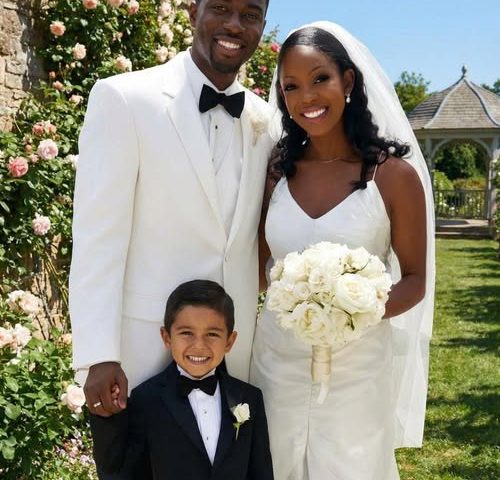
When Jonathan chose love over legacy, his mother walked away without looking back. Three years later, she returned—cold, judgmental, unapologetic. But what waited behind his front door wasn’t what she expected.
My mother didn’t cry when my father left. Not when he slammed the door. Not when she pulled their wedding photo from its frame and dropped it into the fire. She simply turned to me.
I was five years old. Already learning how to stay quiet.
“Now it’s just us, Jonathan,” she said calmly. “And we don’t fall apart.”
That was her rule. Love was never soft. It was precise. Strategic.
She put me in the best schools, enrolled me in piano lessons, taught me posture, eye contact, and how to write perfect thank-you notes. She didn’t raise me to be happy. She raised me to be unbreakable.
By twenty-seven, I’d stopped trying to impress her. There was no winning. Still, I told her I was seeing someone.
We met at her favorite restaurant—dark wood, crisp linens. She wore navy, ordered wine before I sat down.
“So,” she said, studying me. “Is this important?”
“I’m seeing someone. Her name is Anna. She’s a nurse.”
Approval flickered. “Good. Parents?”
“Both alive. Her mom’s a teacher. Her dad’s a doctor.”
She smiled. Then I added, “She’s also a single mother. Her son is seven.”
The pause was subtle. Her tone cooled.
“That’s a lot of responsibility.”
“She’s an incredible mother,” I said. “And her son… he’s special.”
“I’m sure she appreciates the help,” my mother replied.
She never said Anna’s name again.
Weeks later, I introduced them anyway. A small café. Anna arrived late, flustered, with her son Aaron holding her hand. My mother greeted her politely—without warmth.
She asked Aaron one question.
“What’s your favorite subject?”
“Art.”
She rolled her eyes and ignored him for the rest of the visit. When the bill came, she paid only for herself.
In the car, Anna said quietly, “She doesn’t like me.”
“She doesn’t know you,” I replied.
“She doesn’t want to.”
Two years later, I told my mother I’d proposed.
“If you marry her,” she said flatly, “don’t ever ask me for anything again. You’re choosing that life.”
I waited for doubt. It never came.
So I left.
Anna and I married simply—string lights, folding chairs, honest laughter. We moved into a small rental with sticky drawers and a lemon tree. Aaron painted his room green and left handprints on the wall.
One day at the grocery store, he looked up and asked, “Can we get the marshmallow cereal, Dad?”
He didn’t realize what he’d said. I did.
That night, I cried—not from loss, but because joy and grief finally made room for each other.
We built a quiet life. School runs. Night shifts. Cartoons on Saturdays. Mismatched mugs. Socks sliding across the living room floor.
My mother never called.
Then one evening, she did.
“So this is the life you chose.”
“It is.”
“I’ll come by tomorrow. I want to see what you gave everything up for.”
I cleaned—but I didn’t hide anything. The messy shoe rack stayed. The crayon marks stayed.
She arrived on time. Walked in without greeting me. Took one look around—and froze.
“This…” she whispered. “What is this?”
Her eyes landed on the faded green handprints outside Aaron’s room. Inside stood an old upright piano—worn, imperfect, one key stuck.
Aaron walked in, climbed onto the bench, and began to play.
Chopin. The same piece she’d forced me to practice until my hands ached.
“Where did he learn that?” she asked quietly.
“He asked,” I said. “So I taught him.”
Aaron handed her a drawing—our family on the porch. My mother was drawn in an upstairs window, surrounded by flowers.
“I didn’t know what kind you liked,” he said. “So I drew all of them.”
She took it carefully.
At the table, she said, “You could’ve been great, Jonathan.”
“I am,” I replied. “I just stopped performing for you.”
She finally admitted the truth—control had been her armor. Perfection, her safety.
“You lost us anyway,” I said. “Because you never let us choose.”
Anna spoke once. “Jonathan chose us. We’re not a punishment.”
My mother left without apology.
That night, she called again. Crying.
“I didn’t know it would feel like that,” she whispered. “Your home. The way your wife looks at you. The way your son smiles.”
“I don’t think anyone’s ever looked at me like that.”
The next morning, an envelope lay at our door. Inside was a music store gift card. And a note.
“For Aaron. Let him play because he wants to.”
I stood there a long time.
For the first time in years, nothing felt broken.
It wasn’t closure.
But it was something close.