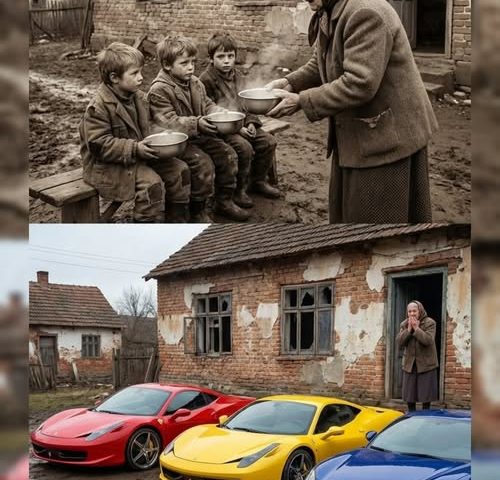


A poor woman once fed three orphaned boys a bowl of hot soup.
Twenty years later, three luxury supercars stopped in front of her tent.
What happened next left an entire street in stunned silence.
The food stall stood quietly at the edge of a narrow street, sheltered by a faded canvas awning that had survived years of sun, rain, and dust. Steam rose from a large metal pot, carrying the comforting scent of broth and fresh flatbread into the evening air.
Valentina Sergeyevna stood behind the counter, slowly stirring the soup with a wooden ladle. She was in her sixties now, her back slightly bent, her silver hair pulled into a neat bun. Everything around her was worn—an old folding table, chipped plastic chairs, a stove that rattled when the flame burned too high. But it was all clean. Carefully kept. Maintained with the quiet dignity of someone who had learned to live with little and complain about nothing.
Cars passed without slowing. People walked by with their heads down, eyes fixed on their phones, minds busy with their own problems. No one paid attention to the small stall. No one ever did.
The sun was sinking behind the buildings, staining the sky orange and gray. Valentina was preparing to close for the night when she noticed them.
Three children stood several steps away from the counter.
They were identical.
Same thin faces. Same hollow cheeks. Same oversized, worn clothing hanging from fragile shoulders. No backpacks. No parents. Just three pairs of hungry eyes filled with hesitation.
One of them—clearly the bravest—took a small step forward.
“Grandma…” he said softly, his voice barely rising above the street noise.
“Do you have anything left? Even something old… something you were going to throw away?”
Valentina froze.
There was no rudeness in his tone. No entitlement. Only apology. As if he were sorry for existing at all.
She sighed, looked at the pot, and spoke simply.
“Come here. Sit down.”
The boys stared at her, stunned.
They glanced at one another, unsure if they had heard correctly. Then, carefully, cautiously, they approached, moving as though one wrong step might make her change her mind.
Valentina poured three bowls of soup. Not large portions—but they were hot. She placed bread beside each bowl and walked away without saying another word.
The boys ate silently. Quickly. But every few seconds, one of them looked up at her, eyes wide, as if expecting the moment to shatter.
That night, Valentina Sergeyevna believed she had only done a small kindness.
She did not know she had just changed three lives forever.
Twenty years passed.
The stall was still there. The awning more faded. The pot more dented. Valentina older, slower, her hands stiff in the cold mornings. But every evening, she stood in the same place, stirring soup, serving whoever came.
She had no family. No savings. No expectations.
Until one evening, the street went quiet.
Three black supercars rolled to a stop in front of her stall.
The engines shut off almost simultaneously.
Pedestrians slowed. Someone stopped completely. Whispers rippled through the air.
Three men stepped out.
Tall. Well-dressed. Confident. The kind of men who looked like they belonged on magazine covers, not in a forgotten neighborhood beside a food tent.
But the moment they saw Valentina—
Everything about them changed.
They approached the stall and stopped.
Then, one by one, they dropped to their knees on the pavement.
“It’s you,” one of them said quietly.
“We finally found you.”
Valentina stared, confused, frightened, unable to understand why strangers were kneeling before her.
The second man lifted his head, tears burning in his eyes.
“Do you remember?” he asked. “Three boys. Identical. Hungry. Homeless.”
He swallowed hard.
“That night, you fed us. You told us not to rush. You told us we were safe.”
“It was the first night in months we slept without fear.”
The third man placed a folder gently on the counter, beside the pot of soup still steaming.
“We survived,” he said.
“We grew up.”
“And everything we became started with you not turning us away.”
Inside the folder were documents.
A house.
A bank account.
Medical care.
Security.
A future she had never imagined for herself.
“This isn’t a gift,” the man said firmly.
“It’s a debt.”
Valentina Sergeyevna began to cry. She shook her head, waving her hands, insisting she had done nothing special. That it was just soup.
The men shook their heads.
“No,” the first said softly.
“You did the most important thing of all.”
“You treated us like human beings.”
The street remained silent.
And for the first time in twenty years, Valentina Sergeyevna realized that kindness—no matter how small—never disappears. It only waits to come back.