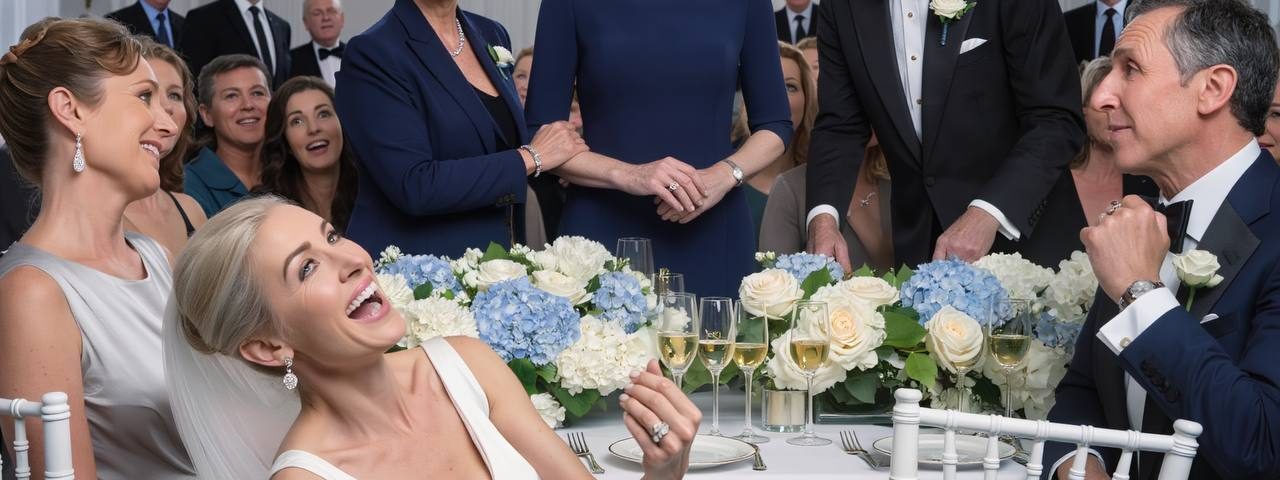
Sister Said ‘My Fiancé’s Dad Is A Federal Judge’ – Until He Called Me ‘Your Honor’ At Dinner
The message came on a Tuesday afternoon while I was reviewing case files in my chambers. My phone buzzed with that particular pattern I’d learned to associate with family drama—three rapid vibrations, always from my sister, Clare.
“Don’t come to the rehearsal dinner Friday. Jason’s dad is a federal judge. We can’t have you embarrassing us in front of his family. This is important. Please just stay away.”
I read it twice, set my phone down, and went back to the appellate brief in front of me.
My clerk, Marcus, knocked softly. “Judge Rivera, the Henderson oral arguments are scheduled for 2:00. Do you need anything before we head to the courtroom?”
“I’m fine, Marcus. Thank you.”
He hesitated. “You okay? You look—”
“Just family stuff.”
“Nothing that matters?”
“Nothing that matters.”
That was the truth. After thirty-eight years, I’d learned exactly how much my family’s opinion mattered, which is to say, not at all.
I was the mistake child. Mom and Dad made that clear from the beginning. Clare was planned, wanted, celebrated. I arrived three years later—unexpected, inconvenient, expensive. Clare got piano lessons; I got hand-me-down shoes. Clare got SAT prep courses; I got a library card and was told to figure it out. Clare went to state university with a full ride from Mom and Dad; I worked three jobs to put myself through community college, then transferred to state on academic scholarship.
“You’ve always been so independent,” Mom would say, like it was a personality trait instead of necessity.
When I got into law school, Dad’s response was, “How are you going to pay for that—loans and scholarships?” and I said, “Sounds irresponsible.”
Clare graduated with a marketing degree and moved back home, got a job at a local boutique making thirty thousand a year, and Mom and Dad were so proud. I graduated law school with honors, clerked for an appellate judge, then for a federal circuit judge, worked as a public defender for six years, and applied for a federal judgeship at thirty-five.
When I got the appointment, I called to tell them.
“That’s nice,” Mom said.
“Clare just got promoted to assistant manager. We’re taking her to dinner to celebrate.”
I wasn’t invited.
The thing about being a federal judge is that people assume you’re wealthy, or that you came from money, or that someone handed you the position. The truth is messier. I spent six years defending people who couldn’t afford lawyers. I learned to see past the charges to the humans underneath. I built a reputation for fairness, for thorough research, for asking the hard questions that other attorneys missed.
When Judge Patricia Harrison, Ninth Circuit Court of Appeals, needed a clerk, I applied. She hired me based on my trial record and my written opinions in mock court during law school. I spent three years learning from one of the sharpest legal minds in the country. Judge Harrison became my mentor, my reference, my advocate.
When a district court position opened, she called me into her office.
“You should apply,” she said. “You’re thirty-five and brilliant and fair and exactly what the bench needs.”
I applied. Six months later, I was confirmed.
Judge Elena Rivera, United States District Court, Central District of California.
My family’s response was predictable. Dad: “So you’re a judge now. Does that mean you make decent money?” Mom: “That’s a lot of responsibility. Are you sure you can handle it?” Clare: “Cool. Can you get me out of a speeding ticket?”
I stopped talking to them about work after that.
Clare had always needed validation. In high school, she dated the quarterback. In college, she joined the most popular sorority. After graduation, she dated men based on their job titles and family connections.
When she met Jason Montgomery at a charity event, she called me for the first time in eight months.
“I met someone,” she said. “He’s a lawyer. His dad is a federal judge.”
“That’s nice.”
I said it in the same tone Mom had used with me.
“His family is incredible. Old money, connected. His dad knows governors and senators.”
“Sounds impressive.”
“We’re getting serious. I think he might propose.”
He did.
Three months later, Clare sent a group text with a photo of a massive diamond ring. Mom’s response: “We’re so proud of you.” Dad’s response: “That’s my girl.” My response: “Congratulations.”
I didn’t hear from any of them for another four months.
The wedding became Clare’s entire personality. Every conversation, every text, every family gathering revolved around floral arrangements and seating charts and whether the bridesmaids should wear blush or champagne. I was named a bridesmaid by default—family obligation, not affection.
The first dress fitting was a nightmare.
“You’ve gained weight,” Clare said, eyeing me critically. “The dress is going to need major alterations.”
I hadn’t gained weight. I’d gained muscle from finally having time to go to the gym regularly.
“I’ll handle it,” I said.
“Maybe go on a diet before the wedding. I want everyone to look perfect.”
Mom jumped in. “Clare’s right. This is her special day. We all need to look our best.”
I ordered the dress in my actual size and said nothing.
The rehearsal dinner became Clare’s obsession three months before the wedding. “Jason’s parents are hosting,” she announced at a family lunch I’d made the mistake of attending at Rosewood Manor. “Five-star. His dad invited some very important people.”
“Sounds lovely,” I said.
Clare turned to me. “You’ll need to be on your best behavior. Jason’s dad is a federal judge. He works with powerful people—senators, attorneys. This isn’t like our usual family dinners.”
“I understand how to behave at a formal dinner.”
“Do you, though?” Clare’s eyes narrowed. “You tend to be awkward, quiet. You never know what to talk about with successful people.”
Mom nodded. “Clare has a point. Maybe just smile and don’t volunteer too much conversation.”
I took a sip of water, counted to ten, and said nothing.
Then, the Tuesday before the Friday rehearsal dinner, Clare’s text arrived again: “Don’t come to the rehearsal dinner Friday. Jason’s dad is a federal judge. We can’t have you embarrassing us in front of his family. This is important. Please just stay away.”
I stared at it for a long moment.
Then a second text: “Mom and dad agree. You can come to the wedding, but the rehearsal dinner is for important guests only.”
A third text: “Don’t make this a big thing. Just stay home.”
I took a screenshot and saved it to a folder I’d been keeping for years—evidence of exactly who my family was.
Then I texted back: “Understood.”
Clare’s response was immediate. “Thank you for understanding. See you at the wedding.”
I set my phone down and went back to work.
Judge Patricia Harrison had been my mentor for twelve years. After I finished clerking for her, we stayed in touch—monthly lunches, occasional phone calls. She’d become more of a mother figure than my actual mother ever was.
That Wednesday, we had lunch at a quiet bistro near the courthouse.
“You look troubled,” Patricia said, cutting into her salmon.
“Family stuff. The sister getting married.”
I’d mentioned it once months ago. Patricia remembered everything.
“Her fiancé is Jason Montgomery.”
Patricia’s fork paused halfway to her mouth. “Robert’s son.”
“You know Judge Harrison?” I asked, though of course she did. Federal judges in California knew each other.
“Robert and I served together on the Ninth Circuit before he took senior status. Good man. Brilliant legal mind.” She set her fork down. “Does your family know you’re a judge?”
“They know. They don’t care.”
“And Jason—I’ve never met him. Clare doesn’t exactly include me in her life.”
Patricia’s expression shifted to something between amusement and outrage. “So Robert has no idea his son is marrying your sister.”
“Apparently not.”
“And your sister just uninvited you to the rehearsal dinner because—”
“Because she doesn’t want me embarrassing her in front of a federal judge.”
Patricia started laughing—actually laughing, the kind that drew looks from other tables.
“What?” I asked.
“Elena, Robert is hosting the dinner at Rosewood Manor.”
“Correct. That’s what Clare said.”
“I’m invited.” Patricia pulled out her phone. “Robert invited me three months ago. We’ve been friends for twenty-five years.”
She looked up, eyes bright with something sharp. “I’m bringing a guest.”
“You, Patricia?”
“You.” She didn’t blink. “I don’t think you’re coming. As my guest, Robert will be thrilled to see you. We’ll let the evening unfold naturally.”
“This feels like chaos.”
“It feels like justice.” Patricia’s smile was fierce. “Your family has spent your entire life dismissing you. Time for a reversal.”
Friday arrived with California sunshine and my complete indifference to Clare’s wedding drama.
I had a morning docket, three motions to dismiss, two discovery disputes, and a sentencing hearing. I handled them with my usual attention to detail, signed the necessary orders, and left the courthouse at 3:00.
Patricia had insisted on picking me up.
“Arrive together,” she’d said. “Make an entrance.”
I wore a navy dress—simple, elegant, appropriate for a formal dinner. My hair was in a low bun, minimal jewelry, except for the pearl earrings Patricia had given me when I was appointed to the bench.
Patricia arrived at 6:15 in a black car service vehicle.
“You look perfect,” she said as I slid into the back seat. “Ready for this?”
“I’m ready to watch my sister’s face when Judge Harrison recognizes me.”
“Robert is going to love this,” Patricia said. “He hates pretention. Always has.”
The drive to Rosewood Manor took twenty minutes.
The restaurant was exactly as pretentious as I’d imagined: stone facade, valet parking, a doorman in a literal top hat.
“Here we go,” Patricia said as we stepped out.
Rosewood Manor’s private dining room was stunning—crystal chandeliers, floor-to-ceiling windows overlooking a garden, tables set with china that probably cost more than my first car.
I spotted my family immediately. Mom and Dad sat at the head table dressed like they were meeting royalty. Clare wore a white cocktail dress, laughing too loudly at something Jason’s mother said. Jason himself was tall, handsome, every bit the successful attorney Clare had described.
And at the center of it all sat Judge Robert Harrison—seventy-two years old, silver hair, sharp eyes, senior status on the Ninth Circuit Court of Appeals, one of the most respected legal minds in California.
Patricia and I paused at the entrance.
Clare saw me first.
Her face went from laughing, to confused, to absolutely horrified in under three seconds. She stood so quickly her chair scraped against the floor.
“What are you doing here?”
The room went quiet.
“I’m Judge Harrison’s guest,” Patricia said smoothly before I could respond.
Robert Harrison turned. His face lit up. “Patricia, there you are.”
Then his eyes landed on me and he froze.
Complete stillness.
“Judge Rivera.”
The room went silent. Not quiet—silent, the kind of silence where you can hear crystal glasses trembling on tables.
“Judge Harrison,” I said calmly. “It’s good to see you.”
Robert crossed the room in four long strides. “Elena, my God. What are you doing here?”
“Patricia invited me,” I said. “But I didn’t know you—”
He looked around, confused, then his eyes landed on Clare and Jason, then back to me. “Wait. Are you related to—”
“Clare is my sister.”
I watched him process it, watched the connections form in his brilliant legal mind.
“Your sister is marrying my son.”
“Apparently so.”
Clare made a sound that was half gasp, half choke.
Jason stood. “Dad… you know her?”
Robert’s expression was pure confusion. “Know her?” He looked at his son. “Jason, Judge Rivera clerked for me fifteen years ago on the Ninth Circuit. She’s one of the finest legal minds I’ve ever worked with.”
He turned back to me, still stunned. “I had no idea you were related to Clare.”
“We don’t exactly advertise our connection,” I said.
Patricia was smiling like Christmas had come early.
Clare’s fork hit her plate with a clatter that echoed through the silent room. “You’re a judge,” she whispered, voice cracking. “You’re actually a federal judge.”
“District Court,” I said. “Central District of California.”
“Since when?”
“Three years.”
“You never told us.”
“I did,” I said. “The day I was appointed. Dad asked if I made decent money. Mom asked if I could handle the responsibility. You asked if I could get you out of a speeding ticket.”
Robert Harrison’s expression darkened. “I’m sorry—what?”
Mom jumped in. “Elena, this isn’t the time.”
“Actually, Virginia, I think this is exactly the time.” Patricia’s voice cut through the room like a gavel. “Your daughter has been a federal judge for three years. She’s presided over hundreds of cases. She’s one of the most respected young judges in California, and you didn’t think that was worth celebrating.”
Dad stood. “Now, wait just a minute—”
“Sit down, Frank.” Robert’s voice had the weight of decades on the bench. “I want to hear this.”
Jason was staring at me like I’d grown a second head. “You’re Judge Elena Rivera?”
“Yes.”
He blinked hard. “I cited your opinion in Rodriguez v. State last month—the Fourth Amendment search case.”
“I remember that case,” I said. “Your analysis was brilliant. I used it to win a motion to suppress.”
He looked at Clare. “You told me your sister worked in—what did you say?”
“Customer service,” Clare said, her face going from white to red.
Clare’s eyes flashed. “I said she worked with people.”
“You assumed,” Patricia said.
“No,” Jason said quietly but firmly. “You specifically said she worked in customer service. You said she’d never amounted to much.”
The silence that followed could have shattered glass.
Robert Harrison pulled out a chair. “Elena, please sit. I think we all need to talk.”
Patricia and I sat. The entire room remained frozen.
“How long have you known my father?” Jason asked, still standing.
“Fifteen years,” I said. “I clerked for Judge Harrison after law school. Then I worked as a public defender for six years before my appointment to the district court.”
“Public defender?” Jason repeated.
Robert said warmly, “You were one of the best. I remember reading your briefs. You had a gift for finding the human story inside the legal arguments.”
Mom tried again. “Elena never told us any of this—”
“Because you never asked,” Patricia said, her voice ice. “I’ve known Elena for twelve years. She’s mentioned her family exactly three times. Each time it was to explain why she was spending the holidays alone.”
“That’s not fair,” Dad said.
“Isn’t it?” Patricia asked.
Jason sat down slowly. “How did I not know any of this?”
“Because I never told you about my family,” I said.
Clare whispered, “I just… I said we weren’t close.”
“You said your sister was a loser who never made anything of herself.”
The words hung in the air like a conviction.
Robert Harrison was a federal judge. He’d spent forty years reading people, evaluating credibility, finding truth in the spaces between words. He looked at my parents, then at Clare.
“I think,” he said quietly, “we need to understand exactly what happened here.”
Robert Harrison didn’t yell. He didn’t need to. His questions had the precision of a scalpel.
“Clare, when did you last have a meaningful conversation with your sister?”
“I—we talked at Christmas.”
“About what?”
“Just… family stuff.”
“Did you ask about her work?”
“She doesn’t like talking about work.”
I laughed—actually laughed. “That’s not true. You’ve never once asked about my work. Not in fifteen years.”
Robert continued, eyes steady. “Virginia. Frank. When was the last time you visited your daughter? Attended one of her events? Celebrated her accomplishments?”
Mom looked cornered. “Elena is very private. She doesn’t like us fussing over her.”
“That’s a convenient interpretation,” Patricia said. “I’ve watched Elena give keynote speeches at legal conferences. She’s argued before the Ninth Circuit. She’s been featured in California Lawyer magazine. She’s the youngest federal judge appointed in this district in twenty years. Are you telling me none of that was worth acknowledging?”
Dad’s face was red. “She never invited us to any of those things—”
“Because you never came when she did invite you,” I said, keeping my voice level, professional, the same tone I used in court. “I invited you to my law school graduation, my swearing-in ceremony, my first oral arguments as a federal public defender. You said you were busy every single time.”
Clare was crying now—quiet, desperate tears. “I didn’t know you were successful. You never said.”
“I did say. You didn’t listen. There’s a difference.”
Jason stood and walked away from the table, stopping near the windows, staring out at the garden.
Robert watched him, then turned back to my family.
“Here’s what I understand. You have a daughter who put herself through college and law school, who clerked for federal judges, who built a career defending people who couldn’t defend themselves, who was appointed to the federal bench at thirty-five years old. And your response was to what—ignore her? Dismiss her? Uninvite her to family events because she might embarrass you?”
“We didn’t uninvite her to family events,” Dad protested weakly.
I pulled up another text and read it aloud. “This is from last Thanksgiving. ‘We’re having dinner at Clare’s new apartment. Small gathering. Just us and Jason’s family. Maybe skip this one.’ I skipped it. Spent Thanksgiving reviewing case files and eating takeout.”
Patricia’s hand found mine under the table and squeezed.
“And the truly remarkable part,” Robert said, his voice dropping to something cold and judicial, “is that you texted her on Tuesday and told her not to come tonight because you were afraid she’d embarrass you. In front of me—a federal judge.”
He shook his head. “I’ve seen a lot in forty years on the bench, but this… this is a special kind of cruelty.”
Jason came back to the table and sat down next to me, not next to Clare.
“Judge Rivera,” he said formally, “I need to apologize.”
“You didn’t do anything wrong.”
“I believed what I was told about you. I never questioned it. That’s on me.” He looked at Clare. “We need to talk later. Privately.”
Clare’s mascara was running. “Jason, please.”
“Later.” His voice was final.
He turned back to me. “I read your opinion in Martinez v. County of Los Angeles—the one about qualified immunity for police officers. It’s the most thorough analysis of Fourth Amendment protections I’ve ever seen. I used it in a civil rights case last year.”
“How’d it turn out?” I asked.
“We won. My client got a settlement. Justice served.” He paused. “Because of your legal reasoning.”
Robert nodded. “Elena’s Martinez opinion has been cited in seventeen cases across four circuits. It’s becoming precedent. She’s changing law.”
Mom made a small sound. “Seventeen cases.”
“Eighteen now,” I said. “The Second Circuit cited it last week.”
The enormity of it was finally hitting them—not just that I was successful, but that I was influential, respected, known in legal circles they’d spent months trying to impress.
“How much does a federal judge make?” Dad asked, because of course he did.
“Two hundred thirty-three thousand a year,” I said. “Plus benefits. Lifetime appointment.”
His face went pale.
“I also own my own home—three-bedroom Craftsman in Pasadena—paid off last year. I have a retirement portfolio worth approximately 1.2 million. I drive a paid-off Tesla. I have no debt.” I kept my voice even. “But thank you for asking about my financial stability. Only took thirty-eight years.”
Clare was sobbing now—full heaving sobs. Jason handed her a napkin and said nothing.
Patricia Harrison had been quiet for several minutes, watching, evaluating. Now she leaned forward.
“I want to tell you something about your daughter,” she said to my parents, “something you should have known, but apparently don’t.”
Mom looked terrified. Dad looked defeated.
“When Elena clerked for me, I had her working eighty-hour weeks. Federal appellate cases are complex, demanding. Most clerks burn out in a year. Elena thrived. She saw patterns other clerks missed. She found case law that changed outcomes. She wrote bench memos that I sometimes used verbatim in my published opinions.”
She turned to me with something like pride.
“After she left my chambers, I recommended her to every federal judge who would listen. When the district court position opened, I personally called five senators to advocate for her appointment because she wasn’t just good. She was exceptional.”
“I didn’t know you did that,” I said quietly.
“Because you don’t seek credit. You just do the work.” Patricia looked back at my family. “And that’s who you dismissed. That’s who you told not to come tonight because she might embarrass you.”
Robert Harrison stood. “I think we need a moment. Jason, Elena, Patricia—would you join me in the garden? I need some air.”
We stood and left my family sitting at the table. As we walked out, I heard Clare say to Mom, “What do we do?” and Mom’s response was, “I don’t know.”
The garden behind Rosewood Manor was beautiful—stone paths, night-blooming jasmine, soft lighting that made everything look like a painting.
Robert lit a cigar and offered one to Jason, who declined.
“I’m sorry,” Robert said to me. “I had no idea Jason’s fiancée was related to you. If I had known—”
“You would have what?” I asked. “Told him not to marry her?”
“No,” Robert said. “But I would have insisted she treat you with respect. I would have made sure Jason knew who you were.”
Jason paced. “I feel like an idiot.”
“You’re not an idiot,” I said. “You believed what you were told. That’s normal.”
“But I’m a lawyer. I’m supposed to verify sources. Question assumptions.” He stopped pacing, jaw tight. “Instead, I just accepted that my fiancée’s sister was nobody important.”
“In fairness to you,” I said, “that’s what my family has always believed.”
Patricia watched me carefully. “How do you feel right now?”
“Honestly? Vindicated, but also sad. Sad because this didn’t have to happen this way—if they’d just cared even a little, we could have had a relationship. They could have been proud.” I looked back at the restaurant. “But they weren’t capable of that.”
Robert took a long pull on his cigar. “What do you want to happen now?”
“What do you mean?”
“Do you want me to end this dinner? Send them home? I’m hosting. I have that authority.”
I considered it. The power in that moment was mine, a complete reversal. I could humiliate them the way they’d humiliated me for years, but that wasn’t who I was.
“No,” I said. “Let dinner continue. But I’m not sitting at their table.”
“Done,” Robert said. “You’ll sit with Patricia and me. We’ll have our own conversation. They can watch what it looks like when people actually value you.”
Jason looked at me. “Can I ask you something?”
“Of course.”
“Do you want me to call off the wedding?”
I blinked. “What?”
“Because if this is who Clare is—if this is how she treats family—I need to reconsider everything.”
“Jason, that’s between you and her. Not my decision.” I kept my voice steady. “You’re her sister in biology only. We don’t have a relationship. Haven’t for years. So whatever you decide, decide it based on who she is to you, not who she is to me.”
He nodded slowly. “That’s fair. But I need to think.”
Robert clapped his son on the shoulder. “Take the time you need. Marriage is a lifetime commitment. Make sure you’re committing to the right person.”
We returned to the dining room.
The seating arrangement had quietly shifted. Patricia, Robert, and I sat at one table. Jason joined us after a moment’s hesitation.
My family remained at their original table—Clare, Mom, Dad, and Jason’s mother, who looked thoroughly confused by everything happening.
The first course arrived: lobster bisque.
Robert raised his glass. “A toast to Elena Rivera—one of the finest jurists I’ve had the privilege of working with—and to unexpected reunions.”
“To Elena,” Patricia echoed.
We drank.
Across the room, my family sat in silence.
The dinner continued. Robert told stories about cases we’d worked on together. Patricia shared memories from my clerkship—late nights in chambers, arguments about constitutional interpretation, the time I found a Supreme Court precedent that completely changed our analysis.
“She was relentless,” Patricia said fondly. “I’d think we’d settled on an opinion, and Elena would come back with a case from 1952 that nobody had cited in seventy years, but was directly on point.”
“That’s good lawyering,” Jason said. He’d been quiet through most of the meal.
“That’s brilliant lawyering,” Robert corrected. “Most clerks can find recent cases. Finding the overlooked precedents that change outcomes—that’s art.”
I felt myself relaxing.
This was my world. These were my people. Not the family that shared my blood, but the family I’d built through work and respect and shared values.
The main course arrived: filet mignon.
Clare appeared at our table, eyes red, voice shaking. “Can I talk to you?”
I looked up. “We’re in the middle of dinner.”
“Please. Just five minutes.”
Robert stood. “We’ll give you privacy. Elena, if you want us to stay—”
“It’s fine,” I said. “Five minutes.”
They moved to the bar area. Clare sat in Patricia’s vacated chair.
“I’m sorry,” she said immediately.
“For which part?” I asked.
“All of it. I didn’t know you were a judge. I should have known. I should have asked. I should have cared.”
“Yes,” I said. “You should have.”
“Can we fix this?”
I looked at my sister—really looked at her—and saw the designer dress, the expensive highlights, the ring that probably cost more than my first year of law school.
“I don’t know,” I said honestly. “This wasn’t one moment, Clare. This was thirty-eight years of being invisible to you, of being the embarrassment, the disappointment, the sister you hid from your successful fiancé.”
“I didn’t hide you.”
“You told Jason I worked in customer service. You uninvited me to your rehearsal dinner because you thought I’d embarrass you in front of a man who has known me and respected me for fifteen years.” I kept my voice level. “That’s not a misunderstanding. That’s a choice. Years of choices.”
“I want to fix it.”
“Why?” I asked. “Because you’re embarrassed? Because Jason’s father thinks you’re cruel? Or because you actually regret how you treated me?”
She opened her mouth, closed it, started crying again.
“That’s what I thought,” I said quietly.
Jason returned to the table before Clare could respond. He’d been at the bar with his mother, their conversation looking tense.
“Clare, we need to go,” he said. “The dinner is over for us.”
He looked at me. “Judge Rivera, I’m sorry for how this evening went. You deserved better.”
“Thank you,” I said.
He turned to Clare. “Let’s go. We need to talk.”
They left. Clare’s eyes pleaded with me one last time before Jason guided her toward the exit.
My parents remained at their table, looking small and uncertain.
Robert, Patricia, and I finished our meal, talked about cases, gossiped about other judges, discussed the upcoming bar conference.
At 10:00, Robert called for the check.
“Elena, Patricia—thank you for being here tonight. This wasn’t the evening I planned, but I’m glad the truth came out.”
“Me too,” I said.
As we stood to leave, Dad approached.
“Can we talk tomorrow?”
“Maybe,” I said.
“I don’t think so, Elena. Please. We’re family.”
“No,” I said. “You’re people I’m related to. Family is people who show up, who celebrate your successes, who value you.” I gestured to Patricia and Robert. “That’s family.”
Mom joined Dad. “We want to make this right.”
“You’ve had thirty-eight years to make it right. You chose not to.” I picked up my purse. “I’m not angry. I’m just done.”
“You can’t mean that.”
“I’m a federal judge,” I said. “I mean everything I say. It’s kind of the job.”
I walked out with Patricia and Robert, leaving my parents standing in that beautiful dining room, finally understanding what they’d lost.
The weekend following the rehearsal dinner was quiet—no calls from my family, no texts from Clare, just silence.
Monday morning, I was back in chambers. Marcus brought me coffee and a concerned look.
“You okay?” he asked. “You seem lighter somehow.”
“Family stuff resolved itself.”
“Good resolved or bad resolved?”
“Truthful resolved,” I said, “which is the same as good.”
That afternoon, Jason Montgomery called my clerk to schedule a meeting.
“Personal or professional?” I asked Marcus.
“He said professional. He has a case he wants to discuss—pro bono civil rights matter.”
“Put him on my calendar.”
Jason arrived Tuesday at 2:00—professional attire, briefcase, no mention of Clare or the dinner.
“Judge Rivera, thank you for seeing me.”
“What can I do for you?”
“I’m representing a client who was wrongfully arrested. Fourth Amendment violation. I’m hoping to get before you for a motion to suppress.”
“Has it been assigned to my court?”
“Not yet. Random assignment. But I wanted to talk to you about the legal theory either way.”
We spent an hour discussing constitutional law. Jason was sharp, prepared, asked good questions.
As he packed up to leave, he paused. “Can I ask a personal question?”
“You can ask.”
“Did you know who I was when we met Friday night?”
“No,” I said. “Patricia told me the day before. I’d never met you—”
“But you came anyway.”
“Patricia invited me,” I said, “and I wanted to see the look on Clare’s face when she realized who I was.”
He smiled—a real smile. “Was it worth it?”
“Completely.”
“For what it’s worth,” he said, “I broke off the engagement.”
I sat back. “Because of Friday.”
“Because of what Friday revealed. Clare didn’t just dismiss you. She built her entire identity around appearing successful while putting you down. That’s not someone I want to marry.” He closed his briefcase. “My father was right. Marriage is a lifetime. I need someone who values people, not status.”
“I’m sorry,” I said.
“Don’t be,” he replied. “You saved me from a mistake.”
He headed for the door, then turned back. “I’d like to stay in touch, if that’s appropriate.”
“As colleagues,” I said, “I’d like that.”
After he left, Patricia called.
“I heard Jason called off the engagement. News travels fast.”
“Robert told me this morning,” I said. “Clare called him crying, begged him to talk to Jason.”
“What did Robert say?”
“That his son makes his own decisions,” I said, “and that Clare had shown him exactly who she was.”
I leaned back in my chair and looked at the framed photo on my desk—Patricia and me at my swearing-in ceremony, the family that mattered.
“How do you feel?” Patricia asked.
“Free.”
Three weeks after the dinner, Clare showed up at the courthouse. Security called my chambers.
“Judge Rivera, you have a visitor. Clare Rivera says she’s your sister.”
“Send her away.”
“She’s insisting it’s important.”
I exhaled. “Ten minutes. Conference room B.”
Clare looked terrible—no makeup, jeans and a sweatshirt, hair in a messy ponytail.
“Thank you for seeing me,” she said.
“You have ten minutes.”
“Jason won’t return my calls. His dad won’t help. Mom and Dad are devastated. Everything’s falling apart—and you want me to fix it?”
“I want you to tell me how to fix it,” she said.
I leaned back in my chair. “You can’t. Jason made his choice based on who you showed him you are. That’s not fixable with an apology.”
“But you could talk to him,” she said. “Tell him I’ve changed.”
“Have you?” I asked.
She blinked. “What?”
“Have you changed, or are you just upset that you lost something you wanted?”
Silence.
“That’s what I thought.”
I stood. “Clare, I’m going to tell you something, and I want you to really hear it. You spent thirty-eight years treating me like I was worthless. You convinced yourself I was a failure to make yourself feel successful. And when the truth came out—when you realized I was everything you pretended to be—your first instinct wasn’t to apologize. It was to figure out how to use my connection to fix your problem.”
“That’s not—”
“It is,” I said. “Even now. You’re not here because you’re sorry. You’re here because you want something from me.”
Her face crumpled. “I don’t know how to be different.”
“Then figure it out,” I said, “but do it away from me.”
I called security and had them escort her out.
That was the last time I saw Clare.
Six months later, Mom sent an email. Subject: Can we talk? I deleted it.
A month after that, Dad sent a letter to my chambers. Marcus handed it to me with a questioning look.
“Family drama,” I said.
The letter was three pages—apologizing, explaining, asking for another chance.
I filed it and didn’t respond.
Three months after that, Clare sent a wedding invitation—not to Jason. She’d apparently moved on. Some guy named Brad who worked in finance.
I didn’t RSVP.
Patricia asked me about it over lunch. “Do you ever regret cutting them off?”
“No,” I said. “They had thirty-eight years to be my family. They chose not to. I’m not obligated to give them a thirty-ninth.”
“No regrets about Jason?”
“Jason made the right call,” I said. “He deserves someone better than Clare. He’s dating someone from his firm—another civil rights attorney. Seems happy.”
“Good for him.”
Patricia studied me. “You really are okay with all this.”
“I am,” I said. “I learned something important. Family isn’t biology. It’s choice.”
“You choose me. Robert chooses me. My colleagues, my clerks, the attorneys I mentor—they choose me. That’s enough. More than enough.”
Patricia nodded. “That’s everything.”
Two years after the rehearsal dinner that ended everything, I was nominated for the Ninth Circuit Court of Appeals.
Patricia called me screaming—actual screaming. “You’re going to the appellate court!”
“If I’m confirmed,” I said, “you’ll be confirmed. Robert and I will make sure of it.”
The confirmation process took eight months—hearings, background checks, testimony from colleagues. Robert Harrison testified on my behalf. So did Patricia. So did Jason Montgomery, who’d become a close colleague and friend.
“Judge Rivera represents the best of the federal judiciary,” Robert told the Senate committee. “She’s fair, thorough, brilliant, and she understands that justice isn’t just about law. It’s about humanity.”
I was confirmed ninety-two to eight.
At forty years old, I became one of the youngest judges ever appointed to the Ninth Circuit Court of Appeals.
The swearing-in ceremony was packed—colleagues, attorneys, law students, people I’d mentored and worked with. Patricia stood beside me. Robert administered the oath.
In the back of the room, I saw a familiar face.
Clare.
She’d somehow found out about the ceremony.
After I took the oath, after the applause died down, she approached.
“Congratulations,” she said. “Thank you. I’m proud of you.”
I looked at my sister—really looked at her—and saw someone I used to know, used to be related to, used to hope would love me.
“I appreciate that,” I said. “But it doesn’t change anything.”
“I know,” she said. “I just wanted you to know.”
She left.
I watched her go.
Patricia appeared at my elbow. “You okay?”
“Perfect,” I said. “She came. She did. Doesn’t matter anymore.”
And it didn’t, because I was surrounded by people who’d chosen me, who’d celebrated every step of my career, who’d believed in me when I was a clerk, a public defender, a district judge, and now an appellate judge.
That night, Robert hosted a dinner—intimate, just the people who mattered. Jason was there with his girlfriend Sarah, who’d argued before me twice and won both times. Marcus, my loyal clerk, and three other federal judges I’d worked with over the years.
We toasted, told stories, laughed about cases and conference arguments, and the time I’d accidentally called a senior judge by the wrong name in oral arguments.
At the end of the night, Robert raised his glass one more time.
“To Elena Rivera, who proved that family isn’t about blood—it’s about who shows up, who believes, who stays.”
“To Elena,” they all echoed.
I looked around the table at the faces of people who valued me, respected me, loved me.
This was family. This was everything.
And my sister—sitting somewhere alone, realizing what she’d lost—would never understand that the moment she dreaded most, the moment she tried to prevent by uninviting me to her rehearsal dinner, was the moment I’d finally been set free.
Free to find the family I deserved. Free to build the life I’d earned. Free to be exactly who I was always meant to be.
A federal judge, a mentor, a friend—someone who mattered. Not because my family finally recognized it, but because I’d built a life where recognition came from people who actually knew how to give.