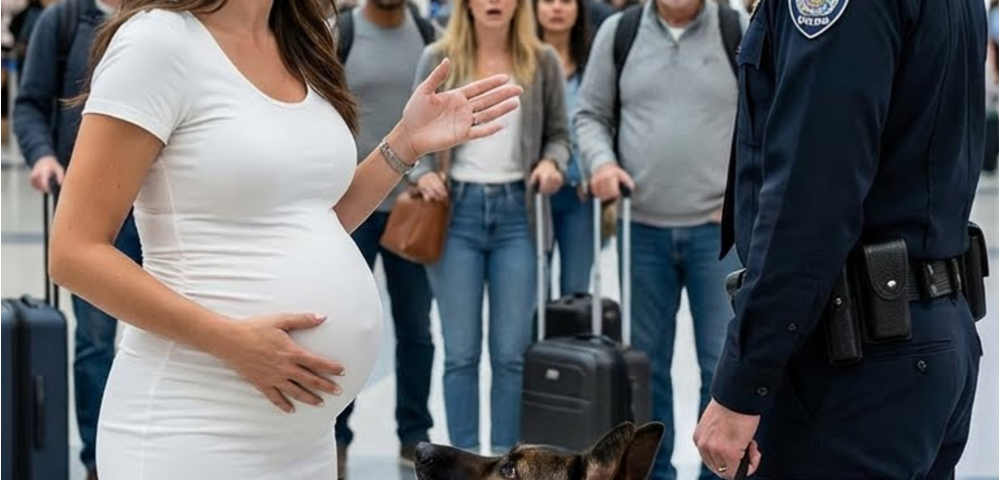
“Fetal distress,” one doctor muttered. “If she’d boarded that flight, the altitude could’ve triggered cardiac failure.”
Daniel stepped back, stunned. Rex sat quietly now, ears tilted toward the muffled cries from the room.
At 10:42 a.m., a newborn’s wail broke through the silence. Both mother and baby were safe.
Everyone in the hallway froze, realizing what had just happened—the dog’s bark hadn’t exposed danger. It had prevented tragedy.
An hour later, the airport had returned to its usual chaos—but Daniel’s hands still trembled slightly as he filled out the incident report.
Under “nature of occurrence,” he paused before writing:
“K9 indicated distress on civilian subject. Medical emergency confirmed. Outcome: both lives saved.”
A reporter from a local station arrived, having overheard the commotion. “Officer Harper,” she asked, microphone ready, “is it true your dog alerted you before the woman collapsed?”
Daniel hesitated. “Yes. He sensed something was wrong. Not drugs, not explosives—something… biological.”
By evening, the story had spread across the internet. Headlines read:
“Airport Dog Saves Pregnant Woman and Her Baby.”
“K9 Hero Barks at a Life in Danger.”
Videos from witnesses showed the exact moment Rex barked, then sat protectively beside the woman. The clip went viral overnight.
In the hospital, Emily woke to find Daniel standing at her bedside, Rex beside him. She smiled weakly, eyes filled with tears.
“They said I could’ve died on that flight,” she whispered. “I didn’t believe them until I saw the monitor. My baby’s heart stopped for thirty seconds.”
Daniel knelt beside Rex. “He’s the one who knew,” he said quietly.
Emily reached out, stroking the dog’s head. “Then he saved us both.”
Later, when the doctors explained it, the logic was simple but astonishing. Changes in Emily’s hormone levels and blood chemistry had altered her scent—something imperceptible to humans but noticeable to a highly trained K9 like Rex. He’d recognized it as distress, not threat.
It wasn’t a miracle. It was instinct sharpened by trust.
By the end of the week, the airport received thousands of emails and letters from strangers thanking Rex. A petition circulated online to award him a K9 Service Medal for Bravery.
Daniel wasn’t used to attention. But watching Rex sleep by his feet, he realized something rare had happened that day—not a heroic act of training, but a moment when intuition met humanity.
Two months later, Daniel received a small envelope in his work locker. Inside was a photo—a baby wrapped in a blue blanket, with a handwritten note beneath:
“His name is Lucas Rex Ward. Because without your partner, he wouldn’t be here.”
Daniel smiled, the kind of quiet, genuine smile that came from the soul.
That afternoon, the airport held a small ceremony. Reporters were present, but it wasn’t about cameras—it was about gratitude. Emily attended, holding her baby, who slept soundly against her chest.
When she approached the podium, her voice trembled. “People call it luck,” she said. “But I believe it’s something deeper—connection. Rex saw something no one else could. He didn’t save just a life; he gave my son a future.”
Applause filled the terminal. Rex wagged his tail, oblivious to the attention, just happy to be near Daniel.
After the ceremony, Daniel took him outside to the observation deck overlooking the runways. Planes lifted off one after another, streaking into the open sky.
“You did good, partner,” he murmured. Rex leaned against his leg, eyes half-closed, as if understanding.
Later that evening, Daniel scrolled through social media. The story was still trending worldwide—photos, art, and letters from children thanking Rex for “listening to his heart.” One comment stood out:
“Sometimes heroes don’t wear badges. Sometimes they have paws.”
Daniel looked down at Rex and thought, Yeah, that’s about right.
As the sun dipped behind the terminal glass, a plane roared into the orange horizon. Somewhere inside that endless sky, a baby named Lucas slept peacefully—his heartbeat steady and strong—all because one dog refused to stop barking.
And for Officer Daniel Harper, it was a reminder that even in a world built on rules and procedures, some of the greatest rescues begin with trust—between a man and the animal who listens when no one else does.