I hadn’t set foot inside our beach house for 26 years—not since Julie and I moved to the city.
She continued returning four times a year, faithfully, almost like a ritual. I always found reasons not to go with her: work, golf, doctor visits, simple laziness. Back then, I had no idea how deeply that decision would come back to haunt me.
Six months after Julie passed away, my children—Marcus and Diana—began circling me like vultures.
“Dad, sell that useless place,” Marcus repeated nearly every week. “It’s draining your finances.”
Diana added, “You never even go there. Why keep it?”
They treated me like an aging burden who needed constant oversight. Maybe grief had clouded my mind, but I wasn’t helpless. And something inside me whispered that before letting go of Julie’s cherished sanctuary, I needed to see it one last time.
So on a quiet Saturday morning, I drove the three hours to Palmetto Cove. The rusty gate creaked as I touched it—my daughter had told me the house looked abandoned, ready to collapse. I prepared myself for peeling paint, overgrown weeds, and moldy walls.
But the moment I pushed the gate open, I froze.
The front yard was pristine—fresh flowers, trimmed grass, repaired porch steps. Everything was lovingly maintained. Someone was living here.
Confused and uneasy, I stepped closer. Children’s laughter floated from behind the house. A warm woman’s voice speaking Spanish followed. None of it made sense. Julie had never mentioned anyone.
Just as I reached the porch, the yellow front door—Julie’s favorite color—swung open. A small Hispanic woman, around her mid-fifties, stood there holding a dish towel. The instant she saw me, her face drained of color.
“Señor Howard,” she whispered, as if she were seeing a ghost.
She knew my name.
Before I could speak, her eyes filled with tears.
“Señora Julie… she is gone?”
“Yes,” I answered, stunned. “She passed six months ago.”
The woman pressed the towel to her trembling lips. “Please… come inside. I explain everything.”
Inside, the house wasn’t abandoned—it was full of life. Family photographs, children’s drawings, the comforting smell of cooking. A home. Not mine.
“You’ve been living here?” I asked.
She nodded. “For fifteen years. Señora Julie… she saved us.”
My heart pounded. “Saved you? From what?”
That was when she told me something that shattered everything I believed about my wife.
“After hurricane Isabel… we lost everything,” she said. “Your wife brought us here. She gave us a home. She paid for my husband’s cancer treatment. She cared for us like family.”
My legs nearly buckled.
Julie had been supporting a family… secretly? For fifteen years?
But the next revelation struck even harder.
“Señor,” she whispered, “she fought cancer too. Three years. She stayed here for treatment.”
The room spun. Julie had been battling cancer—without telling me.
And my children had insisted the house was “useless.”
I felt the ground disappear beneath me. Julie had fought cancer for three years… while I sat in my retirement chair reading mystery novels, thinking she was simply enjoying her retreats. Maria—the woman before me—had comforted my wife through chemotherapy, nausea, and fear.
“Why didn’t she tell me?” I whispered.
Maria placed her hand over mine. “She said she didn’t want to make you sad. She said you already carried too much.”
My throat tightened. Had I really been so distant that my wife chose to suffer alone?
Maria led me to a back bedroom—Julie’s room. Lavender walls, an ocean view, a desk overflowing with books. On the nightstand was a photo of me from our honeymoon. Beside it, a picture of Maria’s three children building a sandcastle with Julie.
“This was her safe place,” Maria said. “Her… secret garden.”
Then she brought out a wooden box I recognized instantly. I had made it for Julie decades earlier. Inside were dozens of letters—addressed to me—but never sent.
My hands shook as I opened the first one.
My dearest Howard,
The cancer has returned. I can’t bear to tell you. You finally seem peaceful in retirement, and I don’t want to take that from you. Maria takes care of me. Her family makes me feel alive. I wish I could explain this world to you, but I know you wouldn’t understand.
Tears blurred the words.
Another letter revealed even more.

Marcus found out. He threatened Maria. He said she was stealing from us. He said if I didn’t evict them, he’d pursue legal action and tell you I was incompetent. Diana agreed. They care more about inheritance than humanity. Howard, I am ashamed of what our children have become.
I felt physically sick.
My own children had threatened this family?
Maria gently touched my shoulder. “Your children came here once. They called us criminals. But Señora Julie… she protected us.”
“When?” I croaked.
“Two years ago.”
My fists clenched. Marcus and Diana had known—and chosen to hide everything from me.
After dinner with the family—warm, noisy, loving—I stepped outside to breathe. The ocean breeze carried Julie’s presence, calm and steady. This family had given Julie what I hadn’t: connection, warmth, a place to be herself.
The next morning, I met Julie’s lawyer, Patricia Henderson. Her office was filled with files.
“Yes,” Patricia said gently, “Julie planned everything. She created a trust to protect Maria’s family for ten years. Your children cannot evict them.”
Relief washed over me.
“And she left you options,” Patricia continued. “But… she hoped you would choose the third.”
She slid a document toward me.
Option 3: Transfer ownership of the beach house to Maria’s family.
A smaller home nearby will be purchased for Howard using Julie’s insurance fund.
My breath caught.
Julie hadn’t only protected Maria.
She was protecting me—giving me a chance at the life she knew I needed: purpose, connection, belonging.
Patricia handed me a final envelope.
Howard, if you’re reading this, choose love. Choose belonging. Choose the family that chose me when ours no longer could.
There was only one decision left.
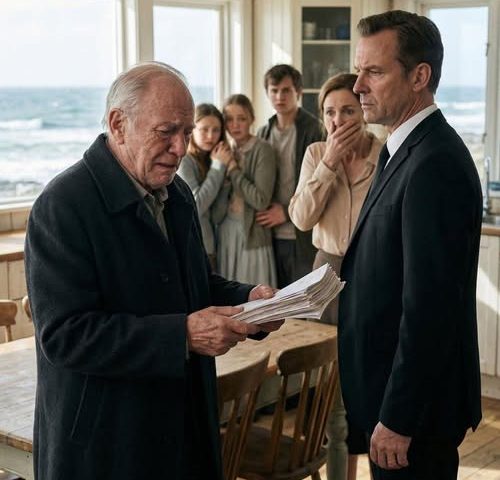
When I returned to the beach house, Marcus and Diana’s cars were already in the driveway. Through the window, I saw them standing stiffly in the kitchen while Maria poured coffee.
The tension was suffocating.
“Dad, you need to come home with us,” Diana said. “These people—”
“Stop,” I said firmly. “Sit down.”
They obeyed reluctantly.
I placed Julie’s letters on the table.
“This,” I said, “is your mother’s truth. The truth you kept from me.”
Their faces drained of color.
When I finished reading, Diana was crying. Marcus stared at the floor.
“This house belongs to Maria now,” I said calmly.
Silence.
“You’re giving everything away?” Diana asked.
“No,” I replied. “I’m honoring your mother’s wishes.”
They left shortly afterward—angry, shaken, powerless.
That night, sitting on the porch with the ocean whispering nearby, I finally understood.
Julie hadn’t just built a house.
She built a home—out of love, compassion, and second chances.
And she left it to me.