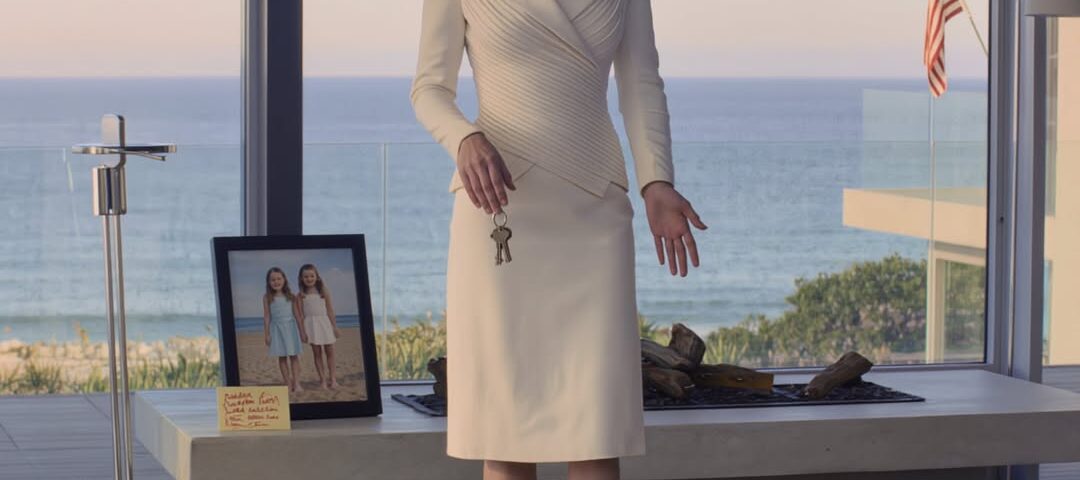
My father promised my sister my two-million-dollar beach house, and she was shocked when she showed up with moving trucks on Saturday morning to find the house completely empty except for one framed photo on the fireplace.
It was a picture of us as children with a note that read:
“Remember when we were best friends before you slept with my husband and Dad gave you everything I built on my own?”
My name is Rebecca Anne Morrison. I’m thirty-four years old, and I spent twelve years building a real estate development career that made me wealthy entirely on my own.
That beach house? I designed it myself, financed it with money I earned, and watched every detail come together over eighteen months of construction. Jennifer, my younger sister by three years, contributed exactly nothing to its existence—unless you count showing up for champagne at the housewarming party, where she apparently decided that both my house and my husband looked like things she wanted for herself.
The affair had been going on for seven months before I found out.
Seven months of family dinners where Jennifer sat across from me, smiling and asking about my marriage while she was sleeping with Derek in the very bed I’d custom-ordered for our master bedroom.
Seven months of my father praising Jennifer for finally getting her life together while she was systematically destroying mine.
The discovery came not through suspicious behavior or a guilty conscience, but through a contractor I’d worked with who saw them at a restaurant two towns over—Derek’s hand on her thigh, both of them laughing like they’d won something.
I filed for divorce immediately.
The proceedings were swift because I’d been smart enough to have a prenuptial agreement that Derek’s lawyer couldn’t touch.
What shocked me wasn’t Derek’s betrayal. Looking back, I could see he’d always been weak, attracted to my success more than to me. What shattered something fundamental was my father’s reaction when I told him what Jennifer had done.
“Rebecca, you’ve always been so independent,” he said in his study—the same room where he’d reluctantly signed my college loan papers because he didn’t think women needed business degrees. “Jennifer needs more support. She’s struggled her whole life. Maybe if you’d been home more instead of always working, Derek wouldn’t have looked elsewhere.”
The words hung in the air like poison.
My father, who had given Jennifer everything—paid her rent through her twenties, bought her three different cars she’d wrecked, funded two failed business attempts—was now suggesting I’d driven my husband into my sister’s bed through the “crime” of professional ambition.
But that conversation was nothing compared to what happened three months later at Sunday dinner.
I’d stopped attending these family gatherings, but my father had called specifically to ask me to come, saying he had important news to share.
I should have known better.
Jennifer was already there when I arrived, sitting in what used to be my chair at the table, wearing a dress I recognized as one I’d left behind when I moved out of the house Derek and I had shared. My father stood at the head of the table with that self-satisfied expression he wore when he thought he was “solving problems.”
“I’m glad you both could be here,” he began, pouring wine like this was a celebration. “I’ve been thinking about how to help this family heal, and I believe I’ve found the solution.”
My stomach tightened with dread.
“Rebecca, you’ve done very well for yourself. Better than I ever expected. Honestly, that beach house of yours is beautiful, but it’s far too large for one person. Meanwhile, Jennifer is still trying to find her footing, and I think she needs a fresh start somewhere inspiring.”
I stared at him, unable to process what I was hearing.
“So, I’ve decided,” he continued, as if he were a king distributing lands, “that Jennifer should have the beach house. You can find something smaller, more practical. You’re good at that real estate business. You’ll bounce back.”
The silence that followed was absolute.
Jennifer was looking down at her plate, but I could see the small smile playing at the corners of her mouth. My father was watching me expectantly, waiting for me to protest so he could lecture me about family and sacrifice.
Instead, I did something that surprised even myself.
I picked up my wine glass, took a long sip, and smiled.
“That’s an interesting plan, Dad,” I said calmly, setting down the glass with precise control. “There’s just one small detail you might want to consider.”
His face flickered with confusion at my lack of resistance.
“The house is in my name. Only my name. I bought it with my money, designed it with my vision, and you have absolutely zero legal right to give it to anyone.”
I stood up, smoothing down my skirt.
“But please, continue making promises you can’t keep. I’d hate to interrupt your little power fantasy.”
As I walked toward the door, I heard my father’s voice rise behind me.
“Rebecca Anne Morrison, if you walk out that door, don’t expect any inheritance from me. I’ll give everything to your sister.”
I turned back, and the look on my face must have unsettled him, because he actually took a step backward.
“Dad, I stopped expecting anything from you when I was sixteen and you told me I should skip college and find a husband instead. Everything I have, I earned without you. The difference between Jennifer and me is that I never needed your handouts. But here’s something for you both to think about: Jennifer might want to be very careful about moving into a house that doesn’t belong to her. Things can get complicated when people try to take what isn’t theirs.”
I left them sitting there—my father sputtering and Jennifer’s smile finally fading into something that looked like uncertainty.
Neither of them understood yet that I wasn’t the same girl who’d sought their approval, who’d bent herself into shapes to earn love that was always conditional.
The real game was just beginning, and I was the only player who knew all the rules.
The week after that disastrous dinner, my father called me seventeen times.
I answered exactly none of them.
Jennifer sent texts that evolved from apologetic to accusatory within forty-eight hours.
The first one read:
“Dad says you’re being unreasonable.”
The last one said:
“You always thought you were better than me. This just proves it.”
I was busy.
My assistant at Morrison Development had standing instructions to track any mentions of my name or property in public records. When Jennifer filed a civil claim three weeks later, asserting she had a verbal contract with our father regarding the beach house, I was ready.
My attorney, Patricia Vance, had been a college roommate before she became one of the state’s top real estate litigators. She reviewed the filing over lunch at her downtown office, a corner suite with floor-to-ceiling windows and a view that said she’d chosen the right major.
“This is pathetic,” Patricia said, flipping through the pages. “She’s claiming your father promised her the house as compensation for emotional distress caused by your divorce. Her lawyer is either incompetent or desperate for billable hours.”
“Probably both,” I replied, signing the counter-motion Patricia had prepared. “How long until this gets dismissed?”
“Three months, maybe four. California doesn’t recognize verbal contracts for real estate transfers. She’d need written documentation showing you agreed to transfer title, which obviously doesn’t exist.”
What Patricia didn’t know—what nobody knew yet—was that I’d already set the larger trap in motion.
Two months before that Sunday dinner, right after my father’s first suggestion that I should be more understanding about Jennifer’s affair with my husband, I’d made several strategic decisions.
The beach house had been listed with a discreet luxury real estate broker in New York, someone who specialized in high-value properties for international buyers who valued privacy. The listing price was $2.4 million—deliberately high—with specific instructions that any offers should come through encrypted channels with forty-eight-hour response windows.
I’d also done something else, something that would seem paranoid to anyone who didn’t know my family.
I’d installed a comprehensive security system with cameras covering every entrance and interior common space. The system was operated by a company I’d partially invested in, which meant I had direct access to all footage, with no intermediary server that could be easily subpoenaed or manipulated.
When Jennifer’s lawyer sent discovery requests demanding access to my financial records and property documents, Patricia filed a motion to quash that was so legally airtight, the judge approved it within a week.
But I voluntarily provided one thing: complete security footage from the beach house for the previous six months.
The footage showed the house empty, except for my occasional visits to check on the property.
What it also showed—timestamped and crystal clear—was Jennifer entering the property three separate times using a key she must have copied during the housewarming party.
The footage showed her walking through rooms, taking measurements, photographing spaces. In one particularly damning clip, she was on the phone and, while there was no audio, the security company’s AI captioning service had captured enough lip-reading data to suggest she’d been saying:
“Dad promised me I could have it.”
Patricia’s eyes had gone wide when I showed her.
“This is trespassing. Multiple counts. You could press charges.”
“Not yet,” I’d said. “Let her keep digging.”
Meanwhile, my father had escalated to showing up at my office.
My assistant, a fierce twenty-six-year-old named Marcus who took his protective duties seriously, blocked him at reception.
“Ms. Morrison is in meetings,” Marcus said—the phrase we’d agreed meant I didn’t want to be disturbed.
“I’m her father,” William Morrison thundered, his voice carrying across the modern open workspace I’d designed specifically to prevent private confrontations like this.
“That’s not on the approved visitor list,” Marcus replied calmly.
And I loved him a little bit more for that.
My father left, but not before leaving a letter with Marcus. I read it at my desk alone after everyone had gone home.
Rebecca,
Your mother would be ashamed of how you’re treating your sister. Family is supposed to forgive. Jennifer made a mistake, but she’s paying for it by having no home and no prospects. You have everything. Why can’t you share? The house is too much for one person. I’m asking you as your father to do the right thing. Sign over the property to Jennifer. I’ll make it worth your while. I’ll give you $500,000 from my retirement fund to make it fair. If you refuse, I’ll have no choice but to tell everyone in our community what kind of daughter you really are: cold, calculating, selfish.
Dad
I read it three times, each read revealing new layers of manipulation.
He was offering me half a million dollars to give Jennifer a two-million-dollar property. He thought that was fair.
He was also threatening to damage my reputation in a community where reputation meant client relationships and business opportunities.
What he didn’t know was that I’d already had conversations with three different journalists who specialized in family-drama exposés. What he didn’t know was that I’d documented every text, every voicemail, every interaction since the affair came to light. What he didn’t know was that I’d hired a private investigator who’d discovered that Jennifer’s unemployment wasn’t just bad luck—she’d been fired from her last two jobs for theft, incidents our father had quietly settled to avoid charges.
But most importantly, what neither of them knew was that the beach house already had a buyer.
A tech executive from Singapore had offered $2.6 million, all cash, with a closing date I’d set for exactly one week after I knew Jennifer’s lawsuit would be dismissed. He didn’t want to take possession immediately—he was using the place as an investment property and was fine with the house sitting empty for six months while he arranged his visa situation.
Which meant I could let Jennifer and my father keep believing they had a chance right up until the moment they discovered the house was no longer mine to give.
The trap was set.
Every piece was in position.
All I had to do was wait for them to spring it themselves.
On the day of Jennifer’s motion hearing, my father showed up at the courthouse in his best suit, prepared to testify about “family values” and “moral obligations.”
Patricia saw him in the hallway and called me immediately.
“Your father is here,” she said, her voice tight with barely suppressed laughter. “He’s telling anyone who will listen that you’re trying to make your sister homeless out of spite.”
“Perfect,” I said. “Let him talk.”
Because every word he said in that courthouse hallway was being recorded by three different people I’d strategically positioned there, including a legal videographer who specialized in capturing courthouse interactions for appeals and documentation.
By the time my father finished his performance, I had forty minutes of footage showing him publicly claiming he had the right to dispose of my property, making statements about my character, and—most beautifully—explicitly stating that he’d promised Jennifer “she could have Rebecca’s beach house because Rebecca doesn’t need it.”
When the judge dismissed Jennifer’s case with prejudice, ruling that she had no standing whatsoever to make claims on property she’d never owned or contributed to, my father stood up in the gallery and actually shouted:
“This is a miscarriage of justice!”
The judge held him in contempt. The fine was five hundred dollars—nothing to a man of his means—but the public record was permanent.
I watched all of this remotely through Patricia’s phone, propped up on her desk, live streaming the hearing.
When it was over, I sent one text message to both Jennifer and my father:
The house was never yours to promise. It was never yours to take. And very soon, it won’t even be mine. Hope the lawsuit was worth it.
Jennifer called immediately.
I let it go to voicemail.
Her message was incoherent, bouncing between rage and panic.
“What do you mean it won’t be yours? You can’t sell it. Dad said—Dad promised. This isn’t fair—”
I deleted the message without finishing it.
That night, I had dinner with Patricia at an upscale restaurant overlooking the ocean—not my beach, but a similar view.
She raised her wine glass in a toast.
“To family,” she said with an ironic smile.
“To family getting exactly what they deserve,” I corrected.
And we drank to that instead.
The sale of the beach house closed on a Tuesday morning in escrow.
All parties were remote. Everything was handled through encrypted electronic signatures. By 10:00 a.m., $2.6 million had transferred into my account, minus closing costs and Patricia’s fees. By noon, I’d wired $1.8 million of it into three different investment vehicles that would be completely invisible to anyone doing casual searches of my holdings.
By 2:00 p.m., my father and Jennifer still had no idea the house was no longer mine.
I’d planned the timing deliberately. The courthouse records wouldn’t update for at least seventy-two hours. The property deed wouldn’t show the new owner in public databases for a week, maybe more. That gap gave me exactly the window I needed.
Three days after the sale closed, my father did something so predictable I’d have put money on it happening.
He showed up at the beach house with Jennifer and a locksmith.
I know this because the security system I’d installed was still active. The new owner had agreed to keep it in place for the six months before he took possession, and the monitoring company sent me alerts the moment anyone approached the property.
I watched through my phone as my father’s Mercedes pulled into the driveway, as Jennifer got out wearing designer sunglasses I’d seen in a boutique window for six hundred dollars, as the locksmith began working on the front door.
While he worked, I called the police from my office, my voice perfectly calm.
“I’d like to report a breaking and entering in progress at 2847 Ocean Vista Drive,” I said. “Three individuals are attempting to force entry into private property. No, I’m not the current owner, but I can provide you with the owner’s contact information and proof that these individuals have no legal right to access.”
The dispatcher asked if anyone was in danger. I told her I didn’t think so, but that one of the individuals had been increasingly erratic and had recently been held in contempt of court for disrupting legal proceedings related to the same property.
That got a faster response time.
Two patrol cars arrived within twelve minutes. By then, the locksmith had successfully changed the locks, and my father was inside with Jennifer, walking through the empty rooms.
The furniture had been moved to storage the week before, per the sale agreement. Only that one framed photograph remained on the mantle, placed there deliberately the night before the sale closed.
I wasn’t there, but the security footage captured everything.
The officers knocked. My father answered, confused but confident. He explained that his daughter owned the property but was being unreasonable about his other daughter taking possession, and he was simply helping “facilitate a family matter.”
The senior officer, a woman in her forties with a no-nonsense expression, asked him if he had documentation proving he had legal access to the property.
My father blustered about family and ownership and his rights as a parent.
“Sir, do you have a key that was legally provided to you by the property owner?” she asked.
“My daughter owns this property,” he said.
“Which daughter would that be?”
“Rebecca Morrison, but she’s being—”
“And is Rebecca Morrison aware you’re here?”
The pause before my father’s answer told them everything.
“This is a family matter.”
“Sir, this is a legal matter. The property records show this house was sold five days ago. The current owner is a corporate entity registered in Singapore. You’re currently trespassing.”
I wish I could have seen my father’s face in person when he realized what I’d done. The security footage didn’t quite capture the full collapse of his expression, but it showed enough.
Jennifer actually stumbled backward, catching herself on the wall.
“That’s impossible,” my father said. “She wouldn’t—she can’t—”
“She did,” the officer replied. “You need to leave the property immediately. The locksmith as well. If the owner wants to press charges for the illegal lock change, that’s their right.”
As they were escorted out, Jennifer spotted the photograph on the mantle. She walked over to it, and I watched her read the note I’d attached.
Her face went through a remarkable journey—confusion, recognition, rage, and finally something that might have been shame, if she were capable of it.
She grabbed the frame and threw it against the fireplace. It shattered beautifully, glass spraying across the hardwood floors I’d personally selected.
“Ma’am, you need to leave now,” the officer said sharply. “That’s destruction of property.”
“It’s a picture of me!” Jennifer screamed. “She’s my sister. This is my house!”
“This is not your house. This has never been your house,” the officer replied. “You need to leave immediately or you’ll be arrested.”
My father had to physically drag Jennifer out.
The locksmith, looking mortified, apologized to the officers and left his business card in case there were damages he needed to pay for.
After they’d gone, I contacted the security company and had them send the full footage to Patricia, to the new owner’s lawyer, and to my own carefully organized documentation file.
Then I did something that might have seemed petty but felt absolutely necessary.
I sent the footage to my father and Jennifer with a one-line message:
Breaking and entering is a crime, even when you think you’re entitled to it.
My father called thirty seconds later.
I answered this time, putting him on speaker so my assistant could witness the call.
“How could you?” His voice was shaking with rage. “How could you sell that house without telling your own family?”
“The same way you promised it to Jennifer without asking me,” I replied calmly. “By recognizing that it was mine to do with as I pleased.”
“That money from the sale should be Jennifer’s. She needs it. She has nothing.”
“Jennifer has exactly what she’s earned, which is nothing,” I said. “She destroyed my marriage, Dad. She slept with my husband in my house, in my bed. And instead of apologizing, instead of showing even a shred of remorse, she tried to sue me for my property—with your help.”
“She’s your sister—”
“She was my sister. Now she’s just a woman who betrayed me and learned there are consequences for that.”
“The family will hear about this,” he threatened. “Everyone will know what kind of person you really are.”
“Please do tell them,” I said, and I was smiling now, even though he couldn’t see it. “Tell them how I built a successful business on my own. Tell them how I bought a beautiful house with money I earned. Tell them how Jennifer slept with my husband and you took her side. Tell them how you tried to break into my property and got escorted out by police. I’m sure that story will reflect exactly the way you think it will.”
He hung up.
I saved the call recording.
What my father didn’t know—what Jennifer didn’t know—was that I’d already contacted every single member of our extended family with a carefully written email explaining the situation.
Not a rant. Not an emotional outpouring. A clear, factual timeline with attached documentation.
The affair.
The divorce.
My father’s demand that I give up my house.
Jennifer’s lawsuit.
The breaking and entering.
I’d sent it from a new email address they couldn’t block. And I’d sent it to personal phones and work emails so they couldn’t claim they never saw it.
By the time my father tried to do damage control, twenty-three cousins, aunts, uncles, and family friends had already read my version of events.
The responses started coming within hours. Some were supportive. Some were diplomatically neutral. But significantly, not a single person reached out to defend my father or Jennifer.
The court records were public. The police report was real. They couldn’t spin their way out of documented facts.
My aunt Margaret—my mother’s sister, who’d always been kind to me—called personally.
“Your mother would be proud of you,” she said quietly. “She always said you had a steel spine. I’m sorry it took this for me to see what William was doing to you girls.”
“He only did it to one of us,” I corrected gently. “Jennifer chose her path.”
“That’s true,” Margaret agreed. “I’m sorry, sweetheart. You deserved better from all of them.”
Two weeks after the beach-house incident, I got a call from an unknown number.
Against my better judgment, I answered.
“Rebecca, this is Dr. Catherine Walsh,” a professional female voice said. “I’m a therapist, and I have a client who’s asked me to reach out to you. Your sister Jennifer has been admitted to an inpatient treatment facility for severe depression and is requesting family contact.”
I felt nothing.
Not sympathy. Not satisfaction. Just a vast emptiness where my feelings for Jennifer used to live.
“I’m sorry to hear she’s struggling,” I said. And I meant it in the abstract way you mean it when you hear anyone is suffering. “But I’m not available for family contact. She knows why.”
“She’s expressed remorse,” Dr. Walsh pressed gently.
“Dr. Walsh, I’m sure you mean well, but my sister’s remorse comes a little late. She had months to express it before she tried to steal my property. Please remove my name from her contact list.”
I hung up before the therapist could push back.
That night, alone in my new apartment—smaller than the beach house but entirely mine, untainted by betrayal—I finally let myself feel the weight of what I’d lost.
Not the house. Not the money.
The fantasy I’d carried since childhood that family meant unconditional love and support.
I poured a glass of wine and stood on my balcony, watching the city lights spread out below. Somewhere out there, Jennifer was in a facility, probably finally understanding that actions have consequences. Somewhere out there, my father was explaining to his friends why his daughters no longer spoke to him.
And here I was—alone, but unbroken. Wealthy, but wounded. Victorious, but at a cost I’d never wanted to pay.
The revenge wasn’t complete yet. There was still one more move to make, one final piece to put in place that would ensure neither of them could ever come after me again.
I just needed to wait for the right moment.
The right moment came six weeks later, delivered via certified mail to my office.
Jennifer’s lawyer—a new one, since the first had apparently dropped her after the breaking-and-entering incident—had filed a civil suit claiming intentional infliction of emotional distress. The argument was breathtakingly absurd: by selling the beach house without informing Jennifer, knowing she’d been “promised” the property by our father, I had deliberately caused her psychological harm that resulted in her psychiatric hospitalization.
Patricia called me the moment she received the filing.
“They’re going for a Hail Mary,” she said. “This is either desperation or stupidity. Possibly both.”
“What are the chances it goes anywhere in front of a sane judge?”
“Zero. But it’ll cost you time and money to defend, which is probably the point. They’re trying to bleed you financially or force a settlement.”
“No settlement,” I said immediately. “I want this in front of a judge. I want it on public record.”
“Rebecca,” Patricia said, her voice shifting to her serious tone, “I need to know something. How far are you willing to take this?”
“All the way,” I replied. “Whatever that means.”
“Even if it means completely destroying your relationship with your father?”
“Patricia, that relationship was destroyed the moment he told me my husband cheating with my sister was my fault for working too much. I’m just making it official.”
She was quiet for a moment.
“Okay,” she said. “Then we go nuclear.”
Patricia’s definition of “nuclear” turned out to be a countersuit that made Jennifer’s filing look like a greeting card.
We sued Jennifer for the cost of repairing the property damage from the broken frame and her trespassing, plus attorney’s fees. We sued my father as an accomplice to the breaking and entering. And then—this was Patricia’s masterpiece—we filed a separate suit against both of them for conspiracy to defraud me of property rights.
“The conspiracy angle is aggressive,” Patricia admitted when she showed me the filings. “But you’ve got documentation of them planning to take your house, attempting to enter it illegally, and your father explicitly stating he believed he had the right to give away your property. That’s conspiracy in the legal sense.”
“How much are we asking for?”
“Enough to make it hurt. Three hundred thousand dollars in compensatory damages, five hundred thousand in punitive damages, plus full attorney’s fees.”
I thought about my father’s retirement fund—the five hundred thousand dollars he’d offered me to give Jennifer the house.
This would take most of it.
“File it,” I said.
The lawsuits hit the family like a nuclear bomb, exactly as Patricia had predicted.
Within twenty-four hours, I received panicked calls from three different relatives trying to mediate. My cousin David, a corporate lawyer who’d always been the family peacemaker, actually showed up at my office.
“Rebecca, please,” he said, sitting across from my desk uninvited. “This has gone too far. You’re going to bankrupt your own father.”
“He tried to steal my house,” I replied calmly. “Correction: he did steal my house keys, changed my locks, and entered my property illegally. All documented by police.”
“He’s an old man who made a mistake trying to help his daughter.”
“He’s a calculating manipulator who’s been enabling Jennifer’s worst behaviors her entire life while treating me like an ATM with an attitude problem. And you know what? I’m done being the reasonable one who absorbs everyone else’s bad behavior.”
David stood up, shaking his head.
“Your mother would be heartbroken,” he said.
“My mother died when I was sixteen. You didn’t know her well enough to speak for her. But I did, and I can tell you she would have been furious at what Jennifer did and disgusted by Dad’s response.”
After David left, I had my assistant hold all calls from family members.
Instead, I focused on the deposition schedule Patricia was arranging.
Jennifer’s deposition was scheduled first, taking place in a conference room at Patricia’s firm. I attended as the plaintiff, sitting at the far end of the table, while Jennifer—looking drastically thinner than I’d ever seen her—avoided my eyes.
Her new lawyer, a public-defender type clearly working for reduced fees, tried his best. But Jennifer was a terrible witness.
Under Patricia’s methodical questioning, she admitted to:
Having an affair with my husband that lasted seven months.
Entering my beach house without permission on three occasions.
Taking measurements and photographs with the intention of redecorating “when it became mine,” believing our father had the legal right to give her my property.
Being present when our father broke into the property and changed the locks.
“And when you learned Ms. Morrison had sold the property,” Patricia asked in her courtroom voice, “what was your reaction?”
“I was devastated,” Jennifer said, finally showing some emotion. “That house was supposed to be my fresh start. Dad promised—”
“What your father promised is irrelevant to this deposition,” Patricia cut in smoothly. “What matters is what you believed you were entitled to. Did you ever at any point consider that the house belonged to your sister and she had the right to do with it as she pleased?”
Jennifer’s silence was damning.
“Ms. Morrison,” Patricia said, “to clarify, please answer the question.”
“No,” Jennifer finally said, her voice small. “I didn’t think she’d actually sell it. I thought she was just being stubborn and would eventually do the right thing.”
“And by ‘the right thing,’ you mean giving you a property worth two million dollars?”
“It’s not about the money,” Jennifer’s voice rose. “It’s about family. She has everything, and I have nothing, and she couldn’t even share one thing.”
Patricia let the outburst hang in the air, preserving it perfectly for the transcript.
“No further questions,” she said.
My father’s deposition was worse.
He arrived with an expensive attorney—the kind who handles corporate litigation and was clearly uncomfortable with family drama. Under questioning, my father tried to maintain that he’d had every right to access my property because “family doesn’t keep secrets from each other.”
“So you believe,” Patricia clarified, “that your relationship with your daughter gave you legal authority to enter her property without permission?”
“I’m her father,” he said. “I had a key.”
“Did she give you that key?”
A pause.
“It was from when the house was being built. I was checking on the construction.”
“That was three years ago. Did Ms. Morrison ever explicitly tell you that you had ongoing permission to access the property whenever you wanted?”
“She didn’t have to. I’m her father.”
“Mr. Morrison, did your daughter ever tell you that you could give her house to your other daughter?”
“It was too big for one person. It was wasteful—”
“That’s not what I asked. Did Rebecca Morrison ever tell you that you had permission to dispose of her property?”
“No. But—”
“But on or about June 15, you arrived at the property located at 2847 Ocean Vista Drive with a locksmith and forcibly changed the locks, did you not?”
My father’s expensive lawyer interjected, but the damage was done. My father had admitted on record that he’d never been given permission, but believed his status as my father gave him rights he didn’t legally have.
After the depositions, Patricia and I met in her office. She was smiling—her shark smile.
“They’re going to push for settlement,” she predicted. “Your father’s lawyer knows this is unwinnable. The question is how much they’ll offer and whether you’ll take it.”
“What would you recommend?”
“Normally, I’d say take whatever they offer. You’ve already won. They’re humiliated on record as trespassers, and Jennifer’s emotional distress suit will be dismissed with prejudice. Walking away now would be the ‘mature’ choice.”
She paused, then smirked.
“But you didn’t hire me to make mature choices. You hired me to destroy them legally. So my recommendation is we push for full damages plus a permanent restraining order that prevents both of them from contacting you without written permission. We make them sign away any future claims to anything you own or will own, including inheritance rights if you predecease them.”
“Can we do that?”
“With the right settlement agreement, we can do almost anything. We’re essentially forcing them to legally disown you, which is fitting, since they’ve already done it emotionally.”
I thought about Jennifer in that deposition room—thin and shaking. I thought about my father’s certainty that being my father gave him ownership over my choices. I thought about the girl I’d been at sixteen, desperate for their approval, willing to shrink myself to fit their expectations.
That girl was gone.
In her place was someone harder, colder, and entirely unwilling to be hurt by them again.
“Draw up the settlement terms,” I said. “Full damages. Restraining orders. Complete legal separation. I want them out of my life permanently.”
“They might not sign.”
“Then we go to trial, and I’ll testify about every moment of my sister’s affair with my husband. Every dismissive comment my father made about my career. Every time they chose Jennifer’s comfort over basic human decency to me. I’ll make it public record. Their choice.”
Patricia nodded slowly.
“You’ve really thought this through.”
“I’ve had a lot of time to think.”
The settlement offer went out the next day. Forty-eight hours to respond, or we’d proceed to trial.
I went about my business—closing a development deal on a property downtown, hiring two new project managers, living my life—and I waited for them to realize they’d lost everything.
They tried to call me sixteen times in the first twenty-four hours after receiving the settlement terms. Every call went straight to voicemail, which I’d set up to automatically forward to Patricia’s office.
I didn’t listen to a single message. I didn’t need to hear Jennifer crying or my father raging.
Their desperation was no longer my problem.
On hour forty-seven of the forty-eight-hour deadline, Patricia received a call from my father’s attorney.
They were requesting a meeting to “discuss terms.”
“They’re going to beg,” Patricia warned me. “They’ll offer sob stories, promise to never contact you again if you’ll just reduce the damages. They’ll say your father’s retirement is at risk. Are you prepared for that?”
“My father was prepared to let Jennifer steal two million dollars from me,” I replied. “His retirement can survive a hit that’s a fraction of that.”
The meeting took place in a neutral conference room at a mediator’s office. I arrived with Patricia, both of us in our most severe business attire.
My father and Jennifer sat on the opposite side with their attorney, who looked like he’d aged five years since the depositions. My father had aged too. The man across from me looked smaller somehow, his expensive suit hanging loose on shoulders that seemed to have narrowed. Jennifer wouldn’t look at me at all, her eyes fixed on the table, fingers twisting a tissue into shreds.
The mediator, a retired judge named Harold Brennan, opened with the standard platitudes about “finding solutions that work for everyone.”
“I’m not interested in solutions that work for everyone,” I cut in. “I’m interested in a settlement that protects me from further harassment by people who’ve proven they don’t respect legal or ethical boundaries.”
My father flinched at the word harassment.
Good.
His attorney cleared his throat.
“Ms. Morrison, my client acknowledges that mistakes were made—”
“‘Mistakes were made’ is what you say when you accidentally send an email to the wrong person,” I interrupted. “What happened here was deliberate theft and conspiracy. Let’s not minimize it with corporate language.”
“Rebecca,” my father started, his voice rough. “Please just listen—”
“No.”
The single word cut through the room like a blade.
“You don’t get to ‘please’ me anymore. You don’t get to use my name like we still have a relationship. We’re here for one reason only—to formalize the end of whatever family connection we once had.”
Jennifer made a small sound—something between a sob and a gasp.
I still didn’t look at her.
Patricia slid a document across the table.
“These are our terms,” she said. “Non-negotiable.”
“Mr. Morrison will pay $250,000 in damages for conspiracy and trespassing. Jennifer Morrison will pay $50,000 for property damage and emotional-distress counter-claims. Both will sign permanent restraining orders that prevent any contact with Ms. Morrison except through legal counsel for essential matters. Both will sign documents waiving any future inheritance claims and acknowledging they have no ownership stake in any property Ms. Morrison currently owns or will acquire.”
“That’s essentially cutting them out of your life entirely,” the attorney protested.
“That’s exactly what it is,” Patricia agreed pleasantly. “They attempted to do the same to her financially. This is just making it official.”
“The $250,000 will bankrupt William,” the attorney said, turning to appeal to me directly. “He’ll lose his retirement security. Is that really what you want?”
I finally looked at my father. Really looked at him. Saw the gray pallor of his skin, the tremor in his hands, the defeat in his eyes. For a fleeting second, I felt something that might have been pity.
Then I remembered him telling me Derek’s affair was my fault. I remembered him promising my house to Jennifer without asking me. I remembered him standing in that courthouse hallway calling me cold and selfish.
The pity evaporated.
“What I wanted,” I said quietly, “was a father who supported my success instead of resenting it. What I wanted was a sister who celebrated my happiness instead of destroying it. What I wanted was a family that loved me for who I am instead of what I could give them. None of you could provide that. So yes. This is exactly what I want.”
“Rebecca, honey, please,” Jennifer’s voice was small, broken. “I’m sorry. I’m so sorry. I was jealous and stupid and I made horrible choices. But you’re my sister. Can’t we—”
“No.”
I cut her off without raising my voice.
“We can’t. You didn’t just sleep with Derek, Jennifer. You destroyed the one person in this family who actually loved you unconditionally. The sister who helped you move into apartments, who co-signed your car loan when Dad wouldn’t, who believed in you when everyone else had given up. And when I needed you to have even a shred of integrity, you sided with him—” I pointed at our father “—against me.
“So no. We can’t reconcile. We can’t ‘try again.’ We’re done.”
“But the money—” Jennifer tried.
“The money you’ll pay will come from Dad, because you’ve never had money of your own,” I said. “Which is fitting, actually. He created this situation. He encouraged your entitlement. He taught you that I owed you something just because we share DNA. Let him pay for those lessons.”
The room fell silent except for Jennifer’s quiet crying. The mediator looked profoundly uncomfortable. My father’s attorney was scribbling notes, probably calculating how to minimize the damage.
Finally, my father spoke.
“You’ve become cruel, Rebecca.”
“No,” I corrected. “I’ve become someone who refuses to be a victim of your cruelty anymore. There’s a difference.”
“I loved you,” he said.
“You loved the idea of me—the obedient daughter who didn’t challenge you. The moment I became successful on my own terms, you couldn’t handle it. So spare me the ‘loving father’ routine. We both know it’s a lie.”
He had no response to that.
Patricia tapped the document.
“You have ten minutes to decide. Sign the settlement, or we proceed to trial. Either way, Ms. Morrison gets what she wants—complete legal separation from both of you. The only question is whether you want to do it quietly or make it a public spectacle.”
My father’s attorney asked for a private consultation. They left the room with Jennifer, who was openly sobbing now.
The mediator excused himself, leaving Patricia and me alone.
“Are you okay?” she asked quietly.
“I’m better than okay,” I said, and I meant it. “For the first time in my adult life, I’m putting myself first without guilt. It feels like breathing after being underwater.”
They returned eight minutes later. My father looked like he’d been carved from stone. Jennifer was red-eyed and silent. Their attorney placed the signed documents on the table.
“My clients agree to the terms,” he said stiffly.
Patricia collected the papers, reviewed every signature, and nodded.
“The settlement is accepted. Wire transfers for the damages should be initiated within forty-eight hours. Restraining orders will be filed with the court this afternoon.”
I stood up, gathering my briefcase.
My father stood too, reflexively—some old habit of courtesy still operating despite everything.
“Rebecca,” he said, his voice cracking on my name. “Is there anything I can say that would—”
“No,” I said simply. “There’s nothing. You had years to say the right things. The time for words is over.”
I walked out of that conference room and didn’t look back.
Patricia followed, her heels clicking efficiently on the polished floor. In the elevator, she squeezed my shoulder.
“That was brutal,” she said. “How are you really feeling?”
I thought about it, examining my emotional state with the same analytical eye I used to evaluate a property investment.
“Free,” I finally said. “Lighter. Like I’ve been carrying weights I didn’t realize were there, and I finally set them down.”
The elevator doors opened to the parking garage. My car was waiting—sleek and black, purchased with money I’d earned without their help or approval.
“What happens now?” Patricia asked.
“Now I live my life,” I said. “Without them in it. Without their judgment or demands or toxic love. I build what I want, where I want, with people who actually value me.”
“That sounds lonely,” she said gently.
“Loneliness implies wanting company you don’t have,” I replied. “I don’t want their company anymore. That’s called liberation.”
I drove home to my apartment, stopping only to pick up dinner from my favorite Thai restaurant. The place was quiet when I arrived—just how I liked it. No emotional landmines hiding in conversations. No walking on eggshells around fragile egos. Just me, my choices, and the consequences I was willing to own.
That night, I received an email notification that the wire transfers had been initiated—three hundred thousand dollars total, split between accounts as specified in the settlement. The money would cover Patricia’s fees with plenty left over, but honestly, the amount was never the point.
The point was making them understand that their actions had costs they couldn’t avoid.
I poured myself a glass of expensive wine—the kind I used to feel guilty about buying—and stood on my balcony, watching the city lights.
Somewhere out there, my father was realizing he’d lost a daughter over his own stubbornness. Somewhere out there, Jennifer was understanding that betrayal leaves permanent scars.
And here I was—finally, beautifully, completely free of both of them.
Three months after the settlement, I received a certified letter from an attorney I didn’t recognize. Inside was a notice that my father had filed for bankruptcy.
The legal fees from our case, combined with the settlement payment, had apparently depleted his retirement fund beyond recovery. His house was being sold to cover debts.
I felt nothing. Not satisfaction. Not guilt. Just a distant acknowledgement that consequences were finally catching up to choices he’d made.
The letter also mentioned that Jennifer had moved to Arizona to live with our father’s brother, Uncle Richard, who was apparently one of the few relatives still speaking to either of them. According to a follow-up email from Aunt Margaret, Jennifer was working as a waitress and attending court-mandated therapy as part of her bankruptcy proceedings.
“They’re telling people you destroyed the family,” Margaret wrote. “Just thought you should know. Most of us aren’t buying it, but William has always been persuasive.”
I didn’t respond to that email.
What people believed about me wasn’t my concern anymore.
My business continued to thrive. Morrison Development won three major contracts in the next quarter, including a downtown revitalization project that would cement my reputation in the industry. I hired two additional project managers and was considering opening a second office in Sacramento.
Tyler—the contractor who’d first spotted Jennifer and Derek together—had become a regular coffee companion. We’d started dating casually, nothing serious. Both of us were too focused on our careers for heavy commitment, but his company was easy and uncomplicated in a way that felt like healing.
“You seem different,” he observed one Saturday morning over breakfast at my favorite café. “Lighter somehow.”
“Cutting toxic people out of your life will do that,” I replied, stealing a piece of his bacon.
“No regrets?” he asked.
I thought about it honestly.
“No,” I said. “I gave them years of trying to earn their love and approval. All I got was judgment and betrayal. The only regret I have is not doing this sooner.”
Six months after the settlement, I received a handwritten letter forwarded through Patricia’s office.
The return address was Arizona.
I almost threw it away unopened, but curiosity won out.
Rebecca,
I don’t expect you to read this. I don’t expect you to respond, but my therapist says I need to write it anyway. For me, if not for you.
I destroyed the best thing in my life when I slept with Derek. Not the marriage—you and Derek would have ended eventually anyway. He wasn’t strong enough for you. But I destroyed you and me. The sister bond we had as kids. I destroyed that because I was jealous and weak. And Dad convinced me I deserved things I didn’t earn.
You were right about everything. Dad enabled my worst behaviors. I never learned to stand on my own because he was always there to catch me. And when you succeeded without needing him, I hated you for it instead of learning from you.
I’m not asking for forgiveness. I know I don’t deserve it. I’m not even asking you to acknowledge this letter. I just needed you to know that I understand now. I understand what I took from you, what I can never give back.
I hope you’re happy. I hope you’re building something beautiful. You always were the strong one.
Jennifer
I read the letter twice, then filed it away in a drawer.
It wasn’t an apology. Not really. It was an admission, which was somehow more valuable.
Jennifer finally understood the magnitude of what she’d done. But understanding didn’t equal absolution.
I didn’t respond.
Some wounds don’t heal with words.
A year after the settlement, Aunt Margaret called to tell me my father had suffered a minor heart attack.
“He’s stable,” she assured me quickly. “But he keeps asking for you. Says he needs to see you before… well, before it’s too late.”
“It was too late the moment he sided with Jennifer,” I said calmly. “I hope he recovers, but I won’t be visiting.”
“Rebecca, he’s your father—”
“Biologically, yes. In every other way that matters, no. He made his choices. I’m living with mine.”
After I hung up, I sat on my balcony with a glass of wine, watching the sunset paint the sky in shades of orange and purple.
I thought about the girl I’d been—the one who craved her father’s approval so badly she’d twisted herself into shapes that hurt. That girl was gone, replaced by a woman who knew her worth wasn’t determined by other people’s ability to recognize it.
My phone buzzed. Tyler, asking if I wanted to grab dinner.
I smiled and replied yes.
Two years after the settlement, Morrison Development broke ground on its largest project yet—a mixed-use development that would transform a neglected industrial area into a thriving commercial and residential space. The mayor attended the groundbreaking ceremony, praising my vision and commitment to sustainable urban development.
As I posed for photos, shovel in hand, I thought about my father’s assessment that I “didn’t need” the beach house because I could “bounce back.”
He’d been right—but not in the way he’d intended.
I’d bounced back by removing him and Jennifer from my life like the malignant tumors they’d become.
That evening, my phone rang from another unknown number. I almost didn’t answer, but something made me pick up.
“Rebecca Morrison.”
“My name is James Chen,” an unfamiliar male voice said. “I’m an attorney representing your father’s estate. I’m calling to inform you that William Morrison passed away yesterday from complications related to cardiac arrest.”
I sat down slowly.
“I see.”
“I’m required to notify you as his daughter, though I understand you’ve been estranged. There will be an estate-settlement process, but I should inform you that you were explicitly excluded from the will. His assets, such as they are, will go to Jennifer Morrison.”
“That’s fine,” I said. My voice sounded distant to my own ears. “I expected that.”
“There is one item he left specifically for you, though. A letter. Would you like me to forward it?”
I thought about Jennifer’s letter, still in my drawer, unacknowledged. Did I need another piece of paper telling me what I already knew?
“No,” I said finally. “I don’t think I do.”
“Are you certain? It’s—”
“I’m certain. Thank you for notifying me.”
I hung up before he could say more.
Tyler found me an hour later, still sitting in the same chair, staring at nothing in particular.
“You okay?” he asked, kneeling beside me, concern in his eyes.
“My father died,” I said.
“Oh God. I’m so sorry.”
“I’m not,” I interrupted gently. “That’s the strange thing. I’m not sad. I’m not relieved. I just… am. He stopped being my father two years ago. Today just made it official.”
“Do you need anything?” he asked.
“No,” I said—and realized it was true. “I have everything I need.”
Three years after the settlement, I stood in the main office of Morrison Development, looking out over the city I’d helped reshape.
The company now had forty employees, three offices, and a reputation for excellence that had nothing to do with my family name.
Jennifer sent Christmas cards every year, postmarked from Arizona.
I never opened them.
Whatever she needed to say—whatever absolution she sought—wasn’t my responsibility to provide.
My chosen family—Patricia, Tyler, Aunt Margaret, colleagues who’d become genuine friends—these were the people who filled my life with meaning and support. Blood hadn’t made them family.
Loyalty, respect, and mutual care had.
Sometimes, late at night, I thought about the beach house. The new owner had finally taken possession and, according to the property-tax records I occasionally checked, had done extensive renovations. It was no longer the house I’d designed, which felt appropriate somehow.
That chapter had closed completely.
I’d built new things instead. Better things.
A life constructed on the foundation of my own worth rather than other people’s opinions. A career that reflected my skills and vision. Relationships that were reciprocal and healthy.
My father and Jennifer had tried to take from me. And in defending myself, I’d taken everything from them—their financial security, their standing in the family, even the comfortable delusion that they were good people who deserved what they claimed to need.
Some people would say I went too far, that family should forgive, that holding grudges poisons the person holding them.
But I wasn’t poisoned.
I was free.
And every day I woke up in a life I’d built entirely on my own terms, I knew I’d made exactly the right choice.
They wanted my beach house.
They got bankruptcy, estrangement, and a daughter who’d learned to love herself more than she feared their rejection.
I’d say that was justice.
Rebecca Morrison, thirty-seven years old. Founder and CEO of Morrison Development.
No longer anyone’s daughter. No longer anyone’s sister.
Just myself.
And that was more than enough.