1. The Funeral That Didn’t Feel Real
The summer heat in Phoenix could make the air feel like boiling water, and that afternoon it pressed down on the cemetery like a punishment. I stood in front of the open grave where they were about to lower my mother, dressed in a dark suit that suddenly felt two sizes too small.
People murmured behind me—neighbors, colleagues, acquaintances who wanted to be seen offering sympathy.
“Poor Andrew,” I heard.
“So young to lose his mother.”
“And look at Melissa—so composed, so strong.”
Melissa.
My wife.
Perfect hair, perfect posture, perfect sunglasses that hid every emotion she never wanted the world to see. Her hand wrapped around my arm not with comfort, but with control.
We’d been married four years. Four years in which she quietly took over everything—our finances, the schedules, the medical decisions, the conversations with doctors, and finally… the story of how my mother died.
“She passed peacefully,” Melissa whispered that morning. “A sudden heart episode in her sleep. It was quick. It was gentle. Let’s remember her that way.”
I wasn’t there—I’d been on an out-of-state work trip she insisted I take. When I rushed home on the earliest flight, the casket was already sealed.
“You don’t need to see her,” she told me firmly. “It’s better this way.”
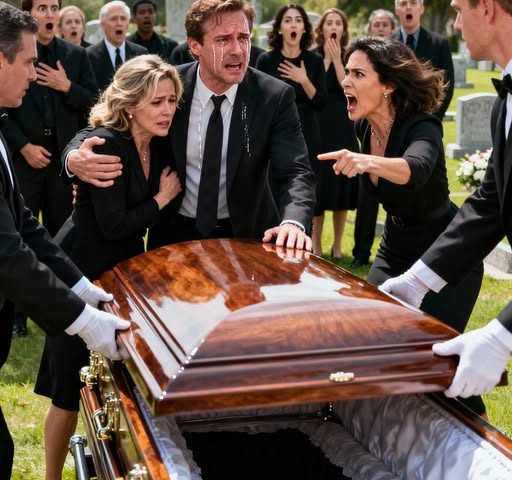
The priest ended the final prayer. Two funeral workers grabbed the straps of the lowering device. The casket creaked as it began to descend.
And then—
“STOP! STOP RIGHT NOW!”
The scream cut through the heat like a blade.
We all turned.
Running between the headstones, breathless and terrified, was Rosa Delgado, the woman who’d worked in our home for more than a decade. She wasn’t just an employee—she was the person my mother trusted most. She’d made coffee for Mom every morning, walked with her in the garden, listened to her stories.
Now she came stumbling toward us with tears streaming down her face.
“Your mother is alive, Mr. Andrew!” she shouted. “That casket is empty!”
The world froze. Every guest stopped breathing.
Even the sun seemed to pause.
2. The Woman My Wife Feared
Melissa stiffened beside me, fingers digging painfully into my arm.
“What is she doing here?” she hissed. “Get her out. Now. This is disrespectful.”
Two security guards rushed forward, grabbing Rosa by the arms as she fought to stay on her feet.
“Let me talk!” she cried. “Please—listen to me! Your mother wasn’t dead last night. I saw everything. Men came through the back door and took her. She was breathing, Andrew. She was moving!”
The guards yanked harder.
Melissa raised her voice, speaking to the crowd with a forced smile.
“Our housekeeper is confused. She’s grieving. She adored my mother-in-law and doesn’t understand what happened.”
“This woman.”
“Confused.”
“These people.”
Her tone stung. My mother grew up poor. She worked as a seamstress before life changed for her in her forties. She never forgot where she came from—and she never let me forget it either.
Rosa was on her knees now, crying. But she wasn’t crying for herself.
She was crying for my mother.
“I know what I saw,” she whispered fiercely. “Your mother was alive when they took her. She moaned, Señor… I mean, Andrew. She tried to speak.”
My heart hammered against my ribs.
I turned to Melissa. “Why was the casket closed before I arrived? Why rush everything?”
Her jaw clenched.
“Andrew, sweetie… don’t start. You saw the certificate. You know what the doctor said. Your mother passed away peacefully. Please don’t embarrass us.”
But the more she spoke, the less sense anything made.
3. My Mother’s Life—and the Woman Who Stayed
While the funeral workers gathered tools to unseal the casket, my mind drifted back.
My mother, Helen Parker, wasn’t the kind of rich woman who cared about chandeliers or showy charity events. She was a former seamstress who used her late husband’s success to help other women get on their feet. She walked barefoot in her garden because she said God made grass for a reason. She talked to strangers at the grocery store. She never hired someone without looking them in the eyes.
And Rosa?
Rosa was more family than employee. My mother found her years ago outside a community center, scared and hungry after leaving a difficult marriage. My mother gave her a job—but more than that, she gave her safety. They watched old TV shows together. They laughed at the same jokes. They argued like sisters.
Melissa, on the other hand, always kept her distance. She came from a wealthy family that had lost most of its money. She knew how to look expensive even when her bank account didn’t match. From the beginning, she judged my mother’s simple manners.
“Your mother needs ‘proper care,’ Andrew,” she’d say.
“She forgets things.”
“She shouldn’t handle her own medications anymore.”
“She’s fragile. Let me help manage everything.”
I’d believed her.
I had trusted her.
And now the consequences were staring me in the face.
4. The Slow Fade I Should Have Noticed
The electric screwdriver buzzed—each screw being removed from the casket felt like another piece of my sanity falling away.
Looking at Melissa, I saw fear for the first time. Not grief—fear. She kept checking her phone, typing frantically.
I thought of the last few months. My mother had become weak, drowsy, confused. Whenever I questioned it, Melissa always had an answer.
“It’s age, Andrew.”
“She’s tired.”
“The doctor adjusted her medicine.”
What doctor?
I never met him.
Melissa always handled the visits.
Rosa had come to me once, months ago, her hands shaking.
“Andrew… the pills aren’t good for your mother. On the days she misses them, she’s alert. She remembers things. She talks. Something’s wrong.”
And like a fool, I dismissed her.
“You’re not a nurse, Rosa. Stop worrying.”
Now regret pressed on my throat like a stone.
5. The Casket Opens
The last screw fell.
The funeral attendant looked at me, waiting for permission.
I nodded.
The lid lifted.
People leaned forward. A woman gasped.
And my stomach dropped.
The casket was empty.
Pristine white satin. Perfectly smooth.
But no body.
No clothing.
Nothing.
A hollow space—like a cruel joke.
“Where is she?” I whispered.
Then louder—
“WHERE IS MY MOTHER?!”
Melissa backed up, trembling so violently she nearly tripped.
“Andrew, listen—I can explain. They were supposed to prepare the body. I—I was protecting you from the stress—”
Rosa lunged, standing between us like a storm.
“Tell him the truth!” she shouted. “Tell him where they took her!”
People began yelling. Phones were recording. Someone called the police.
I grabbed Melissa’s shoulders.
“What did you do? Where is she?”
Melissa cracked.
“She’s not gone!” she sobbed. “She’s at a care facility outside the city. I just needed you to sign the inheritance documents. I wasn’t going to hurt her. I swear I wasn’t!”
I let her go. She collapsed onto the grass.
I turned to Rosa.
“Let’s go,” I said. “We’re getting my mother back.”
6. The Place Where They Hid Her
We left Melissa behind, surrounded by security and furious guests. I jumped into my truck; Rosa climbed in beside me. I drove like a man possessed.
The place Melissa mentioned was a rundown private clinic on the outskirts of Phoenix—a place people whispered about but never acknowledged publicly. Not illegal, exactly… but not a place you sent a loved one.
When we reached it, I didn’t bother knocking. I rammed the gate with the truck, metal screeching as it folded inward.
Inside, nurses shouted, trying to stop us. I shoved past them.
“Where is she?!” I yelled.
One panicked nurse pointed toward a dim hallway.
“Room six… please don’t hurt anyone!”
We ran.
I kicked open the door.
The room was cold, dim, and smelled faintly of disinfectant. On a narrow bed lay my mother, thin, pale, connected to an IV.
“Mama…”
I rushed to her. Her eyelids fluttered.
She was breathing.
Alive.
Fragile, but alive.
Her hand moved weakly toward my face.
“I knew… you’d find me,” she whispered.
My chest broke open.
I cried like I hadn’t cried since I was a child.
Rosa stood in the doorway, also crying.
“Mrs. Parker,” she whispered, “I told you he’d come.”
We carried my mother out—Rosa supporting her carefully as if she were made of glass. As we reached the truck, police cars swarmed the entrance behind us.
Justice was finally arriving.
7. Three Months Later
The storms of that day changed everything.
Melissa was arrested that afternoon. Fraud, coercion, financial exploitation, and unlawful restraint. Her attorneys tried to build a story, but the video of the empty casket destroyed every defense.
The headlines spread across the country.
“The Empty Casket Case.”
“The Wife Who Went Too Far.”
My mother recovered slowly—but beautifully. With good food, sunlight, rest, and Rosa at her side, she grew strong again. She walked in the backyard every morning, feeling the grass between her toes just like before.
Rosa no longer wears a uniform. She sits at the table with us. My mother calls her “my sister in spirit.” And honestly? She is.
I lost money in the divorce. I lost colleagues who sided with Melissa until they realized the truth. But I gained something priceless.
Two women whose love is real.
8. What an Empty Casket Taught Me
Yesterday morning, I walked into the kitchen and found them both laughing—my mother stirring a pot on the stove, Rosa cutting fruit beside her.
“Breakfast?” I asked.
“Cornmeal cakes,” my mother said with a grin. “The kind I used to make when we had nothing but determination.”
I kissed her forehead.
“I’ll never forget what we came from,” I told her.
Sometimes life has to show you an empty casket—not to scare you, but to remind you that real love is alive in the people who stand by you when everyone else walks away.
If your mother is still here, go hug her.
And if you have someone loyal like Rosa in your life, hold on to them. That kind of loyalty?
It’s worth more than anything money can buy.