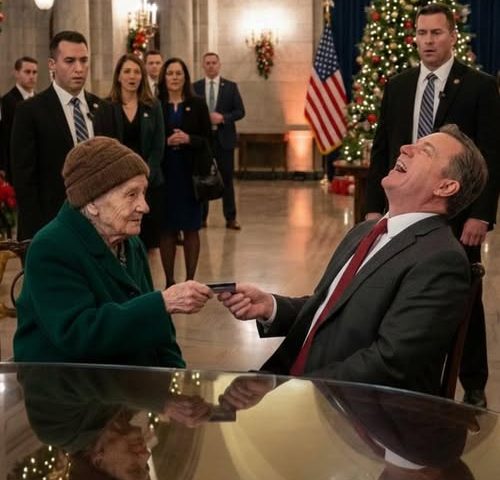

“I’d like to check my balance,” the 90-year-old Black woman said quietly.
Her voice shook just enough to echo across the glossy marble lobby of First National Bank. Conversations stalled. A few people glanced over with curiosity. Others sighed in irritation. Somewhere, muted laughter followed.
At the heart of the lobby stood Charles Hayes, the bank’s president.
Fifty-two years old, dressed in a custom suit worth more than many people’s rent, he moved with the confidence of someone who believed the building—and the people inside it—were extensions of his authority.
When he heard the woman speak, Charles let out a loud laugh, as if she’d just delivered a punchline meant for him alone. It wasn’t kind. It was cutting. Sharp with arrogance, slicing through the room.
Charles had spent years at the top of the institution. He catered to executives, investors, clients with gold watches and hushed voices. To him, the elderly woman looked like a mistake—someone who didn’t belong.
“Ma’am,” he said, projecting his voice so everyone could hear, “you seem confused. This is a private bank. The neighborhood branch down the street may be more appropriate for you.”
The woman—Margaret—rested both hands on her worn cane but didn’t retreat. Her coat was simple. Her shoes were scuffed. Yet her gaze was steady. At ninety, she recognized disrespect instantly.
“Young man,” she replied evenly, drawing a black card from her pocket, “I said I want to check my balance. I didn’t ask for advice on where I should bank.”
She didn’t beg. She didn’t raise her voice. She simply stated her words and waited.
Charles studied the card with open contempt. Its corners were bent. The numbers faded. To him, it looked counterfeit—cheap, meaningless.
He scoffed. “Janet,” he called to his assistant, loud enough for the lobby, “another person trying to be clever with a fake card.”
Well-dressed customers nearby chuckled. A few covered their mouths, pretending restraint.
Margaret remained still. Calm. Anyone paying close attention would have noticed the certainty in her eyes—the kind earned through decades of endurance.
Janet stepped closer and whispered, “Sir, we could just verify it in the system. It would only take a moment.”
“No,” Charles snapped. “I won’t waste time on nonsense.”
He waved her off.
Then something changed.
Margaret smiled.
Not nervously. Not apologetically. It was a smile layered with memory—one that made people pause without understanding why.
For a brief second, Charles felt a tightening in his chest. A warning. Be careful. He ignored it.
Two security guards approached, clearly uncomfortable.
“Ma’am,” one said gently, “Mr. Hayes has asked us to escort you outside.”
Margaret’s eyes sharpened. She’d grown up in the 1940s. She understood exactly what escort outside once meant.
“I never said I was leaving,” she replied softly. “I said I want to check my balance.”
Charles laughed again, louder. “See?” he announced. “This is why we have security—confused people trying to use services they don’t understand.”
A wealthy woman nearby—Catherine Vance—lifted her designer purse to hide her grin.
“Poor thing,” she said loudly. “Probably Alzheimer’s. My maid was like that.”
Then Margaret laughed.
Not gently. Not cruelly. Deeply. Her voice filled the marble hall.
“Alzheimer’s?” she said calmly. “That’s interesting—because I remember very clearly working fourteen-hour days cleaning your grandfather’s office in 1955.”
The lobby went silent.
Charles stiffened. His family had owned the bank since 1932. Very few people knew personal details about his grandfather.
“Excuse me?” he said, suddenly unsure.
“You were fifteen,” Margaret continued. “I worked after school so my mother and I could eat. Your grandfather used to leave lit cigarettes on the marble floor, just to see if I’d complain.”
She met Charles’s eyes. “I never did. We needed the money.”
Janet swallowed hard.
“I remember him telling me people like me should be grateful to serve people like him,” Margaret added. “He said it was our place.”
She smiled sadly. “Funny how habits pass down through families, isn’t it, Mr. Hayes?”
Charles’s face flushed. Sweat gathered along his hairline.
“These are stories,” he muttered. “Anyone could make this up.”
Margaret didn’t blink. “Your grandfather had a scar on his left hand,” she said slowly. “He got it the day he tried to smash a glass over my head. Missed. Cut himself. Told everyone it was a gardening accident.”
Silence swallowed the room.
Several customers quietly left. No one wanted to witness what was unfolding.
“I spent seventy years wondering if I’d ever show the Hayes family what happens when someone like me refuses to stay invisible,” Margaret said.
Charles shouted for security again, panic cracking his voice.
Before anyone moved, the main doors opened.
Gerald Simmons entered—senior vice president, founding board member, authority incarnate.
“Charles,” Gerald said calmly, “why can I hear shouting from the tenth floor?”
Charles rushed to explain. “A confused woman with fake documents—”
Gerald walked past him.
Straight to Margaret.
“Margaret,” he said warmly, “it’s wonderful to see you. Is everything all right?”
The room froze.
Fear replaced arrogance in Charles’s eyes.
Margaret smiled knowingly.
“She believes I don’t look like someone this bank should serve,” she said.
Gerald turned slowly toward Charles.
“My office. Now.”
Charles walked away like a scolded child.
Downstairs, Janet returned with a tablet. “Mrs. Margaret, would you like to review your account privately?”
“No,” Margaret said gently. “Right here. Transparency matters.”
Janet read the numbers aloud.
Eight hundred forty-seven thousand dollars.
Then more accounts.
Millions.
Nearly nineteen million in total.
Shock rippled through the room.
When Charles returned—pale, shaking—Gerald ordered him to apologize.
Margaret stood.
“Didn’t know what?” she asked softly. “That I had money—or that dignity doesn’t depend on wealth?”
She revealed she’d recorded everything.
By evening, Charles was suspended.
Six months later, Margaret sat on the board—the first Black woman in the bank’s history.
Charles was gone.
The bank had changed.
Scholarships expanded. Policies rewritten.
Margaret continued visiting—not to check balances, but to interview students.
She had proven something lasting:
True wealth isn’t what we accumulate.
It’s what we use to lift others.
And that day, in a marble lobby, dignity won.