PART ONE – HOUSTON, TEXAS, UNITED STATES
“What is that child doing in first class?”
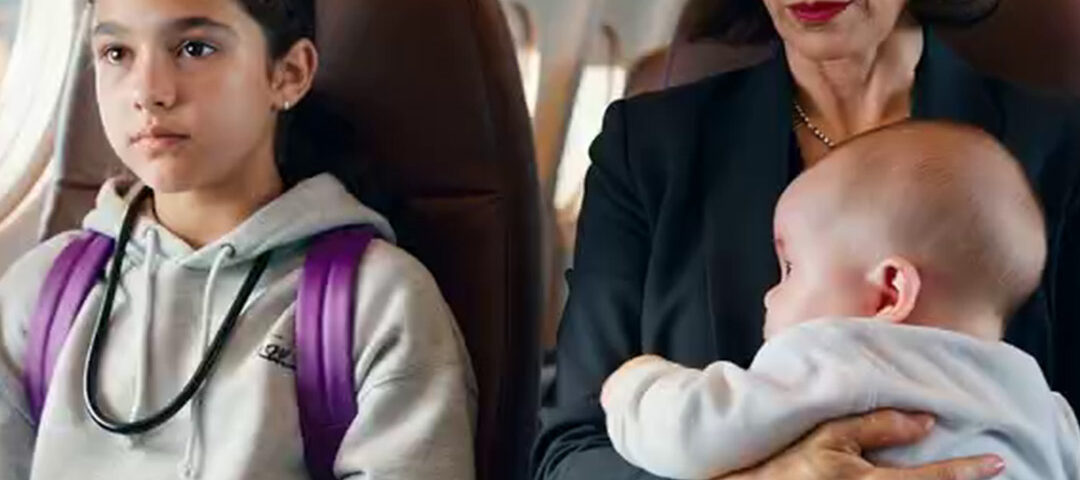
Senator Rebecca Hartwell stared at the twelve‑year‑old Black girl in seat 2B as if someone had dumped trash on the leather. Her manicured hand tightened on the strap of her designer diaper bag. In her arms, her eleven‑month‑old son Andrew screamed without pause.
“These seats are always getting mixed up,” she muttered, voice sharp enough for the whole cabin to hear. “People are always trying to sneak up here. Get her out of this section.”
The girl looked up from her tablet, voice quiet but steady.
“Ma’am, my ticket is—”
“I don’t care about your little story.” Rebecca’s laugh was vicious. “You think I’m stupid? A kid like you in first class? You belong in the back somewhere. I’m not going to sit here and pretend this makes sense.”
But then, a heartbeat later, Andrew’s body went strangely limp in her arms. His lips were starting to lose color. His breathing turned shallow and irregular.
“Somebody help my baby!” she screamed.
The girl in 2B unbuckled, her eyes suddenly focused, sharp.
“I can help him,” she said.
Rebecca’s face twisted with a mix of terror and anger.
“Don’t you dare touch my son,” she snapped. “We need a real doctor, not some kid playing dress‑up.”
Eight minutes later, that same United Airlines flight would be taxiing back to the gate. Eight minutes later, a senator of the United States would be on her knees in a Boston airport, begging that child for forgiveness.
Ninety minutes earlier, in another part of the country, the morning had begun like any other.
It was 6:15 a.m. at George Bush Intercontinental Airport in Houston, Texas. The departure board over Gate 23 flashed: UNITED FLIGHT 447 – HOUSTON (IAH) TO BOSTON (BOS).
Boarding had just begun.
Maya Washington stood in line, hugging a purple backpack to her chest. At twelve years old and barely four foot nine, she reached only to the shoulders of most of the adults crowding around her. Her father’s gray hoodie—three sizes too big—swallowed her small frame like a protective shell.
Inside the backpack: three published medical research papers, an official invitation from Boston Children’s Hospital in Massachusetts, and a silver stethoscope in a hard case. Engraved on the case, in neat lettering, were four words:
HEAL WITH LOVE – DAD.
The gate agent scanned Maya’s boarding pass. Her eyebrows shot up.
“First class, honey? Are you sure?” she asked, glancing down at the ticket, then at Maya.
“It’s correct, ma’am,” Maya said softly.
“Are you traveling with an adult?”
“No, ma’am. I have my unaccompanied minor paperwork.”
Maya passed over a carefully organized folder. Every document was neatly placed in clear sleeves: consent forms, emergency contacts, a copy of the invitation to present at the International Pediatric Endocrinology Conference in Boston.
The agent looked through it all, then looked at Maya again. Her expression said what her mouth didn’t: This doesn’t look like what I expect to see.
But everything was in order.
“Go ahead,” the agent said finally. “First class is down that way.”
First class was a different universe from the crowded terminal.
Leather seats gleamed under warm lighting. The air smelled faintly of coffee instead of recycled airport air. Only eight seats: two rows on each side, two seats per row. Quiet. Calm. Expensive.
Maya found her place at 2B, the window seat on the left side. She slid into the leather, her feet not quite touching the floor, and pulled out her tablet. With a few taps, she opened a medical journal article she’d been studying for weeks:
“Advances in Detecting Adrenal Crisis in Infants Under One Year of Age.”
In row 1, a white businessman in a freshly pressed suit gave her a quick glance, then turned away, pretending to ignore her. In row 3, an elderly white woman clutched her purse a little tighter when she noticed Maya.
Maya pretended not to see any of it. She had grown used to that quick look—curious, then wary. Used to people asking where her parents were, then looking surprised when she answered in full scientific sentences.
Ten minutes later, chaos walked into first class wearing Chanel.
Senator Rebecca Hartwell swept down the aisle of the United States domestic flight like she owned the cabin and maybe the airline too. Her designer diaper bag swung from one shoulder; in the other arm, her eleven‑month‑old son Andrew writhed and screamed.
“Yes, Martin,” she said into her phone, raising her voice over Andrew’s cries. “The Boston Children’s Hospital gala is tonight. Fifty‑thousand‑dollar donation, photos with the kids on the oncology floor, great press. I know exactly why I’m going. Andrew, please—stop.”
She shifted him, bouncing him without really looking at his face.
“What? No, I fired the nanny. Too expensive.” She rolled her eyes. “We’ll find another one when we get back to D.C. Andrew!”
His screams grew more frantic.
Rebecca stopped at row 2 and froze. In seat 2B sat Maya, small and quiet, dark skin framed by the hood of her oversized sweatshirt, reading a medical article.
Rebecca’s expression curdled.
“Excuse me,” she said sharply. “I think there’s been a mistake.”
Maya looked up.
“Ma’am, this is seat 2B,” she said. “I’m assigned here.”
“This is first class,” Rebecca replied, as if maybe the child hadn’t understood that part.
“Yes, ma’am. I’m in 2B.”
“You’re in first class.” Rebecca’s voice rose. “Where are your parents?”
“My father passed away,” Maya said quietly. “My mother is working in Houston.”
“So you’re alone in first class.” The disbelief in Rebecca’s voice was thick. “How convenient.”
“Johns Hopkins Hospital purchased my ticket,” Maya told her. “Ma’am, I’m presenting at a medical conference in Boston.”
Rebecca barked out a laugh that turned heads in row 1 and row 3.
“A medical conference? That’s creative,” she said. “Flight attendant!” She raised her voice. “Flight attendant!”
A young woman in a United uniform hurried up the aisle. Her name tag read JESSICA. She had the strained look of someone who’d already had a long morning.
“Yes, Senator Hartwell?” she asked.
“There’s been a ticketing error,” Rebecca said crisply. “This child is in first class alone. I need this resolved.”
Jessica glanced at Maya, an apology already in her eyes.
“Ma’am, if I could just—”
“I am Senator Rebecca Hartwell,” the woman cut in. “United States Senate, Transportation Committee. I know the regulations. Unaccompanied minors do not fly in first class, especially not—”
She stopped herself, but everyone in the small cabin heard the word she didn’t say. Maya felt it land anyway.
Her hands tightened on her tablet. In her head, she heard her father’s voice:
Stay calm, baby girl. Stay dignified. Let the facts speak.
Jessica took Maya’s boarding pass and scanned it with the handheld device.
Once.
Twice.
“Senator, this is confirmed first class,” Jessica said quietly. “Paid in full by Johns Hopkins Hospital in Baltimore. Everything is in order.”
“That’s impossible.” Rebecca’s face flushed red. “Look at her. Does she look like she belongs here?”
In row 4, Marcus Thompson, a forty‑year‑old Black journalist for The Washington Post, silently slid his phone out of his pocket. He had seen scenes like this too many times in airports and on Amtrak trains up and down the East Coast. He pressed record.
Andrew’s crying ratcheted up another level. His little body arched against her shoulder.
“Fine,” Rebecca snapped. “Fine.”
She dropped into 2A, the seat beside Maya, still on her call, still half wrestling the baby.
“But if anything goes missing from my bag,” she told Jessica loudly, “I’m holding this airline responsible. You can’t just put anyone up here and expect us not to notice.”
Jessica swallowed, nodded, and stepped back.
“Can I get you something to drink, Senator?” she asked.
“A vodka tonic,” Rebecca said without hesitation. “I cannot deal with this situation sober.”
Maya turned toward the oval window. Her reflection stared back: a small Black girl trying to make herself smaller. Her eyes burned, but she refused to let tears fall.
She opened her medical journal again, forcing herself to focus on the words: sodium retention in infants with adrenal insufficiency… Her hands shook slightly.
In front of her, Marcus’ phone kept recording.
Behind her, Andrew’s screaming began to change.
No one noticed yet.
The cabin door closed with a heavy thunk. The aircraft pushed back from the gate, rolling slowly into the gray Texas morning.
Rebecca finally put down her phone and tried to settle Andrew. He was still crying, his face flushed a deep, unhealthy red.
She fumbled a bottle out of her bag and tried to push the nipple into his mouth. He turned his head away, whimpering.
“Andrew, for heaven’s sake,” she muttered.
She tried again. He batted the bottle away with a weak hand. Formula spilled across her Chanel suit.
“Perfect,” Rebecca snapped. “Just perfect.”
She looked over at Maya.
“This is your fault,” she said, anger looking for an easy target. “If I wasn’t so distracted by this ridiculous seating situation…”
Maya said nothing. She kept her eyes on the tablet, the words blurring and sharpening and blurring again.
The businessman in row 1 leaned around his seat.
“Senator Hartwell,” he said, “I have to say, I agree with you completely. Airline standards have really gone downhill. First class used to mean something.”
“Thank you,” Rebecca said, voice softening for the first time. “Finally, someone with common sense. I mean, look at this. A twelve‑year‑old alone in first class.”
She didn’t bother to lower her voice.
“Please,” she went on. “We know what’s happening here.”
In row 3, the elderly woman nodded.
“My granddaughter is twelve,” she said. “She’d never be allowed to fly alone like this. It’s not proper.”
“And it’s not safe,” Rebecca added. She paused with false delicacy. “Who knows what kind of family situation we’re dealing with.”
Maya’s jaw tightened. She kept her eyes on her screen.
At the front of the cabin, the flight attendants began the safety demonstration. Rebecca ignored it, scrolling through her phone with one hand while Andrew writhed in the other.
“Jessica,” Rebecca called, snapping her fingers.
“Yes, Senator?”
“My drink?”
“Right away.”
Jessica hurried off.
Rebecca turned back to Maya.
“So, Johns Hopkins, was it?” she asked. “Tell me, sweetheart, what exactly does a child do at Johns Hopkins Hospital? File papers? Fetch coffee?”
Maya looked up.
“I’m a junior medical researcher in the pediatric endocrinology department,” she said. “I study rare diseases in infants.”
Rebecca laughed, loud enough that passengers in economy could have heard if the curtain hadn’t been closed.
“Oh, this is something,” she said. “A researcher at twelve. And let me guess, you’re a genius? A prodigy?”
Maya’s voice stayed quiet, measured.
“I’ve published three papers on infant adrenal insufficiency,” she said. “I wrote them with my father before he passed away.”
“Your father. The doctor,” Rebecca said slowly, her tone making it clear she didn’t believe a word. “How convenient that he’s not here to confirm any of this.”
Maya’s hand moved to her backpack, fingers brushing the outline of the stethoscope case through the fabric.
“He died three years ago,” she said. “Pancreatic cancer. Stage four.”
“Oh, sweetheart,” Rebecca said, voice dripping with performative sympathy. “I’m sure that’s a very sad story. But making up credentials to get free tickets? That’s fraud. That’s a crime.”
“I’m not lying,” Maya said.
“Then prove it,” Rebecca said. “Show me these supposed papers you wrote.”
Maya hesitated. She could have pulled out the printed copies in her bag, could have shown the journal mastheads, the invitation letter signed by Dr. Patricia Carter from Johns Hopkins.
But something in Rebecca’s expression told her it would not matter. The senator didn’t want the truth. She wanted to be right.
“I don’t need to prove anything to you, ma’am,” Maya said.
“Ha.” Rebecca turned toward the businessman. “Did you hear that? ‘I don’t need to prove anything.’ That’s what people say when they’ve been caught.”
Jessica returned with the vodka tonic.
Rebecca took a long drink.
“You know what I think?” she said, her words getting looser at the edges. “I think someone made a mistake. A charity, probably one of those programs that sends ‘under‑resourced youth’ on trips so donors can feel good, bought you a ticket. And somehow you got upgraded. And now you’re sitting here with your little tablet, reading words you probably don’t even understand, pretending to be a scientist.”
Maya’s breathing stayed steady, but her eyes were wet now. She blinked hard.
“I’m not pretending,” she whispered.
“Sure you’re not.” Rebecca took another drink. “Let me tell you something about the real world, honey. People don’t just get to skip the line. You don’t get first‑class seats and fancy education just because you tell a sad story about your father. There’s an order to things, and you—” she flicked her eyes up and down Maya’s hoodie, her skin, her braids “—you’re out of order.”
The cabin had gone silent except for Andrew’s weakening cries. Even the flight attendants had gone still, stunned by the cruelty spilling out in the small, expensive space.
Marcus in row 4 leaned forward slightly, making sure his phone captured every second.
“Senator Hartwell,” Jessica tried again.
“Don’t ‘Senator’ me.” Rebecca waved her off. “I’m doing this child a favor. Better she learns now. The world doesn’t owe her anything. Not a seat beside me, not respect, not admiration. Respect is earned. She hasn’t earned it.”
“Ma’am… please…” Maya’s voice cracked on the last word.
“Oh, now you want to cry,” Rebecca said, laughing. “What did you think would happen? You come up here, sit with your betters, and we all just nod and smile and pretend you belong?”
Andrew, in her arms, suddenly sagged.
His scream cut off mid‑wail.
She didn’t notice.
“You know what really bothers me?” Rebecca continued, her face flushed now with alcohol and righteous anger. “It’s situations like this that make people like me look heartless when we talk about personal responsibility. I fight for policies that expect people to earn what they get. And then you show up with your questionable ticket and your dramatic story and your—”
“Ma’am,” Maya said, and her voice was different now. Urgent. “Ma’am, your baby.”
“Don’t you dare tell me about my baby,” Rebecca snapped.
“He’s not breathing right.”
Rebecca finally looked down.
Andrew’s lips had gone from red to a frightening pale. His chest moved too fast and too shallow. His eyes were unfocused.
“What?” she whispered. “Andrew?”
She jostled him. He didn’t respond. His small hand dangled, limp, revealing the edge of a silver medical alert bracelet on his wrist.
Three engraved letters caught Maya’s eye.
C A H.
Her blood ran cold.
“Ma’am,” she said, already unbuckling her seatbelt. “When did Andrew last eat?”
“What? I—this morning, I think—I don’t know,” Rebecca stammered. “The nanny usually handles that.”
“Does he take daily medication?” Maya asked. “Steroid medication, every day?”
Rebecca stared at her.
“How do you even—Jessica!” she screamed suddenly. “Jessica, something’s wrong with my baby!”
Andrew’s breathing was getting worse—rapid, gasping, ineffective.
Maya stood up in the narrow aisle.
“Ma’am, I need you to listen very carefully,” she said. “Your son has CAH—congenital adrenal hyperplasia. That bracelet… you know what it means, right?”
Rebecca looked from Maya to the letters, then back to Maya. Her face was blank.
“You don’t know,” Maya said quietly.
“I… the doctor said it was manageable,” Rebecca stammered. “He gave us prescriptions. The nanny—she was trained… the nanny usually… she just quit two days ago, but I didn’t think he’d missed anything—”
Maya’s voice shifted, something clinical and focused sliding into place.
“He’s dehydrated from flying,” she said. “He’s stressed, probably fighting some mild infection. If he’s missed doses of his medication, his adrenal system is shutting down. He’s going into adrenal crisis. If we don’t treat him in the next eight to ten minutes, his heart could stop.”
The small first‑class cabin went utterly silent.
Rebecca stared at the twelve‑year‑old girl she had just spent ten minutes tearing apart.
Then, for the first time in a long political career built on never backing down, she broke.
“Help him,” she whispered. “Please. Please help my baby.”
Maya froze for half a second. Every eye in first class was pinned on her.
The businessman cleared his throat.
“Senator, you can’t seriously be asking a child—”
“Be quiet,” Rebecca snapped, desperation shredding her usual polish. “She’s the only one who seems to know what’s happening. Please. Help him.”
The aircraft’s engines roared louder as they approached the runway.
Jessica rushed up the aisle.
“Ma’am, you need to sit down,” she said. “We’re about to take off. If there’s a medical emergency, we’ll turn the plane around—”
“Turn it around,” Rebecca cried. “My baby needs a hospital!”
The pilot’s voice crackled over the intercom.
“Ladies and gentlemen, this is your captain. We’ve been notified of a medical situation onboard. We will be returning to the gate. Please remain seated with your seatbelts fastened.”
The plane began to bank, slowly, far too slowly for Maya’s liking.
“He doesn’t have that kind of time,” she said, more to herself than anyone.
Then, louder: “He needs treatment now. We have about eight minutes before his heart could fail.”
“Then do something,” Rebecca begged, thrusting Andrew into her arms.
Maya’s hands shook as she took the baby. He was shockingly light, his skin cool and mottled. His breathing was fast and shallow, barely moving his chest.
“Jessica,” Maya said, her voice suddenly full. “I need the medical kit. The emergency one. Now.”
“You can’t—” Jessica started. “You’re just a—”
The elderly woman in row 3 stood up, voice trembling.
“By the time we get back to the gate, he could be gone,” she said. “Let the girl try.”
Maya’s words rang through the cabin, stronger this time.
“Jessica. Now.”
Jessica ran.
Maya cradled Andrew, fingers finding his tiny wrist.
Thready, racing pulse.
She opened his mouth. His gums and inner lips were pale and dry. She pressed gently on the soft spot at the top of his head.
Sunken.
“Tachycardia,” she murmured under her breath. “Hypotension. Severe dehydration.”
Her voice, when she spoke again, was steady and professional.
“Adrenal crisis,” she said. “He’s in adrenal crisis.”
Rebecca sobbed.
“What does that mean?” she asked.
“His body can’t produce enough cortisol,” Maya explained. “His adrenal system is collapsing. Without treatment he’ll go into shock. Then his heart will stop.”
“Oh God,” Rebecca whispered. “What do we do?”
Jessica returned with the red emergency kit.
Maya snapped it open. Stethoscope. Gauze. Syringes. Vials.
She found what she was praying would be there: injectable hydrocortisone.
Two vials, 100 mg each.
“Jessica,” Maya said, “call the gate. Ask for paramedics with IV saline and glucose, and pediatric transport. Tell them: adrenal crisis, eleven‑month‑old male, approximately ten kilograms, known CAH patient, suspected missed doses.”
Jessica stared at her.
“How do you—”
“Please,” Maya said. “We’re already down to minutes.”
Jessica grabbed the interphone.
Maya laid Andrew carefully across the empty seats in row 2. She unzipped her backpack with one hand and pulled out her father’s stethoscope, the silver tubing catching the cabin light.
HEAL WITH LOVE – DAD.
She pressed the diaphragm to Andrew’s chest.
“Heart rate about one‑eighty,” she said. “Breath sounds rapid and shallow.”
She looked up at the adults around her: the businessman, the elderly woman, Jessica, and Rebecca who had called her a liar and a fraud minutes before.
Marcus, in row 4, still held his phone, still recording.
Maya’s hands trembled again. She had studied this scenario. She had written papers, reviewed forty‑seven cases of infant adrenal crisis, run simulations on hospital software.
But she had never done this on a real child.
“I can’t,” she whispered. “I’m not certified. I’m just—”
“You’re the only person here who knows what’s happening,” Rebecca said, gripping her shoulder. Her voice broke. “Please. Please save my baby.”
Maya looked down at Andrew. His eyes were rolling back. His tiny chest fluttered with shallow breaths.
In her memory, her father’s voice was clear.
In an emergency, your hands can shake, baby girl. Your mind has to stay steady. Trust what you know.
Her hands stopped shaking.
She drew up the hydrocortisone, calculating the dose.
“Two to three milligrams per kilogram,” she murmured, doing the math in her head, “for a ten‑kilogram infant… twenty to thirty milligrams. We’ll start with twenty‑five.”
She looked at Jessica.
“Tell them on the radio: hydrocortisone twenty‑five milligrams intramuscular, administered en route,” Maya said.
Then she found the injection site on Andrew’s thigh, wiped it with an alcohol pad, and pushed the needle in.
“This will help you,” she whispered. “Stay with us.”
She depressed the plunger slowly and steadily, then withdrew the needle and pressed gauze over the site.
“Hydrocortisone, twenty‑five milligrams IM,” she said aloud. “Time: 7:47 a.m., Central.”
Rebecca’s voice was barely audible.
“How long until it works?”
“Two to five minutes,” Maya said. “If it doesn’t…”
She didn’t finish.
She grabbed a small cup of apple juice from the galley. With a finger, she dabbed drops against Andrew’s lips, trying to nudge his blood sugar up.
“Come on, Andrew,” she whispered. “Stay with us. Stay here.”
The plane slowed. The gate was close now. The door opened with a hiss. Paramedics rushed in, uniforms marked with BOSTON EMS even though the aircraft was still technically on the ground in Houston’s tarmac in the story’s timeline—her mind already leaping ahead to the city where they would land. In reality, these paramedics wore Houston Fire Department patches.
“Where’s the patient?” the lead paramedic called.
“Here,” Maya said.
He saw Andrew first, then saw Maya, twelve years old, holding a syringe and a stethoscope.
“Who are you?” he asked.
“Maya Washington,” she said. “Junior medical researcher, Johns Hopkins pediatric endocrinology program. I administered twenty‑five milligrams of hydrocortisone intramuscularly ninety seconds ago. He has CAH, likely salt‑wasting type, and missed medication doses.”
The paramedic blinked.
“You’re a kid,” he said.
“I’m a researcher who specializes in this condition,” she replied. “He has about four minutes left before things get much worse.”
The paramedic looked at his partner. Some silent conversation passed between them.
“Get the IV kit,” he said. “Pediatric line. Glucose drip. Let’s move.”
They worked quickly, placing an IV, hanging fluids.
“Blood pressure?” he asked.
“Sixty over forty,” his partner answered. “Critical.”
“Glucose?”
A quick finger prick, a portable meter.
“Forty‑two. Severe hypoglycemia.”
“Increase glucose to D10,” the lead paramedic said. Then he looked back at Maya.
“You bought him time, kid,” he said. “Good work. We’ll take it from here.”
They lifted Andrew onto a stretcher.
“Ma’am,” the paramedic asked Rebecca, “does he have any other conditions? Any allergies? Medication schedule?”
“I—I don’t…” Rebecca stammered. “The nanny usually—”
She looked lost.
“She doesn’t know,” Maya said quietly. “He has CAH. Congenital adrenal hyperplasia. Salt‑wasting type. He should be on daily hydrocortisone and probably fludrocortisone as well.”
The paramedic wrote it down.
“You got all that from a bracelet,” he said.
“And the symptoms,” Maya replied.
He looked at her again. Really looked.
“How old are you?” he asked.
“Twelve,” she said.
He shook his head, almost laughing in disbelief.
“Twelve,” he muttered. “And you just saved this kid’s life.”
He held out his fist.
Maya bumped it.
They wheeled Andrew away. Rebecca followed, then stopped and turned back. She looked at Maya for a long, long moment.
“Thank you,” she whispered.
Then she was gone.
The first‑class cabin was very, very quiet.
Maya stood there in the aisle, her father’s stethoscope still hanging around her neck, her hands smudged from labels and alcohol wipes, her eyes dry but burning.
The businessman in row 1 cleared his throat and stared down at his polished shoes.
“I… I apologize for earlier,” he said. “I was wrong.”
The elderly woman in row 3 was openly crying now.
“Sweetheart,” she said, voice shaking, “I’m so sorry. We should have believed you. We should have listened.”
Maya didn’t look at either of them. Her eyes stayed fixed on the space where Andrew had been.
Her legs suddenly felt weak.
Jessica caught her arm.
“Hey,” she whispered. “You okay?”
“I need to sit down,” Maya said.
Jessica helped her back into 2B. Maya collapsed into the seat, her whole body trembling now that the adrenaline was wearing off.
“You were incredible,” Jessica said softly. “I’ve been flying for twelve years, and I’ve never seen anything like that.”
Maya didn’t answer. She was looking at her own hands, still shaking.
Jessica squeezed her shoulder and moved to calm the rest of the cabin.
Conversations erupted all at once. People stood, leaned into the aisle, talked over one another. Phones came out, fingers flew. Marcus in row 4 walked up to 2B and crouched beside her.
“Hey,” he said gently. “I’m Marcus Thompson. I write for The Washington Post in D.C.”
Maya looked at him, exhausted.
“Okay,” she said.
“I recorded what happened,” he told her. “From the moment the senator started raising her voice until the paramedics took Andrew out. I want to publish it. But I won’t do that without your permission.”
Maya shook her head.
“I don’t want to be famous,” she said. “I just want to do my work.”
“I get that,” he said. “But that senator—Rebecca Hartwell—three months ago she voted against expanding the Children’s Health Insurance Program. CHIP. She called it ‘fiscally irresponsible.’ Said some families were abusing the system to get free health care for their kids.”
His voice dropped, intense and steady.
“She pushes policies that hurt kids in poor communities, kids whose parents can’t afford the treatments her son gets,” he said. “And then you—this twelve‑year‑old Black girl she treated like a problem—saved her son’s life.”
Maya was quiet for a long time.
“Will it help other kids?” she asked finally. “Kids who get dismissed because of how they look?”
“Yes,” Marcus said without hesitation.
“Then… okay,” Maya said. “But tell my mom’s story too. And my dad’s. I want people to know why this matters.”
Marcus held out his hand.
“Deal,” he said.
Maya shook it.
An announcement crackled over the speakers.
“Ladies and gentlemen, due to the medical emergency, this flight will be delayed approximately one hour while we complete incident reports and await a replacement crew. We apologize for the inconvenience.”
Groans rolled through the cabin.
Then something unexpected happened.
A woman in navy‑blue hospital scrubs appeared at the first‑class curtain. She was Black, maybe in her early thirties, her ID badge from a Houston pediatric hospital still clipped to her pocket.
“Excuse me,” she said. “I heard what happened. Is the little girl who helped the baby up here?”
Jessica pointed to 2B.
The woman walked over, tears already shining in her eyes.
“Baby,” she said, kneeling beside Maya’s seat, “I’m a pediatric nurse. I was back in economy and heard everything. What you did…” Her voice broke. “My son has CAH. He’s four now. When he was a baby, he had a crisis just like that. If the ER doctor hadn’t known what to look for, I would have lost him.”
She put a hand over her heart.
“You saved that baby’s life,” she said. “You’re a hero.”
Maya’s eyes filled with tears.
“I was so scared,” she whispered.
“Of course you were,” the nurse said. “But you did it anyway. That’s what heroes do.”
Other passengers had gathered now: an older Black man, a young Latina woman holding a baby, a white couple still gripping each other’s hands.
“You made us proud,” the older man said. “My daughter wants to be a doctor. I’m going to tell her about you.”
The young Latina woman nodded.
“I’m going to tell my son about you too,” she said.
A white woman stepped forward, hesitating.
“I’m a teacher,” she said, her voice breaking. “And I’m ashamed. I saw you sitting here and I… I made assumptions. I’m sorry. I’m going to do better.”
Maya nodded. She still couldn’t quite speak.
One by one, passengers from both first class and economy came up. Some apologized. Some said thank you. Some just wanted to squeeze her hand.
The crowd swelled, people from the back of the plane pushing forward, some trying to take photos with her.
But not everyone was moved.
A white man in an expensive suit from row 7 in economy pushed his way to the front.
“This is ridiculous,” he said loudly. “We’re delayed because of this little circus. The senator ought to sue the airline for letting an unaccompanied minor perform medical procedures. It’s negligent. It’s—”
“It’s the reason that baby is still alive,” Marcus said, stepping between him and Maya. “If you have a problem with that, I suggest you take it up with your conscience.”
The man stepped back, muttering.
Flight attendants tried to restore order. People kept snapping pictures, making calls, starting hashtags.
Jessica finally raised her voice.
“Folks,” she said, “I know everyone is grateful and excited, but Maya needs some space. Please return to your seats so we can prepare for departure.”
Slowly, reluctantly, the crowd thinned.
A more senior flight attendant, an older woman with kind eyes, came to sit briefly in the empty seat beside Maya.
“Sweetheart,” she said, “the airline would like to upgrade your return ticket, and we’d like to offer you anything you want on this flight. Food, drinks—whatever you need.”
Maya shook her head.
“I don’t want anything,” she said. “Thank you.”
“Are you sure?”
“I’m sure.”
The attendant hesitated, then left a bottle of water and a package of cookies on Maya’s tray.
“Just in case,” she said, then moved away.
An hour later, United Flight 447 lifted off from the runway and pointed its nose toward Boston, Massachusetts.
Maya stared down at the Texas landscape falling away beneath them. She touched the engraving on her father’s stethoscope.
“I got him, Dad,” she whispered. “I got him.”
Her phone buzzed in airplane‑Wi‑Fi‑assisted mode. A text popped up from her mother, Kesha, back in Houston’s Third Ward.
Baby, Dr. Carter just called me. She heard what happened. She’s so proud of you. I’m so proud of you. Call me when you land. I love you.
Maya typed back.
Love you too, Mama.
She tried to close her eyes and sleep, but every time she did, she saw Andrew’s pale lips, heard Rebecca’s cracking voice:
Help him, please.
She felt again the weight of his tiny leg under her hand, the needle in her fingers, the choice she’d made.
She opened her eyes and picked up her tablet instead.
Her presentation waited on the screen: “Early Detection Protocols for Adrenal Crisis in Infants – A Call for Universal Screening.”
At the bottom of the title slide, in smaller font:
Co‑authors: Maya R. Washington and Dr. James Washington (in memoriam).
She touched the line with her father’s name.
For the first time since he died, she let herself cry—for him, for Andrew, for every child whose life swung between science and politics.
PART TWO – LEGACIES AND FOUNDATIONS
Two hours into the flight, Jessica slipped into the seat beside Maya again.
“Hey,” she said gently. “I called ahead to Boston. Andrew’s in the pediatric ICU. He’s stable. They said if you’d waited two more minutes, he would have gone into cardiac arrest.”
She swallowed.
“You saved his life,” Jessica said.
Maya stared out at the clouds.
“My dad would have been faster,” she said. “He wouldn’t have hesitated.”
“Your dad sounds amazing,” Jessica replied.
“He was,” Maya said.
She pulled up a photo on her tablet: her father in his white coat, DR. JAMES WASHINGTON, PEDIATRIC ENDOCRINOLOGY stitched over the pocket, smiling with an arm around Maya, who wore a too‑big stethoscope.
“He used to take me to the hospital on weekends,” she said softly. “Let me sit in on rounds. By ten, I was reading his journals. He said I had ‘the gift.’ We co‑authored three papers before he died.”
“What happened?” Jessica asked.
“Pancreatic cancer,” Maya said. “Stage four. He worked at a public hospital—understaffed, underfunded. He had symptoms for months but kept putting off tests. Too busy trying to save other people’s kids. When they finally diagnosed him, it was too late. He died six months later, at thirty‑eight.”
“Oh, Maya,” Jessica whispered.
“The hospital couldn’t afford certain newer treatments,” Maya continued. “He could have lived longer. Saved more kids. But the system…” She shook her head. “The system failed him.”
Jessica wiped her eyes.
“That’s the worst part,” Maya said. “Three months before he died, he applied for a research grant. He wanted to develop cheap diagnostic tests for adrenal disorders in infants. For public hospitals, rural clinics, community health centers. To save kids like Andrew before the crisis hits.”
“What happened?” Jessica asked.
“The foundation denied his application,” Maya said.
She pulled up another document on her tablet: a formal letter on heavy paper.
“Not ‘commercially viable,’” she said, reading from memory. “They wanted research that could be patented and sold. Profitable. Saving kids who can’t pay high prices… didn’t make financial sense.”
Jessica’s face paled.
“What foundation?” she asked.
Maya turned the tablet so she could see.
Across the top of the letter: THE HARTWELL FOUNDATION FOR MEDICAL INNOVATION.
Founded by Senator Hartwell’s father. Current board member: Senator Rebecca Hartwell.
Jessica stared.
“The woman who denied your father funding for research that could have saved her own son,” she said slowly, “is the same woman whose son you just saved on a United flight from Texas to Massachusetts.”
“Yes,” Maya said. Her laugh was short and bitter. “The system that killed my father almost killed her son too.”
Before Jessica could answer, another figure approached.
“Excuse me,” a calm voice said. “Am I interrupting?”
Maya looked up.
Dr. Patricia Carter stood in the aisle, wearing a blazer, her conference badge already clipped to her lapel. Fifty‑something, Asian American, one of the most respected pediatric endocrinologists in the United States.
“Dr. Carter?” Maya gasped. “What are you doing on this flight?”
“Same as you,” Dr. Carter said, sliding into the seat in front and turning around. “Heading to the conference in Boston. I was going to surprise you in the hotel lobby. You surprised me first.”
She smiled, but her eyes were serious.
“What you did back there,” she said, “was resident‑level medicine.”
“Just what my dad taught me,” Maya replied.
“He taught you well,” Dr. Carter said. “But you hesitated before you gave the injection.”
“I’m twelve,” Maya said. “I’ve never treated a real patient. What if I’d been wrong?”
“But you weren’t wrong,” Dr. Carter said. “You know why? Because you studied forty‑seven cases. You read every paper on infant adrenal crisis. You’ve simulated this scenario a hundred times. Your knowledge is real. Your skill is real. The only thing holding you back is a world that keeps telling you you’re too young to know what you know.”
Maya looked down.
“Sometimes I believe them,” she admitted.
“I know,” Dr. Carter said softly. “But today, you proved them wrong. Everyone on that plane who saw ‘just a kid’—you showed them who you really are.”
She reached into her bag.
“I was going to give you this at the conference dinner,” she said. “But after today, you should have it now.”
She handed Maya a thick envelope.
Maya opened it with shaking hands.
On Boston Children’s Hospital letterhead, the words blurred, then came into focus:
DEAR MAYA WASHINGTON,
We are honored to present you with the James Washington Memorial Award for Excellence in Pediatric Research. In addition, we are pleased to offer you a full scholarship to our medical training program for exceptional young scholars, beginning Fall 2026.
Maya’s hands trembled so hard she had to rest the paper on her lap.
“Dr. Carter…” she whispered.
“Your father would be so proud,” Dr. Carter said. “I am proud. And after today, the whole country is about to know your name.”
Maya stared at the letter, at her father’s name printed there as a memorial. A scholarship in his honor. Proof that his work—and hers—mattered.
She heard Rebecca’s voice again in her mind: You don’t belong here.
Maya knew now, deep down, that she did.
In row 4, Marcus opened his laptop. The cabin lights had dimmed, but the screen glowed bright.
He typed a headline that would soon race across America:
“SENATOR WHO VOTED AGAINST CHILDREN’S HEALTH FUNDING WATCHES 12‑YEAR‑OLD BLACK MEDICAL RESEARCHER SHE INSULTED SAVE HER SON’S LIFE ON A UNITED FLIGHT.”
Below it, he attached the video file he had uploaded over in‑flight Wi‑Fi: Rebecca’s words, Maya’s calm, the crisis, the injection.
By the time United Flight 447 began its descent into Boston three hours later, the video would already have tens of thousands of views.
By that night, millions.
By tomorrow, the world would have an opinion.
PART THREE – BOSTON, MASSACHUSETTS
Logan International Airport, Boston, Massachusetts. 11:47 a.m. Eastern Time.
When the wheels touched down, Maya’s phone exploded.
Forty‑seven missed calls.
One hundred thirty‑four text messages.
Hundreds of notifications from social media platforms she barely used.
“What in the world…” she murmured.
She opened one of the notifications. Marcus’ tweet filled the screen.
“Senator Rebecca Hartwell, who voted against children’s health coverage expansion three months ago, is seen on this video shouting at a 12‑year‑old Black medical researcher on a United flight—until that same child saves her son’s life during an in‑flight medical emergency. This is what prejudice looks like. This is what grace looks like. Meet Maya Washington.”
The view count: 8.2 million and climbing.
Her phone rang with a Boston area code.
“Maya Washington?” a polished voice asked. “This is Bradley Carter from CNN. We’d love to have you on tonight—”
She hung up.
Another call.
“Maya, this is Rebecca Goldstein with Good Morning America—”
Hang up.
Another.
“A publisher in New York, we’d like to talk about a book deal—”
Hang up.
“Film rights—”
Hang up.
Dr. Carter put a hand on her shoulder.
“Turn it off,” she said gently. “Just for now.”
Maya powered down the phone.
They walked up the jet bridge into the terminal. Television screens hung from every corner, tuned to different cable news networks.
On all of them, Maya saw her own face.
On mute footage looped: Rebecca gesturing angrily in first class, then crying; Maya leaning over Andrew; paramedics rushing in.
The caption across one network read: “SENATOR APOLOGIZES AFTER VIDEO SHOWS TENSE EXCHANGE WITH CHILD WHO SAVED HER SON.”
The sound came up just in time for Maya to hear the anchor.
“Senator Hartwell has released a statement,” the anchor said. “Quote: ‘I want to publicly apologize to Maya Washington for my behavior on United Flight 447. I was stressed, frightened for my son, and I allowed my fear to come out as cruelty toward a child who ultimately saved his life. I have no excuse. I am deeply sorry and grateful beyond words.’”
The anchor continued.
“However, the controversy may only be beginning. Senator Hartwell’s voting record on children’s health coverage is now under intense scrutiny. Multiple advocacy groups are calling for her resignation from the United States Senate.”
Maya quickened her pace, keeping her eyes on the polished floor.
They were halfway through the terminal when she heard her name.
“Maya! Maya Washington!”
She turned.
Senator Rebecca Hartwell was running toward her.
Her Chanel suit was wrinkled and stained. Her mascara had smudged. Her hair had mostly come out of its careful style. She looked less like the polished politician from Capitol Hill and more like what she actually was in that moment: a terrified mother who had nearly lost her child.
Security guards started toward her.
“Ma’am, you can’t—”
“Maya, please,” Rebecca called. “Please, I need to talk to you.”
Maya stopped.
Rebecca reached her, breathing hard.
“Five minutes,” she pleaded. “That’s all I’m asking.”
“You should be with your son,” Maya said. “He’s in the hospital.”
“He’s stable,” Rebecca said, voice cracking. “With specialists. They told me I should find you. They said…” Her throat closed. “They said you saved his life. That if you’d waited three more minutes, he would have gone into cardiac arrest. They said your diagnosis was perfect. Your treatment was perfect. They said you knew more about his condition than I did.”
Her voice shook.
“His own mother,” she whispered.
Maya said nothing.
“I didn’t even know what those three letters meant,” Rebecca said, looking down at her trembling hands as if the letters CAH were etched there. “The pediatrician told me when he was six months old. Said it was manageable. Gave us prescriptions. I hired a nanny to handle the medications. I never learned the details. I never thought I needed to. I was too busy. Too important. Always running to the Capitol. Always in meetings. And then the nanny quit two days ago. I didn’t even know what he’d missed.”
She took a shuddering breath.
“I failed him,” she said. “So badly that a twelve‑year‑old stranger knew how to save him better than his own mother.”
Tears streamed down her face.
“And the worst part,” she said, “the absolute worst part is that on that plane I stood there and treated you like you were nothing. Like you didn’t belong. When the truth is you are everything I should have been. Prepared. Informed. Compassionate. You knew my son’s condition better than I did. You cared more about his life in that moment than I did.”
She bowed her head.
“And I…” Her voice dropped. “I called you a liar. I implied you didn’t earn your seat. I looked at you and saw everything I had been taught to look down on. And I was wrong.”
Maya stood very still. People were gathering, phones out, recording again.
Dr. Carter rested a steady hand on Maya’s shoulder. Airport security hovered nearby, watching.
This was the moment when Maya could have destroyed the senator’s career with one sentence. She could have refused any forgiveness, laid out every insult in front of every camera.
It would have been understandable.
But when Maya looked at Rebecca, she didn’t see a senator, or a headline, or a quick victory. She saw something else.
Fear.
The same fear she had seen on her father’s face three years earlier when the oncologist said there would be no more treatment options. The same fear she had felt herself, holding a syringe over a baby’s leg.
“The important thing is that your son is alive,” Maya said quietly. “That’s what matters most.”
“Because of you,” Rebecca said. “Because you had knowledge I didn’t have. Not because you’re better than me—because you learned what I chose not to learn. You spent three years studying the disease that took your father so you wouldn’t have to watch another child suffer. I…” She shook her head. “I didn’t even pick up the pamphlet.”
Rebecca’s face crumpled.
“Your father,” she whispered suddenly. “Who was he?”
“Dr. James Washington,” Maya said. “Pediatric endocrinologist. He died three years ago from pancreatic cancer. Stage four. Diagnosed too late because the public hospital where he worked couldn’t afford better screening. He spent his last months trying to get funding for research that would help kids like Andrew—kids whose parents don’t have private insurance, kids in neighborhoods like mine.”
She unlocked her tablet and pulled up the rejection letter.
“Your family foundation denied his grant,” she said.
Rebecca took the tablet with shaking hands.
“The Hartwell Foundation for Medical Innovation,” Maya said. “Founded by your father. You sit on the board. You turned him down because his work wasn’t ‘commercially viable.’”
Rebecca read the letter. Her mouth moved silently over the words not a funding priority and insufficient potential for commercial development.
“Oh my God,” she whispered.
“My father could have developed screening tests that would have caught Andrew’s CAH earlier,” Maya said. “He could have helped educate parents—all parents, not just wealthy ones—about warning signs of adrenal crisis. He could have saved thousands of kids. But your foundation decided that kind of research wasn’t profitable enough.”
“I didn’t know,” Rebecca said, voice breaking. “I swear, I didn’t know.”
“You didn’t want to know,” Maya said, her voice still calm. “Just like you didn’t want to know what CAH meant. It’s easier not to look too closely when the consequences fall on people you don’t see. Easier to talk about budgets when you’re not looking at the faces of the families who pay the price.”
Rebecca was sobbing now.
“I’m sorry,” she said. “For your father. For Andrew. For you. For everything. I am so, so sorry.”
Maya watched her for a long moment.
When she finally spoke, her words would become the most quoted line of the entire story.
“I don’t need you to be sorry,” Maya said. “I need you to be better. Go back to Washington, D.C., and vote differently. Look at kids like me and see human beings, not statistics. Fund research that saves lives, not just research that turns a profit. Be the kind of leader you should have been for Andrew. Be that for other people’s children, too.”
Silence spread through the terminal.
Then Rebecca nodded.
“I will,” she said. “I swear I will.”
“Good,” Maya said.
She started to walk away, then turned back.
“And Senator,” she added, “learn what CAH means. Learn his medication schedule. Learn the signs of an adrenal crisis. Be his mother. Not just his nanny’s employer. His mother.”
Rebecca stood there, crying, as Maya walked away with Dr. Carter toward the conference and the work that had brought her to Boston in the first place.
That afternoon, in a conference room at Boston Children’s Hospital, Maya stood at a podium in front of fifty reporters and a room full of pediatric specialists. Behind her, a banner announced the International Pediatric Endocrinology Conference – Boston, Massachusetts, USA.
Dr. Carter stood at her side. Marcus stood on the other.
Cameras flashed.
“I’m not here to talk about what happened on the plane,” Maya began. “I’m here to talk about the thousands of children in the United States and around the world who die every year from preventable diseases because they don’t have access to the same health care that wealthy families do.”
She looked up from her notes.
“I’m here to talk about the fact that CAH—a condition that can be managed with daily medication—becomes deadly when parents can’t afford regular care, or when information doesn’t reach their communities,” she said. “I’m here to talk about why research into affordable diagnostic tests gets rejected, while profitable drug projects get millions of dollars.”
Reporters scribbled furiously.
“My father spent his life trying to fix these inequalities,” Maya said. “He died because of them. I’m standing here because I don’t want any other twelve‑year‑old to grow up without a parent because a system valued profit over people.”
A reporter raised her hand.
“Maya, do you blame Senator Hartwell for your father’s death?” she asked.
Maya paused.
“No,” she said. “I blame a system that lets lawmakers make health‑care decisions based on money instead of human lives. Senator Hartwell is a product of that system. So was I on that plane—just on the other end of it. The difference is that today she has a choice. She can keep voting the same way, or she can change. We all have that choice.”
Another reporter called out.
“What do you want people watching this to take away?”
Maya looked directly into the television cameras broadcasting her words across the United States.
“I want people to understand that intelligence doesn’t come with an age limit,” she said. “That expertise doesn’t have a color. The kid sitting next to you on a domestic flight might be the one who saves your life someday. If we keep dismissing people because of how they look instead of listening to what they know, we’re going to keep losing brilliant minds like my father’s. Children can’t afford that. None of us can.”
She stepped away from the microphone.
The room erupted in applause.
PART FOUR – AFTERMATH IN AMERICA
Three days later, on a Friday afternoon, Andrew Hartwell was discharged from the pediatric ICU at a Boston hospital.
Cameras waited outside the double doors, as they did for any story involving a senator in the United States. Rebecca walked out holding Andrew in her arms. He looked healthier now, color back in his cheeks.
She looked exhausted. Different.
In one hand, she held a thick folder—a complete medical education packet about CAH. For three days, between ICU visits, she had sat with doctors, nurses, and advocates, learning everything she could: medication schedules, warning signs, emergency protocols.
She had also spent those three days in meetings with hospital administrators, advocacy groups, and policy experts.
The photo that went viral that day wasn’t of her leaving the ICU.
It was of her standing in the hospital’s research wing, signing a check.
FIVE MILLION DOLLARS – THE JAMES WASHINGTON MEMORIAL RESEARCH GRANT.
The program’s mission: to develop affordable diagnostic screening for rare pediatric diseases in underserved communities across the United States.
“I can’t bring Dr. Washington back,” she told reporters. “But I can help make sure his work continues. And I can help make sure no other child dies because their parents can’t afford the level of care my son receives.”
When asked whether she would vote differently on upcoming health‑care funding bills in the U.S. Senate, she answered simply:
“Yes. I’ve been wrong. It’s time to be right.”
Political analysts predicted she’d lose her next election. Some of her biggest donors began to withdraw support. She didn’t seem to care.
Meanwhile, in a small apartment in Houston’s Third Ward, Maya’s mother Kesha watched the news coverage with tears streaming down her face.
Her phone rang. Another Boston number.
“Ms. Washington,” a voice said, “this is Dr. Patricia Carter from Johns Hopkins Hospital in Baltimore. I’m calling about Maya’s full scholarship to our medical scholars program. We’d also like to offer you a position as a pediatric nurse specialist in our research division—relocation assistance to Maryland, full benefits, and a salary that means you can stop working double shifts at the public hospital.”
Kesha dropped the phone, then scrambled to pick it back up, laughing and crying all at once.
“Yes,” she said. “Yes. Oh my God, yes.”
In Boston, in her hotel room, Maya stood at the window and looked at a framed photo of her father she kept in her bag.
“We did it, Dad,” she whispered. “We saved him.”
For the first time in three years, she felt like maybe her father’s death had meant something beyond pain. Like his legacy would live on, not as a sad story, but as a force for change.
Six months later, the James Washington Memorial Research Grant funded its first three projects.
In January 2026, one of those projects—developed at Morehouse School of Medicine, a historically Black medical school in Atlanta, Georgia—completed human trials on a rapid diagnostic test for adrenal insufficiency in infants.
The test cost about twelve dollars to manufacture. It could be administered by any trained health‑care provider in community clinics across the United States, not just specialists at major hospitals.
In its first six months of use, that test saved forty‑seven children.
Dr. James Washington’s dream was becoming reality.
In February 2026, Maya sat at a long table in a hearing room on Capitol Hill in Washington, D.C., speaking into a microphone before the U.S. Senate Health Committee.
She was thirteen now. Still small. Still wearing her father’s stethoscope around her neck.
When she spoke, seasoned senators leaned forward to listen.
“Members of the committee,” she began, reading from her prepared statement, “I’m here to testify in support of the Children’s Health Care Access Act. This bill would expand Medicaid, fund research programs at public hospitals, and provide grants for affordable diagnostic technologies. Exactly the kind of support my father needed and never received.”
She looked up.
“Some of you will say we can’t afford it,” she continued. “That it’s not fiscally responsible. I’m here to tell you that we can’t afford not to do it. Every child we lose to a preventable disease is a future doctor, scientist, teacher, or leader we’ll never have. Every parent who dies because they can’t afford treatment is a parent who can’t raise the next generation of problem‑solvers.”
She let the silence sit for a beat.
“My father died at thirty‑eight,” she said. “He could have had another forty years. He could have saved thousands more children. But he’s gone because the system he worked in valued profit margins more than his life. I’m asking you today not to let that keep happening.”
When she finished, the committee room was quiet.
Then Senator Rebecca Hartwell, seated among her colleagues, pressed her button.
“Thank you, Ms. Washington,” she said, microphone carrying her voice through the room and across the United States on live television. “I vote yes on this bill, and I urge my colleagues to do the same.”
The Children’s Health Care Access Act passed the U.S. Senate 73–27.
Three weeks later, President Rodriguez signed it into federal law.
September 2026.
The halls of Johns Hopkins Hospital in Baltimore buzzed with their usual organized chaos—beeping monitors, rolling carts, doctors and nurses moving quickly with quiet purpose.
Maya walked through those halls wearing a white coat with her name stitched neatly over the chest:
MAYA R. WASHINGTON – JUNIOR MEDICAL RESEARCHER.
At thirteen, she was the youngest researcher in the hospital’s 130‑year history.
Patients and parents stopped to stare sometimes. Some recognized her from the viral video that had looped on American news networks for weeks. Some just saw a kid in a lab coat.
She didn’t worry about it anymore.
She stepped into the pediatric endocrinology research lab. Her lab. Her team.
Dr. Carter smiled at her from behind a stack of charts.
“Ready to change the world?” she asked.
Maya touched her father’s stethoscope.
“I already started,” she said.
One year after the flight, Andrew Hartwell’s first birthday party was quiet.
No cameras. No press releases. Just a small house outside Washington, D.C., a simple cake on the table, a few family members.
Andrew was thriving. His CAH was carefully managed. Rebecca knew every medication by name, dose, and time. She knew every early sign of adrenal crisis by heart.
On the wall of their home hung a framed photo: Andrew in a hospital gown, grinning, with Maya standing beside him in her hoodie and white coat.
Beneath it was a handwritten note from Maya:
**Dear Andrew,
Your life matters. Not because of who your mother is or how much money your family has. Just because you’re you.
Don’t ever let anyone tell you otherwise.
Love,
Maya.**
Rebecca read it every day.
It reminded her of what she had almost lost.
And of what she had been given the chance to become.
The video of Maya and Rebecca on United Flight 447 has now been viewed more than forty‑seven million times across platforms in the United States and around the world.
It inspired a documentary. Maya declined to appear in it.
It inspired a children’s book, “The Girl Who Knew”—written by Maya’s mother, Kesha. The proceeds fund medical scholarships for young people from underrepresented communities.
It helped change health‑care policy in a dozen U.S. states.
It saved lives that Maya would never hear about.
But for Maya, the most important part was simpler.
A twelve‑year‑old Black girl from Houston’s Third Ward had been told she didn’t belong.
She proved that she belongs anywhere her work takes her—in first class, in hospital labs, in Senate hearing rooms.
PART FIVE – THE LESSON
So what’s the lesson in all of this?
Maya Washington is extraordinary. A published medical researcher at twelve. Calm under pressure. Brilliant.
But here’s the hard truth: Maya almost wasn’t allowed to be extraordinary on that flight.
If Senator Rebecca Hartwell had gotten her way, Maya would have been removed from first class. Humiliated. Treated like a problem. Andrew would have stayed in his mother’s arms, untreated, while the plane reached the runway.
He would have died.
All because adults couldn’t see past their assumptions.
Think about how close the world came to losing a child’s life that morning because people judged before they listened.
Think about how many Maya Washingtons are out there right now—in Houston, in Boston, in small towns and big cities across the United States and beyond—brilliant, talented, capable, and being dismissed because they’re too young, from the wrong neighborhood, the wrong background.
How many future doctors are we losing because we judge before we listen?
How many life‑saving discoveries are we missing because we fund profitable research instead of necessary research?
How many children are dying because their parents can’t afford the health care that lawmakers’ children get as a matter of course?
Maya’s father fought those inequalities his whole life and lost. His daughter fought them at thirty‑five thousand feet and, this time, she won—not just for Andrew, not just for herself, but for kids who would never know her name.
Remember how it began.
Rebecca had screamed, “Don’t touch my son!” at Maya.
Eight minutes later, she was begging that same child to save him.
It would be easy to say, “Justice served,” and stop there.
But justice wasn’t as simple as a viral video and a public apology.
Rebecca had called Maya a kid from the wrong side of town. She had demanded Maya be removed from first class. Then Andrew stopped breathing.
Maya gave him twenty‑five milligrams of hydrocortisone at exactly the right moment, about eight minutes before his heart would have failed.
Rebecca hadn’t known what CAH meant—her own son’s diagnosis. She hadn’t learned his medication schedule. A twelve‑year‑old stranger on a United flight from Houston to Boston knew more about Andrew’s condition than his mother did.
Three months before Maya’s father died, he had applied for grant funding to do research that would help kids like Andrew.
Rebecca’s family foundation denied him. Not profitable enough.
The same woman whose foundation turned down research that could have saved her son’s life was the woman whose son Maya saved.
Three months before the flight, Rebecca had voted against expanding children’s health coverage. She’d said some families were misusing the system.
Then her own child almost died because she herself hadn’t taken the time to learn his condition.
Maya lost her father because a system valued profit over people.
Then she saved the child of a woman who had represented that system.
Rebecca only changed after the video went viral—after millions of people watched her words and her tears.
That’s the exhausting part.
Why should anyone have to save a life just to be seen as fully human?
So here’s what to do with this story.
The next time you see someone who doesn’t look like they belong—on a plane, in a classroom, in a boardroom—pause. Ask yourself: What do I actually know about this person? Not what you assume. What you actually know.
If you have power—if you vote, hire, write grants, make policy—invest in people instead of only profits. Fund research that helps communities that don’t show up in glossy brochures. Listen to the voices you’re used to ignoring.
If you’re young and dismissed, remember Maya. You do belong. Your voice matters. Your knowledge matters, even if the world hasn’t caught up yet.
And remember this: the kid sitting next to you on a flight from Texas to Massachusetts might be the one who saves your life someday.
Stop judging before you listen.
Intelligence doesn’t have a color.
Expertise doesn’t have an age.
Never underestimate anyone.
Because you never really know who might save your life—or change your country—when the moment comes.