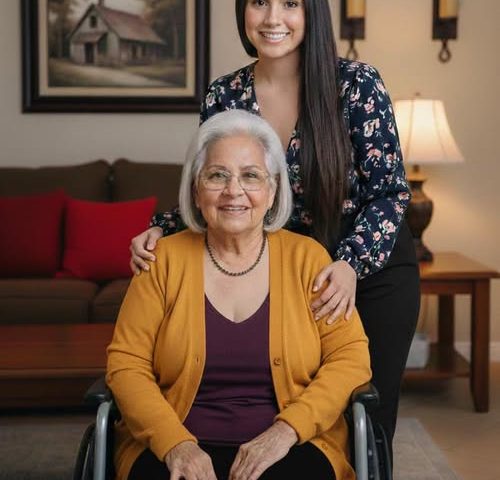
For seven years I cared for Dona Marlene, an elderly woman who lived in my neighborhood and who, despite being well-off, was completely abandoned by her own family.
Her children only appeared long enough to take her money and then disappear.
She would always wait at the window for affection, attention—any gesture of love that never came.
Dona Marlene had possessions, but she had no affection.
And, over time, she became like family to me.
We cooked together, played cards, talked for hours. She gave me advice, and I kept her company. Little by little, her house became the only place where I truly felt at home.
I, who had no one left in the world, found in her a reason to keep going.
But a few weeks ago, Doña Marlene passed away.
At the wake, the family appeared with fake tears.
But in their eyes there was no sadness—only greed.
I noticed: they were less concerned about her death and more about who would inherit her belongings.
I went home devastated… until a knock on the door made my heart freeze.
It was two police officers.
“Are you the one who cared for Doña Marlene?”

“Yes… is something wrong?”
The officer continued, serious:
“We need you to come with us.”
My stomach sank.
When I arrived at her house, I found the whole family gathered—and furious.
Then the daughter pointed in my direction and showed me a video on her cell phone.
It was Dona Marlene, recorded a few days before she d.ied:
“If you’re watching this, it’s because I’m already gone. I want to make it clear that everything I own—the house, the car, my savings, everything—belongs to the only person who truly cared for me: my caregiver. She was like a daughter to me when my own daughters stopped being my daughters.”
I started to tremble.
The family erupted:
“THIS IS A FORGERY!”
“SHE MANIPULATED MY MOTHER!”
“ARREST THIS WOMAN!”
But the police chief, who was also there, raised his hand, signaling for silence.
He explained:
“The video is legitimate. Dona Marlene came to us months ago, registered everything at the notary’s office, and left explicit instructions regarding her will. You can try to contest it, but legally… everything belongs to the caregiver.”
The family screamed, cried, and despaired—not over the loss of their mother, but over the loss of the money.
In sh0ck, I could only repeat:
“I never asked for anything… I never wanted anything…”
The chief placed a hand on my shoulder and said:
“She knew. That’s why she left her everything.”
I went home not knowing whether to cry from sadness or gratitude.
No inheritance could erase the void Dona Marlene would leave in my life.
But that day I finally understood:
She didn’t leave me possessions.
She left me the greatest act of love anyone has ever given me.
And, despite the pain, a piece of her would live with me forever.