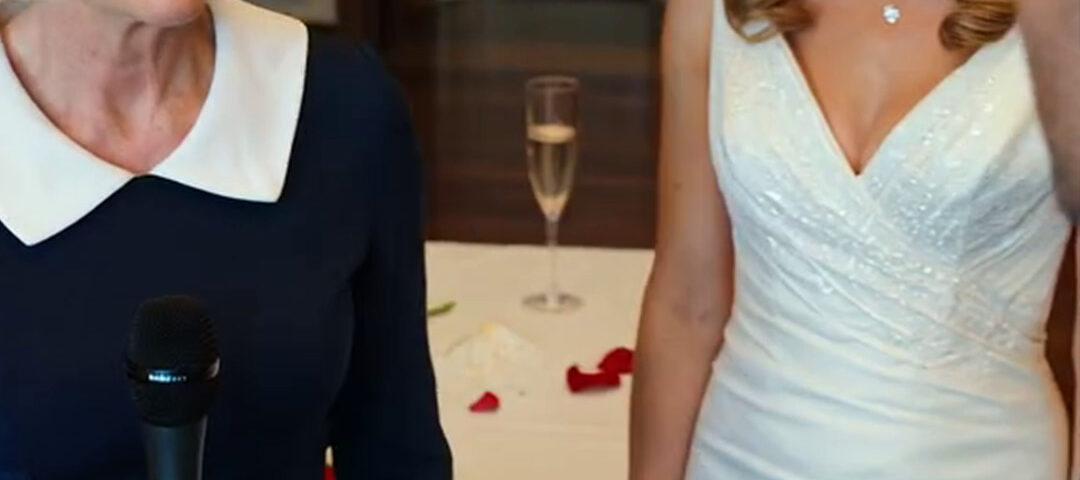
“AS YOUR NEW WIFE, I’M GRACIOUSLY ALLOWING YOUR MOTHER TO LIVE IN MY OLD APARTMENT!” Harper announced, gripping the microphone in the center of the banquet hall.
A murmur of approval swept through the tables. Some guests applauded politely. Others nodded with admiring smiles. I stood near the head table, clutching a glass of champagne I no longer had the stomach to drink, feeling every pair of eyes in the room pivot toward me, waiting for my reaction.
Harper looked radiant in her fitted white gown, her hair swept into an elaborate, glossy chignon, that smile of hers looking like it had been painted onto her face. My son, Liam, stood beside her, squeezing her hand with a conspiratorial look, glancing at me with an expression I couldn’t quite decipher in that moment.
I smiled.
It was automatic. A response conditioned by years of being polite, of not causing trouble, of always keeping the peace.
“I appreciate your generosity, Harper,” I said, my voice as steady as I could manage. “But I live very happily at my farmhouse. I don’t need to move anywhere.”
The silence that followed was thick and uncomfortable. I saw guests exchanging confused glances. I heard whispers. Harper kept her smile, but something shifted in her eyes—a cold glint that vanished as quickly as it appeared.
Liam interrupted immediately.
“Mom,” he said, his voice cutting through the air like shattered glass, “I decided not to tell you earlier because I didn’t want to ruin the day, but my in-laws and my sister-in-law are moving in there. To your farmhouse. It’s all arranged.”
I felt the floor drop out from under me.
The chandeliers in the ballroom suddenly seemed blindingly bright. The background noise faded into a distant hum. I looked at Liam, searching for some sign that this was a joke, some indication I had misheard, but no—he looked at me with absolute seriousness. It was that expression he wore when he had made up his mind and would brook no argument.
I scanned the room, looking for faces I didn’t know well. Harper’s parents. Her sister. The Sterling family. I swept my gaze over every table decorated with white hydrangeas and crisp linen, searching through groups of guests chatting and laughing.
They weren’t there.
“Where are they?” I asked, and my voice came out smaller than I intended. “Where are your in-laws and your sister-in-law, Liam?”
“Mom,” he replied with a casualness that pierced me like ice, “they went to the farmhouse a few hours ago. We wanted them to start getting settled while we were here at the reception. It’s just more practical this way.”
The words rained down on me like stones.
While I was here—standing in an elegant ballroom in Columbus, Ohio, celebrating what I thought was a special moment for my son—three people I barely knew were inside my house. In my farmhouse. In the place I had bought with thirty years of work and sacrifice.
Then I spoke up, loud enough for everyone in that hall to hear.
“No one lives in my farmhouse without my consent. No one.”
The silence that followed was absolute.
The jazz band in the corner seemed to stop playing. Conversations ceased. Everyone was staring at us now.
Liam’s face flushed a deep crimson. Harper was no longer smiling.
“Mom, you’re making a scene,” Liam hissed, taking a step toward me. “Don’t ruin my wedding with your whims.”
“Whims?” I repeated, feeling something fracture inside my chest. “Defending my home is a whim now.”
Harper stepped forward, crossing her arms.
“Eleanor,” she said, like she was addressing a child who had embarrassed her in public, “my family needs a place to live. You have that huge farmhouse for just one person. It’s selfish to refuse when I’m offering you my apartment in exchange. It’s a fair trade.”
Fair.
That word echoed in my head like a cruel joke.
There was nothing fair about this. Nothing fair about them disposing of my home without asking me. Nothing fair about offering me a “favor” I had never requested.
“I didn’t ask for your apartment, Harper,” I replied, maintaining my calm even though I was trembling on the inside. “And your family has no right to enter my property without my authorization. I don’t care what you agreed to between yourselves. That farm is mine.”
Liam raised his voice. “It’s already decided, Mom. They’re staying there. You can move into the apartment or find somewhere else. But this isn’t negotiable.”
Not negotiable.
The words of my son. The boy I had raised alone after I became a widow. The young man I had worked double shifts for to pay tuition. The man who was now kicking me out of my own home.
I took off the shawl I was wearing and let it drop onto the nearest chair. I gripped my purse with shaking but firm hands and took a step back, distancing myself from them.
“So you’ve decided for me,” I said, looking Liam directly in the eyes. “You’ve decided to give away what isn’t yours. You’ve decided your mother doesn’t even deserve to be consulted about her own home.”
“Mom, don’t exaggerate,” he snapped. “It’s just three people. The house has four bedrooms. There’s plenty of space.”
Plenty of space, as if that were the only thing that mattered. As if the years I worked to buy that land meant nothing. As if my right to decide over my own sanctuary was optional.
“I’m leaving,” I announced clearly. “I’m leaving this party right now. And when I get to my farm, your in-laws and your sister-in-law are going to have to leave. I don’t care how you solve it, Liam, but that house is mine and mine alone.”
“You can’t do that,” he shouted. “We already told them they could stay. You can’t humiliate me like this in front of everyone.”
I looked at him, feeling a profound sadness mixed with something new I was just beginning to recognize.
Anger.
Disappointment.
And clarity.
“You humiliated me first, son,” I said, and my voice didn’t shake anymore. “You decided on my life without consulting me. You gave away what wasn’t yours to look good for your wife. Now I decide for myself.”
I turned and started walking toward the exit.
Every step took an enormous effort. I could feel stares burning into my back. I heard whispers, stifled gasps, my name spoken with pity or judgment. Harper yelled something behind me, but I wasn’t listening anymore. Her words were swallowed by the buzzing that filled my ears.
Liam called after me one more time.
I didn’t stop.
I couldn’t stop.
If I hesitated for even a second, I would crumble right there in front of everyone.
When I pushed through the doors and the cool night air hit my face, I breathed deeply, letting the oxygen fill my lungs like medicine. My hands shook as I dug for my keys in my purse. I had to get to the farm. I had to see with my own eyes what was happening there.
I got into my car and locked the door. For a moment, I sat still, gripping the steering wheel tight, trying to steady the tremors in my hands. Through the windshield I could still see the venue lights glowing—warm, celebratory, like nothing had just shattered.
I started the engine and drove out of the parking lot.
The road to the farmhouse was dark. There were barely any other vehicles. City lights faded behind me as I moved along the route I knew by heart.
It had been twenty years since I bought that property. Twenty years since I finalized the paperwork with shaking hands, unable to believe I finally had something of my own—a place where no one could tell me what to do. A space built with my effort, my labor, my dreams of a quiet refuge in old age.
Liam was ten when we moved there.
I remembered how he ran across the land exploring every corner, how he helped me plant the first apple trees, how he told me that when he grew up he was going to take care of me and the farm.
Now that same boy was taking everything from me.
I gripped the wheel harder.
I wasn’t going to cry. Not yet.
First, I had to resolve this. First, I had to get home and see what was really going on.
The road narrowed as I got closer. Trees formed dark shapes under the moonlight. I knew every curve, every dip, every rise. Finally, I saw the front gate.
It was open.
That never happened. I always locked it. Always.
I drove in slowly, my heart beating faster and faster.
The house lights were on—every single one of them—as if someone had decided to illuminate every room.
I parked near the main entrance and sat there for a moment longer. I took three deep breaths, trying to calm myself.
I needed to be calm. I needed to think clearly.
I got out of the car and walked to the door.
It was ajar.
I always locked it when I left. Always.
I pushed the door gently and stepped inside.
The first thing I saw were suitcases—three large suitcases piled right in the entryway of my living room. Then I saw boxes. Cardboard boxes with clothes, personal items, things that weren’t mine.
I heard voices coming from the kitchen.
Laughter. The clatter of plates. Someone cooking on my stove.
I walked toward the kitchen, disbelief and rage growing with every step. When I reached the doorway, there they were—three people I barely knew.
An older woman with carefully styled gray hair stood at the stove. A man my age was rummaging through my refrigerator. And a young woman sat at my table eating calmly from a plate I recognized as my good china.
They turned when they saw me.
The older woman smiled like she belonged here.
“Eleanor,” she said warmly, as if I’d just returned from a pleasant errand. “So good that you’re here. We were just making some dinner. Liam told us it was no problem for us to get settled in.”
I stood in the doorway, staring at them.
These people had walked into my house. Opened my refrigerator. Used my things. And they were acting like it was the most normal thing in the world.
“Get out of my house,” I said, my voice low but firm.
The three of them blinked at me like they hadn’t understood.
“Excuse me?” the young woman said, putting her fork down.
“I said, get out of my house,” I repeated, louder this time. “All three of you. Right now.”
I hadn’t always been a woman of silence.
There was a time when my voice filled spaces, when my decisions mattered, when I knew exactly who I was and what I wanted. But that was many years ago, before life taught me that sometimes love means staying quiet—means yielding—means putting others first, even if it means losing yourself along the way.
I met James when I was twenty-three. He worked at the same manufacturing plant where I had just started as a machine operator. He was a good man—hardworking, with rough hands and an honest laugh that made me feel safe.
We married six months after meeting, in a simple ceremony with barely twenty guests.
Liam was born a year later.
I remember the first time I held him in my arms, wrapped in a pale blue blanket I had knitted myself during the last months of pregnancy. He was so small, so fragile, so completely dependent on me. James cried tears of happiness looking at our son.
“We’re going to give him everything, Eleanor,” he told me. “Everything we never had.”
And we did—at least, we tried.
We lived in a small two-bedroom apartment on the outskirts of the city. James worked double shifts at the plant while I stayed home caring for Liam. The money barely stretched, but we were happy. Or that’s what I told myself every night when I went to bed exhausted after a full day of washing, cooking, cleaning, and tending to a baby who cried incessantly.
When Liam turned four, James started complaining of headaches.
At first we blamed fatigue—the stress of work, the overtime he took so we could save a little. But the pain got worse. Then came a day when he couldn’t get out of bed without the world spinning.
I took him to the county hospital. We waited seven hours to be seen.
The doctor told us they needed to run scans—that there was something in his brain that didn’t look right on the basic exams. The out-of-pocket costs were thousands. We had barely three hundred dollars in savings.
We borrowed from family, from friends, from co-workers. We scraped the money together bit by bit—crumpled bills handed to us with pity in people’s eyes.
Finally, we paid for the scans.
The result came two weeks later.
Brain tumor. Inoperable. Six months to live—maybe less.
I remember James took my hand when the doctor delivered the news. His hand was trembling, but his voice was steady.
“We’re going to be fine, Eleanor,” he said. “You and Liam are going to be fine. I’m going to handle this.”
But there was no time to handle anything.
James died four months later in a hospital bed, holding my hand until the very last moment.
I was twenty-nine. Liam was five. And suddenly I was a widow—alone with no income, a child to feed, and rent to pay.
I went back to the plant. I got my job back as a machine operator. The pay was meager. Rent took half my check. Food, transportation, utilities, clothes, Liam’s school supplies—everything came out of wages earned working ten hours a day, six days a week.
Liam grew fast.
He was a smart boy, curious, with his father’s smile. I enrolled him in the local public school. Every morning, I dropped him off before heading to the plant. Every afternoon, I picked him up after my shift. We ate dinner together in that small apartment that never seemed to have enough light. I helped him with homework while he told me about his day.
“You were always good with numbers, Mom,” he told me once when I explained a math problem. “You should have studied more. You should be a teacher or something.”
I smiled and didn’t tell him the truth—that I’d had to drop out of school to work and help my family. That my dreams had been buried under the needs of others. That now my only dream was to see him grow, study, and have opportunities I never had.
Years passed.
Liam finished elementary school and started high school. I was still at the plant, but I took a second job cleaning office buildings at night. I left the factory at six, picked up Liam, gave him dinner, and at eight I went out again to clean until midnight. I slept five hours a night if I was lucky.
When Liam turned fifteen, he told me he wanted to study engineering.
I knew what that meant—tuition, books, materials, all the costs I didn’t have but was going to find somehow. I started saving every cent. I stopped buying red meat, bought only cheap chicken or canned tuna. I stopped buying new clothes and wore what I’d owned for years. I walked instead of taking the bus whenever I could. Every dollar I didn’t spend went into an old coffee tin I hid under my bed.
Liam graduated high school with honors.
I cried at the ceremony—tears of pride and relief. My son, the son of a factory worker and a man who died too young, was going to college. He was going to be an engineer. He was going to have a better life than ours.
College cost everything I had and more.
I got a third job on weekends selling homemade pies and cakes at the farmers market, waking up at four in the morning on Saturdays and Sundays to bake, selling until two in the afternoon, going home for a short nap, then catching up on housework.
Liam studied hard. He was responsible, dedicated.
But I started noticing changes.
He didn’t tell me as much about his day. He spent more time with friends than with me. When I asked how things were going, his answers turned into single syllables.
“Fine.”
“Nothing special.”
“Don’t worry about it.”
He met Harper in his junior year.
She was studying engineering too. The first time Liam spoke of her, something in his voice shifted—an enthusiasm I hadn’t heard in years, an admiration that edged toward obsession.
“I’d like you to meet her mom,” he said one afternoon. “She’s incredible. She’s smart, beautiful, and her family has important connections. Her dad owns a construction firm.”
I smiled and told him I’d love to meet her, but something inside me tightened—instinct, maybe, or the quiet fear of a mother who can feel her son pulling away.
Harper came to dinner one Saturday night. She arrived in an elegant dress and heels that clicked loudly against the worn floor of my living room. She looked around with an expression that tried to be polite but failed to hide her disdain.
“It’s cozy,” she said, forcing a smile.
I made my best meal—roast chicken with potatoes, salad, homemade bread, a simple fruit cobbler with cream. Harper ate little, moving food around her plate more than bringing it to her mouth. She talked almost the entire dinner about her family, about trips to Europe, about her father’s company expansion plans.
Liam looked at her like she was the answer to every prayer he’d never said out loud.
I looked at him and saw a young man falling in love—not just with a woman, but with a lifestyle he’d never had.
After that dinner, Liam spent less time at home. Weekends with Harper and her family. Fewer calls. When he came by, he always seemed in a hurry to leave.
I told myself it was normal. Children grow up, they build lives, they become independent. I told myself I should be happy.
But deep down, the void grew.
Liam graduated as an engineer at twenty-four.
I was at the ceremony in a secondhand dress that had cost me two weeks of savings, and when I watched him walk across the stage to receive his diploma, I felt like every sacrifice had been worth it.
He got a job immediately—at Harper’s father’s company. Good salary. Benefits. Opportunities.
He moved into a nice condo in a safer neighborhood. I helped him carry boxes, even though my back ached.
“You’ll come visit often, right, Mom?” he asked as we arranged furniture in his new living room.
“Of course,” I said. “Whenever you want me to come, I’ll be here.”
But visits became sporadic.
Once a week turned into once every two weeks, then once a month, then only on special occasions—birthdays, Thanksgiving, Christmas.
I was still working at the plant. I quit the other jobs because my body couldn’t handle that pace anymore. I was fifty-two and felt every year in my joints, my back, my hands that could no longer hold heavy things without trembling.
Around that time, I started thinking about buying a property—something of my own, a place where I could spend my final years in peace.
I had saved for thirty years. I never allowed myself luxuries. Everything went into that account, which now held nearly fifty thousand dollars for a down payment.
I looked for months.
Finally, I found the farmhouse—about an hour outside the city, surrounded by trees, with a large lot and a simple four-bedroom house. The price was right for a fixer-upper in the country.
It was perfect.
I told Liam about my plan.
He frowned. “Why do you want to go so far away? Mom, you’re going to be alone out there. It’s better if you stay close by.”
But I had already decided.
I put down my life savings, took on a manageable monthly payment, and moved to the farm when I was fifty-four.
Liam helped me move, but he complained the whole time—about the distance, about how isolated the place was, about what would happen if I got sick.
“I’ll be fine,” I told him. “This is my dream. My own place.”
And it was.
For the first few years, the farm was my sanctuary. I planted a vegetable garden and flowers. I fixed up the house bit by bit, painted walls, refinished floors, made the place feel truly mine.
For the first time in my life, I felt I had something no one could take away from me.
Liam came to visit less and less. He always had work, commitments, plans with Harper. I understood—or I told myself I did.
Children have their own lives.
It’s natural.
It’s how it should be.
When Liam told me he was marrying Harper, I was happy for him. I asked if I could help with anything, if he needed support for the wedding. He told me no—Harper’s family was handling everything—and that all he needed was for me to be there on the day.
So I was there, in my best dress, with a smile on my face, proud of my son, even though inside I felt something shifting, because I knew that look in Harper’s eyes. The way she observed me like I was something to be tolerated, something to be managed.
Six months before the ceremony, preparations started.
I found out through a quick, almost casual phone call—Liam informing me they’d chosen a date and booked the venue. He didn’t ask my opinion. He didn’t check if it worked for me. He stated it like someone announcing a weather report.
Harper’s family took charge of everything from the start.
Every detail, every decision, every element of the celebration passed through the hands of Linda Sterling—Harper’s mother—a woman in her early sixties with perfectly dyed chestnut hair, designer clothes, and a way of speaking that made it clear she believed she knew more than everyone else about every subject.
I tried to get involved at first.
I asked Liam if I could help with anything, if they needed me for any aspect of planning.
He told me not to worry, that everything was under control, that Harper’s family had experience with these kinds of events.
“But I’m his mother,” I said, trying not to sound desperate. “I’d like to participate, even if it’s something small.”
“Mom, don’t complicate things,” he replied, in that tone he’d developed in recent years—a mix of forced patience and barely contained annoyance. “There are already enough people handling everything. You just have to show up on the wedding day and enjoy yourself.”
Enjoy myself.
As if I were just another guest.
Weeks passed and I still knew nothing concrete. I didn’t know the colors. I didn’t know the headcount. I didn’t know if they wanted me to speak or if they expected me to sit silent and clap.
One Saturday afternoon, I decided to visit Liam at his condo.
I rang the bell. I waited several minutes before he opened the door. His hair was messy, like he’d just woken up, even though it was two in the afternoon.
“Mom, I didn’t know you were coming,” he said, not moving from the doorway.
“I wanted to talk to you about the wedding,” I replied. “I haven’t heard anything in weeks, and I’d like to be in the loop.”
He sighed and finally let me in.
The condo was messy—boxes stacked in a corner, clothes thrown over the sofa, dirty dishes on the table. This wasn’t how I raised him, but it wasn’t my place to comment anymore.
Harper arrived a few minutes later.
She walked in with shopping bags from expensive boutiques, sunglasses still on even though we were inside. She greeted me with a peck on the cheek that barely grazed my skin.
“Eleanor, what a surprise,” she said, dropping the bags on the sofa. “We didn’t know you were coming.”
“I just wanted to talk about the wedding,” I repeated, and my voice sounded smaller than it should have. “I’d like to know if there’s anything I can help with.”
Harper exchanged a look with Liam before answering.
“Well, everything is pretty much set. My mother has handled every detail. She’s an expert at organizing events. Actually, she just hired the best catering service in the city. It costs nearly twenty thousand dollars, but it’s worth every penny.”
Twenty thousand dollars on food.
James and I had gotten married with a total budget of five hundred, and we’d been just as happy. But I said nothing. I just nodded.
“And is there anything I can contribute?” I asked. “Maybe the flowers, the centerpieces, something.”
Harper smiled in that way I learned to recognize—one that didn’t reach her eyes, one that said my offer was unnecessary and likely unwelcome.
“That’s very sweet of you, Eleanor. But really, it’s all covered. My father insisted on paying for the entire wedding. You just have to worry about showing up and having a good time.”
There it was again.
Just show up.
As if I had no real role in my son’s life beyond being a spectator.
“And my dress?” I asked. “Is there a specific color I should wear or avoid?”
Harper shrugged. “Whatever you want is fine. We don’t have a strict dress code for the guests.”
Guests.
She had just called me a guest at my own son’s wedding.
Liam tried to smooth it over. “Mom, don’t take it the wrong way. Harper just means there’s no pressure. Wear whatever makes you feel comfortable.”
Comfortable.
Nothing about this felt comfortable.
I stayed a few minutes longer, asking questions Harper answered vaguely. Then I understood my presence wasn’t desired, and I said goodbye.
Liam walked me to the door.
“Don’t feel bad, Mom,” he said quietly. “It’s just that Harper and her family have a very particular way of doing things. It’s better to let them handle it.”
I nodded and walked out with a weight in my chest.
On the drive back to the farm, I stared out the window, wondering when I’d lost my son. When I’d gone from being the most important person in his life to someone in the way.
The following weeks were a series of small exclusions piling up.
Liam called less. When he did, the conversations were brief and superficial.
“How are you?”
“Fine.”
“How’s everything going?”
“Good.”
“See you at the wedding.”
“Sure.”
I tried not to think too much about it. I told myself he was busy with preparations, work, his new life.
But at night, when the farmhouse fell silent and I lay in bed, I couldn’t help feeling something breaking between us—something that maybe couldn’t be repaired.
A month before the wedding, Linda Sterling called me directly for the first time.
Her voice was sweet, but with a barely perceptible edge.
“Eleanor, I need to ask you something important,” she said. “Liam mentioned you live alone on a rather large farm. Is that correct?”
“Yes,” I replied, not understanding where this was going. “I’ve lived there almost ten years.”
“It must be difficult to maintain such a large property at your age,” she continued. “And you must feel lonely out there, so far from everything.”
“I’m very well,” I said, my back tightening. “I like my house. I don’t feel lonely.”
There was a brief pause.
“Of course, of course,” Linda said. “I was just asking because we are looking for a quieter place. The city has become so noisy, and Richard needs clean air for his breathing issues. And Tiffany, our youngest, also prefers a more country atmosphere.”
I didn’t answer.
Something in her tone put me on alert, like she was testing a door handle to see if it was locked.
“Anyway,” she finished lightly, “just curious. See you at the wedding, Eleanor.”
She hung up before I could say anything else.
I stood there with the phone in my hand, uneasiness crawling under my skin. That conversation hadn’t been casual. It felt like preparation.
Two weeks before the wedding, Liam came to visit me at the farm.
He arrived alone—which was strange, because lately he always came with Harper. He sat in my living room, accepted the coffee I offered, but there was a tension in him that made me nervous.
“Mom, I need to talk to you about something,” he said after several minutes of awkward silence.
“Tell me,” I replied, bracing myself.
He looked down at his coffee cup as if the words he needed were inside it.
“Harper and I have been thinking about the future,” he began, “about how we want to build our life together.”
“That’s normal,” I said. “That’s what any couple getting married does.”
“Yes,” he said, “but we’ve also been thinking about family. About how to take care of everyone. Harper’s parents aren’t going through a good time financially. Her dad’s business has had problems, and they need to cut costs. And Tiffany isn’t doing well either. She broke up with her boyfriend and lost her job. She’s going through a tough time. She needs a quiet place to recover.”
I listened, still not understanding why my stomach was tightening.
“I’m sorry they’re struggling,” I said sincerely. “But I don’t see what that has to do with me.”
Liam finally looked me in the eye.
“Mom… your farmhouse is huge. It has four bedrooms. You only use one. There’s plenty of space.”
My heart began to beat faster.
No, I thought. He can’t be suggesting what I think he’s suggesting.
“Liam,” I said carefully, “this is my house. My space. My sanctuary.”
“I know, Mom,” he said, but his voice hardened, “but think about family. They need help, and you have the resources to give it. It would only be temporary until they stabilize.”
“No,” I repeated more firmly. “This house is mine. I bought it with my work. I’m not sharing it with people I barely know.”
His expression changed—harder, colder.
“I knew you were going to react like this,” he said. “You’ve always been selfish with your things.”
Selfish.
That word hit me like a slap.
“I am not selfish,” I replied, and I felt my voice crack. “I gave my whole life for you. I worked extra jobs to pay for your schooling. I sacrificed everything. And now you call me selfish because I don’t want to hand over my home?”
“It’s not handing it over,” he insisted. “It’s sharing. It’s helping. It’s what people who care about their family do.”
“They are not my family,” I said. “They are Harper’s family. And if they need help, they can look somewhere else.”
Liam stood up abruptly.
“I knew I couldn’t count on you,” he said, and his eyes were sharp. “Harper was right. She said you were going to be difficult. That you only think about yourself.”
Then he left my house, slamming the door so hard the frame shook.
I stayed seated in my living room, trembling—not from cold, but from rage, pain, disbelief.
My son had just called me selfish and difficult because I refused to give away my home.
That night I couldn’t sleep. I tossed and turned thinking about his words, about what Harper had been saying about me behind my back. I understood then they’d been planning this for a while—that Linda’s phone call hadn’t been random, that it was all part of a strategy to pressure me.
But I wasn’t going to yield.
This farm was mine.
I had bought it with thirty years of sacrifice.
It was the only place in the world where I felt truly at peace, and no one—not even my own son—was going to take it from me.
The wedding day arrived with a clear sky and a gentle breeze moving the curtains of my bedroom.
I woke up early even though the ceremony didn’t start until six that evening. I slept poorly, dreams fractured—Liam shouting words I couldn’t quite understand, Harper laughing from somewhere I couldn’t see.
I made coffee and sat on the porch, looking at the garden I’d cultivated for years. The apple trees I’d planted with my own hands were bearing fruit. Flowers along the driveway filled the air with a soft sweetness.
This place was mine.
I spent the morning tidying things that didn’t need tidying—watering plants, organizing shelves, cleaning surfaces that were already clean—anything to keep my mind from circling Liam’s words from two weeks ago.
At two in the afternoon, I started getting ready.
I took a long bath, dried my hair carefully, applied light makeup. I took the dress I’d bought especially for the occasion from the closet—wine-colored, elegant, discreet, long sleeves, a cut that flattered me. It had cost two hundred dollars I’d saved for months.
I wanted to look good for my son.
I wanted him to be proud of me.
I put on low-heeled shoes I’d polished that morning and a faux-pearl necklace James had given me on our second anniversary. In the mirror I saw a sixty-four-year-old woman who had worked her whole life, lost the love of her youth, raised a son alone, and was now preparing to watch him marry a woman who despised her.
I left the farm at four-thirty.
The venue was an hour away, and the drive was silent except for the engine and the tires on pavement. The sky stayed clear, warm but not hot—perfect wedding weather.
I arrived fifteen minutes before the ceremony began.
The place was elegant—white walls, high ceilings, crystal chandeliers that broke light into a thousand sparkles. Flowers everywhere: white roses, lilies, orchids. It must have cost a fortune. Guests arrived dressed in expensive clothes, speaking in hush tones, admiring decor like they were touring someone else’s life.
I stood near the entrance not knowing where to place myself.
An event coordinator approached with a professional smile.
“You are the groom’s mother?”
“Yes,” I replied.
“Perfect. Your seat is in the front row on the left side. Please follow me.”
She led me to a prime seat with a direct view of the altar.
But I was alone in that row.
On the right side, the front row was full—Linda Sterling in a gold dress, Richard Sterling in a dark suit, Tiffany Sterling in pink that showed too much skin, and several other relatives conversing animatedly like the event belonged only to them.
I sat and waited.
The hall filled.
Music started.
Liam entered from the side with his best man. He looked nervous but happy, in a perfectly tailored black suit. He stood at the altar and looked toward the entrance, waiting for his bride.
Then Harper appeared.
She walked arm in arm with her father down the center aisle while everyone stood. Her dress was spectacular—bright white, crystal embroidery, a long train held carefully by two little girls. Her veil covered her face, but you could see her satisfied smile beneath the transparent fabric.
The ceremony was short.
The officiant spoke about love, commitment, family. Liam and Harper exchanged vows—pretty words about the future, about building a life together, about loving each other forever.
I listened and felt a huge distance between my son and me, as if the man at the altar was a stranger wearing Liam’s face.
They kissed when the officiant declared them husband and wife. Guests applauded. Music swelled. Cameras flashed.
Then came the reception.
Tables dressed in white linen. Fresh flowers. Elegant china. A raised head table for the bride and groom and both sets of parents.
As I headed toward it, Linda intercepted me.
“Eleanor, your seat is at that table,” she said, pointing to a table next to the head table, but not at it.
“But I’m the groom’s mother,” I said, confused.
“I know,” she replied smoothly, “but we decided that only the couple and us would be at the head table. It’s a tradition in our family. I hope you understand.”
I didn’t understand.
In no wedding I’d ever seen was the groom’s mother excluded from the head table.
But I said nothing. I nodded and sat where she indicated—beside distant relatives of Liam’s who barely spoke to me all night.
Dinner was served.
A seafood appetizer I barely touched. Steak and vegetables I ate in silence while conversations around me floated past—trips, investments, new properties, renovations, golf clubs, things that sounded like another language.
Then speeches began.
Richard Sterling stood with champagne and spoke about his daughter, about how proud he was, about how Liam was lucky to deserve someone as special as Harper.
Applause.
Linda spoke next, crying as she told anecdotes from Harper’s childhood, wishing the couple endless happiness.
More applause.
I waited for my turn.
It never came.
No one brought me the microphone. No one asked me to say a few words about my son.
It was as if I didn’t exist.
I sat there feeling humiliation turn into a physical weight pressing down on my chest. I looked at Liam, searching for some sign he noticed, some flicker of discomfort.
But he was laughing with Harper, pouring champagne, greeting guests who approached to congratulate him.
Music started and people danced.
I stayed in my chair.
No one asked me to dance. No one came to talk beyond superficial greetings. I felt invisible.
And then Harper took the microphone.
The room quieted as she stood with that perfect smile, waiting until every eye was on her.
I watched her, wondering what she was going to say.
And then she said it—the words that would change everything.
“As your new wife,” she announced, “I’m graciously allowing your mother to live in my old apartment.”
The room erupted in murmurs of approval.
I felt heat rise to my face. I felt the humiliation of being treated like a charity case, like someone who needed permission to have a place to live.
I smiled.
Reflex. Habit. Survival.
“I appreciate your generosity, Harper,” I said with the steadiest voice I could find, “but I live very happily at my farmhouse.”
Harper’s smile froze for a fraction of a second.
Liam tensed.
Then he spoke.
“Mom, I decided not to tell you earlier because I didn’t want to ruin this day, but my in-laws and my sister-in-law are moving in there.”
The world stopped.
His words echoed, but my mind refused to accept them. I looked around the hall searching for the Sterlings.
Linda wasn’t at the head table.
Neither was Richard.
Tiffany had disappeared.
All three had disappeared.
“Where are they?” I asked, and my voice sounded weak. “Where are they right now?”
“They went ahead to the farm,” Liam replied, with that cruel naturalness. “A few hours ago. To start getting settled. We thought it was better this way.”
“I did not authorize that,” I said, and the words left my mouth before I could soften them. “I did not give permission for anyone to enter my property.”
“Mom, don’t make a scene,” Liam said, his face twisting with a mix of shame and anger. “They need a place and you have plenty of room. Don’t be selfish.”
Selfish.
There it was again—hurled at me in front of two hundred people like a public verdict.
Harper approached, her dress swishing against the floor.
“Eleanor,” she said, “my family needs that place. You are alone on that huge farm. It’s only fair that you share your space. Besides, I’m offering you my apartment. It’s a reasonable trade.”
Fair.
Reasonable.
Pretty words hiding the theft of my home, the theft of my peace, the theft of the only thing that was truly mine.
I looked at my son—the boy who had grown up in my arms, who had cried on my shoulder when his father died.
Now he looked at me like I was an obstacle.
Then I said loudly so everyone could hear:
“No one lives in my farmhouse without my consent.”
“If your in-laws and your sister-in-law are there right now,” I continued, “I suggest you call them and tell them to leave, because that property is mine and mine alone.”
The silence was total.
I could hear my own breathing.
I could feel every eye pinned on me.
Liam’s face went red with embarrassment and rage.
“You are ruining my wedding,” he muttered through gritted teeth.
“No, son,” I replied, and something cold and clear settled in my chest. “You are making a fool of yourself by disposing of my home without consulting me. By inviting people to live in my house without my permission.”
Harper crossed her arms.
“You are ungrateful. My family just needs help, and you have plenty of space. You should be grateful I’m offering you my apartment.”
“I don’t need your apartment,” I said, staring at her. “And your family has no right to my farm. I worked thirty years to buy that property. No one gave it to me, and no one is going to take it from me.”
Liam took a step toward me.
“It’s already decided,” he said. “They stay. Period. You can move, or find another place.”
Something broke inside me in that moment.
It wasn’t just pain.
It was lucidity.
My son was kicking me out of my own home.
In front of everyone.
Like he had that right.
I reached for my shawl. I grabbed my purse with both hands.
“So you’ve made your decision,” I said, my voice firm. “And now I’m making mine. I’m leaving right now. And when I get to my farm, I’m going to make your in-laws leave. I don’t care how you solve it.”
“You can’t humiliate me like this!” Liam shouted.
“You humiliated me first,” I said, and the words came out clean and sharp. “You gave away what wasn’t yours. You decided for me. Now I decide for myself.”
I turned and walked toward the exit.
Murmurs exploded behind me. Voices rose. My name was spoken. But I didn’t stop.
The cool night air hit my face as I stepped outside. I breathed deeply, trying to calm the tremor running through my body. My fingers fumbled for the keys. The keys slipped. I had to try three times before I could grip them.
I got into the car and locked the door.
For a moment I sat still, hands on the wheel, looking at the hall lights through the windshield. I could imagine the whispers, the comments, the disapproving looks at the groom’s mother who “ruined” the wedding with her selfishness.
But I knew the truth.
I hadn’t ruined anything.
They had crossed a line.
They had taken something that wasn’t theirs.
And I wasn’t going to sit there accepting it with a smile.
I started the engine and drove out of the lot.
Traffic still moved through the city streets even though it was close to nine. I drove carefully, forcing myself to focus on the road even though my mind tried to race in a thousand directions.
I needed to get to the farm.
I needed to see what was happening.
I needed to confront the people who had entered my house without permission.
But as I drove, doubts whispered in my head.
What are you going to do when you arrive?
How are you going to get three people out of your house?
Do you even have the right?
Or is Liam right—and you’re just being difficult?
I shook my head, trying to silence that voice.
No.
That property was in my name.
I had paid every cent.
I was the legal owner.
No one could stay there without my consent.
Still, fear tightened my stomach.
When I left the city and took the highway toward the farm, I pulled my phone from my purse.
I needed to talk to someone. I needed advice.
I thought about calling old co-workers from the plant, but I hadn’t spoken to them in years. I thought about calling my cousin Mary, but she lived in another state.
Then I remembered Mr. Harrison.
A lawyer I’d met briefly at a holiday party years back. He’d given me his card and told me to call if I ever needed legal advice. I’d kept it tucked in my wallet without thinking I’d ever use it.
I pulled onto the shoulder and searched for the card with trembling hands.
It was bent and worn, but the number was still legible.
I dialed, not knowing if he’d answer at this hour.
The phone rang four times before a male voice picked up.
“Hello?”
“Mr. Harrison,” I said, my voice tight, “my name is Eleanor Davis. I don’t know if you remember me. We met a few years ago at the Millers’ holiday party.”
There was a pause.
“Eleanor… yes,” he said carefully. “I believe I remember. What can I do for you?”
“I’m sorry to call so late,” I said, and my voice cracked despite my effort, “but I have a legal emergency and I don’t know who else to turn to.”
“Tell me what’s happening,” he replied, professional but kind.
I explained everything—the wedding, the announcement, the farmhouse, the way they had entered without my permission while I was at the ceremony. I spoke fast, stumbling over words, trying not to sound hysterical.
Mr. Harrison listened without interrupting.
When I finished, he was silent for a moment.
“Eleanor,” he said, “what they’re doing is clearly unlawful. No one can occupy your property without your consent. It doesn’t matter if they’re relatives of your daughter-in-law or if your son gave them permission. He isn’t the owner. You are.”
“So I can make them leave?” I asked, relief flooding me so hard it almost made me dizzy.
“Yes,” he said. “And you should address it immediately. Go to your property, inform them clearly they do not have permission to be there, give them a reasonable time to pack and leave. If they refuse, contact law enforcement and report them for trespassing.”
“Do you need proof that the property is mine?” I asked.
“Do you have documents showing ownership?” he replied.
“Yes. Everything is in my name.”
“Good,” he said. “Then tomorrow morning, come to my office. We’ll review everything and make sure your son cannot try to claim anything later. And Eleanor—listen to me—you are not doing anything wrong. You are defending what is rightfully yours.”
“Thank you,” I whispered, tears finally rising.
“That’s what I’m here for,” he said. “Be careful.”
I ended the call and sat on the shoulder for a moment, the highway humming past like a river of indifferent noise.
Mr. Harrison’s words echoed in my head, steadying me.
I wasn’t being selfish.
I wasn’t exaggerating.
I was defending my right to decide over my own life, my own home.
I took three deep breaths, started the engine again, and continued down the highway with renewed determination.
The road grew darker as I moved away from the city. Only my headlights cut through the night. I knew every sign, every bend, every mile marker.
Finally, the farm appeared ahead.
The gate was wide open—metal doors swung outward as if someone had pushed them without a second thought.
I always locked that gate.
Always.
I drove through and followed the dirt road leading to the house.
Lights were on in every room. Movement shifted behind the windows—shadows crossing from one side to the other, people walking through my home as if it belonged to them.
I parked near the entrance and turned off the engine.
For a moment, I sat still, listening.
I could hear music from inside.
Laughter.
They were celebrating in my house.
I got out of the car and walked to the door.
It was ajar.
I pushed it open and stepped inside.
Suitcases in the entryway. Open boxes. Shoes kicked off on my floor. Grocery bags on my counter. A coat hanging on my rack that wasn’t mine. A laptop open on my coffee table. Magazines scattered on my sofa. Drink glasses sitting directly on wood I had polished by hand.
I walked toward the kitchen.
The voices were coming from there.
When I entered, I saw them clearly—Linda at my stove, cooking something that filled the air with a smell I didn’t like. Richard sitting at my table with a bottle in his hand. Tiffany leaning against my refrigerator, laughing at something on her phone.
All three turned when they sensed me.
For a heartbeat, no one moved.
Then Linda smiled.
“Eleanor,” she said. “So good you’re here. We were making some dinner. Liam told us we’d be very comfortable here. The farm is beautiful.”
“Get out of my house,” I said, my voice low, controlled, and completely firm.
Linda’s smile faltered.
Richard set the bottle down slowly.
Tiffany lowered her phone.
“Excuse me?” Linda asked, her brow furrowing.
“I said, get out of my house,” I repeated, louder. “All three of you. Right now.”
Richard stood up, trying to sound calm.
“Eleanor, I think there’s a misunderstanding. Liam told us we could stay here. He assured us you were on board.”
“I am not on board,” I said, feeling rage rise in my chest. “I never gave permission for you to enter my property. This house is mine. You have no right to be here.”
Tiffany stepped forward, arms crossed.
“You’re exaggerating,” she said. “We just need a place to stay temporarily. It’s not a big deal. Besides, Liam is your son. You should want to help his in-laws.”
“You are not my family,” I said, looking directly at her. “You are strangers who entered my house without permission.”
Linda let out a dry laugh.
“You wouldn’t dare,” she said. “Liam would never forgive you. Think about your relationship with your son.”
I surprised myself with how easily the words came out.
“I don’t have a relationship with my son anymore,” I said quietly. “He broke it when he disposed of my home without consulting me. When he called me selfish in front of everyone. When he chose to impress you instead of respecting his mother.”
Silence fell heavy.
Richard and Linda exchanged glances. Tiffany’s arms dropped, her expression shifting from smug to uncertain.
“You have forty-eight hours,” I said, and my voice didn’t waver. “Pack your things and get out. If you are still here after that, I will involve law enforcement. And believe me—my hand won’t shake.”
“This is ridiculous!” Tiffany shouted. “You can’t kick us out like this. We have an agreement with Liam.”
“Liam doesn’t own this property,” I replied. “I do. And the only agreement that matters is the one I authorize. I do not authorize you living here.”
Richard tried another tactic, softening his tone.
“Eleanor, let’s be reasonable. We’re going through a tough time. We just need time to stabilize. You have so much space here. It wouldn’t cost you anything to share it.”
“It cost me thirty years of work to have it,” I said, every word weighted with a lifetime. “It cost me sacrificing everything to have something that was mine. I’m not giving it away because it’s convenient for you.”
I reached for the phone, not because I wanted drama, but because I wanted the moment documented. I dialed Mr. Harrison.
He answered quickly.
“Mr. Harrison,” I said. “I’m at the farm. They’re here and refusing to leave.”
His voice sharpened instantly.
“Tell them exactly what I instructed. Forty-eight hours. If they don’t leave, report it. And come see me tomorrow.”
I ended the call and faced the Sterlings.
“You heard,” I said. “Forty-eight hours.”
Then I added, quieter but colder:
“And now get out of my kitchen.”
That night, I slept in my own house feeling like a stranger.
I locked myself in my bedroom—something I had never done before, because I had always been the only person living there. But now there were intruders under my roof, and I didn’t trust them.
Through the walls I heard laughter, cabinets opening, footsteps moving back and forth. Every creak of the wood put my nerves on alert.
I lay in bed with my phone in my hand, listening.
This was my house.
My sanctuary.
And for the first time in ten years, I felt like a prisoner inside it.
…
When morning finally broke, I got up exhausted.
I took a quick shower, dressed, and left my room with my shoulders squared, determined not to hide in my own house. The Sterlings were already in the kitchen having breakfast. They had used my coffee maker, my mugs, my bread, my butter—served themselves like it was all theirs, like I was the guest in the home I’d spent decades building.
“Good morning,” Linda said with a forced smile when she saw me.
I didn’t answer.
I took a mug from the shelf, poured myself coffee, and walked straight out to the porch, where the air was cooler and the silence felt cleaner than anything inside. I wasn’t going to argue with them. I wasn’t going to give them the satisfaction of seeing me lose control. I was going to wait for the deadline to expire, and I was going to reclaim my life without begging for permission.
I spent the morning in the garden, tending to plants and watering the fruit trees, doing anything—anything at all—to keep my hands busy and my mind from spiraling. Every time I heard a door open behind me, my stomach tightened. Every time I heard laughter float out through the screen door, something in me went cold.
At ten o’clock, I left the farm and drove back toward the city.
Mr. Harrison’s office was downtown in an older building that had been kept clean and proud, the kind of place with polished brass near the entry and a small American flag on a receptionist’s desk that had probably been there for years. I rode the elevator up to the third floor and knocked on a door with a simple sign that read:
HARRISON & ASSOCIATES
A secretary let me in a few minutes later. Soon I was sitting across from Mr. Harrison at his desk. He was around fifty, graying at the temples, with a serious expression that softened when he looked at me.
He listened intently as I laid out every detail—what Harper had announced, what Liam had admitted, how the Sterlings were already inside my home and acting as if they belonged there. My voice stayed steady, but my hands betrayed me. They trembled as I opened my purse and slid my ownership records across his desk—everything that showed, clearly and simply, that the property was mine.
Mr. Harrison read through the documents carefully, flipping pages with slow patience, then looked up.
“Your situation is clear, Eleanor,” he said. “You are the sole owner of the property. Your son has no legal authority over it. And the people occupying your home without your permission are committing a civil offense that edges into unlawful entry.”
“If they refuse to leave,” I asked, my throat tight, “what happens next?”
“If they don’t leave voluntarily within the time frame you gave them,” he said, “we can proceed formally. But you were right to set a deadline, and you were right to document everything.”
“And my son,” I asked, and the words hurt coming out. “Can he claim anything? Can he try to say the farm is his?”
Mr. Harrison didn’t flinch.
“No,” he said. “Not unless you have given him rights in writing. Have you ever signed anything granting him control of that property?”
“Never,” I replied immediately. “Not once.”
“Then he has no claim,” he said, as if he needed me to hear it twice. “The farm is yours—fully.”
A strange relief washed through me, but it didn’t erase the ache in my chest. If anything, it made it sharper. Because what this meant—what it truly meant—was that my own son had tried to take something he had no right to, and he had done it with a smile on his face, dressed in wedding black.
Mr. Harrison leaned back slightly.
“My recommendation,” he continued, “is that you also prepare clear instructions for your assets going forward. Not because you’re doing anything dramatic—but because you need to protect yourself from confusion and opportunism.”
I stared down at my hands. Preparing those instructions meant admitting something I wasn’t ready to say out loud: that my relationship with Liam had cracked in a way that might never fully heal.
Mr. Harrison’s voice stayed calm, practical.
“I also recommend you change your locks immediately,” he said. “And install a security system if you can. You deserve to feel safe in your own home.”
“I will,” I said, and I meant it. “I’ll do whatever is necessary.”
I left his office with a list of steps in my head and a tight knot of determination in my ribs.
First, I went to a hardware store and bought new deadbolts for the doors. It cost me one hundred and twenty dollars—money I hadn’t planned to spend—but at that moment, it didn’t feel like spending. It felt like defending my pulse.
Then I went to an electronics store and asked about basic security systems. The simplest one was three hundred dollars. Again, money I hadn’t planned to spend. Again, it didn’t matter.
When I returned to the farm around noon, the Sterlings were still there.
They had hung their clothes on my clothesline out by the garden—shirts and pants flapping next to my own like we were one happy household. The sight of it hit me like an insult I couldn’t wash off.
Inside, Tiffany was in my living room watching television with the volume turned up like she owned the place. Linda was in the kitchen making food that filled the house with smells that didn’t belong to me. Richard was on the porch smoking a cigarette, even though I had never allowed smoking on my property—never.
I stepped into the doorway and let my voice carry.
“Not long until the deadline,” I said, loud enough for all of them to hear.
Tiffany lowered the volume a little and looked at me with that lazy disdain that made my skin crawl.
“Relax, Eleanor,” she said. “You’re not going to die from sharing your house a few more days.”
“It’s not a few more days,” I replied. “It is forty-eight hours. And when that time is up, if you are still here, I will contact law enforcement.”
Linda came out of the kitchen wiping her hands on a rag.
“You are acting in a very unchristian way,” she said, her voice dripping with moral judgment like she’d been waiting to use it. “The Bible says we must help the needy.”
“The Bible also says, ‘Thou shalt not steal,’” I shot back, and I didn’t soften it. “And entering someone’s home without permission is theft.”
Richard stepped inside from the porch, cigarette still in hand, as if he couldn’t be bothered to respect even the air in my house.
“Eleanor,” he said, trying to sound reasonable, “think of Liam. He’s going to be very upset when he finds out you kicked us out.”
“Liam already knows what I think,” I said, looking him straight in the eye. “And if he chooses you over me, that’s his decision. But I am not changing mine.”
That night, they ate dinner in my kitchen using my food.
I locked myself in my room with a sandwich I made before they could touch the fridge again. Through the door, I heard their voices like a poison seeping under the frame.
“Crazy old woman,” Tiffany said, laughing like she was telling a joke.
“Selfish,” Richard added, like he was diagnosing a disease.
Every word was a blow, but I didn’t open the door. I wasn’t going to give them the satisfaction of watching me break. I waited until their voices faded, until the house quieted, until I heard the last footsteps drag down the hall toward the bedrooms they’d claimed.
Then I crept out to the kitchen and washed the dirty dishes they’d left in the sink.
I don’t know why I washed them. Habit, maybe. The muscle memory of cleaning up messes I didn’t make.
The next day, with less than twenty-four hours left on the deadline, my phone rang.
It was Liam.
I stared at his name on the screen for several rings, my thumb hovering, my heart thudding like it was warning me. Finally, I answered.
“Mom, you need to stop acting like this,” he said without even saying hello.
“Hello to you too,” I replied, and my voice came out calm in a way that surprised even me.
“Harper’s parents called me,” he continued, rushing forward like speed could win him the argument. “They said you’re threatening them with the police. This is ridiculous.”
“It is not ridiculous,” I said. “It is my right. They entered my home without permission. I am not allowing them to stay.”
“Mom, they just need a temporary place,” he argued. “You’re not losing anything by sharing your space.”
“I am losing my peace,” I said, and this time my voice cracked. “I am losing my sense of safety. And I am losing trust in my own son, who treated my home like a prize to hand out.”
“You’ve always been dramatic,” Liam replied with a tired tone that made me want to scream. “Always exaggerating everything. You can’t just be generous for once in your life.”
I let out a breath that felt like it came from the bottom of thirty years.
“I have been generous my whole life,” I said, and the anger finally rose clean and hot. “I was generous when I worked myself raw so you could have opportunities. I was generous when I supported you even when I disagreed. I was generous when I accepted Harper even though I saw how she looked down on me from the very beginning.”
My throat tightened.
“But this isn’t generosity you’re asking for,” I continued. “This is you asking me to let myself be trampled.”
“I’m not going to keep arguing this,” Liam said sharply. “The Sterlings are staying at the farm. Period. If you have a problem with that, it’s your problem.”
Then he hung up.
I stood there with the phone in my hand, staring at nothing, feeling a huge void open in my chest. My son—the boy I raised, the boy I protected, the boy I sacrificed for—had just told me my pain didn’t matter.
And the clock kept moving toward the end of those forty-eight hours, whether he liked it or not.
…
When the forty-eight hours were exactly up, I was in the living room with my phone in my hand, ready to do what I said I would do.
The Sterlings were in the kitchen eating dinner calmly, as if nothing was happening, as if my deadline had been a cute little suggestion I would eventually forget.
I didn’t raise my voice. I didn’t argue. I didn’t plead.
I dialed.
When the operator answered, my words came out steady, almost strangely calm.
“I need to report trespassing,” I said. “There are three people on my property refusing to leave, even though I gave them a clear notice and a deadline.”
The operator asked for my name, my address, the details. I gave everything. I repeated the same sentence twice because I wanted it simple and unmistakable: they did not have my permission to be there, and they would not leave.
“An officer will respond,” she told me. “Stay inside if you can, and do not engage.”
I ended the call and sat in the living room, phone still in my hand.
Linda came out of the kitchen with a look of disbelief that turned sharp.
“You can’t be serious,” she said. “You’re not actually calling the police.”
“I already did,” I replied, without looking away from her. “They’ll be here soon. If you don’t want this to get worse, I suggest you start packing.”
Richard appeared behind her, his face tightening like a door slamming shut.
“This is absurd,” he snapped. “Liam is going to be furious.”
“Let him be,” I said, and something in me settled. “I don’t care anymore.”
Tiffany stormed in like she wanted an audience, her voice loud, her eyes bright with indignation.
“You are crazy,” she shouted. “Completely crazy. What kind of person calls the police on their own family?”
“You are not my family,” I said, and my tone didn’t change. “You are people who walked into my home without permission and refused to leave when told. You don’t get to call that ‘family’ just because you like how it sounds.”
The next twenty-five minutes were chaos.
They ran back and forth down my hallway, shoving clothes into suitcases, yanking drawers open, slamming them shut, talking over each other in frantic bursts. Linda cried dramatically, loud enough for me to hear from the living room. Richard cursed under his breath. Tiffany shot me looks of pure hatred as she packed, like I was the villain in a story she’d already decided to tell.
I stayed where I was.
I didn’t help them. I didn’t stop them. I didn’t speak unless I had to.
I watched the clock.
When headlights swept across the windows and gravel crunched outside, Linda froze.
Richard stopped moving.
Tiffany’s face tightened, and for the first time since they arrived, I saw something flicker in her expression that wasn’t arrogance.
Fear.
A marked vehicle pulled up in front of the house, its lights washing the porch in white.
Two deputies stepped out. They moved with the calm of people who have seen every kind of family emergency, every kind of lie someone will tell to keep a place that doesn’t belong to them.
One of them knocked.
I opened the door before they had to knock again.
“Are you the caller, ma’am?” the older deputy asked.
“Yes,” I said. “I’m the homeowner.”
He glanced past me and took in the scattered suitcases, the open boxes, the unmistakable signs of people moving in without respect. His eyes returned to mine.
“Do you have proof you own the property?” he asked.
I already had it ready.
I handed him the ownership record and the supporting paperwork I’d gathered, the same way I’d handed my son school forms and medical forms for years—prepared, organized, used to the fact that no one else would do it for me.
The deputy studied the pages, then looked toward the kitchen.
“Who are they?” he asked.
“My daughter-in-law’s parents,” I said. “And her sister. My son told them they could move in. I told him he had no right. I gave them a deadline. They refused to leave.”
The younger deputy stepped inside and addressed them directly.
“Sir, ma’am,” he said, voice firm but controlled, “do you have documentation showing you’re allowed to live here? A lease, a rental agreement, anything in writing from the owner?”
Richard started talking immediately, gesturing as if the volume of his explanation would create legitimacy.
“We have an agreement with her son,” he said. “He told us we could stay. He’s family. He—”
The older deputy cut him off without raising his voice.
“If the son isn’t the owner of the property,” he said, “he can’t grant permission for you to live here. The owner is standing right here, and she is telling you to leave. Unless you can show legal permission from her, you need to go.”
Linda’s face tightened, her tears drying up as anger replaced them.
“This is unbelievable,” she said. “We were told—”
“You were told by the wrong person,” the deputy replied, and the bluntness of it took the air out of the room. “You do not have established residency here. You were notified to leave. The owner has asked you to leave. At this point, staying becomes unlawful entry.”
Tiffany threw her hands up.
“This isn’t over,” she hissed. “We’re going to talk to Liam. We’re going to fix this.”
“There is nothing to fix,” I said, and my voice came out colder than I expected. “Don’t ever come back to my property. If you do, I will report it again.”
Outside, their car sat in my driveway like a stain. They hauled suitcases toward it, movements sharp and embarrassed, like the weight of their own choices had finally become real.
Linda stopped once at the bottom step and turned back toward me, her eyes flashing.
“You’ll regret this,” she said.
I didn’t blink.
“No,” I replied. “I will remember it. There’s a difference.”
They drove away in a rush, tires spitting dust on the road, like leaving fast could erase what they’d done.
The deputies stayed a few minutes longer to take notes and confirm details. The older one looked at me before he left.
“You did the right thing, ma’am,” he said. “No one has the right to invade your home. Not even people who claim they’re ‘family.’”
I nodded, and for a second my throat tightened so hard I couldn’t speak. I simply watched them walk back to their vehicle and pull away.
When the sound of their engine faded, the farm went quiet again.
Real quiet.
The kind of quiet I used to love.
I stepped inside and locked the door.
Then I locked it again, like my hands needed the proof.
The silence was absolute. For the first time in days, the house felt like mine.
I walked from room to room, collecting what they had left behind: a scarf thrown over my chair, a half-empty bottle in the trash, a cheap plastic hair clip on my counter, a sweatshirt on a hook by the door that did not belong to anyone I knew.
I didn’t throw things across the room. I didn’t scream. I didn’t fall apart.
I cleaned.
I washed the sheets they’d used. I scrubbed surfaces. I wiped down my kitchen counters until the smell of their food faded. I opened windows, letting cold night air sweep through like a cleansing wave.
I wanted every trace of them gone.
Not because I couldn’t stand the idea of them touching my things, but because I needed my mind to understand something my heart was still catching up to: they had come into my life like a storm, and I had forced them back out.
Sometime after midnight, I stood in the hallway and listened.
No footsteps.
No laughter.
No doors opening and closing.
Just the quiet creak of old wood settling, the distant sound of wind moving through trees, the soft hum of my refrigerator doing its simple job.
I walked into my bedroom and sat on the edge of the bed, still dressed, still holding my phone like I might need it again.
I didn’t feel triumphant.
I felt bruised. I felt hollow. I felt older than I had the week before.
But underneath it all, I felt something else too—something I hadn’t felt in years.
Safety.
I lay down and stared at the ceiling for a long time, the events replaying in my head like flashes: Harper’s smile on a microphone, Liam’s voice telling me it was “already decided,” strangers eating off my good china like it was theirs.
And then I closed my eyes.
In my own house.
With my own locks.
And for the first time since the wedding, I slept without jolting awake at every sound.
…
The days after the deputies escorted the Sterlings off my property were strangely quiet.
I woke up each morning expecting retaliation—an angry call, a surprise car on the driveway, a knock at the door that wasn’t really a knock but a demand. I kept listening for the sound of tires on gravel, the slam of a car door, the kind of noise that announces someone believes they still have a right to your space.
Nothing came.
The silence should have felt like relief, but at first it felt like the pause before another strike.
The first thing I did was change the locks.
I called a local locksmith the next morning, and he showed up early in a plain work van, smelling faintly of metal and machine oil. He didn’t ask personal questions. He didn’t judge. He simply looked at my doors, listened to what I wanted, and replaced every deadbolt with quick, competent hands.
When he handed me the new keys, the weight of them felt different. It felt like control.
After that, I had a basic security system installed—cameras at the front entrance, one at the gate, one facing the back of the house, motion sensors that would alert my phone if anyone tried to move through my yard like they owned it. The technician tested everything twice, showed me how to check the feed, and waited until I nodded, until my eyes stopped darting toward every window.
“You’re all set,” he said.
I thanked him, and when he drove away, I stood on the porch for a long time, watching the dust settle behind his tires, letting my heart learn a new rhythm.
Liam didn’t call in those first few days.
I checked my phone too often at first, as if staring at the screen could summon his name. Part of me wanted him to call so I could explain, so I could make him understand what he’d done. Another part of me knew that if he called too soon, all we would do is reopen the wound and call it conversation.
Harper sent messages instead—sharp, accusing lines that tried to make my boundary sound like cruelty. I didn’t respond. I didn’t argue. I blocked her number.
Linda tried a different approach. She sent long messages about forgiveness and doing the “right thing,” wrapped in language that sounded gentle until you read it twice and realized it was just guilt wearing perfume. I blocked her too.
I spent my days reclaiming the farm in small, stubborn ways.
I pruned the apple trees. I cleaned out the pantry and threw away food they’d left behind. I scrubbed the kitchen until it smelled like my soap and my coffee again, not their spices, not their entitlement. I washed every dish, every mug, every piece of china they had touched, not because I believed they had contaminated it, but because my mind needed the ritual.
I needed the proof.
At night, the house felt larger than it used to.
Not because the rooms had changed, but because the illusion had. I used to feel alone here in a peaceful way, like solitude was a choice that belonged to me. After the wedding, after the invasion, the quiet came with an edge. I’d sit on the porch with a cup of tea and stare into the dark fields, hearing every insect, every distant dog bark, every branch shifting in the wind, and sometimes the tears would come before I even realized I was crying.
It wasn’t only sadness.
It was rage—old rage I had swallowed for years because swallowing was what mothers did.
It was grief for a son I thought I knew.
It was the shock of realizing how easily people can call you “selfish” when you stop letting them use you.
And then, after the tears, I would wipe my face, breathe in, and remind myself of something that felt new and strange on my tongue:
Setting a boundary isn’t cruelty.
A week after the Sterlings were forced to leave, my neighbor Sarah came by.
She lived a few miles down the road, the kind of woman who kept her porch light on and her word even brighter. She arrived in an old SUV with a homemade pie balanced carefully on her lap, as if bringing food was the most natural way to bring support.
When I opened the door, she looked at my face the way people do when they already know what you’re trying to hide.
“I’ve been thinking about you,” she said simply.
I stepped aside and let her in.
In a small town, news travels the way wind does—quiet, fast, and everywhere. I knew she’d heard. I also knew she hadn’t come to collect details like gossip. She came with that pie like it was a shield.
We sat at my kitchen table, the same table where Tiffany had eaten from my good china like she deserved it. Sarah slid the pie box toward me and placed her hand lightly on my wrist.
“I want you to know something,” she said. “You did the right thing.”
I swallowed hard.
“I keep wondering if I went too far,” I admitted, and saying it out loud made me ashamed of myself. “If I should have handled it differently.”
Sarah shook her head, slow and steady.
“I’ve seen too many women our age get trampled by their own families,” she said. “They take the house, they take the peace, they take the savings, and then they leave you with nothing but a polite smile and a ‘thank you’ you never actually hear. You were brave to defend yourself.”
Brave.
No one had called me brave in a long time.
I’d been called dependable. Responsible. Selfless. Strong, sometimes—usually when people wanted me to carry more than my share.
But brave sounded different.
Brave sounded like a woman who could still choose herself.
Sarah stayed most of the afternoon. We talked about children growing up and forgetting what it cost to raise them. We talked about how love can turn into expectation if you never say no. We talked about loneliness—not as a weakness, but as a place you can learn to live without abandoning yourself.
When she finally left near sunset, the house felt less hollow.
That night, I slept better than I had since the wedding. I didn’t jolt awake at every creak. I didn’t lie there imagining headlights on my driveway. I slept like my body believed me again.
Days turned into weeks.
I established a routine that didn’t revolve around anyone else’s needs. I got up early, ate breakfast on the porch, worked in the garden in the cool morning hours, rested when the sun was high, read in the afternoon, did small repairs that I’d put off for years because I was always saving time for someone else.
Liam still didn’t call.
His silence sat in my life like a bruise—dull, constant, easy to bump into when I least expected it. Some mornings I would reach for my phone without thinking, and then I’d remember. I’d set it down and tell myself the same thing again:
I wasn’t going to be the one to apologize for defending what was mine.
If he wanted to speak, he knew where to find me.
One afternoon, while I was watering the garden, my phone rang.
Unknown number.
My stomach tightened automatically, like my body had learned to distrust the sound of ringing.
I answered anyway.
“Eleanor,” a familiar voice said. “This is Mr. Harrison.”
I exhaled, relief and tension arriving at the same time.
“Mr. Harrison,” I said. “Good to hear from you.”
“I’m calling to let you know I’ve prepared the protective paperwork we discussed,” he said. “The documents that make your long-term instructions unmistakable, and the emergency decision authorization you wanted so a trusted person—not someone who pressures you—can act if you ever need help.”
My hand tightened around the phone.
“Okay,” I said quietly.
“We should have you come in and finalize everything,” he continued. “Sooner rather than later.”
I looked out over my land—the apple trees, the fence line, the gate that now stayed locked the way it always should have.
“I’ll be there tomorrow,” I said, even though my chest felt heavy saying it, because I knew what it meant.
It meant I was no longer protecting myself from strangers.
I was protecting myself from the possibility of my own son trying again.
“All right,” Mr. Harrison said. “I’ll see you then.”
When the call ended, I stood there for a long moment with the hose still running, water spilling into the dirt at my feet like time I couldn’t get back.
Then I turned it off.
And I went inside, because the next step was waiting, and I wasn’t going to delay it just because it hurt.
…
The next morning, I drove back into the city with my shoulders tight and my hands steady on the wheel.
It wasn’t a long drive, but it felt like one. Every mile carried the same thought: this shouldn’t be necessary. A mother shouldn’t have to protect her life from her own child. And yet, the world doesn’t stop being the world just because you gave birth to someone.
Mr. Harrison met me in his office with the same calm, professional expression he’d had on the phone.
He didn’t treat me like a dramatic woman who couldn’t handle her feelings. He treated me like a homeowner who had been violated, like a person who had the right to decide what happened next.
He went over everything carefully, page by page, making sure the future was clear—making sure no one could “misunderstand” my intentions again, no matter how loudly they claimed they deserved something.
I listened, nodded, asked questions when I needed to, and when it came time to make it official, I did.
There was a moment—just one—when my chest tightened so hard I thought I might stand up and leave, because putting those instructions in place felt like admitting a truth I wasn’t ready to hold.
It meant I was no longer counting on Liam to protect me.
It meant I was preparing for life as if my safety depended on me alone.
But then I thought of the open gate. The lights in every room. Tiffany’s fork on my good china. Liam’s voice saying, It’s already decided.
And I kept going.
For the part that mattered most—who would speak for me if something happened, who would be trusted to act with care—I chose Sarah.
Not because she was perfect.
Because she was present.
Because she showed up with a pie instead of a demand.
Because she offered help without making it a leash.
Mr. Harrison nodded like he understood exactly what that choice meant.
When I left the building, the air felt colder, sharper, like winter was trying to settle into the city.
I sat in my car for a long moment before starting the engine.
I didn’t feel cruel.
I felt awake.
A few days later, Mr. Harrison called again.
“Eleanor,” he said, and there was something satisfied in his tone, like a door had clicked shut in the right way. “I reviewed everything thoroughly. Your ownership position is solid. No one can make a claim on that property through pressure, family ties, or assumptions. It’s protected.”
Relief hit me so hard I had to sit down.
“Thank you,” I whispered.
“There’s one more thing,” he added. “I put a preventive notice on record. If those people attempt to return and cross your boundary again, you’ll have immediate support to address it.”
For a second, guilt tried to rise—old guilt, trained guilt, the kind that makes women apologize for defending their own lives.
But then I remembered Linda’s smile in my kitchen, the way she had said, You wouldn’t dare.
“Yes,” I said simply. “Good.”
When I ended the call, I walked outside and stood at the edge of my porch, staring out over the land I’d worked for—apple trees, fence lines, the long quiet stretch of road leading up to my gate.
My gate that now stayed locked.
My home that now stayed mine.
I found a strange peace in the routine that followed.
I woke early. I made coffee. I watched the sunrise from my porch like it was a promise the world still kept, even when people didn’t. I worked in the garden, fixed what needed fixing, painted what needed painting, and I stopped waiting for anyone else to tell me my time mattered.
Sarah visited twice a week.
Sometimes she brought food. Sometimes she brought nothing but conversation. We sat on the porch and talked about life—the kind of talk that doesn’t try to solve you, just lets you breathe.
In town, people knew.
In small places, news doesn’t travel like a headline. It travels like a whisper that slips into grocery aisles and church parking lots and the line at the gas station. A few times, strangers looked at me like they recognized my pain.
Then one afternoon, I ran into Betty—an old coworker from the plant—outside a grocery store.
She hugged me hard, like she was trying to squeeze some strength back into my ribs.
“I heard,” she said quietly. “And I just want you to know—we’re on your side. All of us. The women you worked beside for years. We think you did the right thing.”
I stood there, speechless.
Betty leaned in a little, lowering her voice.
“You know what your story did?” she said. “It made Christina finally tell her daughter no. It made Valerie stop letting her grown son treat her like a wallet. It made a few of us realize we’re allowed to have boundaries too.”
I felt tears rise, and this time I didn’t try to swallow them.
“Thank you,” I managed.
Betty squeezed my hand.
“You were always strong, Eleanor,” she said. “You just didn’t know it yet.”
That night, I pulled out the old journal I’d started years ago after James died.
Page after page was about Liam. About his milestones, his worries, his joys. My whole life recorded like it only existed through him.
But that night, I started writing about me.
About Eleanor.
About the woman who worked thirty years to buy herself a quiet refuge.
About the woman who finally said no.
Weeks turned into a month.
Liam still didn’t call.
The ache of his silence didn’t vanish, but it changed. It became less sharp, less like a fresh wound and more like a scar you touch sometimes just to remind yourself it’s real.
Then one afternoon, my phone rang with a number I didn’t recognize.
I hesitated, then answered.
“Eleanor?” a man said. “This is Chris from the local credit union.”
“Yes,” I said cautiously.
“I’m calling with an update,” he continued. “The small improvement fund you requested has been approved. You can stop by tomorrow if you want to pick it up.”
I had almost forgotten I’d applied.
Not because it wasn’t important, but because I’d spent so much time dealing with chaos that I’d stopped allowing myself to plan anything that looked like hope.
“Thank you,” I said, and my voice sounded lighter than it had in weeks. “I’ll come by.”
The next day, I went into town and handled it, then drove straight home with my mind already building the list of things I’d dreamed of doing for years.
Not for Liam.
Not for Harper.
For me.
I hired a local carpenter to build a small greenhouse out back so I could grow vegetables year-round. I had solar equipment installed to ease the monthly strain and make the farm more self-sufficient. I bought paint for the exterior and spent a weekend rolling it on myself, watching the house brighten under my hands like it was breathing again.
Workers came and went. The property transformed slowly, steadily, like a life being rebuilt from the foundation up.
Sarah came by one afternoon and stood beside me, looking at the new greenhouse frame catching sunlight.
“Look at that,” she said, smiling. “What happens when you invest in yourself instead of people who don’t value you.”
She was right, and hearing it out loud made something in me loosen.
One night, after the greenhouse was finished, I stood outside under the moonlight and admired it like it was a small miracle I’d given myself. My phone buzzed.
A message from an unknown number.
When I opened it, my stomach tightened.
It was Harper.
Your son is suffering because of you. I can’t believe how cruel you’ve been to him and my family. I hope you can live with that guilt.
I read it twice.
Months ago, a message like that would have destroyed me. It would have dragged me into a spiral of doubt.
That night, I felt something else.
Cold calm.
I blocked the number without replying.
Then I went inside, locked my door, and slept deeply—surrounded by the silence of a house that finally felt like comfort again.
Six months passed.
The farm looked better than it ever had. The greenhouse was full of green life. The trees were pruned. The paint was fresh. The cameras stayed quiet. The gate stayed shut the way it should.
One Saturday, I drove into town to the farmers market.
I went for strawberries to make jam.
I was walking between stalls when I saw him.
Liam stood on the other side of a stand piled with tomatoes, staring down like he’d forgotten why he came. He looked thinner. Paler. His shoulders were slumped in a way I’d never seen when he was wearing confidence like armor.
Our eyes met.
For a moment, neither of us moved.
Time stretched thin, like the air itself was holding its breath.
Then Liam took a step toward me.
“Mom,” he said quietly.
“Liam,” I replied, and my voice stayed steady even though my heart started beating hard.
“Can we talk?” he asked, pointing to a bench near the edge of the market.
I nodded.
We walked side by side without touching, the space between us filled with everything we hadn’t said.
When we sat down, Liam stared at his hands.
I looked straight ahead, watching people pass with coffee cups and tote bags, laughing like the world had never cracked open.
“I’ve been thinking a lot,” he said finally. “About everything that happened.”
I didn’t answer. I let him speak.
“Harper and I… we’re having problems,” he continued, his voice rough. “A lot of problems. Her parents keep pressuring her. She pressures me. Everything is about money and who has what and what they think they’re entitled to.”
He swallowed hard.
“I didn’t value what you did for me,” he said, and his voice cracked. “You worked your whole life to give me opportunities, and I acted like it was owed. I never thanked you. I never respected you. And when you finally had something of your own, I tried to take it.”
Tears slipped down his cheeks.
I watched him, and I saw the boy he had been—the one who used to run through the fields and call my name like the world was safe.
But I also saw the man who stood beside Harper with a microphone and let me be humiliated.
“Forgive me, Mom,” he whispered. “Please. I don’t deserve it, but I’m asking anyway.”
I breathed in slowly before I spoke.
“What you did hurt me more than you can imagine,” I said, each word measured. “You didn’t just try to take my home. You dismissed me. You embarrassed me. You called me selfish for defending what was mine.”
“I know,” he said, covering his face. “I know, and I’m ashamed every day.”
I let the silence sit between us for a moment, not as punishment, but as truth.
Then I said the thing that surprised even me.
“I forgive you,” I told him quietly. “Not because what you did was okay. But because carrying that anger would keep hurting me.”
Liam’s head lifted, eyes red.
“Does that mean… we go back?” he asked, hopeful in a way that made my chest ache.
“No,” I said gently, and I didn’t flinch from it. “It means we move forward differently.”
He nodded slowly, like he was trying to understand a language he should have learned long ago.
“What does that mean?” he asked.
“It means you earn my trust,” I said. “It means you respect my boundaries. It means you never again decide my life for me. And it means whatever happens between you and Harper’s family is yours to handle—not mine.”
Liam swallowed and nodded again.
“I understand,” he whispered. “I’ll prove it. I’ll show you.”
“Don’t promise,” I said softly. “Show.”
We sat there a little longer, the market noise wrapping around us like a normal day trying to pretend it wasn’t standing next to something broken.
Finally, Liam asked, “How are you? How’s the farm?”
“It’s beautiful,” I replied, and for the first time, I let myself smile. “I’ve made improvements. I’ve built things. I’ve grown things. I’ve made it mine in a way I never did before.”
“I’d like to see it someday,” he said, his voice small.
“If I allow it,” I replied honestly, “someday. When we’re both ready.”
We stood.
He leaned in for a brief hug, careful, like he knew he didn’t have the right to take more.
It wasn’t the hug from before.
But it was a start.
I watched him walk away into the crowd, and I felt two things at once—sadness for what we lost, and hope for what might still be built, slowly, with respect.
When I drove back to the farm, the sun caught on the new panels, and the greenhouse glowed with life. The house looked steady, rooted, like it belonged to a woman who finally understood she was allowed to belong to herself.
That afternoon, Sarah came by like she always did.
She brought fresh bread, and we sat on the porch while the sky softened toward evening. I told her about seeing Liam.
Sarah listened without interrupting, then nodded.
“You did the right thing,” she said. “You gave him a chance, but you didn’t hand him your trust. He has to earn it.”
“That’s right,” I replied, and I meant it.
That night, I walked the property alone. I touched the trees I planted. I checked the greenhouse. I stood in the quiet and breathed in the cold clean air, and something inside me settled into peace.
I didn’t know what Liam would do next.
I didn’t know if he would truly change.
I didn’t know what the future held.
But I knew this:
My farm was mine.
My life was mine.
My decisions were mine.
And no one—absolutely no one—was going to take that from me again.