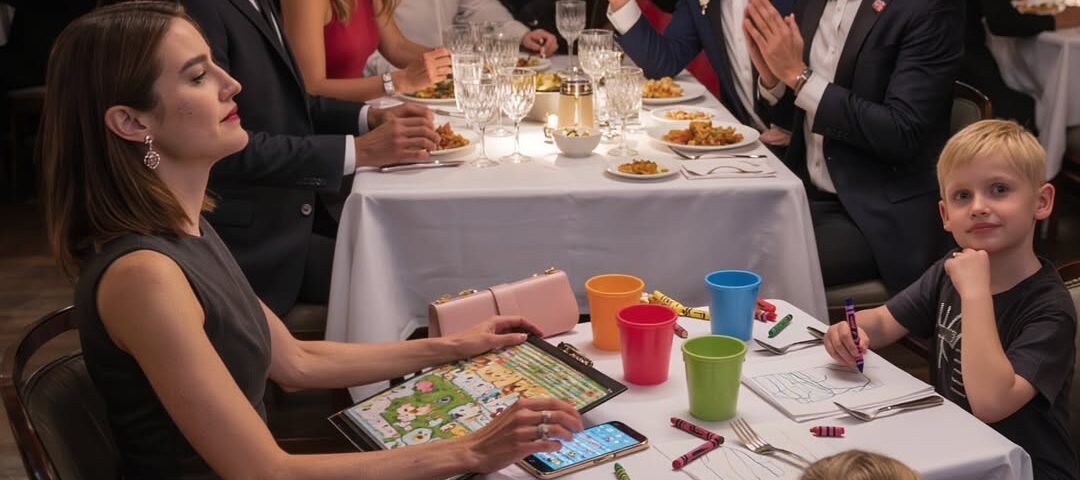
“Nancy, sweetie, you’ll be sitting over there with the little ones tonight.”
My mother’s voice was light, almost cheerful, as she gestured toward the small table wedged into the corner of the private dining room. I stood frozen in the entryway of Celestine’s, one of Portland’s most upscale restaurants, my coat still draped over my arm.
Around me, my family mingled in their finest clothes, champagne glasses already in hand. The warm lighting and elegant décor should have felt welcoming, but instead everything suddenly felt cold.
“Excuse me?” I asked, certain I had misheard.
“The children’s table, dear,” my mother repeated, adjusting the pearl necklace at her throat. “We’ve reserved the main table for the adults. And, well, since you’re not married, we thought you’d be more comfortable with the kids.”
My name is Nancy. I’m twenty-seven years old and I own a successful event planning company in Portland, Oregon. I’ve spent the last five years building my business from the ground up, working eighteen-hour days, managing million-dollar weddings, and earning recognition in my field. Last month, a prominent lifestyle magazine featured my work in a six-page spread.
I bought my own condo two years ago. I have a retirement account, health insurance I pay for myself, and a car I purchased outright.
But apparently, none of that mattered tonight.
I glanced at the corner table. My nephew Tyler, eight, was already seated there, swinging his legs and playing a game on his tablet. Next to him was my niece Sophia, who had just turned six. The table was set with plastic cups decorated with cartoon characters.
“Mom, I’m twenty-seven,” I said, keeping my voice level despite the heat rising in my chest. “I’m not a child.”
“Oh, don’t be so sensitive,” my father chimed in, approaching with a glass of scotch. “It’s just a dinner. Besides, the kids love you. You’ll have fun.”
I looked past them to the main table, elegantly set with white linens, crystal glasses, and flickering candles. My older brother Daniel sat there with his wife, Courtney, both looking smug and comfortable. My sister Bethany was already seated with her husband, Greg, laughing at something someone had said. Even my cousin Angela, who had gotten married just six months ago, had a place at the adult table with her new husband.
But not me.
“This is ridiculous,” I said quietly.
“What was that?” my mother asked, her smile tightening.
“Nothing.” I forced myself to smile back. “Where should I put my coat?”
As I walked toward the coat check, my phone buzzed in my purse. I pulled it out and saw a message from my business partner, Kelsey.
How’s the family dinner? Hope they’re finally treating you like the boss you are.
I nearly laughed out loud at the irony.
The hostess took my coat and I made my way back to the private dining room. The children’s table seemed to shrink with every step I took toward it.
Tyler looked up from his tablet and grinned.
“Aunt Nancy, are you sitting with us?”
“Looks like it, buddy,” I said, ruffling his hair as I slid into the child-sized chair.
My knees nearly hit the underside of the table.
From where I sat, I had a perfect view of the main table. Daniel was holding court, telling some story about a client at his accounting firm. Everyone laughed on cue. Bethany chimed in with an anecdote about her daughter’s ballet recital. My mother beamed at them both, her face glowing with pride.
I remembered that expression. She used to look at me that way back when I was younger—before I chose a career path she didn’t understand, before I prioritized my business over finding a husband.
“Are you okay, Aunt Nancy?” Sophia asked, tugging on my sleeve. “You look sad.”
“I’m fine, sweetheart,” I lied, turning my attention to her. “Tell me about school.”
As Sophia launched into a story about her teacher’s pet hamster, I felt my phone buzz again. Another text from Kelsey.
P.S. The Thornton wedding contract came through. Biggest client yet. We should celebrate tomorrow.
The Thornton wedding. Three hundred and fifty guests. A waterfront venue. A four-million-dollar budget. It was the kind of event that would cement my company’s reputation for years to come. I had spent months courting that client, perfecting the proposal, negotiating every detail.
But tonight, I was sitting at the children’s table because I didn’t have a ring on my finger.
A waiter approached and handed me a plastic menu with pictures on it.
“For the young lady,” he said with a condescending smile.
I stared at the menu. Chicken fingers, macaroni and cheese, a hot dog plate. At the adult table, they were being presented with leather-bound menus featuring filet mignon, pan-seared salmon, and herb-crusted lamb.
Something inside me went very still.
I looked around the room at my family, laughing and talking. Not one of them glanced in my direction. Not one of them thought there was anything wrong with this picture.
I had driven two hours to be here. I had rearranged client meetings. I had bought a new dress specifically for this dinner, and they had seated me with the children.
I pulled out my phone and opened my messages. My fingers hovered over the keyboard for a moment before I typed:
Kelsey, change of plans. I’m going to need that celebration tonight after all. I’ll explain later.
Then I stood up, smoothed down my dress, and picked up my purse.
“Where are you going?” Tyler asked.
“I just need to make a phone call, buddy,” I said softly. “I’ll be right back.”
But I wouldn’t be.
I walked past the main table without looking at anyone and headed straight for the coat check. My hands were steady as I handed the attendant my ticket, but inside my thoughts were racing.
Years of moments like this crashed over me all at once, a tidal wave of memories I had pushed down and tried to forget.
The coat check attendant returned with my jacket.
“Leaving so soon?” she asked.
“Change of plans,” I said simply.
As I slipped my arms into the sleeves, I thought about my college graduation. I had earned my degree in business administration with honors despite working two jobs to pay for it. My parents had attended the ceremony, but they had spent most of the reception talking about Daniel’s upcoming promotion at his firm.
“At least one of our children chose a stable career,” my father had said within my earshot.
I thought about the day I signed the lease on my first office space. I had called my mother, so excited I could barely speak.
“Mom, I did it. I found the perfect location for my company.”
Her response had been lukewarm at best.
“That’s nice, dear. When are you going to settle down and find a nice young man? You’re not getting any younger.”
I was twenty-four at the time.
I thought about last Christmas, when Bethany had announced she was pregnant with her second child. My mother had cried tears of joy and immediately started planning a baby shower. Two weeks later, when I told them about landing my first six-figure contract, my father had simply nodded and said, “That’s good,” before changing the subject to Daniel’s new house.
The pattern had always been there. I just hadn’t wanted to see it clearly until tonight.
I pulled out my phone and texted my mother.
Had to leave. Something came up with work. Sorry.
I didn’t wait for a response.
I walked through the restaurant’s main dining room, past couples enjoying romantic dinners and groups celebrating birthdays. Everyone looked so normal, so content. I wondered if any of them had families who dismissed their accomplishments because they didn’t fit into a predetermined mold.
The cool evening air hit my face as I stepped outside. Portland in October was beautiful, the trees just starting to turn gold and red. I had always loved this city—loved building my life here on my own terms.
But standing there on the sidewalk, I felt suddenly exhausted by the constant battle to prove my worth to people who should have valued me unconditionally.
My phone buzzed. A text from my mother.
What do you mean you left? Where did you go?
I ignored it and called Kelsey instead.
“Hey, that was fast,” she answered. “Are you done with dinner already?”
“I’m done, all right,” I said, walking toward where I had parked my car. “Long story. Are you free?”
“Always. Want to meet at Bruno’s? We can grab a bottle of wine and you can tell me everything.”
“Perfect. See you in twenty.”
As I drove through the city streets, my phone kept buzzing with incoming messages. I didn’t look at them. I knew what they would say. My mother would be confused, maybe even concerned. My father would be annoyed. My siblings probably wouldn’t even notice I was gone until dessert was served.
Bruno’s Wine Bar was a cozy spot Kelsey and I had discovered during our early days of building the business. We had spent countless nights there planning strategies, celebrating small victories, and commiserating over difficult clients.
The owner, Mauricio, greeted me with a warm smile as I entered.
“Nancy, good to see you. Your friend is already here,” he said, gesturing toward our usual corner booth.
Kelsey stood up as I approached, her face immediately registering concern.
“Okay, spill. What happened?”
I slid into the booth and let out a long breath.
“They sat me at the children’s table,” I said.
“What?”
“My family’s fancy dinner. They literally seated me with my eight-year-old nephew and six-year-old niece. Plastic cups, kids’ menu, the whole thing. Because I’m not married.”
Kelsey’s mouth fell open.
“You’re joking.”
“I wish I were.”
She was quiet for a moment, processing this. Then she reached across the table and squeezed my hand.
“Nancy, that’s insane. You know that, right? That’s completely insane.”
“I know.”
“Did you say anything?”
“I left.”
“Good.”
Mauricio appeared with a bottle of wine, apparently having sensed the mood.
“On the house, ladies. You both look like you need it,” he said.
As he poured, my phone buzzed again and again and again. I pulled it out and looked at the screen.
Seven missed calls. Fifteen text messages. The notifications kept coming.
“Wow,” Kelsey said, watching the phone light up repeatedly. “They noticed you’re gone.”
I scrolled through the messages.
My mother: Nancy, what’s going on? Where are you?
My father: This is very rude. We’re all waiting for you.
Daniel: Mom’s freaking out. What did you do?
Bethany: Can you please just come back? You’re ruining dinner.
“Ruining dinner,” I repeated, my voice flat. That was rich.
“What are you going to do?” Kelsey asked.
I stared at my phone, watching the missed calls pile up.
“Twenty… twenty-five.”
My mother had called nine times in the last ten minutes.
Part of me wanted to answer, to explain, to make them understand how much they had hurt me. But a bigger part of me knew it wouldn’t matter. They would find a way to make this my fault. I was too sensitive. I didn’t understand. It was just a joke. I was overreacting.
I had spent twenty-seven years trying to earn their respect, their approval, their recognition.
And tonight, they had shown me exactly what they thought I was worth.
I turned my phone face down on the table.
“I’m not answering,” I said quietly.
Kelsey raised her glass.
“Good. Let them sweat.”
The wine was smooth and rich, but I could barely taste it. My mind kept replaying the moment my mother had casually directed me to the children’s table as if it were the most natural thing in the world, as if I were still a kid who needed to be managed and organized according to her rules.
“Tell me something,” Kelsey said, swirling her wine. “Has it always been like this?”
I thought about her question.
“Not always. When I was younger, things were okay. But once Daniel got married, something shifted. Suddenly there was this divide between the ‘real adults’ and everyone else, and I ended up on the wrong side of it.”
“Because you chose your career over a husband.”
“Exactly.” I took another sip of wine. “It’s not like I’m against marriage. I’m just not going to settle for someone who doesn’t respect what I’ve built. My business is important to me. It’s mine. I created it from nothing.”
“And you’re incredible at it,” Kelsey added. “Nancy, you’ve built something amazing. We’ve grown thirty percent this year alone. We have a waitlist of clients. You’re twenty-seven years old and you’re running a thriving company. That’s not nothing.”
“Try telling my parents that.”
My phone buzzed again. I glanced at it despite myself.
A text from my mother.
Nancy Catherine, this is unacceptable. Call me immediately.
The use of my middle name made me smile bitterly. That was her signature move, saved for when she was truly angry.
“How many calls now?” Kelsey asked.
“Thirty-two.”
“Jesus.”
“I know.”
Another text came through, this time from Bethany.
Mom is crying. Dad is furious. Are you seriously not coming back?
I showed Kelsey the message. She read it and shook her head.
“They’re trying to guilt you into coming back so they don’t have to face the fact that they messed up,” she said.
“Pretty much.”
“Are you going to go back?”
I looked at my phone, at the steady stream of notifications that wouldn’t stop. Part of me felt guilty. I had been raised to be polite, to keep the peace, to not make waves. Walking out of that dinner went against every instinct my parents had instilled in me from childhood.
But another part of me felt something I hadn’t felt in a long time.
Free.
“No,” I said firmly. “I’m not going back. Not tonight. And maybe not for a while.”
Kelsey smiled.
“Good. They need to understand that you’re not going to accept being treated like that anymore.”
“I just wonder how long I can hold out,” I admitted. “You know how my family is. They’ll keep calling. They’ll show up at my office. My mother will leave voicemails about how I’ve hurt her feelings. They’ll find a way to make me the bad guy in all this.”
“Let them try,” Kelsey said. “Nancy, you’ve spent years trying to prove yourself to them. When are you going to accept that it’s their problem, not yours?”
Her words hit me harder than I expected. She was right. I had spent so much time trying to be enough for my parents, to make them see my success, to earn their pride.
But what if that was impossible? What if nothing I did would ever be good enough because it didn’t fit their narrow definition of success?
My phone rang again. This time it was my father.
“Forty-three calls,” I said, looking at the screen.
“That’s commitment,” Kelsey said dryly. “Or panic.”
“Probably both.”
I declined the call and opened my messages. There was a new one from Daniel.
You’re being incredibly selfish. This was supposed to be a nice family dinner and you’ve made it all about you.
I read it aloud to Kelsey, who actually laughed.
“The irony,” she said. “They make a whole seating arrangement about how you don’t measure up, and somehow you’re the selfish one.”
“That’s my family for you.”
“Nancy, can I ask you something?” Kelsey set down her glass and looked at me seriously. “What would you tell a client if they were in this situation? If they came to you and said their family was treating them this way?”
I thought about it.
“I’d tell them they deserve better. That they shouldn’t accept being disrespected, no matter who it’s coming from.”
“Exactly. So why are you any different?”
She had a point. In my business, I advised clients all the time about setting boundaries, about knowing their worth, about not accepting less than they deserved. I helped people plan the most important days of their lives, making sure every detail reflected their value and vision.
But somehow, when it came to my own family, I had accepted scraps.
Not anymore.
“You’re right,” I said. “I’m done.”
“Done with what?”
“Done accepting this. Done trying to prove myself to people who will never value what I’ve accomplished. Done shrinking myself to make them comfortable.”
Kelsey grinned.
“There she is. There’s the Nancy I know.”
My phone buzzed again. Another call from my mother. I looked at it for a long moment, then made a decision.
I turned the phone completely off.
“What are you doing?” Kelsey asked.
“Taking a break,” I said. “From all of it. They can wait.”
“How long are you going to make them wait?”
“As long as it takes for them to understand that I’m not a child anymore. That I won’t be treated like one. That my life and my choices have value, even if they don’t understand them.”
Mauricio appeared at our table again.
“How’s the wine, ladies?”
“Perfect,” I said, and I meant it.
“For the first time all evening, I felt like I could breathe.”
“Another bottle?” he asked with a knowing smile.
“Absolutely,” I said.
As he walked away, Kelsey raised her glass.
“To standing up for yourself.”
“To standing up for myself,” I echoed.
We clinked glasses and I took a long drink, feeling the warmth spread through me. My phone sat dark and silent on the table, and I felt no urge to turn it back on.
Let them wonder. Let them panic. Let them finally understand what it felt like to be dismissed and ignored.
Tomorrow would bring its own challenges. But tonight, I was going to enjoy my freedom.
I woke up the next morning with a slight headache and a sense of resolve I hadn’t felt in years. Sunlight streamed through the windows of my condo, and for a moment I just lay there, staring at the ceiling, replaying the previous night’s events.
My phone was still off. I had left it that way intentionally, needing the silence, needing the space. But I knew I couldn’t avoid reality forever. Eventually, I would have to turn it back on and face whatever storm was waiting.
I made coffee—strong and black—and sat at my kitchen counter with my laptop. Work had always been my refuge, and today was no exception. I pulled up the Thornton wedding file and lost myself in the details: color schemes, vendor contracts, timeline adjustments.
This was something I understood, something I was good at, something that didn’t require me to shrink or apologize for who I was.
Around ten in the morning, I finally turned my phone back on.
The notifications exploded across my screen like fireworks.
Seventy-three missed calls. One hundred nineteen text messages. Fifteen voicemails.
My battery had died at some point during the night, which meant these had accumulated over hours.
I scrolled through them, my coffee growing cold beside me.
My mother: Nancy, I don’t understand what’s happening. Please call me. I’m worried sick.
My father: This behavior is unacceptable. You owe your mother an apology.
Daniel: Way to ruin dinner for everyone. Real mature.
Bethany: I can’t believe you just left like that. Mom cried all night.
And then, buried in the middle of all the anger and guilt-tripping, there was one message that made me pause.
It was from my aunt Helen, my mother’s sister, sent around midnight.
Nancy, I heard what happened at dinner. I just want you to know that I understand why you left. Your mother called me upset, but when she told me about the seating arrangement, I told her she was wrong. You’re a grown woman with a successful career. You didn’t deserve that. Call me if you need to talk.
I stared at that message for a long time.
Aunt Helen had always been different from the rest of my family. More independent. Less concerned with appearances. She had never married, had built a career as a freelance photographer, and had traveled the world on her own terms. My mother often spoke about her with a mixture of admiration and pity, as if Helen’s life was somehow incomplete without a husband and children.
I saved her message and kept scrolling. More of the same from everyone else—accusation, guilt, anger. No one seemed to understand why I had left.
Or maybe they did understand and just didn’t care.
Then I saw the most recent message, sent just twenty minutes ago. It was from my mother, and the tone had shifted.
Nancy, your father and I have been discussing the situation. We think you may have overreacted, but we’re willing to overlook it if you apologize. We’re having Sunday brunch at the house this weekend. Your siblings will be there. We expect you to come and make things right with the family.
I read it three times, feeling my jaw clench tighter with each reading.
They expected me to apologize. They thought I had overreacted. They were willing to overlook it—as if they were doing me some grand favor.
I set my phone down carefully, afraid that if I held it any longer, I might throw it across the room.
My laptop dinged with an incoming video call. It was Kelsey.
“Morning,” she said when I answered. “How are you feeling?”
“Like I’m living in an alternate reality,” I said. “Did you know my family expects me to apologize to them?”
“What?”
I turned my phone around to show her the message. Kelsey’s face went through several expressions as she read it—disbelief, anger, and finally something that looked like determination.
“You’re not actually considering it, are you?” she asked.
“No. Absolutely not. But I need to figure out how to respond.”
“Easy. You don’t.”
“Kelsey—”
“Nancy, I’m serious. You’ve spent your whole life responding to their demands, jumping when they say jump, trying to earn approval they’ll never give you. What if you just stopped? Stopped responding. Stopped playing their game. They want you to come to Sunday brunch so they can put you back in your place, make you apologize for having boundaries, and reassert their control. What if you just didn’t show up?”
I thought about it. The idea was both terrifying and exhilarating.
“They’ll lose their minds,” I said.
“Good. Let them. But Nancy, what’s the worst that can happen? They get angry? They already are. They stop talking to you? From what you’ve told me, that might actually be a relief. They cut you out of the family? Sweetie, they already did that when they sat you at the children’s table.”
Her words hit me like a physical blow because they were true. They had already shown me exactly where I stood in the family hierarchy.
I was less than. I was other. I was acceptable only when I conformed to their expectations.
“You’re right,” I said quietly.
“Of course I’m right. I’m always right. You know this.”
Despite everything, I smiled.
“What would I do without you?”
“Probably still be sitting at that children’s table eating chicken fingers and wondering why you feel so empty inside.”
The image made me laugh even though it hurt.
“So what do I do?” I asked.
“You live your life. You focus on your business. You spend time with people who actually value you. And you let your family figure out that you’re not going to dance to their tune anymore.”
“They won’t just let it go.”
“Probably not. But that’s their problem, not yours.”
After we ended the call, I sat at my kitchen counter for a long time, thinking. Then I picked up my phone and typed a response to my mother’s message.
I won’t be coming to Sunday brunch. I need some space to think about things. I’ll reach out when I’m ready.
My finger hovered over the send button for several seconds. This felt like crossing a line, like stepping off a cliff with no idea where I would land.
I pressed send.
The response came within thirty seconds.
What do you mean you need space? Space from what? We’re your family. You don’t get to just decide you need space from family.
Then another message.
Nancy, this is ridiculous. Stop being so dramatic.
And another.
Your father is very disappointed in you.
I watched the messages roll in, one after another, each one trying to pull me back, to make me doubt myself, to restore the old dynamic where I apologized and accommodated and made myself smaller.
But something had shifted inside me.
I thought about what Kelsey had said, about what Aunt Helen had written, about the way I had felt sitting at that children’s table with plastic cups and a kids’ menu.
I turned off my phone again and went back to work.
The week that followed was surreal. I threw myself into work with an intensity that surprised even me. The Thornton wedding required constant attention, and I was grateful for the distraction. Kelsey and I met with vendors, toured venues, and refined every detail until it was perfect.
In the world of event planning, I had control. I had respect. People valued my expertise and trusted my judgment. It was everything my family had never given me.
On Wednesday afternoon, as I was reviewing floral arrangements with a vendor, my office phone rang. My assistant, Sophie, knocked on the door.
“Nancy, your mother is on line two. She says it’s urgent.”
I looked at the phone, then back at Sophie.
“Tell her I’m with a client and I’ll call her back.”
“She says she’ll wait.”
“Tell her I’ll call her back when I have time.”
Sophie nodded and closed the door. Through the glass, I could see her relaying the message. A minute later, my cell phone started ringing. I declined the call and turned my attention back to the vendor.
“Sorry about that,” I said. “Now, about the centerpieces…”
But it was hard to concentrate. My mother called three more times during that meeting.
When the vendor left, I checked my messages. My mother had left two voicemails, both increasingly frantic. My father had texted, Your mother is very upset. This has gone on long enough. Call her back.
Daniel had sent a message too.
What is your problem? Just call Mom and stop being so childish.
I stared at that message for a long time.
Childish. They still saw me as a child. Even as I ran a successful business, even as I managed projects worth hundreds of thousands of dollars, even as I employed five people and had built something significant from nothing.
My phone rang again. This time it was Aunt Helen.
I answered.
“Hey, Nancy.”
“Hi.”
“I hope I’m not catching you at a bad time.”
“Not at all. How are you?”
“I’m fine, but I wanted to check in on you. Your mother called me last night. She’s… well, she’s very worked up.”
“I can imagine.”
“She told me you refused to come to Sunday brunch, that you’re not returning her calls.”
I waited for the lecture, the gentle scolding about family obligations and keeping the peace.
Instead, Helen said, “Good for you.”
I nearly dropped my phone.
“What?”
“Good for you,” she repeated. “Nancy, I’ve watched your mother treat you like you’re less than your whole life. It was wrong when you were younger and it’s wrong now. What she did at that dinner was inexcusable.”
“She doesn’t see it that way.”
“Of course she doesn’t. Your mother has very specific ideas about how life should look, and anything that doesn’t fit that picture makes her uncomfortable. But that’s her issue, not yours.”
I felt tears prick my eyes.
“Thank you for saying that.”
“I’m saying it because it’s true. Listen, I know your mother is my sister and I love her, but that doesn’t mean I agree with how she’s treated you. You’ve built an incredible life for yourself. You should be proud.”
“I am proud. I just wish they could see it.”
“They might eventually, or they might not. But you can’t keep sacrificing yourself hoping they’ll change.”
After we hung up, I sat in my office for a while, just breathing. Aunt Helen’s words had cracked something open inside me, something I had kept locked away for years—the realization that maybe, just maybe, the problem wasn’t me.
That evening, as I was leaving the office, Sophie stopped me.
“Nancy, before you go, your mother called again. Four times, actually. And your father called twice. They both said it was extremely important.”
“Did they say what it was about?”
“Your mother said she needs to speak with you about a family emergency.”
My stomach dropped.
“Did she say what kind of emergency?”
“No. Just that it was urgent and you needed to call immediately.”
I pulled out my phone with shaking hands. A family emergency. What if something had happened to someone? What if my father was sick? What if Bethany or Daniel had been in an accident?
I dialed my mother’s number.
She answered on the first ring.
“Nancy, finally. I’ve been trying to reach you for hours.”
“Sophie said there was a family emergency. What happened? Is everyone okay?”
“Well, no. Everyone is not okay. Your father and I are extremely upset, your siblings are upset, and this whole situation is causing problems for everyone.”
I felt the fear drain out of me, replaced by a slow-burning anger.
“That’s the emergency?” I asked. “That everyone is upset?”
“Yes, Nancy. This has gone on long enough. Whatever point you were trying to make, you’ve made it. Now it’s time to stop being difficult and come home for brunch on Sunday.”
“Mom, I told you I need space right now.”
“Space. Space from what? We’re your family. And frankly, I think you’re being incredibly selfish. Do you know how embarrassing this is? People are asking questions. They want to know where you were at dinner, why you left, why you’re not coming to brunch. What am I supposed to tell them?”
“How about the truth? That you seated me at the children’s table and I decided I deserved better.”
There was a sharp intake of breath.
“Is that what this is about? That silly seating arrangement? Nancy, you’re being ridiculous. It wasn’t personal.”
“Mom, you gave me a kids’ menu with chicken fingers on it. You made me sit with an eight-year-old and a six-year-old while every other adult in the family sat at the main table. How was that not personal?”
“You’re blowing this completely out of proportion. It was just a practical decision. The table could only fit so many people. And since you’re not married, we thought—”
“That I was less of an adult than everyone else?”
“That’s not what I said.”
“But it’s what you meant.”
My mother’s voice turned cold.
“I don’t appreciate your tone. I’m your mother, and you need to show me some respect.”
“Respect goes both ways, Mom.”
“I’m giving you until Sunday to calm down and reconsider. If you don’t show up for brunch, there will be consequences.”
“What kind of consequences?”
“Your father and I have been discussing it. If you can’t be part of this family, then maybe you shouldn’t be included in family matters at all. That means holidays, gatherings, everything. You’ll be on your own.”
The threat hung in the air between us. She was trying to scare me, to make me panic at the thought of being cut off from the family.
A year ago, even a month ago, it might have worked.
But after sitting at that children’s table, after a week of relentless calls and manipulation, after years of feeling less than, something inside me had changed.
“If that’s how you want it, then okay,” I said quietly.
“What?”
“If that’s your decision, I’ll accept it. But I’m not coming to brunch to apologize for having boundaries, Mom.”
I hung up.
Sunday morning arrived gray and drizzly—typical Portland weather. I woke up early and went for a run through my neighborhood, letting the rain wash over me. My mind was clearer than it had been in weeks. I had made my choice and I was prepared to live with whatever consequences came next.
When I got back to my condo, I showered and made breakfast. I was just sitting down with coffee and toast when my phone rang. It was Kelsey.
“Hey, aren’t you supposed to be at brunch right now?” she asked.
“Nope. I’m at home watching the rain and feeling surprisingly peaceful.”
“You didn’t go?”
“I didn’t go.”
“And how do you feel about that?”
“Honestly? Good. Really good.”
“That’s my girl. Listen, I know today might be tough, so I wanted to let you know I’m here if you need anything. We could grab lunch later, or I could come over with wine and trashy movies.”
“Thanks, Kels. I’ll let you know.”
After we hung up, I settled onto my couch with my laptop to do some work, but I found it hard to concentrate. I kept wondering what was happening at my parents’ house. Were they sitting around the brunch table right now talking about me? Were my siblings there, shaking their heads at my absence? Was my mother playing the victim, telling everyone how terrible I was being?
Around noon, my phone started ringing. First Daniel, then Bethany, then my father. I let them all go to voicemail. Then my mother called and called again and again. I turned my phone to silent and set it face down on the coffee table.
Two hours later, I heard a knock at my door.
I looked through the peephole and my stomach sank. My mother stood in the hallway, her face tight with anger. Behind her was my father, looking stern and uncomfortable.
I took a deep breath and opened the door.
“Hi, Mom. Dad.”
“We need to talk,” my mother said, pushing past me into the condo.
My father followed, closing the door behind him.
“You could have called first,” I said.
“I did call. Many times. You didn’t answer.”
“I was taking some space. Like I said I needed.”
“This has gone far enough, Nancy.” My father’s voice was hard. “You’re acting like a spoiled child.”
The irony of him calling me a child wasn’t lost on me.
“I’m acting like someone who has boundaries,” I said calmly. “There’s a difference.”
“Boundaries?” My mother laughed, but there was no humor in it. “Is that what you call disrespecting your family? Humiliating us in front of everyone?”
“I disrespected you? Mom, you sat me at the children’s table.”
“Oh, for heaven’s sake. We’re back to that. It was just a seating arrangement.”
“It was a message. A very clear message that you don’t see me as an equal to my siblings.”
“That’s not true.”
“Isn’t it? When was the last time you asked about my business? When was the last time you celebrated one of my achievements the way you celebrate everything Daniel and Bethany do?”
My mother’s face flushed.
“We’re very proud of you,” she said weakly.
“No, you’re not. You’re confused by me. You’re embarrassed that I’m not married. You wish I had chosen a different, more traditional path like Bethany did. But I didn’t. And that doesn’t make my life less valuable.”
“We never said your life was less valuable.”
“You didn’t have to say it. You showed it. You’ve been showing it for years. But I was too busy trying to earn your approval to see it clearly.”
My father stepped forward.
“Nancy, you’re blowing this out of proportion. All we did was make a practical decision about seating, and you’ve turned it into this huge drama.”
“A practical decision,” I repeated. “Every other adult in the family sat at the main table. Every single one. The only person who didn’t was me. And the reason given was that I’m not married.”
“Well, you’re not,” my father said.
“And that makes me less of an adult?”
He shifted uncomfortably.
“That’s not what I’m saying.”
“Then what are you saying?”
Neither of them answered.
I took a deep breath.
“Look, I love you both. But I can’t keep doing this. I can’t keep shrinking myself to fit into the box you want to put me in. I’ve built a good life. I have a successful business that I’m proud of. I have friends who respect me and support me, and I need family who can do the same.”
“We do respect you,” my mother said, but her voice lacked conviction.
“No, you don’t. If you respected me, you would have seated me at the adult table. If you respected me, you wouldn’t have expected me to apologize for leaving a situation that was humiliating. If you respected me, you would understand why I need space right now.”
“So what are you saying?” my father asked. “That you’re done with us?”
“I’m saying I need time to figure out what a healthy relationship with you looks like. And that might mean not seeing you for a while.”
My mother’s eyes filled with tears.
“You can’t mean that.”
“I do mean it. I’ve spent my whole life trying to be enough for you, and I’m tired. I’m tired of feeling like I’m failing just by being who I am.”
“This is ridiculous,” my father said. “You’re our daughter. You don’t just get to cut us off.”
“I’m not cutting you off. I’m setting a boundary. There’s a difference.”
“It doesn’t feel different from where we’re standing,” my mother said.
“I know. And I’m sorry that it hurts. But I have to do what’s best for me.”
They stood there for a moment, struggling for words. Finally, my mother spoke, her voice trembling.
“If this is really what you want, then fine. But don’t expect us to come crawling back when you change your mind.”
“I don’t expect anything,” I said quietly. “That’s the whole point.”
They left without another word. I watched through the window as they got into their car and drove away. Then I sat down on my couch and let myself cry.
It wasn’t tears of regret or uncertainty. It was grief for the family I had wanted but never had, mixed with relief that I had finally stopped pretending.
My phone buzzed with a text. It was from Aunt Helen.
Your mother just called me very upset. I told her she needed to respect your boundaries. I’m proud of you, Nancy. This took courage.
I typed back: Thank you. That means more than you know.
Another text came in, this time from Kelsey.
Still up for that lunch? I have a feeling you might need it.
I smiled through my tears.
Yes. Give me an hour.
Take your time. I’m not going anywhere.
I set down my phone and looked around my condo at the life I had built for myself. It wasn’t the life my parents had wanted for me, but it was mine.
And for the first time in a long time, that felt like enough.
Three weeks passed in relative peace. I threw myself into work with renewed energy, and the Thornton wedding was shaping up to be the event of the season. Kelsey and I met with the bride and groom several times, refining details, adjusting timelines, and ensuring everything would be perfect.
During those weeks, my family continued their attempts to contact me, but with decreasing frequency. The calls went from daily to every few days and then to once a week. The messages shifted from angry to confused to something that almost resembled concern, though it was hard to tell if they were concerned about me or about how my absence reflected on them.
I didn’t respond to any of it.
Aunt Helen checked in regularly, offering support and updates on family drama. Apparently, my absence had created quite a stir. My mother told people I was busy with work. My siblings told their friends I was “going through a phase.” No one seemed willing to admit the real reason I had stopped coming around.
One Thursday afternoon, I was in the office reviewing contracts when Sophie knocked on my door.
“Nancy, there’s someone here to see you. She doesn’t have an appointment, but she says it’s important.”
“Who is it?”
“She said her name is Courtney. Your brother Daniel’s wife.”
I hadn’t heard from her directly since the dinner incident. I considered telling Sophie I was busy, but curiosity got the better of me.
“Send her in,” I said.
Courtney entered looking uncomfortable, clutching her purse like a shield. She was dressed impeccably, as always, her blonde hair perfectly styled, but there was something off in her expression.
“Nancy, thank you for seeing me,” she said, sitting down without being invited.
“What can I do for you, Courtney?”
She fidgeted with her purse strap.
“I wanted to talk to you about what happened at the dinner.”
“Okay.”
“Look, I know you and your family have been having issues, and Daniel tells me you’re being difficult, but I wanted to hear your side of things.”
I leaned back in my chair.
“You want to hear my side?”
“Yes, because honestly, the way your mother tells it, you just got upset over nothing and stormed out. But I’ve known you for five years, Nancy, and that doesn’t sound like you.”
I studied her carefully.
“What does Daniel say about it?”
“He says you’re being dramatic and childish, that you’re punishing everyone because of a silly seating arrangement.”
“And what do you think?”
Courtney was quiet for a moment. Then she said, “I think you got seated at the children’s table while the rest of us sat with the adults, and I think that was messed up.”
I raised my eyebrows.
“You noticed?”
“Of course I noticed. I thought it was weird, but your mother insisted that was how she wanted it. She said something about you being more comfortable with the kids since you’re single.” Courtney paused. “Nancy, I didn’t say anything at the time, and I should have. That’s part of why I’m here. I wanted to apologize.”
“You’re apologizing?”
“Yeah. I should have stood up for you. I should have said something, but I didn’t, and I feel terrible about it.”
I wasn’t sure what to say. Of all the people I expected to receive an apology from, Courtney had not been on the list.
“Thank you,” I finally said. “I appreciate that.”
“Your mother has been calling me,” Courtney continued. “She wants me to convince you to come to Thanksgiving. She says if you don’t come, it will ruin the holiday for everyone.”
“Thanksgiving is two months away.”
“I know, but she’s already planning and panicking. She wants everything to be perfect, and your absence is throwing off her plans.”
“Let me guess,” I said. “She wants you to talk me into coming back so she doesn’t have to admit she was wrong.”
Courtney smiled sadly.
“Pretty much. But Nancy, I’m not here to convince you of anything. I’m here because I think you deserve to know what’s really going on.”
“What do you mean?”
“Your mother has been calling everyone—family, friends, distant relatives, even people from her church. She’s telling them this whole story about how you’ve abandoned the family, how you’re being selfish and hurtful. She’s painting herself as the victim.”
I felt a familiar anger stirring.
“Of course she is.”
“But here’s the thing. Not everyone is buying it. My own mother asked me what really happened. And when I told her about the children’s table, she was horrified. She said your mother was out of line.”
“Really?”
“Yeah. And I’ve heard similar things from other people. Your mother thinks she has everyone on her side, but she doesn’t. People are starting to ask questions.”
This was interesting. I had assumed my family would close ranks, present a united front, and make me out to be the problem. The idea that some people were actually questioning the narrative gave me a small sense of validation.
“Why are you telling me this?” I asked.
“Because you deserve to know the truth. And because I think what your mother did was wrong. You’re not the problem here, Nancy. You’ve never been the problem.”
After Courtney left, I sat in my office for a long time, thinking. My mother’s attempts to control the narrative didn’t surprise me, but the fact that it wasn’t working completely did. Maybe people weren’t as blind as I thought. Maybe some of them could see through the performance.
My phone buzzed with a text from Kelsey.
The Thornton bride just called. She wants to add another 50 guests. Can we make it work?
I smiled and texted back.
Absolutely. Let’s schedule a meeting.
Work. This was something I understood, something I could control. And right now, that felt like exactly what I needed.
The Thornton wedding arrived on a perfect October evening. The venue, a historic mansion overlooking the Willamette River, was transformed into something magical. String lights hung from every tree. Candles flickered on tables draped in silk, and flowers cascaded from every surface.
It was the culmination of months of planning, and as I walked through the space doing final checks, I felt a deep sense of pride.
This was what I was good at. This was what I had built.
The ceremony went off without a hitch. The bride looked radiant. The groom cried happy tears. Their 350 guests witnessed a moment of pure joy.
During the reception, as I coordinated with the catering staff and ensured the timeline stayed on track, I noticed several guests approaching me.
“Are you Nancy?” one woman asked. “The wedding planner?”
“Yes, that’s me.”
“This is absolutely stunning. Do you have a card? My daughter is getting engaged next month, and we want the best.”
By the end of the night, I had handed out twenty-seven business cards and scheduled six consultations.
Kelsey was beaming as we packed up our supplies.
“Nancy, this was incredible. The bride’s mother told me this was the best wedding she’s ever attended. We’re going to be booked solid for the next year.”
“We did good work,” I said, exhausted but happy.
“We did great work. And you did it while dealing with all that family drama. I’m impressed.”
As I drove home that night, I felt content in a way I hadn’t felt in years. My life was mine. My success was mine. And I didn’t need anyone’s validation to know my worth.
The next morning, I woke to my phone ringing. It was an unknown number, which I normally wouldn’t answer, but something made me pick up.
“Hello?”
“Nancy, it’s Caroline Thornton. The bride.”
My heart skipped.
“Caroline, hi. Is everything okay?”
“Everything is perfect. More than perfect. Nancy, I just wanted to call and thank you personally. Last night was like a dream. You made everything so beautiful and so seamless. It was exactly what we hoped for.”
“I’m so glad. It was an honor to be part of your day.”
“I’ve already told everyone I know about you. In fact, I’m having brunch with some friends this morning, and they’re all asking for your information. I hope you don’t mind.”
“Mind? Not at all. Thank you, Caroline.”
After we hung up, I lay in bed smiling. This was the reward. Not just the money or the bookings, but knowing I had created something meaningful, something that brought joy to people’s lives.
My phone buzzed with a text. It was from a number I didn’t recognize.
Hi Nancy, this is Patricia Thornton, Caroline’s mother. I wanted to reach out about planning my younger daughter’s wedding. Would you be available for a consultation?
Before I could respond, another text came through from a different number.
Nancy, this is Denise Howard. I attended the Thornton wedding last night. I’m on the board of the Portland Arts Foundation, and we’re looking for an event planner for our annual gala. Are you interested in discussing this opportunity?
And then another.
Hi Nancy, this is Jessica. Caroline gave me your number. I’m getting married next June and would love to work with you.
I stared at my phone as the messages kept coming. Within an hour, I had nine new inquiries. By the end of the day, it was fifteen.
Kelsey called me that evening, laughing.
“Nancy, our email inbox is exploding. Have you checked it?”
“I’ve been getting texts all day.”
“Well, add emails to that. The Thornton wedding is apparently the talk of Portland society. Everyone wants to know who planned it.”
“This is insane.”
“This is success, Nancy. This is what happens when you’re brilliant at what you do and you finally get the recognition you deserve.”
That week was a whirlwind. I met with potential clients, gave presentations to corporate event planners, and even did an interview with a local magazine about my business. Every meeting ended with a contract or a solid lead. My calendar filled up months in advance.
On Friday evening, as I was leaving a consultation with a tech company that wanted me to plan their annual retreat, my phone rang.
It was my mother.
I stared at the screen for a moment, then answered.
“Hi, Mom.”
“Nancy.” Her voice was stiff. “I’ve been trying to reach you.”
“I’ve been busy with work.”
“Yes, I heard. Apparently, you planned some big wedding that everyone is talking about.”
“The Thornton wedding. Yes.”
There was a pause.
“I saw the photos online. It looked very nice.”
“Thank you.”
Another pause.
“Nancy, your father and I have been discussing things. We think maybe we overreacted about the whole dinner situation.”
I waited.
“We’re willing to move past it if you are. Thanksgiving is coming up, and it would be nice if we could all be together as a family.”
“Move past it,” I repeated slowly.
“Yes. We can forget about all this unpleasantness and go back to normal.”
“What about an apology?” I asked.
“An apology?”
“Yes. For seating me at the children’s table. For dismissing my feelings. For threatening to cut me off when I tried to set boundaries.”
My mother’s tone hardened.
“I’m not going to apologize for trying to organize a family dinner. You’re the one who made this into a big deal.”
“Then I guess we don’t have anything more to discuss.”
“Nancy—”
I hung up.
Thanksgiving morning arrived cold and clear. I woke up early and went for a run, enjoying the quiet streets and the way my breath fogged in the crisp air. When I got back to my condo, I showered and put on comfortable clothes—jeans and a soft sweater, something I would never have been allowed to wear to one of my mother’s formal holiday dinners.
Kelsey was hosting a Friendsgiving at her apartment, and she had invited me weeks ago.
“For everyone who doesn’t want to deal with family drama,” she had said with a grin.
I had accepted immediately.
As I was getting ready, my phone buzzed with messages.
The first was from Aunt Helen.
Happy Thanksgiving, Nancy. I’m proud of you for standing your ground. Enjoy your day.
The second was from Courtney.
Happy Thanksgiving. Just so you know, your mom has been complaining all morning about how you’re ruining the holiday by not being here. Daniel told her to drop it. Things are tense. Hope you’re having a better day than we are.
I smiled at that message.
Then came one from my mother.
Since you’ve decided not to be part of this family, I suppose there’s no point in wishing you a happy Thanksgiving. I hope you’re satisfied with your choices.
I deleted it without responding.
The Friendsgiving was exactly what I needed. Kelsey had invited a dozen people—colleagues, friends, and a few clients who had become friends. The atmosphere was warm and relaxed, filled with laughter and good food. No one asked why I wasn’t with my family. No one made me feel like I was missing out on something essential.
During dinner, as we went around the table sharing what we were thankful for, I said, “I’m thankful for friends who accept me as I am, for a career that fulfills me, and for finally learning that I don’t need to shrink myself to fit into someone else’s expectations.”
Kelsey raised her glass.
“To Nancy, who is absolutely killing it at life.”
Everyone clinked glasses, and I felt a warmth spread through me that had nothing to do with the wine.
Later that evening, as I was helping clean up, my phone rang. It was a number I didn’t recognize, but the area code was local.
“Hello?”
“Nancy, this is Gregory Thornton. Caroline’s father.”
My heart raced.
“Mr. Thornton, hello. How are you?”
“I’m wonderful, thanks to you. Listen, I’m calling because I want to offer you an opportunity. I’m on the board of several companies here in Portland, and we’re always looking for top-tier event planners for corporate functions. Your work at my daughter’s wedding was exceptional. I’d like to bring you in to pitch for several upcoming events. We’re talking significant contracts.”
My heart picked up.
“I would be very interested in that,” I said.
“Excellent. I’ll have my assistant reach out to schedule a meeting. Nancy, you’re going to do very well in this city. Mark my words.”
After we hung up, I just stood there in Kelsey’s kitchen, phone in hand, trying to process what had just happened.
“Good news?” Kelsey asked, noticing my expression.
“Potentially life-changing news.”
“Tell me.”
I explained about Gregory Thornton’s call. Kelsey squealed and hugged me.
“Nancy, this is huge. Corporate events are where the real money is.”
“I know.”
“Your family has no idea what they’re missing out on, do they?”
“Not a clue.”
The next few weeks were transformative. I met with Gregory Thornton and his associates, presented proposals, and landed three major corporate contracts. My business grew exponentially. I hired two more employees and started looking for a larger office space.
One December afternoon, as I was reviewing contracts in my new office, Sophie knocked on the door.
“Nancy, your mother is here. Should I send her in?”
My mother. Here.
I took a breath.
“Yes. Send her in.”
My mother entered, looking around at the expanded space, the new furniture, the large windows overlooking downtown Portland. Her expression was hard to read.
“This is quite an upgrade,” she said.
“Business has been good.”
“So I’ve heard.”
She sat down without being invited.
“Nancy, I wanted to talk to you about Christmas.”
“I’m not coming to Christmas, Mom.”
“I figured as much, but I wanted you to know that your absence is affecting the whole family. Your siblings’ children keep asking where Aunt Nancy is. Daniel and Bethany are upset. Your father barely speaks anymore.”
“And whose fault is that?” I asked.
My mother’s jaw tightened.
“You’re being very selfish.”
“No, I’m being healthy. There’s a difference.”
“You’re throwing away your family over one small incident.”
“It wasn’t one small incident, Mom. It was years of being treated like I didn’t matter because I didn’t fit your ideal. The dinner was just the moment I finally saw it clearly.”
“So that’s it? You’re just done with us?”
“I’m done accepting less than I deserve. If you can’t respect me and my choices, then yes, I’m done.”
My mother stood up.
“You’ll regret this,” she said.
“Maybe,” I replied. “But I doubt it.”
She left without another word.
Through my office window, I watched her get into her car and drive away. Then I turned back to my desk, to the contracts and proposals and plans for my growing business.
My phone buzzed. A text from Kelsey.
Brunch tomorrow to celebrate your new contracts?
I smiled and texted back.
Absolutely.
In the months that followed, my parents made a few more attempts to contact me, each one less forceful than the last. When I didn’t respond, they eventually stopped trying. My siblings followed suit, apparently deciding that maintaining their relationship with our parents was more important than maintaining one with me.
I heard through Aunt Helen that my mother told people I had become too successful to care about family anymore—still unable to see the irony in that statement.
Daniel and Courtney divorced eight months later. Courtney reached out to tell me she had finally stood up to the family’s unrealistic expectations, and she thanked me for showing her it was possible.
Bethany’s marriage grew strained as she struggled under the weight of being the only “perfect” child left to fulfill our parents’ expectations. My mother’s attempts to control every aspect of her life eventually led to a falling out that mirrored my own, though Bethany eventually returned to the fold after apologizing.
As for my parents, they found themselves increasingly isolated, unable to understand why their rigid expectations and conditional love had driven their children away.
One spring afternoon, I sat in my office looking out at the city where I had built my life. I thought about that night at the children’s table. It had felt like the end of everything at the time, but it turned out to be the beginning.
The beginning of knowing my worth. The beginning of refusing to accept less. The beginning of building a life that was truly mine.
I had lost a family, but I had gained something more valuable—myself.
And standing there in my own space, surrounded by the success I had created, I knew I had made the right choice.
Sometimes the best revenge is simply refusing to shrink yourself for people who will never appreciate you anyway.