Two days before Christmas, I ignored every warning about strangers and took in a shivering mother and her baby. I believed I was only offering them a warm place for the night—never imagining it would change all of our lives.
Two days before Christmas, I opened my home to a mother and her baby. On Christmas morning, a box arrived with my name on it—and everything shifted.
I’m 33, raising two little girls on my own. They’re five and seven, and they believe in Santa with absolute conviction.
They scribble letters full of backward S’s and lopsided hearts. They debate which cookies he prefers. They take the whole thing very seriously.
Their father left three years ago.
Not with a fight or a goodbye—just a gradual disappearance. Fewer messages. Missed calls. Cancelled visits. Until one day, I noticed he hadn’t asked about the girls in weeks.
Now it’s just us.
I work at a hospital.
I plan grocery trips like a high-stakes mission.
I know which store has the lowest milk prices, which morning bread gets discounted, and how to stretch one pack of ground beef across three dinners.
I’ve learned how to fix clogged drains, flip breakers back on, and coax our ancient heater into working.
Some days, I feel strong and capable.
Other days, it feels like if one more thing breaks, I might just sink down onto the kitchen floor and stay there.
The only real cushion we have is the house.
It belonged to my grandparents.
It’s small, noisy, and the siding has seen better decades—but it’s paid off.
No mortgage is the reason we’re still afloat.
Two nights before Christmas, I was driving home after a late shift.
That bone-deep exhaustion had set in—the kind where your eyes sting and everything feels slightly unreal.
It was already dark.
The roads glistened with a thin skin of ice that looked harmless and felt anything but.
Soft Christmas music hummed through the radio while my brain ran through its tired checklist.
Wrap gifts.
Hide stocking stuffers.
Remember to move the stupid elf.
My girls were at my mom’s house.
They’d had hot cocoa, sugar cookies, and too many holiday movies.
In my mind, I pictured them asleep in flannel pajamas, cheeks pink, mouths slack with sleep.
Warm. Safe.
I felt a wave of gratitude—and then the familiar thought: I still have to wrap everything when I get home.
That’s when I saw her.
She stood at a bus stop, half-sheltered under the small plastic awning.
A woman clutching a baby tightly to her chest.
She wasn’t pacing.
She wasn’t checking her phone.
She was just standing there. Perfectly still.
The wind was vicious—the kind that cuts straight through coats and bones.
The baby was bundled in a thin blanket, cheeks red from the cold. One tiny hand peeked out, fingers stiff and curled.
My chest tightened.
I drove past her.
For maybe five seconds.
Then every warning bell in my head went off at once.
All the lectures about strangers.
All the reminders that I’m a mother now—that I can’t be reckless.
And beneath all that, a quieter thought:
What if that were me?
What if that were my child?
I slowed down.
Pulled over.
My hands trembled as I lowered the passenger window.
“Hey,” I called out. “Are you okay?”
She flinched, then stepped closer.
Up close, she looked exhausted beyond words—dark circles, cracked lips, hair pulled into a bun that had long since given up.
“I…” She paused, swallowing hard. “I missed the last bus.”
She tightened her grip on the baby.
“I don’t have anywhere to go tonight.”
She didn’t cry.
She said it calmly, like someone who had already spent every ounce of energy coming to terms with it.
“Do you have anyone nearby?” I asked. “Family? Friends?”
“My sister,” she said. “But she lives far away.”
She glanced away, embarrassed.
“My phone died. I thought there was one more bus. I got the times wrong.”
The wind tore through the bus shelter.
I glanced at the empty road, the slick sidewalk, the baby’s flushed cheeks.
My daughters were asleep in warm beds at my mom’s house.
This child was out here in the cold.
Before my fear had time to argue, the words came out of my mouth.
“Okay. Get in. You can stay at my place tonight.”
Her eyes flew open.
“What? No—I can’t. You don’t even know me.”
“That’s true,” I said. “But I do know it’s freezing, and you’re holding a baby. Please. Get in.”
She hesitated for just a second.
Then she opened the door and climbed into the car, still holding the baby tight, like armor.
The moment the warm air touched him, he gave a small, tired cry.
“What’s his name?” I asked as I pulled away from the curb.
“Oliver,” she said, and her face softened instantly. “He’s two months old.”
She adjusted him gently.
“I’m Laura,” she added.
“I’m an exhausted mom,” I replied. “That’s about as much of a name as I can manage.”
She let out a quiet, surprised laugh.
The entire drive, she kept apologizing.
“I’m really sorry.”
“I swear I’m not unstable.”
“I’ll be gone first thing in the morning—you don’t need to feed me.”
“You’re fine,” I told her again and again. “You’re not a burden. This was my choice.”
We turned into my driveway.
The porch light softened the look of the peeling paint, almost making it feel inviting.
“This is your house?” she asked softly.
“Yeah,” I said. “It belonged to my grandparents.”
“It’s lovely,” she said—and I could hear that she meant it.
Inside, the air smelled like detergent and old wood.
The Christmas tree lights blinked quietly in the living room.
“Sorry about the clutter,” I said out of habit.
“It’s beautiful,” she replied.
I showed her to the small guest room.
A twin bed.
A faded quilt.
A dresser that leaned slightly to one side.
But the sheets were clean.
“I’ll grab you some towels,” I said. “Bathroom’s across the hall. Are you hungry?”
“You’ve already done so much,” she said, eyes glossy. “I don’t want to take anything else from you.”
“You’re not taking,” I said gently. “I’m offering. Let me.”
Her shoulders relaxed a fraction.
“Okay,” she whispered.
In the kitchen, I reheated leftover pasta and garlic bread.
I added baby carrots to the plate, mostly to convince myself it was balanced.
When I returned, she was perched on the edge of the bed, still wearing her coat, rocking Oliver slowly.
“I can hold him while you eat,” I offered.
She stiffened immediately.
“Oh—no, no. I’ve got him. I’ll eat later.”
She picked at the food, managed a few bites, then turned all her attention back to him.
I heard her murmur into his hair.
“I’m sorry, sweetheart. Mommy’s trying. I’m so sorry.”
It hit me straight in the chest.
I’ve never said those words out loud to my girls—but I’ve thought them more times than I can count.
That night, sleep came in fragments.
Every creak of the house jolted me awake.
One voice in my head said, You did the right thing.
Another muttered, You let a stranger into your house. Brilliant.
At one point, I got up under the excuse of checking the thermostat and peeked into the guest room.
Laura was half sitting, half lying back against the wall.
Oliver slept on her chest.
Her arms were wrapped around him like a seat belt.
In the morning, soft movement woke me.
I stepped into the hallway.
The guest room door stood open.
Laura was inside, neatly making the bed.
The blanket she’d used was folded with careful precision.
Towels in a neat stack.
Oliver was bundled against her again.
“You didn’t have to do that,” I said.
She jumped, then smiled nervously.
“I didn’t want to leave a mess,” she said. “You’ve done so much already.”
“Do you need a ride to your sister’s?” I asked.
“If it’s not too much,” she said. “I can meet her near the station once I charge my phone.”
“It’s not too much,” I said. “Come on. Let’s get you there.”
At the front door, she turned and hugged me awkwardly, one arm still holding Oliver.
“Thank you,” she whispered. “If you hadn’t stopped… I don’t know what would’ve happened.”
I hugged her back.
“I’m glad I did,” I said.
I watched her walk down the path, snow crunching under her shoes, then shut the door and thought that was the end of it.
Fast-forward two days.
Christmas morning.
The girls were finally home.
They were in their pajamas, hair everywhere, practically vibrating around the tree.
“Can we open them now? Pleeease?” my five-year-old begged.
“Rock-paper-scissors,” I said. “Winner goes first. Those are the rules.”
They played.
The little one won and did a victory dance that looked like interpretive karate.
She was reaching for the first present when the doorbell rang.
We all froze.
“Santa?” she whispered.
My seven-year-old scoffed.
“Santa doesn’t ring doorbells,” she said. “Use your brain.”
“Maybe he forgot something,” the little one said.
I laughed.
“I’ll get it.”
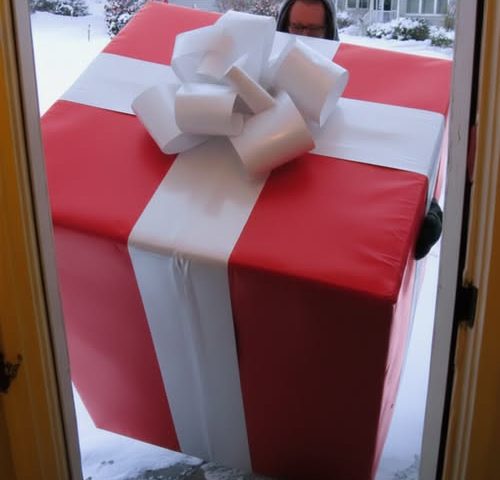
A courier stood on the porch, cheeks pink from the cold, holding a large box wrapped in glossy Christmas paper.
Big red bow.
“Delivery for you,” he said, tilting it so I could see the tag.
My name was written on it in neat handwriting.
No sender listed.
I signed, thanked him, and carried the box into the kitchen.
The girls hovered in the doorway like nosy little cats.
“Is it for us?” my younger one asked.
“I’m not sure,” I said. “Let me look first.”
My heart was pounding, and I didn’t know why.
I peeled off the wrapping paper.
Underneath was a regular cardboard box.
I opened the flaps.
On top was a folded letter.
The first line hit me like a punch.
“Dear kind stranger.”
“Mommy?” my older daughter asked. “Why are you making that face?”
I hadn’t realized my hands were shaking.
I swallowed and started to read.
It was from Laura.
She wrote that after I dropped her off, someone at the station let her charge her phone.
Her sister arrived—crying, shouting, and hugging her all at once.
She made it home safely.
She told her family everything.
About the bus stop.
The cold.
My house.
The guest room.
The meal.
She said her family didn’t have much.
Her parents lived on a fixed income.
Her sister worked two jobs.
There was no way for them to repay me in any meaningful way.
If you want it softer, more grateful, or more dramatic, I can adjust the wording instantly.
“But you gave us warmth and safety when you didn’t have to,” she wrote.
“If you hadn’t stopped, I don’t know what would’ve happened to me and Oliver.”
She said her sister had teenage daughters.
As they heard what happened, they wanted to help.
“They went through their clothes,” she wrote.
“They picked things they loved. They said they wanted your girls to feel special.”
My eyes blurred.
I set the letter down and looked into the box.
Clothes.
Neatly folded.
Soft sweaters in my girls’ sizes.
Dresses that looked almost new.
Jeans. Leggings. Pajamas.
Shoes in great condition.
A pair of sparkly boots that made my seven-year-old gasp.
“Mom,” she whispered. “These are amazing.”
My five-year-old held up a dress with stars on it.
“Is this for me?” she asked.
“Yeah,” I said, my voice cracking. “It’s for you.”
At the bottom of the box were a couple of costumes — a princess dress, a witch outfit, a superhero cape.
There was a smaller note in different handwriting.
“From our girls to yours,” it said, with a little heart.
That was when the tears really started.
“Mommy?” my older daughter said softly. “Why are you crying?”
I knelt down and pulled them both into a hug.
“I’m crying,” I said, “because sometimes people are really, really kind. And sometimes, when you do something good, it comes back to you.”
“Like a boomerang,” my five-year-old said.
I laughed through my tears.
“Exactly like a boomerang.”
Those clothes meant more to me than I could ever fully explain.
I’d been delaying buying anything new—
wearing shoes longer than I should,
telling myself we’d manage somehow.
That box felt like the universe gently saying, “It’s okay. Take a breath.”
Later that day, after the girls had tried on half the contents and were spinning around the living room, I sat down at the kitchen table and opened Facebook.
I wrote a post.
No names.
No details that weren’t mine to share.
Just this:
Two days before Christmas, I saw a mother and her baby at a bus stop.
I brought them home.
This morning, a box of clothes and a letter appeared on my porch.
I ended with: “Sometimes the world is kinder than it seems.”
About an hour later, I received a message request.
It was from Laura.
“Is that post about me?” she wrote.
My heart skipped.
“Yes,” I replied. “I kept it anonymous. I hope that’s okay.”
“It’s more than okay,” she wrote back.
“I’ve been thinking about you since that night. I just didn’t know how to thank you again without it feeling awkward.”
We talked for a while.
She told me Oliver was doing well.
That her family had insisted on sending the box, even though money was tight.
That her nieces had debated over which dress my girls would like most.
I sent her a photo of my daughters twirling in their new clothes, hair flying, faces glowing.
“They look so happy,” she wrote.
“They are,” I replied. “You helped make that happen.”
We added each other as friends.
Now we check in sometimes.
Kid photos.
“Good luck today” messages.
Quiet admissions of “I’m exhausted too.”
Not just because of the clothes.
Not only because of the box.
But because on one freezing night before Christmas, two mothers crossed paths.
One needed help.
One was afraid—but stopped anyway.
And neither of us forgot.