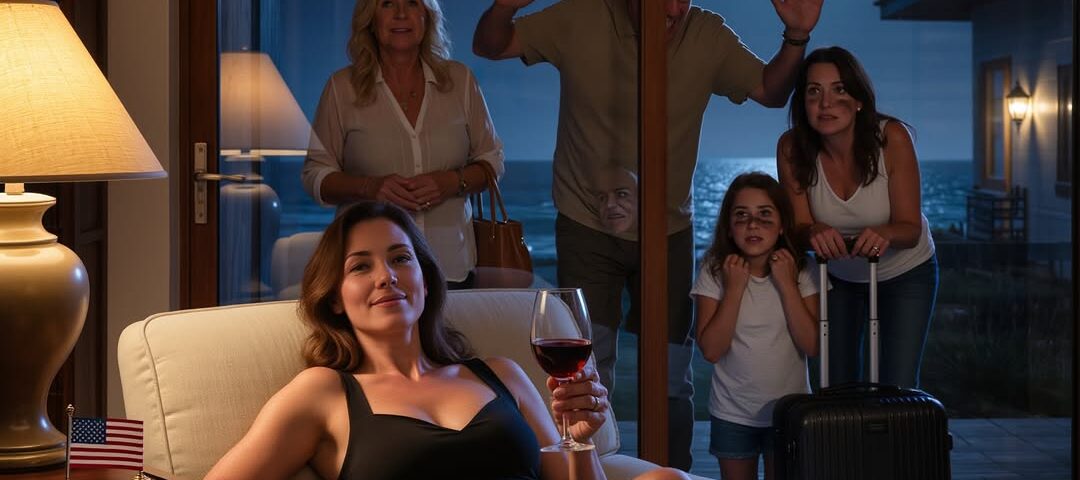
My name is Aurora. I am thirty-six years old and I live in Seattle.
I was sitting in a glass-walled boardroom downtown, surrounded by people who respected me. This was the biggest meeting of my year. My phone was face down on the table, but it vibrated against the wood. I usually ignore it during meetings. Today, for some reason, I turned it over.
The screen lit up. It was a notification from Instagram. My mother.
I slid the phone closer to my hand. I shouldn’t have looked, but I did. My heart stopped for a second.
The photo was bright and sunny. It showed my mother, my father, and my sisters. They were laughing. They were holding glasses of white wine. Behind them was a view I knew better than my own face: the wide wooden deck, the blue infinity pool, the Pacific Ocean stretching out to the horizon.
They were in my Malibu beach house.
I stared at the screen. I had not given them the keys. I had not told them they could go. They didn’t even ask me. They were vacationing in my home, a home I bought with my own hard work, completely behind my back.
Then I read the caption.
“Finally, peace without the drama.”
I felt sick.
The “drama” was me. They were enjoying my house and my money specifically because I wasn’t there.
My name is Aurora. I am thirty-six years old. I sat there in the boardroom. The air conditioner hummed low in the background. My phone was in my hand, burning a hole in my palm.
The investor, a man named Robert who had flown in from New York, was talking about scalability and market share. I nodded. I kept my face calm. I had practiced this face in the mirror for years. It was my business face. It meant nothing could hurt me. But under the table, my thumb hovered over the screen.
I unlocked my phone again. I had to look. I knew it was poison, but I had to drink it.
I opened Instagram. The picture loaded instantly. It wasn’t just one picture. It was a carousel. My mother had posted ten photos—ten proofs of her theft.
In the first photo, she was sitting on my white linen outdoor sofa. I bought that sofa six months ago. I had it imported from Italy. I remembered telling my mother on the phone:
“I finally furnished the deck. It’s white and delicate, so no red wine.”
In the photo, she was holding a glass of red wine. She was resting her feet, wearing dirty sandals, right on the white cushion. She was smiling that wide, fake smile she used for church and social media.
I swiped left.
The next photo was of my father. He was standing by the grill—my stainless-steel built-in grill that I had never even used yet. He was flipping burgers. He looked like the king of the castle. He was wearing a hat that said RELAX MODE.
I swiped again.
My sister Jessica was in my bedroom, my primary suite. She was wearing my silk robe, the one with my initials, “AM,” embroidered on the pocket. She was posing in the mirror, doing a duck face for the camera. The caption under that one read:
“Living the dream. #vacationmode #Malibu.”
I felt a physical blow to my chest. It wasn’t just that they were there. It was the entitlement. They were using my things, my personal private things, as props for their social media performance.
They were trying to look rich. They were trying to look successful. They were using my hard work to paint a picture of a life they didn’t earn.
I looked at the comments. This was the part that truly made my stomach turn.
My Aunt Linda had commented:
“So glad you guys are getting a break. You deserve it.”
Deserve it. What did they deserve? My parents had retired early with no savings and expected me to fix it. My sister had quit three jobs in two years because she “didn’t like the vibe.”
Another comment from a neighbor back home:
“Wow, is that a rental? Looks expensive.”
And then my mother’s reply. I stared at the words until they blurred.
“No, it’s Aurora’s place. She said we could use it whenever we wanted. So blessed to have a generous daughter.”
I nearly dropped the phone.
“She said we could use it whenever.”
It was a lie. A clean, simple, devastating lie.
I had never said that. In fact, three months ago I told them specifically that the house was off-limits because I was doing renovations. I told them I wasn’t ready for guests. I told them I needed space.
They didn’t care. They heard “no,” decided they didn’t like it, and replaced it with “yes.”
“Aurora?”
Robert’s voice snapped me back to the room. Everyone was looking at me.
I stood up. My legs felt heavy, like they were filled with lead.
“I apologize,” I said. My voice was steady. It didn’t shake. “I have a family emergency I need to attend to. My team can finish the presentation.”
I didn’t wait for permission. I walked out of the boardroom, down the long hallway, and into the elevator. As soon as the metal doors closed, I let out a breath that sounded like a scream.
I went down to the parking garage and got into my car. It was quiet there, and dark, and for a second, it felt safe. I didn’t start the engine. I just sat in the driver’s seat and looked at the phone again.
I zoomed in on the background of the photos. I was looking for damage. I was looking for clues.
In the corner of the photo with my dad, I saw a suitcase. It was open. Clothes were spilled out all over the floor of the deck. They hadn’t been there for an hour. They looked settled.
I looked at the timestamps. They had been there since yesterday.
They had slept in my bed. They had showered in my bathroom. They had eaten my food.
My phone buzzed again. A text from my sister Jessica.
“Hey, Mom said you might be busy, but just wanted to say hi. Hope Seattle is rainy lol. It’s beautiful here.”
She didn’t say where “here” was. She was playing a game. She wanted me to ask. She wanted me to see the photos, get jealous, and ask:
“Where are you?”
So she could say, “Oh, just at the beach house. Didn’t Mom tell you?”
It was a power play. If I got angry, I was the villain. I was the crazy daughter who wouldn’t share. If I said nothing, I was the doormat.
I typed a response.
“Where are you?”
I deleted it.
No. I wasn’t going to play their game.
I looked at the photo of my mother again—the red wine glass, the white sofa. Growing up, if I spilled a drop of juice on the carpet, my mother would scream for an hour. She would tell me I was careless. She would tell me I didn’t respect the value of money. She would make me scrub until my fingers were raw.
Now she was ruining a five-thousand-dollar sofa and calling it “peace.”
The hypocrisy wasn’t new. It was the soundtrack of my life. But seeing it here, in the sanctuary I had built for myself, broke something inside me.
The Malibu house wasn’t just a house. It was my escape. It was the one place where I wasn’t “Aurora the bank.” It was the one place where I wasn’t Aurora the disappointment, or Aurora the cold one.
It was mine.
And they had taken it.
I started the car. I didn’t drive back to my apartment. I drove toward the highway. I needed to move. I needed to think.
I thought about calling them. I could hear the conversation in my head.
“Mom, get out of my house.”
“Oh, Aurora, stop being so dramatic. We’re just family. You weren’t even using it. Why are you so selfish?”
“You didn’t ask.”
“I’m your mother. I don’t need to ask permission to see my daughter’s success.”
It would go in circles. They would gaslight me. They would make me feel small. They would make me apologize for owning a home.
I merged onto the freeway. The rain hit the windshield, that familiar Seattle gray.
I wasn’t going to call. Calling was weak. Calling was engaging in the drama. My mother wanted drama. She wanted a fight so she could tell her friends how difficult I was.
I wasn’t going to give her a fight. I was going to give her consequences.
I drove for an hour just listening to the tires on the wet pavement. My anger was hot at first, burning in my throat. But as I drove, it started to cool down. It turned into something else. It turned into ice.
I pulled over at a rest stop and looked at the phone one more time.
My mother had posted a story update, a video. She was walking through my kitchen. She was opening my cupboards.
“Look at this,” she was saying to the camera. “Empty. She has all this space and no food. She works too much. Sad. Really. We’re going to fill this place up with love.”
“Sad.”
She called my life sad. She was mocking my choices while standing in the middle of the luxury I provided.
I put the phone down. I was done feeling hurt. Hurt was a child’s emotion. Hurt was for people who couldn’t do anything about it.
I wasn’t a child anymore. I was the owner.
I turned the car around and headed back to the city. I had a plan.
I walked into my Seattle apartment. It was clean, minimal, and quiet. Everything was exactly where I had left it. That was how I liked things: order, control.
I sat down at my desk and opened my laptop. I didn’t go to social media this time. I went to my security dashboard.
I have a comprehensive smart-home system in Malibu—cameras, smart locks, climate control, pool sensors. I paid a premium for it because I travel so much. I needed to be able to see my house from anywhere in the world.
I logged in. The screen filled with live feeds.
Camera one: driveway. There was my father’s beat-up Ford truck. It was leaking oil onto my pavers. Next to it was a rental car, a convertible. They had splurged, probably assuming I would end up paying for gas or dinners eventually.
Camera two: living room. My sister was on the couch, the indoor one, watching my eighty-five-inch TV. She was eating chips. The bag was open on the leather. Crumbs were falling.
Camera three: kitchen. My mother was cooking. She was using my copper pans, the ones I hand-wash. She was scrubbing one with a rough sponge. I winced. She was scratching the finish. I could see it from a thousand miles away.
Camera four: pool deck. My father was asleep on a lounger.
I watched them. It was like watching a nature documentary: an invasive species taking over a new habitat.
I checked the access logs. How did they get in?
I scrolled back to yesterday.
2:00 p.m. Entry code used: “Mom Emergency.”
I closed my eyes. I remembered giving her that code four years ago. It was when I bought my first condo. I told her:
“This is for emergencies only, like if I’m in the hospital or the house is on fire.”
I had forgotten to delete it when I bought the Malibu house. I had set up the same user profiles for the new system out of habit.
She had remembered. She had kept that code for four years, waiting for a moment to use it. She didn’t call to ask. She just punched it in, hoping it would work.
And it did.
She must have felt so smart. So clever.
I picked up my phone and dialed a number.
“Mark, it’s Aurora.”
Mark was my property manager in Malibu. He was a good guy—professional, expensive.
“Aurora, hi. Everything okay? I saw some activity at the house. I assumed it was you.”
“It’s not me,” I said. My voice was calm. “It’s my family. They’re there without permission.”
There was a silence on the line. Mark managed houses for celebrities, tech founders, people whose families saw dollar signs instead of relatives. He knew about leeching relatives.
“I see,” Mark said. His tone shifted. He went from friendly to tactical. “Do you want me to call the police? I can have them removed for trespassing.”
I thought about it. Police sirens. My mother crying in the driveway, telling the officers her daughter was a monster. The neighbors watching over their hedges.
“No,” I said. “Not the police. Not yet. I want to handle this quietly.”
“Okay. What do you need?”
“I need you to reset every code on the property,” I said. “Gate, front door, back door, garage, everything.”
“Done,” Mark said. “I can do that remotely right now.”
“No,” I said. “Not right now.”
I looked at the clock on my laptop. It was 4:30 p.m. in Seattle, which meant 4:30 p.m. in Malibu. The sun was still up. They were enjoying the afternoon.
“Wait until midnight,” I said.
“Midnight?”
“Yes. They’re comfortable right now. I want them to stay comfortable. At 12 a.m., I want the codes changed. I want the Wi-Fi password changed. I want the smart TV logged out of all accounts.”
“Scorched earth,” Mark said. I could hear the smile in his voice.
“And Mark?”
“Yeah?”
“Can you set the alarm to Away mode at 12:01?”
“If I do that, and they open a door or a window, the siren will go off. It’s loud, Aurora. It’s deafening.”
“I know,” I said. “If they’re inside, they won’t be able to get out without setting it off. If they’re outside… well, they won’t be able to get back in.”
I looked at the cameras again. I saw a cooler of beer on the deck. My dad was drinking. My sister was texting. They looked like they were settling in for a long night. They would probably stay up late. Maybe go in the hot tub.
“Perfect,” I said. “Do it.”
“You got it. Anything else?”
“Yes. Be ready to go over there tomorrow morning, early, around 7:00 a.m. You might need to escort them off the premises.”
“I’ll bring my security guy, Big Mike,” Mark said. “Just in case.”
“Thank you, Mark.”
I hung up. I sat back in my chair. My heart beat a little slower now. This was better than screaming. This was control.
I looked at the Instagram post again. My mother’s caption: “Peace without the drama.” She thought she had won. She thought she had outsmarted me. She thought that because I was thousands of miles away, I was powerless. She thought that because she was “Mom,” she had a free pass to trample my boundaries.
She didn’t understand who I was anymore. She still saw the little girl who cried when she wasn’t invited to the party. She didn’t see the woman who managed multimillion-dollar portfolios. She didn’t see the woman who knew how to execute a strategy.
I wasn’t going to cry. I was going to close the deal.
I went to the kitchen and poured myself a glass of water. I stood by the window, looking out at the Seattle skyline. The Space Needle poked through the clouds. I felt a strange sense of calm.
It was the calm before the storm.
For years, I had let them get away with it—the small insults, the “borrowed” money that never came back, the guilt trips.
If you loved us, you’d help us.
Family helps family.
You changed.
I used to believe them. I used to think I was the bad guy. I used to write checks just to make the guilt stop.
But looking at my mother’s dirty sandals on my white sofa, something shifted. The checkbook was closed. The emotional bank account was overdrawn.
I checked the time. 5:00 p.m. Seven hours until midnight.
I ordered dinner. I ate a salad at my desk while I worked. I answered emails. I reviewed contracts. I acted like it was a normal night. But every few minutes, I glanced at the second monitor, the live feed.
The sun went down in Malibu. The pool lights turned on. I had programmed them to turn purple at sunset. My sister took a selfie with the purple water in the background. My dad started the gas fire pit. He figured out the switch.
They were having a party. My party, without me.
I watched my mother pour another glass of wine. She was laughing at something my sister said. They looked so happy. They looked relieved that I wasn’t there to “ruin the mood” with my rules or my presence.
It hurt. I won’t lie—it hurt to see that they were happier without me. But the hurt was hardening into resolve.
I wasn’t going to let them steal my peace anymore. If they wanted a house, they could buy one. If they wanted a vacation, they could pay for it.
I was done subsidizing my own mistreatment.
I waited. The digital clock on my laptop ticked forward.
11:58 p.m.
I picked up my phone. I opened the security app.
11:59 p.m.
I watched the screen.
12:00 a.m.
The app flashed.
Configuration updating. System rebooting. Codes changed. Alarm system armed: AWAY.
It was done.
I leaned forward, my eyes glued to the screen. I sat in my office chair in Seattle, waiting for the fallout.
It was just past midnight. The house in Malibu was now a fortress, but the chaos hadn’t started yet.
In that quiet moment, staring at the glow of my monitors, my mind drifted. It didn’t stay in the present. It went back.
Back to a kitchen table in Ohio twenty years ago.
I was sixteen. I was studying for the SATs. I had a heavy book open in front of me, highlighting vocabulary words. My sister Jessica was twelve then. She was watching TV in the next room, laughing loudly at a cartoon.
My mother walked in carrying a basket of laundry. She stopped and looked at me. She didn’t look proud. She looked annoyed.
“Aurora,” she said. “Put the book away. Your aunt is coming over. You need to be social.”
“I have to study, Mom,” I said. “I want to get a scholarship.”
She rolled her eyes. It was a gesture I knew well. It meant I was being “difficult.” It meant I thought I was better than them.
“You’re always working,” she said. “You’re going to burn out. You take everything so seriously. Look at your sister. She knows how to be happy. You just know how to stress.”
She knows how to be happy.
That was the narrative. Jessica was the fun one, the light one, the one who brought joy to the family. I was the serious one, the cold one, the one who cared about grades and money and the future.
They didn’t understand that I cared about those things because I was terrified. I was terrified of being stuck.
My father was always complaining about bills. My mother was always borrowing money from her sister. I didn’t want that life. I wanted safety.
To me, money was safety. To them, my ambition was an insult.
I remembered my high-school graduation. I was valedictorian. I gave a speech. When I looked out into the crowd, I saw my parents. They weren’t beaming. They were talking to each other. My dad was checking his watch.
Afterward, at dinner at a chain restaurant off the interstate, my dad raised a glass of soda.
“To Aurora,” he said. “For finally being done with school. Now maybe you can get a real job and help out around here.”
I wasn’t done, though.
I went to college, then business school. I worked three jobs during college. I missed Thanksgiving twice because I couldn’t afford the flight home and I had to work the holiday shift at the campus library.
When I called them on Thanksgiving, crying because I was lonely, my mother didn’t comfort me.
“Well,” she said, her voice sharp. “You chose to go that far away. You chose that fancy school. This is the consequence. Aurora, you chose money over family.”
Money over family.
They said that phrase like a curse.
Five years ago, everything changed.
I sold my first company. It wasn’t a massive exit, but it was enough to put me in a different tax bracket. Suddenly, I had seven figures in the bank.
I flew home to Ohio for Christmas. I had paid off their mortgage as a surprise. I thought, This is it. This is the moment they understand. This is the moment they say thank you.
I handed them the envelope. My mother opened it. She read the document. She didn’t cry. She didn’t hug me. She looked at my father and said:
“Well. It’s about time.”
My heart sank.
“What do you mean?” I asked.
“We sacrificed so much for you,” she said. “We let you study. We let you go away. It’s only right that you pay us back.”
They didn’t see it as a gift. They saw it as a return on investment.
From that day on, the dynamic shifted. I wasn’t boring Aurora anymore. I was Aurora the wallet.
Suddenly, they wanted to be involved in my life.
“Aurora, we should come visit you in Seattle.”
“Aurora, your cousin needs a loan for a car.”
“Aurora, why don’t you take us on a trip? The Millers went to Hawaii. We’ve never been to Hawaii.”
If I said yes, they loved me. They posted photos of the dinners I paid for. They bragged to the neighbors about “our successful daughter.” If I said no, I was back to being the villain.
“You’ve changed. You think you’re better than us. You’re greedy.”
They loved my success, but they hated me. They loved the beach house, the cars, the dinners, but they didn’t like the woman who earned them. They didn’t respect the work. They only felt entitled to the reward.
Two years ago, I bought the Malibu house. It was my sanctuary. I specifically didn’t tell them the address for the first six months. I wanted to keep it pure.
When they finally found out—because I made the mistake of posting a photo of the view—the guilt trip started immediately.
“You have a beach house and you didn’t invite your own mother. I guess we aren’t good enough for Malibu.”
I eventually gave them one weekend there last year. I was there with them. It was a nightmare.
My dad smoked cigars on the non-smoking deck. My sister invited random friends over without asking. My mom rearranged my kitchen because “it didn’t make sense.”
After they left, I hired a cleaning crew and told myself, Never again.
I set a boundary.
“The house is my private residence,” I told them. “It’s not a vacation rental.”
They nodded. They said they understood.
But they didn’t understand. To them, “no” was just a suggestion. To them, my property was community property.
And that brought me back to tonight. The lie on Instagram.
“Aurora said we can use it whenever.”
That lie was the final straw. It wasn’t just a lie to her friends. It was a rewriting of reality. She was publicly claiming permission she didn’t have, forcing me into a corner where I had to either play along or look like a monster.
She was counting on my silence. She was counting on the fact that I usually just rolled over and paid the bill to keep the peace.
But I wasn’t that sixteen-year-old girl anymore, desperate for their approval. I wasn’t the college student crying in a library on Thanksgiving.
I was a CEO. I was a homeowner.
And I was done paying for love I never received.
I looked at the clock on my laptop. 12:10 a.m. The memories faded. The anger remained, cold and solid, like a stone in my stomach.
I turned my eyes back to the live feed from Malibu.
12:12 a.m.
On the screen, everything looked peaceful at first. The pool lights were still purple. The fire pit was still glowing. My dad was asleep on the lounger. My mom and sister were inside the living room. I could see them through the glass sliding doors.
My sister was holding her phone up in the air, probably trying to refresh her feed.
That was the first sign. The Wi-Fi was gone.
I watched Jessica tap the screen aggressively. She stood up. She walked toward the router, which sat on a shelf near the television. She picked it up and shook it.
I took a sip of water.
Shaking it won’t help, Jessica. I cut the line.
She said something to my mother. My mother looked up from her magazine, annoyed. She pointed at the TV. The TV had gone black. I had logged them out of Netflix, Hulu, everything.
My mother stood up and walked over to the sliding glass door to yell at my dad. Maybe she wanted him to fix it. She put her hand on the handle of the sliding door. She turned the latch. She slid the door open.
Beep. Beep. Beep. Beep.
I couldn’t hear it, but I saw the reaction instantly: the alarm system.
I had set it to Away. That meant the motion sensors were active and the door contacts were armed. Opening the door triggered the entry delay. My mother froze. She looked at the keypad on the wall. It was flashing red.
She started typing. I knew exactly what she was typing: 1-9-5-8. Her birth year. That was the old code, the one she used to get in.
It didn’t work.
Beep. Beep. Beep.
She typed it again, faster this time. She shouted to my dad. He woke up on the lounger, startled. He looked around, confused. My sister ran over to the keypad. She pushed my mother out of the way. She tried a code. Probably my birthday. Or hers.
Beep. Beep. Beep.
They had thirty seconds before the siren.
I watched them panic. It was chaotic. My dad was stumbling toward the door. My mom was yelling. My sister was holding her hands over her ears, bracing for the noise.
Then it happened.
The siren cut loose.
Even though I couldn’t hear it, I could see the physical impact. It was a deafening, piercing sound designed to scare off intruders.
My sister screamed. Her mouth opened wide. My dad covered his ears. My phone on the desk lit up.
INCOMING CALL: MOM.
I watched it ring. I didn’t touch it.
INCOMING CALL: MOM.
I let it go to voicemail.
On the screen, the neighbors’ lights were turning on. The house next door—a modern glass box owned by a very private, very wealthy director—lit up.
My family was now a public nuisance.
My father did the only thing he could think of. He decided they needed to leave. He started grabbing things. He pointed to the front door.
“Get out. We have to get out.”
My mother ran to the bedroom. I switched cameras to the bedroom feed. She was throwing clothes into her suitcase. She didn’t fold them. She just shoved them in. She looked terrified. She probably thought the police were already on their way.
My sister was crying. She grabbed her makeup bag. She dropped a bottle of foundation on the floor. It shattered. A beige stain spread across my hardwood.
I flinched, but I didn’t look away.
Add it to the bill.
They dragged their suitcases into the living room. My dad was already at the front door. He unlocked it and threw it open. The siren was still blaring. They hauled their luggage out onto the driveway. The cool night air hit them.
My dad tried to go back in to get something—maybe the cooler of beer. But the moment the door clicked shut behind them, the smart lock engaged. I had set it to auto-lock instantly upon closing.
He grabbed the handle. He pulled.
Locked.
He pounded on the door. He kicked it. I watched his face twist in rage. He was shouting at the door, shouting at the house, shouting at me.
They were outside. It was 12:20 a.m. They were standing on the driveway in their pajamas and swimsuits, surrounded by hastily packed suitcases, with a siren screaming into the night.
My phone was vibrating so hard it was moving across the desk.
INCOMING CALL: DAD.
INCOMING CALL: JESSICA.
Incoming texts.
“What is happening?”
“The alarm is going off. Help us.”
“Pick up the phone, Aurora.”
I picked up the phone, but I didn’t answer the call. I opened the security app instead. I pressed the button to silence the siren.
On the video feed, the silence was almost visible. They all stopped moving. They looked around, panting. They thought it was over. They thought maybe it was a glitch and I had fixed it.
My dad reached for the door handle again. He tried the code. Red light. Denied. He tried again. Red light. Denied.
They were locked out. Half their things were still inside. My mother’s purse was probably on the counter.
I zoomed in on the driveway. The rental car keys were in my dad’s hand.
Good. They could leave. But they couldn’t get back in to sleep.
I watched the realization wash over them. They huddled together in the driveway. My mother was shivering. She was wearing a thin robe.
My phone rang again.
MOM.
This time, I looked at the screen and felt a strange detachment. This was the moment. They needed me. For the first time in years, they didn’t just want my money. They needed my help.
And for the first time, I wasn’t going to give it.
I swiped to answer.
I didn’t say hello. I didn’t ask what was wrong. I just listened.
“Aurora!” My mother sounded hysterical. “Aurora, thank God. Something is wrong with the house. The alarm went off. We’re locked out. It’s freezing. You need to unlock the door right now. The codes aren’t working.”
Her voice was demanding. Not apologetic. She didn’t say sorry for waking me up. She didn’t say sorry for being there. She just gave orders.
“Aurora, are you there? Fix this.”
I took a breath. I looked at her on the screen. She looked small.
“I know,” I said. My voice was calm, low, steady. “I know the codes aren’t working.”
“What? What do you mean you know? Reset them.”
“No,” I said.
There was a pause. The kind of silence that happens before an explosion.
“Excuse me?” she said.
“I changed the codes, Mom,” I said. “I set the alarm. I locked you out.”
“You… you what?” she shrieked. “You locked your own mother out of your house? We are your family.”
“You broke into my home,” I said. “And now you’re leaving.”
“Broke in?” she repeated, scandalized. “We are your family. This is your house. How dare you use that word?”
“You didn’t ask,” I said. “You stole my time. You stole my space. And you lied about it.”
“Aurora, open this door right now!” My father’s voice came from the background, rough and full of fury. “I’m not playing games with you. Open the door.”
“I’m not playing either, Dad,” I said. “The door stays shut. You have the car keys. I suggest you go find a hotel.”
“A hotel?” my sister screamed. “It’s midnight. We don’t have our wallets. Mom left her purse inside.”
I looked at the camera. I saw the purse sitting on the kitchen island.
“That’s unfortunate,” I said. “Maybe you can ask the neighbors. Or maybe you can use the emergency cash Dad always keeps in his truck.”
“Aurora, please.” My mother’s voice changed. It switched from anger to the victim tone, that wavering, tearful voice she used to manipulate me. “Please, honey. It’s cold. Your father’s back hurts. We just wanted to be close to you. We wanted to feel close to your success. Don’t do this to us. Don’t be cruel.”
Cruel.
Was I cruel?
I looked at the picture she posted six hours ago.
“Peace without the drama.”
“You wanted peace,” I said. “Now you have it. You’re off the property.”
“I will never forgive you for this!” she screamed, the mask slipping. “You ungrateful little brat. After everything we did for you—”
“Goodnight, Mom,” I said.
I hung up.
I watched the screen. My mother stared at the phone in her hand. She threw her hands up in the air. She screamed something at the camera. She knew where the lens was.
Then she slumped against the rental car.
I didn’t feel happy. I didn’t feel sad. I just felt light. The weight of their expectations, the weight of their entitlement—that was all on the other side of that locked door.
I was safe in Seattle. And for the first time, my house in Malibu was safe, too.
But I knew the night wasn’t over.
They wouldn’t just leave. They would stage a protest. They would make a scene.
I texted Mark, my property manager.
“They are outside. They are locked out. Please proceed with the 7 a.m. removal. If they are still in the driveway, call the police if necessary.”
I put the phone down. I kept the live feed open on my second screen. I wasn’t going to sleep tonight.
I was going to stand guard.
It was 2:00 a.m. Two hours had passed since the lockout. I was still sitting in my office in Seattle. My coffee had gone cold, but I didn’t get up to microwave it. I was glued to the monitors.
In Malibu, the adrenaline of the initial chaos had worn off. Now reality was setting in.
It was a coastal night. The air coming off the Pacific was damp and cold. It wasn’t freezing like a Seattle winter, but it was in the low fifties—cold enough to make you shiver in silk pajamas or swim trunks.
I watched them on the driveway camera. They had retreated into the rental car. The engine was running. I could see the exhaust puffing into the night air. They were burning gas to keep the heater on.
My phone started ringing again. I had silenced it for an hour to let them sit in their own choices. Now I decided to answer.
I needed to reiterate my position. I needed them to understand this wasn’t a tantrum. This was a policy change.
I picked up. It was my father.
“Hello,” I said.
“Aurora.” His voice was different now. It wasn’t the booming yell from before. It was tight, controlled. Underneath the control, there was a deep, simmering rage. “This has gone on long enough. Your mother is crying. Your sister is freezing. Open the door.”
“I can’t do that,” I said.
“Don’t give me that ‘can’t’ garbage,” he snapped. “You have a phone. You have an app. I watched you turn off the siren. You can unlock the door just as easily.”
“I physically can,” I corrected. “But I won’t. You’re trespassing, Dad. If you were strangers, I would have called the police two hours ago. I gave you the courtesy of leaving on your own.”
“Trespassing?” he laughed. It was a harsh, ugly sound. “We are your parents. We raised you. We fed you. You don’t get to call us trespassers. We have a right to be here.”
“No,” I said. “You don’t. You have a right to your own home in Ohio. You don’t have a right to my property in California. You didn’t ask. You snuck in. You used an emergency code to steal a vacation.”
“We didn’t steal anything,” he shouted. The control was slipping. “We were just using it. It was sitting empty. What kind of selfish person lets a house sit empty when her family could be enjoying it?”
“It’s not about the house being empty,” I said. “It’s about respect. You lied to me. Mom posted on Instagram implying I gave you permission. That was a lie.”
“Oh, who cares about Instagram?” he yelled. “That’s just internet nonsense. Real life is family. Real life is helping your flesh and blood.”
“Real life is boundaries,” I said.
“Listen to me,” he said, his voice dropping to a low, dangerous growl. “If you don’t open this door in five minutes, I’m going to break a window. I’ll smash the glass. I’ll climb in and I’ll sleep in that bed and you can send me the bill.”
I looked at the monitor. I saw him sitting in the driver’s seat of the rental. His jaw was clenched. His eyes were wild.
“If you break a window,” I said, keeping my voice steady, “the alarm will trigger again. The police will be dispatched automatically, and I will press charges.”
There was silence on the line.
“You wouldn’t,” he said. “You wouldn’t call the cops on your own father.”
“Try me,” I said. “I’ve spent the last ten years trying to buy your love. I’m done paying. If you destroy my property, I will treat you like anyone else who destroys my property.”
He hung up on me.
I watched the screen. He slammed his phone against the steering wheel. My mother said something to him. He waved her off.
He didn’t break the window. He knew I was serious. For the first time in his life, he realized I wasn’t bluffing.
Ten minutes later, my sister called.
I answered.
“Aurora,” her voice was shaking. She was crying. “Aurora, please. I have to pee. I really have to pee. Please just let me in for five minutes to use the bathroom.”
It was a tactic. I knew it. If I unlocked the door for five minutes, they would all rush in. They would refuse to leave. They would barricade themselves inside.
“There’s a gas station three miles down the highway,” I said. “It’s open twenty-four hours.”
“I can’t drive the rental car,” she sobbed. “Dad has the keys and he won’t drive. He’s just sitting there, staring at the wall.”
“Then walk,” I said. “Or go in the bushes. I don’t care, Jessica.”
“You are such a—” She cut herself off. The crying stopped instantly. Her voice turned sharp. “You are a jealous, lonely, bitter woman. You have all this money and no friends. That’s why you’re doing this. You’re jealous that we actually like each other and you’re all alone.”
“I’m alone by choice tonight,” I said. “And I’m warm, and I have a bathroom.”
“I hate you,” she said. “I hope you lose everything. I hope the market crashes and you lose every dime.”
“Goodnight, Jessica,” I said.
I hung up.
The words stung. Lonely. Bitter. They knew exactly where to hit me. They knew my deepest insecurity—that my success had isolated me.
But as I sat there, staring at the monitors, I realized something.
My success hadn’t isolated me.
They had isolated me.
Their behavior made it impossible for me to trust anyone. I kept people at a distance because I was so used to people wanting something from me. Locking them out wasn’t making me lonelier.
It was protecting the peace I had left.
3:30 a.m.
The car engine turned off. They must have been worried about gas, or maybe they finally realized it wasn’t worth burning fuel all night.
The lights in the car went dark. They were going to sleep there—three adults curled up in a mid-sized sedan in my driveway.
I felt a twinge of guilt. It was deeply ingrained. It was the voice of my grandmother saying, “Honor your father and mother.”
I looked at my mother in the passenger seat. She had reclined the seat back. She had a towel from their beach bag draped over her legs.
I almost reached for the unlock button. I almost did it.
But then I looked at the timestamp on the video feed. I looked at the cooler of beer still sitting on my porch. I remembered the caption:
“Peace without the drama.”
If I let them in now, I would be teaching them that my “no” meant “yes” if they just waited long enough. I would be teaching them that if they suffered just a little bit, I would cave.
I took my hand off the mouse.
I wasn’t going to cave. Not this time.
I watched them sleep. I didn’t sleep. I stayed awake, drinking water, reviewing the security logs, and waiting for the sun to rise.
This was the longest night of my life.
But it was also the most important.
I was breaking a cycle. Breaking cycles is painful work.
The sky began to lighten around 6:00 a.m. The gray gloom of the marine layer rolled in off the Pacific. In the driveway, the car was covered in dew. The windows were fogged up. I saw movement inside.
My father woke up first. He opened the car door and stepped out. He stretched, holding his lower back. He looked stiff. He looked old.
For a second, I felt pity.
Then he turned and kicked my garbage can. He kicked it so hard it dented the metal.
Pity evaporated.
6:45 a.m.
A black SUV turned onto my street in Malibu. Then a second one. It was Mark and his team.
I’d been texting Mark through the night. He knew the situation. He knew they were family. He also knew they were hostile.
“Treat them with respect,” I had texted. “But remove them. They do not enter the house again.”
I watched the SUVs pull into the driveway, blocking the rental car in. There was no escape now.
Mark stepped out of the first vehicle. He wore a dark polo shirt and slacks. He looked like a businessman, but he was built like a linebacker. From the second vehicle came Mike. Mike was huge, in a security uniform.
My father saw them. He stiffened. He walked to the center of the driveway, puffing out his chest.
I turned up the volume on the exterior camera. The microphone picked up the ocean and the voices.
“Can I help you?” my father demanded. “This is private property.”
“I know it is,” Mark said calmly. “I’m the property manager. I work for the owner, Aurora.”
“I’m her father,” my dad said. “We had a malfunction with the alarm last night. We’ve been stuck out here all night. You need to let us back in.”
Mark shook his head.
“I can’t do that, sir. I have direct orders from Aurora. You are not permitted to enter the residence.”
My mother scrambled out of the car. Her hair was a mess. Her makeup was smeared. She looked frantic.
“Orders?” she shrieked. “She’s my daughter. You can’t take orders against a mother. We have our things inside. My purse. My medicine.”
Mark nodded.
“I understand. Here’s the procedure. Mike is going to go inside. He’ll collect your personal belongings. He’ll bring them out to you. Then you will vacate the property immediately.”
“I’m not leaving until I speak to her!” my mother yelled. She lunged toward the front door.
Mike stepped in front of her. He didn’t touch her. He just occupied the space. He was a wall of muscle.
“Ma’am,” Mike said, his voice deep and even. “Please step back.”
“This is ridiculous!” my sister yelled from the back seat. “Just let us in to shower. We smell like a car.”
“No entry,” Mark repeated. “Mike, go get the bags.”
Mike unlocked the door with a master key. The sound of the lock clicking open must have been torture for them. They watched him walk into the warmth of the house.
My father turned to Mark.
“You’re making a mistake,” he said. “She’s going to regret this. I’m going to sue her. I’m going to sue you.”
“You can take that up with legal counsel,” Mark said, completely unbothered. He crossed his arms and waited.
It took twenty minutes. I watched Mike on the interior cameras. He moved efficiently. He went to the kitchen and got the purse. He went to the bedroom and swept the remaining clothes into the suitcases. He checked the bathroom, grabbed toiletries, tossed everything into bags.
He didn’t pack nicely. He just threw things in and zipped.
He carried the bags out, two in each hand. He walked to the driveway and set them down on the pavement.
“Here are your belongings,” Mark said. “Please check to ensure you have everything.”
My mother ripped open her purse. She checked for her wallet.
“My heart medication,” she yelled.
“It’s in the side pocket,” Mike said.
My father glared at Mark.
“We aren’t leaving,” he said. “We’re staying right here until she talks to us.”
Mark checked his watch.
“Sir, you are trespassing on private property. The owner has requested your removal. I am giving you five minutes to load your vehicle and leave. If you’re still here in six minutes, I’m calling the Los Angeles County Sheriff’s Department.”
“Call them,” my dad challenged. “Let them come.”
“Okay,” Mark said.
He pulled out his phone. He started dialing.
My mother grabbed my father’s arm.
“No. No police. Bill, stop it. We can’t have the police come.”
My mother cared about one thing more than money: her reputation. If the police came, there would be a report. It might get out. People at her church might hear about it.
“We’re leaving,” my mother said. She sounded defeated.
“We are not,” my dad argued.
“Get in the car, Bill!” she screamed at him. It was a raw, primal sound. “Get in the car. Now.”
She won. She always did when reputation was on the line.
My father looked at her. He looked at Mark. He looked at Mike, who stood with his arms crossed, a quiet wall.
He spit on the driveway. A final act of disrespect. Then he grabbed the suitcases and threw them into the trunk of the rental. He slammed it so hard the car shook.
They got in.
Mark moved his SUV to the side, clearing the path. My father reversed the rental car. He didn’t look back. He peeled out of the driveway, tires screeching, and sped down the Pacific Coast Highway.
Mark stood in the driveway and watched them go. He waited until they were completely out of sight. Then he looked up at the security camera. He knew I was watching.
He gave a small nod.
I nodded back at the screen.
I slumped back in my chair in Seattle. My body felt like jelly. I hadn’t realized how tense I’d been. My shoulders dropped inches.
They were gone.
My house was empty. It was messy—there were still dishes in the sink, the bed was unmade, the floor was dirty—but it was mine again.
I closed my eyes and let out a long, shaky breath. I didn’t cry. I didn’t feel like crying. I felt a strange, hollow sensation, like I had just cut off a limb to save the body.
It was necessary. But the phantom pain was already starting.
The silence didn’t last long.
By 9:00 a.m., the digital assault began.
My phone showed forty-seven missed calls, eighty-nine text messages. It wasn’t just my parents and sister anymore. It was the extended network. The flying monkeys.
My Aunt Linda:
“Aurora, your mother called me sobbing. She said you threw them out on the street in the middle of the night. How could you do that? They are elderly.”
My cousin Mike:
“Wow. Ruthless. Remind me never to piss you off.”
My grandmother, who barely knew how to text:
“Family is everything. God sees all.”
I didn’t reply to any of them.
I knew what my mother had done. She had spun the narrative immediately. She had called everyone she knew from the car ride to the airport. She wouldn’t have told them the truth.
She wouldn’t have said, “We broke in and she caught us.”
She would have said, “We went for a surprise visit, and she snapped. She’s having a breakdown. She’s unstable. She kicked us out because she’s cruel.”
I opened Facebook. I had to see the public damage.
There it was. A new post from my mother, posted from the airport terminal. It was a picture of her looking tired, holding a coffee cup, her eyes red and puffy.
The caption:
“Heading home early. Sometimes you think you know people, but money changes them. My heart is broken. Pray for families drifting apart. We tried our best. #heartbroken #familyfirst.”
The comments were flooding in.
“Oh no, what happened? Sending prayers, Sharon.”
“Money is the root of all evil.”
“You guys are better off without that toxicity.”
I read them. Each one was a tiny stab wound. These were people I grew up with—neighbors, teachers. They all believed her. They all thought I was the monster.
I started typing a comment.
“They broke into my house. They used an emergency code without permission. I asked them to leave and they refused.”
My finger hovered over the Post button. I looked at the words. They were true. But did they matter? If I posted that, it would just be a fight. She would deny it. She would say I gave her the code. It would become a he-said, she-said in the comments of a Facebook post.
It was undignified. It was messy.
I deleted the comment.
I realized that defending myself to these people was a waste of energy. They wanted the drama. They wanted the soap opera.
I wasn’t going to give them a season two.
I blocked my mother on Facebook. I blocked my father. I blocked my sister. I blocked Aunt Linda.
Then I went to my phone contacts. I blocked their numbers.
It felt radical. It felt dangerous.
What if there was a real emergency? What if someone died?
Then I thought, If someone dies, the police will call me or a hospital will call me. I don’t need to hear it from them.
I spent the rest of the day working. I tried to focus on spreadsheets, but my brain was foggy.
Around noon, Mark called me.
“House is secure,” he said. “We did a walk-through. No major damage. Some stains on the rug, a broken glass in the sink. The spare key is missing, though.”
“Change the locks,” I said. “Physical locks, not just the codes.”
“Already on it. Locksmith is here now. And Aurora?”
“Yeah?”
“Send me the bill for everything,” I said before he could finish. “The cleaning, the locksmith, your time, the security detail. Everything.”
“It’s going to be steep,” Mark warned. “Weekend rates. Emergency call-out.”
“I don’t care,” I said. “Send it.”
“Okay. One more thing,” he added. “I found a note.”
“A note?”
“Yeah. On the kitchen counter. Scribbled on a napkin. It’s from your sister.”
I tightened my grip on the phone.
“Read it.”
Mark hesitated.
“It says, ‘You’ll die alone.’”
The air went out of the room.
You’ll die alone.
It was the meanest thing she could think of. It was designed to haunt me.
“Throw it away,” I said.
“Already did,” Mark replied. Then, gentler, “Listen, Aurora. I see this a lot. Wealthy clients, leeching families. You did the right thing. They were taking advantage. You stood up for yourself. Don’t let the note get to you.”
“Thanks, Mark.”
I hung up.
I sat in my apartment in Seattle. It was quiet.
I wasn’t lonely. That was the surprise. I expected to feel a crushing loneliness, but I didn’t. I felt relief.
For the first time in years, I didn’t have to worry about what they were thinking. I didn’t have to worry about their next demand. I didn’t have to worry about the next holiday.
The bridge was burned. I was standing on one side and they were on the other. Looking at the charred remains of the connection, I realized I didn’t want to rebuild it.
I ordered Thai food. I ate it on my couch, watching a movie I wanted to see. I didn’t check my phone. I didn’t check Instagram.
The storm was raging online. I was sure they were telling everyone I was mentally unstable. But in my living room, there was silence.
And in that silence, I started to find myself again. The Aurora who existed before the guilt. The Aurora who built a company. The Aurora who bought a house on the ocean because she loved the sound of the waves.
I was the villain in their story. Fine. I could live with that.
Because in my story, I was finally the hero.
It wasn’t enough to just change the locks. I knew my family didn’t respect physical barriers, and they certainly didn’t respect verbal ones.
I needed something stronger.
I needed the law.
Two days after the lockout, I sat in a downtown Seattle conference room with my attorney, Sarah. She was sharp, expensive, and not emotional. I liked her.
“I want to make sure they can never claim residency,” I said. “I want to make sure they can’t sue me for an illegal eviction.”
Sarah watched the security footage I’d sent her. She watched the clip of my father kicking the door. She watched my mother screaming at the camera.
“You’re in the clear regarding eviction,” Sarah said. “They were guests—uninvited guests at that. But to be safe, we’re going to send a formal trespass notice. It states they are not permitted on the property at [address] indefinitely. If they return, they will be arrested.”
“Do it,” I said.
“This is a nuclear option, Aurora,” she said gently. “If we send this, it’s a legal declaration of war. It usually ends relationships permanently.”
“The relationship ended when they broke into my house,” I said. “This is just the paperwork.”
Sarah nodded and took notes.
“I’ll also draft a letter regarding the misuse of your funds if you want to pursue the cost of the damages,” she offered.
I thought about the broken makeup bottle, the stained rug, the scratched pan.
“No,” I said. “I don’t want their money. I just want them to stay away.”
“Done.”
Leaving her office, I felt a strange lightness. For years, I had walked around with a heavy backpack of guilt. I felt guilty for making money. I felt guilty for not sharing it “enough.” I felt guilty for being happy.
Now the backpack was gone. I had set it down on the driveway in Malibu.
A week later, I flew back to the beach house.
I was nervous. I hadn’t been there since the night of the lockout. I was afraid it would feel tainted. I was afraid I would walk in and feel their anger hanging in the air.
I unlocked the front door with my new key. The heavy wood swung open. The house was silent. The air smelled like the ocean and lemon cleaning polish. Mark’s cleaning crew had done a good job.
I walked into the kitchen. The counter was clear. The purse was gone. The napkin with the note was gone.
I walked into the living room. I looked at the white sofa. I inspected the cushion where my mother had put her dirty feet. It was spotless. The cleaners had steamed it.
I stood in the middle of the room and waited for the bad feelings to hit me. I waited to feel sad.
But I didn’t.
I felt something else.
Ownership.
This wasn’t their house. It never was. They were just ghosts passing through.
I spent the next three days purifying the space, my way. No sage or crystals. Just routine.
I woke up early and made coffee. I sat on the deck and read a book in silence. I swam in the pool without anyone splashing or screaming. I ate dinner at the table without anyone complaining about the food or asking for a loan.
It was quiet. And for the first time, I realized peace wasn’t just the absence of noise.
It was the absence of anxiety.
I wasn’t waiting for the other shoe to drop. I wasn’t waiting for a snide comment. I realized I had been living in a state of chronic stress for twenty years. My body had been tight, ready for a fight, ready to defend myself.
Now my muscles could finally relax.
But I didn’t want to be alone forever. My sister’s words still echoed sometimes.
You’ll die alone.
I decided to prove her wrong.
I invited my friends.
I have a small circle of friends in Seattle—people I met in business school or through work. People who had their own careers, their own money, their own lives. We didn’t talk about money. We talked about ideas. We talked about books.
I sent a text to a group chat.
“Impromptu weekend in Malibu. I’m cooking.”
Three of them said yes immediately.
Elina, who runs a nonprofit.
David, an architect.
Sam, a writer.
They arrived on a Friday night. When they walked in, the difference was immediate and painful.
My mother had walked in and said, “Why is the kitchen so small?”
Elina walked in and said, “Aurora, this view is incredible. Thank you so much for having us.”
My father had walked in and demanded a beer.
David walked in and handed me a bottle of vintage wine—a housewarming gift.
“I know you’ve had the place a while,” he said. “But it feels like a new chapter, right?”
We cooked dinner together. We made tacos. Everyone helped. David chopped vegetables. Elina set the table. Sam made drinks.
Nobody sat on the couch waiting to be served. Nobody criticized my choice of ingredients.
We sat on the deck as the sun went down. The fire pit was lit—the same fire pit my family had used—but the energy was completely different. We laughed. We told stories.
At one point, I went into the kitchen to get more water. I looked out at them through the glass door.
They were my chosen family. They didn’t love me because I paid their bills. They loved me because I was Aurora. They respected my home. They respected my boundaries.
I realized then that biology is an accident. Family is a choice. I had spent so long trying to force the accident to work that I had neglected the choice.
I walked back outside with the water pitcher.
“Everything okay?” Sam asked. “You looked a little intense in there.”
I smiled. A real smile, not the tight business smile I used in meetings.
“Yeah,” I said. “Everything is perfect. I was just thinking about how much I like you guys.”
“We like you too,” Elina said, raising her glass. “Even if you are a tough negotiator.”
We clinked our glasses. The sound rang out over the ocean.
That night, I slept in my bed with the window open. I could hear the waves crashing. I didn’t dream about my mother. I didn’t dream about the lockout.
I slept a deep, dreamless sleep—the sleep of a woman who is safe in her own home.
The next morning, I woke up and checked my phone out of habit.
Blocked messages. Hidden in the spam folder.
Twelve.
I didn’t open them. I didn’t read them. I selected “Delete all.”
I went downstairs to make pancakes for my friends. I was building a new life. It was quieter than the old one. Smaller. But it was solid. It was built on respect, not obligation.
Standing there flipping pancakes while my friends laughed in the next room, I knew I had made the right trade.
I traded family for peace.
And it was a bargain.
A month later, the letter arrived.
It was a thick envelope with my mother’s handwriting on the front. I sat at my dining table in Seattle and stared at it. Part of me wanted to burn it, but curiosity won.
I opened it.
A photo fell out. It was me at five years old, sitting on my dad’s shoulders at a summer fair in Ohio. We looked happy.
It was pure emotional blackmail.
I read the card.
“Dearest Aurora,
We forgive you for your anger. We know you are stressed. We are willing to move past this if you apologize to your sister. We love you no matter what.”
I put the card down.
They forgave me.
They broke into my house, lied to the world, refused to leave, and in their version of the story, I was just the unstable daughter who “snapped.”
There was no apology. No accountability. Just gaslighting wrapped in a greeting card.
Five years ago, this letter would have broken me. I would have called them crying, begging to be let back in.
But I wasn’t that woman anymore. I didn’t need their permission to be good.
I stood up and walked to the kitchen trash can. I dropped the letter in. It landed on top of coffee grounds. I dropped the childhood photo in next.
It wasn’t dramatic. It didn’t need to be. It was just garbage.
I opened my laptop and emailed my attorney.
“Sarah, send the formal trespass notice. Certified mail. I want it on record.”
I hit send.
That was the real ending. Not a tearful reunion. A legal boundary.
I walked to the window. I thought about the beach house, quiet and safe. I thought about the moment the siren went off. The moment the door locked.
It cost me my family to find my peace. That is a heavy price. There will be quiet Christmases and silent birthdays.
But the alternative was worse.
The alternative was losing myself.
Some people say when one door closes, another opens.
Sometimes that isn’t the point.
Sometimes the point is just to lock the door, slide the deadbolt home, and finally be safe inside.
At midnight, I closed the door for good.
And I have never slept better.