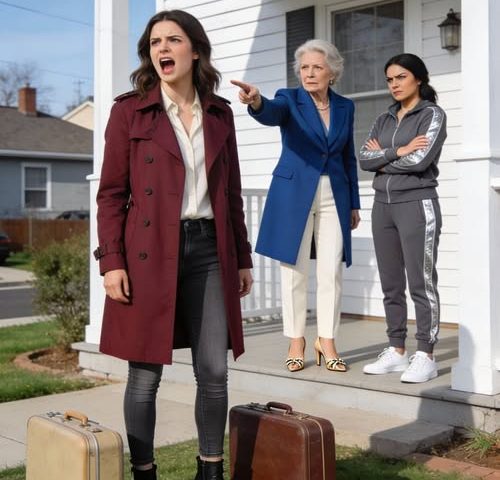
I remember the moment my mother-in-law, Linda, ordered me out of her house as if it were burned into my memory. There was no argument, no raised voices, no misunderstanding to clear up. Just a sharp, humiliating decree.
“Emily,” she said, standing stiffly in the doorway, arms folded, “you have exactly one hour to leave. If you’re still here after that, I’ll put your bags on the lawn myself.”
I stared at her, stunned. “What? Why? What did I do?”
Her tone never softened. “My daughter doesn’t feel comfortable with you here. And this is her home. That’s all you need to know.”
Behind her stood Heather—my husband’s stepsister—wearing a smug smile, like someone who had just won a long-planned game. I had only been staying there temporarily while my husband, Mark, was away on a month-long work trip. During that time, I helped with groceries, cleaned the house, and even paid part of the utilities. None of it mattered. The moment Heather returned from her latest “self-discovery retreat,” I became disposable.
So I packed quietly.
I didn’t cry. I didn’t argue. I didn’t beg. Something inside me shifted—a calm, irreversible decision to walk away and let them deal with the consequences of how they treated me.
I rented a small Airbnb and kept going. I didn’t tell Mark right away. He was already overwhelmed with work, and I wanted clarity before adding more weight to his shoulders.
A week later, my phone rang.
Linda.
“Emily,” she said sharply, skipping any greeting, “why haven’t you paid this month’s rent yet? The mortgage is due.”
I almost laughed. “Rent? Linda, I don’t live there anymore. You kicked me out.”
Heather’s voice shrieked in the background. “She still has to pay! She promised! She owes us!”
That was the moment everything became crystal clear.
“No,” I said calmly. “I don’t owe you anything. Not rent. Not help. Not money. Nothing.”
“You can’t just abandon us!” Linda snapped.
“I already did,” I replied.
The silence on the line was electric.
Two days later, Mark came home.
When I picked him up at the airport, he took one look at my face and knew something was wrong. Once we were in the car, the truth poured out—Linda’s ultimatum, Heather’s grin, the way I was pushed out with barely an hour’s notice.
Mark didn’t interrupt. He didn’t excuse them. His jaw tightened, his hands gripping the seatbelt.
“They threw my wife out of my own family home,” he said quietly, “and then demanded rent?”
“Yes.”
He exhaled slowly. “I’m calling her. Now.”
We pulled into a gas station. He stepped out and called his mother, his voice cold and steady. I could hear everything.
“Mom, explain why you kicked Emily out.”
Excuses followed. Heather shouting. Stories rewritten. None of it worked.
“You had no right,” Mark said. “And don’t ever ask her for money again. If Emily isn’t welcome, neither am I.”
The call ended abruptly.
From that moment on, we cut financial support entirely.
For a while, things were peaceful.
Then the messages started—pleas, accusations, guilt trips. I blocked them all.
Three months later, the truth surfaced.
Linda had been evicted. Heather had drained her savings, maxed out credit cards, and disappeared. The daughter Linda had protected at all costs had left her with nothing.

Mark and I talked long into the night. In the end, we chose compassion but with boundaries.
We arranged help through social services. Temporary housing. Job assistance. No money. No moving in. No return to the old cycle.
Then one Saturday morning, Linda showed up at our door.
She looked smaller somehow. Tired. Defeated.
She admitted everything – how Heather manipulated her, how she ignored warnings, how she lashed out at the one person who had actually helped.
“I treated you like a burden,” she said quietly. “When you were the only one holding us together.”
Mark was firm. “We’ll help you rebuild, Mom. But you won’t depend on us. And you won’t control us.”
She agreed.
Over time, she rebuilt her life slowly. Our relationship didn’t magically heal, but something new formed—respect, earned the hard way.
The last time I visited her, she took my hand.
“You were stronger than I ever saw,” she said. “Thank you for choosing kindness when you didn’t owe me anything.”
That’s when I realized something important:
Family isn’t defined by who hurts you first but by who chooses to change when everything falls apart.
And choosing peace over reve:nge was how I finally claimed the life I deserved.