The Man Who Owned Everything — Except What Truly Matters
Roberto Salazar was the kind of man people wrote articles about.
He started with nothing.
At twenty, he knocked on doors under a merciless sun, selling insurance to strangers who barely listened. At thirty-five, he founded his first real estate company. By fifty, he didn’t just own buildings—he owned entire blocks. His name appeared in glossy magazines beside phrases like self-made, visionary, proof of the American dream.
Money obeyed him. Power followed him. Doors opened before he even reached for the handle.
At home, he had Amanda.
She stood beside him for twenty-eight years—not as an ornament, but as an equal. She knew the man behind the suits, the ambition behind the smile. Together, they raised three children: Roberto Jr., Melissa, and Santiago. Roberto gave them everything he never had—elite private schools, summers in Europe, brand-new cars at eighteen, credit cards without limits.
He believed love could be expressed in comfort, security, opportunity.
Then Amanda died.
Cancer took her slowly, cruelly. And when she was gone, something else disappeared with her—the last person who saw Roberto as a man, not an empire.
The children changed after that.
At first, they came every other weekend. Then once a month. Then only on holidays. Eventually, not even that. Phone calls became short. Excuses became automatic. Silence became normal.
Six months ago, illness found Roberto too.
His body weakened day by day. Doctors spoke gently, carefully, the way people do when hope is thin. His bones ached. His lungs burned. Sleep came in fragments.
But none of that hurt as much as the quiet.
The silence of a mansion built for laughter that never came. The echo of empty hallways. The phone that never rang. No one asking, Are you okay, Dad?
That was when he hired Rosa.
She was a widow with tired eyes and steady hands, grateful for the job. She cleaned, cooked simple meals, and sometimes sat nearby while Roberto stared through the window at a world he no longer touched.
And every day, she brought her daughter.
Lucía.
Seven years old. Small for her age. Too thin. With eyes far older than they should have been—eyes that watched quietly, absorbing everything. She did her homework at the kitchen table, played silently in corners, never asked for anything.
Roberto barely noticed her at first.
Until one ordinary Tuesday…
when everything changed.
That day, Rosa had to rush out to the pharmacy. She left Lucía to watch the man for half an hour. The girl sat silently outside the room.
But at some point, he went down to the kitchen.
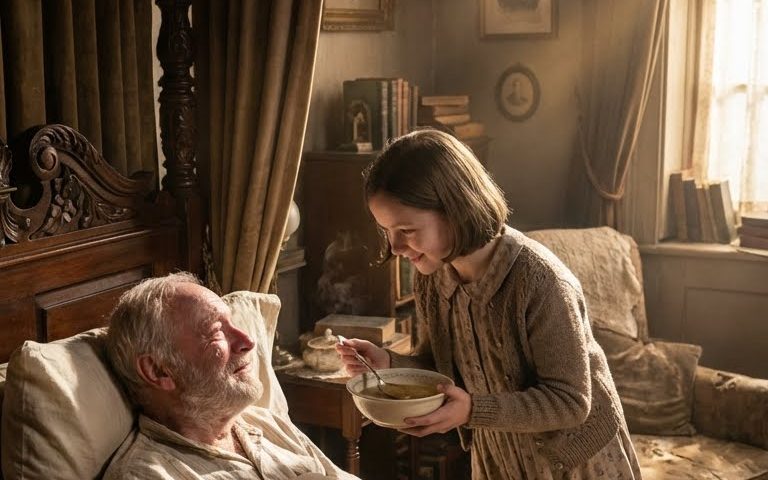
When Roberto heard footsteps coming back up the stairs, he thought Rosa had returned. But it was Lucía. She was carrying a bowl with both hands, walking slowly so as not to spill anything.
What was in that bowl was simple: noodle soup with vegetables. Nothing fancy. Nothing sophisticated. But made with the trembling hands of a little girl who saw a man suffering and wanted to help.
Lucía sat on the edge of the bed, afraid of doing something wrong. She brought the spoon to her lips. Roberto looked into her eyes. And in that moment he understood something he had forgotten for decades.
Love doesn’t come with university degrees or prestigious surnames. Love is this. A girl you barely know, giving you her time and effort without expecting anything in return.
She tasted the soup. It was salty. The noodles were half-cooked. But she didn’t mind.
Cry.
She cried for the first time in years. Tears that had been trapped behind a wall of pride and loneliness. Lucía was frightened, thinking she had done something wrong. But he took her hand and thanked her in a broken voice.
That night, Roberto couldn’t sleep. Not because of the illness. But because he had finally seen clearly what his children had become. And what he had allowed to happen.
The Decision That Changed Everything
The next morning, Roberto made three calls.
The first call was to her lead attorney, Fernando Ortiz, who had been handling her legal affairs for over 20 years. She asked him to come immediately with the entire team. It was urgent.
The second call was to his accountant. He needed exact figures, account statements, property valuations. Everything ready that same afternoon.
The third call was to his three children.
Roberto Jr. was in Monaco. Melissa was on a beach in Thailand. Santiago was at a resort in the Maldives. All three answered with their usual apathy. Yes, Dad. We’re coming. Next week for sure. I’m busy right now.
He didn’t insist. He just told them he loved them. And hung up.
When the lawyers arrived, Roberto was sitting in his study, more composed than he had been in months. As if something inside him had awakened. He explained what he wanted to do. Fernando initially thought he was delirious from the medication. He tried to reason with him. But Roberto was clear.
He wrote a new will.
In it, he completely disinherited his three children. Each would receive only ten thousand dollars. A symbolic amount. Enough to show that he hadn’t forgotten them, but insufficient to maintain the lifestyle they were accustomed to.
The remainder of his fortune, estimated at $47 million, would be divided as follows:
- 20 million would go into a trust for Lucía, Rosa’s daughter, which would be released when she turned 18, provided she finished university. In the meantime, she would receive funds for her education, health, and well-being.
- 15 million would be given to Rosa, in cash and property, so that she would never again have to worry about making ends meet.
- The remaining 12 million would be divided between foundations that help low-income people, public hospitals, and university scholarships for underprivileged youth.
Fernando warned him that his children would sue. That they would try to contest the will, claiming he wasn’t of sound mind. Roberto smiled for the first time in months. Let them try. He had recorded a video explaining every decision with perfect mental clarity. There were recent medical exams that proved his capacity for reasoning. And there were witnesses.
He signed each page with a trembling but determined hand.
Two weeks later, Roberto Salazar died peacefully. Rosa and Lucía were with him. They held his hand until the very end. Lucía sang him a lullaby that her mother had taught her.
He closed his eyes with a smile.
When the Children Discovered the Truth
On the day of the reading of the will, Roberto Jr., Melissa, and Santiago arrived dressed in black, wearing dark glasses and sporting well-rehearsed expressions of mourning. They expected to hear the division of the fortune into three equal parts. They had already made plans. Roberto Jr. wanted to buy a yacht. Melissa was thinking of opening an art gallery in New York. Santiago dreamed of investing in cryptocurrencies.
Fernando Ortiz began to read.
At first, silence.
Then, disbelief.
Then, screams.
Roberto Jr. slammed his fist on the table. Melissa began to cry, not from sadness, but from rage. Santiago accused the lawyer of fraud. They threatened lawsuits. Investigations. Destroying his dead father’s reputation.
But when Fernando played the video that Roberto had recorded, something broke.
On the screen appeared their father. Emaciated, but lucid. Looking directly at the camera. And telling them in a firm voice what he never dared to say to them while he was alive.
He told them he had loved them with all his heart. That he had given them everything material, thinking that was how he showed his love. But he had been wrong. That he had turned them into empty people, incapable of feeling empathy or gratitude. That when he needed them most, they weren’t there. But that a 7-year-old girl, who owed him nothing, had restored his faith in humanity.
He told them he hoped that ten thousand dollars would be enough for them to learn how to work. To value things. To be, for the first time in their lives, real people.
The video ended.
The three brothers left that office devastated. Not because of the loss of the money, but because they finally understood that they had lost something much more valuable: their father’s respect and love.
The Future That a Little Soup Built
Today, eight years later, Lucía is 15 years old.
She studies at one of the best private schools in the country. She’s the top student in her class. She wants to be a doctor. Specifically, a pediatric oncologist. To help children like her, who come from humble families and need hope.
Rosa no longer cleans houses. She lives in her own small but beautiful home in a quiet neighborhood. She cooks for a community kitchen she founded with some of the money Roberto left her. She feeds 200 families a week. For free.
Roberto’s three children tried to contest the will. They spent their last savings on lawyers. They lost every appeal. Eventually, they were forced to work for the first time in their lives. Roberto Jr. sells used cars. Melissa teaches yoga. Santiago works in a call center.
None of them have spoken to each other since. Not only did the fortune disappear, but so did the family.
But sometimes, at night, each of them thinks about that video. About their father’s words. And they wonder if they will ever be able to forgive themselves for having been so blind.
Meanwhile, fresh flowers appear on Roberto Salazar’s grave every month. Lucía brings them. And she always leaves a small handwritten note.
“Thank you for teaching me that love is not inherited. It is earned.”
The Lesson This Story Teaches Us
In the end, Roberto Salazar understood something many learn too late: money can buy comfort, luxury, and even power. But it can’t buy presence. It can’t buy a hand to hold yours when you’re afraid. It can’t buy soup made with love by someone who just wants to see you smile.
Her children had everything, except the one thing that matters: a grateful heart.
Lucía had nothing, but she gave everything.
And in the end, the millionaire who had everything decided to leave his fortune not to those who shared his blood, but to those who shared his humanity.
Because true inheritances are not measured in dollars.
They are measured in soup. In affection. In being present when no one else is.
And that is a wealth that no will can take away.