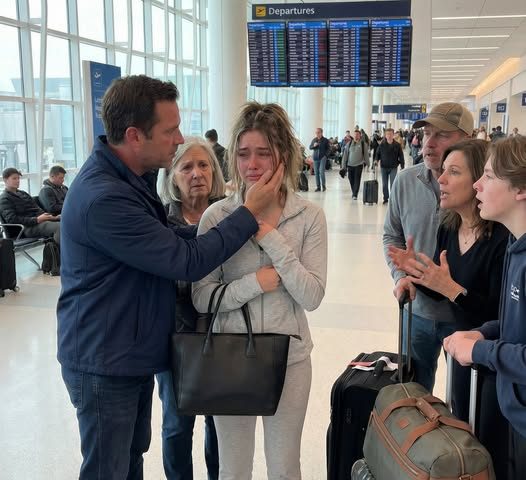

The Day I Chose Myself
At the airport, right before we were supposed to fly to Hawaii, my sister suddenly struck me across the face—in full view of dozens of travelers. My parents immediately rushed to defend her, as if they always had a script ready that cast her as the victim and me as the problem. She had always been their golden child. What none of them knew was that I was the one who had paid for the entire vacation. So I didn’t argue. I didn’t explain. I simply walked to the counter and quietly canceled all of their tickets. Then I turned around and left. What unfolded afterward shocked every single person standing there…
Chapter 1: The Invisible Daughter
My name is Celia Rachel, and I’m 27. For most of my life, I’ve been the quiet one—the easygoing daughter who swallowed her feelings and said, “It’s fine,” even when it absolutely wasn’t. My parents never paid much attention to me, not the way they did with my sister, Kara. Kara was the star of our family: dramatic, demanding, and spoiled from the moment she could talk. If she wanted something, it appeared. If I wanted something, it turned into a long negotiation, or simply didn’t happen at all. It became an unspoken family rule: Kara’s wants always came first, and mine rarely mattered.
A few months back, a naïve part of me wanted to change that pattern. I’d been saving for years—working late shifts, skipping outings with friends, budgeting every cent. Slowly, I built up a solid savings account. With those savings, I planned something big: a surprise family vacation to Hawaii. I booked the flights, the 5-star resort, the activities, even money for meals—every last detail paid for by me. I kept it a secret, hoping that maybe, finally, they’d see me… really see me. A grand gesture of love. A chance to break the cycle. I was wrong.
When the day of the trip came, the airport buzzed with energy—mostly from Kara’s excitement. She was barking orders at me like I was her assistant.
I looked at her with a calmness I barely felt. “No, Kara. You can carry it yourself.”
She froze. Slowly she lowered her sunglasses, her expression twisting into disbelief. “What did you just say?”
“I said no.”
Her response was immediate. A sharp slap cracked across my face, loud enough to stop conversations nearby. My cheek throbbed, my ears rang, and dozens of strangers stared at us in stunned silence.
I waited—stupidly—for my parents to defend me. To ask what happened. To check if I was hurt.
They didn’t.
My mother rushed to Kara instead. “Celia, don’t start drama,” she scolded. “Your sister’s been under stress.”
My father added, “You always take things too far. Just drop it.”
I stood there with a burning cheek and a colder realization: They had never seen me. Not once. Not for who I was, or what I did, or what I gave.
And what they absolutely didn’t know was that I had paid for the entire Hawaii trip. Every flight. Every room. Every dollar.
But in that moment, something inside me snapped. I was done being the forgotten daughter. Done being their emotional punching bag. Done being invisible.
Chapter 2: The Silent Retaliation
I stayed there for a moment, watching my parents fuss over Kara as if she were the victim. She played her part perfectly—lip trembling, eyes shimmering with pretend tears—occasionally glancing at the crowd to see who was watching. No one seemed to care that my cheek was still burning like a brand. No one cared that my own sister had humiliated me in front of strangers, while my parents silently sided with her.
With a steadying breath, I reached into my purse and took out my phone. My hands trembled—not from fear, but from a deep, simmering anger that had been building for years. The type of anger that doesn’t explode—it crystallizes.
I opened the booking app I had used to plan every detail of this trip. For a moment, my thumb hovered. Then I started.
One by one, I opened each reservation: the flights, the luxury hotel, the island excursions, the fancy dinner bookings, the rental car.
Tap. Cancel. Confirm.
Tap. Cancel. Confirm.
Each confirmation felt like removing another brick from a house built entirely on their entitlement. Brick by brick, I dismantled the trip I had crafted for them out of love—a love they had never returned.
They had no idea. My parents were arguing about where to eat before boarding. Kara was redoing her makeup, still pretending to be shattered by the “scene” she caused.
I inhaled deeply, letting the cold airport air fill my lungs. Then I turned and walked away. No confrontation. No tears. No explanations. Just a quiet exit, accompanied only by the sound of my own footsteps.
No one saw me leave. Not my parents. Not Kara. Not the spectators who had witnessed the slap. They were all too caught up in their own drama to notice that I was slipping out of their orbit for good.
I moved through the terminal, out the sliding doors, and into the cool air outside. I didn’t cry. I didn’t shout. I didn’t glance back.
Only silence—and the calm, steady realization that I was finally walking toward something I hadn’t felt in years:
Freedom.
Chapter 3: Escape to Paradise
Once outside the hectic terminal, I didn’t head home. Instead, I flagged down a taxi and asked the driver to take me to another terminal entirely. While I had been quietly dismantling my family’s dream vacation, a rebellious part of me had already begun crafting a backup plan. I had secretly booked a separate trip—a single ticket to Maui, the calmer, more peaceful island I’d always dreamed of visiting but never had the chance to. This time, the getaway would be mine alone.
As I settled into the back seat, the glow of the passing city lights smudging against the window, my phone started vibrating nonstop. First my mom. Then my dad. Then Kara. Calls, texts, notifications—an avalanche of frantic messages. I didn’t bother opening a single one. Instead, with a calm, unwavering swipe, I blocked all three numbers. The act sent a thrill through me—a mix of fear and fierce liberation. For the first time in my entire life, I put myself first. I chose peace over chaos, boundaries over guilt.
The flight to Maui felt like stepping into another world. Quiet. Still. Free from drama, tension, and the constant pressure to swallow my feelings. All I heard was the hum of the engines, the gentle tone of the flight attendant offering snacks, and my own breath slowly unwinding. I leaned my forehead against the cool window and watched the Pacific stretch endlessly beneath us. The sunset painted the sky in soft shades of gold, rose, and violet. And for the first time in years, a sense of freedom bloomed in my chest. I felt weightless.
After landing, I collected my small carry-on—the only bag I had packed for myself, unlike Kara’s mountain of luggage. Stepping outside the terminal, a warm breeze brushed my skin, carrying the scent of salt and plumeria. I felt something inside me uncurl, relax, expand. I hadn’t realized how tight I’d been wound until that very moment.
I murmured, almost to myself, “Thank you… I needed this more than I thought.”
My room overlooked the shoreline. I slid open the balcony door and stepped out into the soft night air. The ocean whispered against the sand. The breeze was warm. The stars blinked awake one by one. I stood there, breathing it all in—feeling the quiet press against my skin like a balm.
No accusations.
No belittling.
No being dismissed or overlooked.
Just me.
Just peace.
And it felt astonishingly, breathtakingly good.
Chapter 4: Finding My Voice
The next morning, I woke up rested — so rested it almost felt unreal.
I ordered breakfast to the room: pillowy pancakes, colorful fresh fruit, and coffee so rich it felt sinful. I ate slowly by the window, watching the sunrise streak the ocean with gold and pink.
I didn’t think about where my family was, how they were coping, or who was complaining.
They were no longer my responsibility.
That afternoon, I wandered the shoreline alone, letting the warm sand sift between my toes. On a whim, I signed up for a snorkeling trip — something I’d secretly wanted to do for ages but always avoided, sure Kara would laugh at me. The guide cracked jokes, the group was kind, and for the first time in what felt like forever, I laughed too — a real laugh, deep and free.
As sunset flared across the sky, I posted a photo online: me on the beach, smiling freely, waves behind me.
No caption.
Just peace.
But I knew they’d notice.
The next morning, curiosity pushed me to turn my phone back on.
It erupted — more than fifty missed calls, rage-filled texts, and long manipulative paragraphs from Mom.
Mom: I can’t believe you abandoned us! We’re stuck at the airport! How selfish are you? Your sister is devastated!
Dad: Celia, this is childish. Come home and fix the mess. We didn’t raise you like this.
Kara: YOU’RE DEAD TO ME. You ruined EVERYTHING. Hope you’re happy, freak.
I read every word with a steady heartbeat and clear eyes.
Their voices had finally lost their power.
I opened Instagram — Kara had predictably posted a poor-quality selfie at the airport, complete with a dramatic caption: When your deranged sister destroys your vacation.
Her comments were divided — some loyal, clueless friends offering sympathy — but others were asking uncomfortable questions: Wait, didn’t your sister pay for the trip? Did you actually slap her?
I closed the app and tossed my phone onto the bed.
That chapter — the toxic cycles, the begging for scraps of affection — was finished.
Instead of spiraling, I put on my swimsuit and went straight to the water.
I spent the day drifting in warm waves, reading under palm trees, sipping iced tea. Later, I booked a spa massage. The therapist — soft-spoken and intuitive — touched my shoulders and murmured, “You’ve been carrying so much.”
I smiled and answered, “Not anymore.”
That night, I ate dinner alone at a quiet outdoor restaurant, Hawaiian music floating in the breeze. The air was warm, the lights soft and golden.
Mid-meal, I looked around at the joyful tables and felt a startling truth settle over me:
I didn’t miss them.
Not even a little.
For the first time, I belonged fully to myself.
Chapter 5: My Story Matters
The next morning, I sat on my balcony with a warm cup of coffee in hand, replaying everything that had happened. It was still surreal—the slap, my parents’ icy silence, the way they instantly sided against me as though I had provoked Kara’s meltdown. But instead of feeling wounded or shaken, something else stirred inside me. A strength I didn’t recognize. It felt like a long-quiet volcano finally rumbling to life.
I opened my laptop and began to type—not for attention, not for anyone’s approval, but simply because I needed to put it into words. I wrote about the airport incident, of course, but I also poured out years of buried hurt: the subtle digs, the endless times I played the supporting role while no one ever supported me. I wrote about how being the quiet one had made me practically invisible, overshadowed by Kara’s constant spotlight. When I finished, I hesitated only for a moment before posting it on a blog I had made months ago but never dared to use. I titled it simply and honestly: The Day I Chose Myself.
Hours later, curiosity nudged me to check back. Dozens of views had become hundreds. Then thousands. Comments flooded in—gentle, understanding, raw.
Thank you for sharing this. You’re stronger than you think.
You didn’t miss a vacation. You reclaimed your life.
By the next day, the post had gone viral. It was being shared everywhere. A popular travel page even reposted it with the caption: Sometimes peace begins with a plane ticket—and a boundary.
Messages from strangers soon filled my inbox. People told me my story gave them courage. They shared experiences of walking away from toxic relationships or finally standing up to family expectations. And right there, sitting on that serene Maui balcony with the ocean murmuring below, I understood something deeply: My story mattered. I mattered. I wasn’t a background extra anymore—I was the main character of my own life.
A few days later, while hiking a quiet forest trail, I turned my phone on—just to check blog updates—and instantly regretted it. Kara had gone into full public meltdown. She’d posted a long, angry rant online, twisting the story in a desperate attempt to save face.
My sister ditched us at the airport! She’s lying! She’s always been jealous of me!
She even attached a fabricated screenshot of a plane ticket she claimed she bought—except the date was wrong and she had misspelled her own last name. People weren’t fooled for a second. The comments underneath were harsh.
Just admit she cut you off.
She paid for the trip and you slapped her. That’s on you.
This is exactly why boundaries exist.
Her attempt to drag me down collapsed spectacularly. I later learned she had also tried to rebook the Hawaii trip under my name, thinking she still had access to the “family” credit card—which was actually mine. But by then, I had already cancelled every shared card, closed every joint account, and secured everything she used to exploit. When she tried to use it at a fancy restaurant in front of her friends, it declined three times. She stormed out, mortified—and naturally, someone filmed the scene and posted it online. The internet truly misses nothing.
Meanwhile, I was in Maui savoring fresh mangoes, wandering along black sand beaches, and sleeping better than I had in years. My blog traffic continued to explode. A few travel companies even reached out, asking if I’d consider writing more or partnering with them.
That made me stop and think.
Maybe this trip wasn’t just a break.
Maybe it was the start of something entirely new.
Chapter 6: A New Horizon
After a week in Maui, I was no longer the woman who had been slapped at an airport.
Something inside me had shifted—lighter, steadier, outwardly calm but glowing with a quiet confidence I’d never carried before.
One morning, while sitting in a little café by the water, I opened my laptop and reread a message from a travel company that had reached out to me:
I stared at it for a long time.
Me. The person who spent years swallowing her words, constantly told to be quiet, sit down, don’t make trouble.
And now, someone wanted to hear me.
Someone valued what I had to say.
I replied with a single, powerful word: “Yes.”
Over the next several weeks, I kept writing—more stories about growing up invisible, about learning to draw boundaries, and about the wild liberation of choosing myself. I mixed in travel insight, healing moments, and photos of the tranquil places I was discovering.
What began as a rebellious little blog grew into something meaningful.
People wrote back, sharing their own stories.
Some booked their first solo trip after reading mine.
Others finally confronted people who had hurt them for years.
A few simply wrote, “Thank you for making me feel seen.”
I cried over those messages—joyful tears, swollen with gratitude and connection.
I stayed longer in Maui—not to escape my past, but to build a future on my terms. I even began imagining turning the blog into a full-time path, maybe even writing a book. And the most surprising part?
I didn’t feel guilty anymore—not for leaving, not for saying no, not for stepping away from people who never truly recognized me.
Then a message arrived—not from strangers or family (still blocked), but from Josh.
He was a college friend—one of the rare people who had always been genuinely kind. We had drifted apart through the years I spent exhausting myself for people who never cared.
His message nearly knocked the air from my lungs:
Celia, I read your blog. I don’t know how to put this—you’ve always deserved far more than you got. I’m proud of you.
Then:
If you’re still in Hawaii, I’d love to catch up or just talk. No pressure—just someone cheering you on.
I stared at it for a long while.
No guilt.
No manipulation.
Just support.
I smiled—really smiled—and typed back:
“Hi, Josh. I’m still here, and I’d love that.”
For the first time in ages, I felt something soft and unfamiliar blooming: hope.