The Day My Perfect Life Cracked Open
My name is Daniel Miller. On paper, I am the man everyone points to when they want to describe success. I built a tech consulting firm from nothing, own a glass-and-stone mansion in an exclusive neighborhood outside Dallas, drive cars that I used to recortar de revistas, and I’m married to Lauren Pierce, the kind of woman people stop to look at when she walks into a room.
I was the son who “made it.” The one who brought his mother, Rosa Miller, from a small town in New Mexico so she could “live her golden years like a queen.”
Or at least, eso era lo que me contaba a mí mismo.
I thought I had done everything right. I thought money, comfort, and a big house meant I was a good son. I thought bringing my mother into my world was the same as protecting her.
I had no idea how wrong I was.
The Marble Floor and My Mother on Her Knees
That day, my meeting in Houston finished hours earlier than planned. The highway traffic, que siempre me parecía un castigo, se sintió como un regalo extraño. I just wanted to get home, loosen my tie, see my twin boys, and, por una vez, just be Daniel, not “Mr. Miller.”
I pulled into the garage and stepped into the house from the side door. The moment I crossed the threshold, something felt off. The house was quiet, but not the peaceful kind of quiet. It was the kind of silence that feels like it’s hiding something.
I dropped my briefcase near the entry table and slipped off my jacket. I was halfway through loosening my tie when I heard it—a soft, almost broken sound. Not a baby crying. Not a TV.
A tiny, muffled whimper.
It came from the hallway near the guest bathroom. I frowned. That bathroom was usually pristine, almost for show. No one really used it.
Then I heard another sound.
Click. Click. Click.
The sharp, rhythmic sound of high heels on tile.
Lauren.
Her voice llegó antes que su sombra. Smooth, sharp, each word cutting the air with a cold edge.
“Are you going to sit there whining all day, or are you actually going to clean it properly?”
Every muscle in my body tensed. That tone. I had heard that tone before in arguments, in tense dinners, pero nunca dirigido así.
I stepped closer to the bathroom door. My heart picked up speed. I didn’t knock. I pushed it open.
And my world tilted.
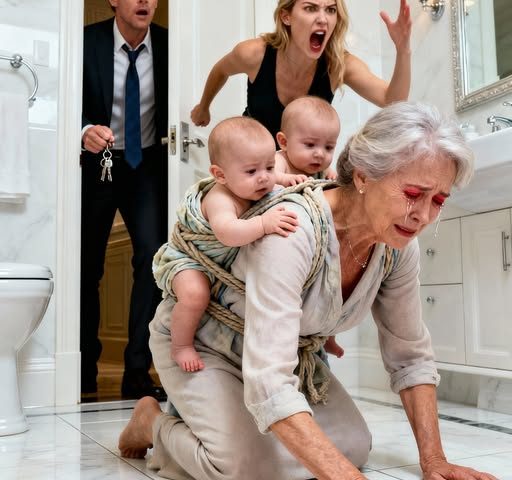
My mother was on her knees.
Not on a mat. Not on a cushion. Directly on the cold, polished marble floor. Her back rounded, shoulders shaking, hands red and raw as she scrubbed a corner behind the toilet with a sponge that smelled like something that burns your nose just by breathing.
But that wasn’t what broke me.
Tied to her back with an old, faded baby carrier were my twin sons, Noah and Caleb. My boys. My future. My blood.
They squirmed against her thin frame, their little faces pressed to her shoulder, letting out small, frustrated sounds. The weight of them bent her even more toward the floor.
Her hair was damp with sweat. Her breathing was short. Her knees were pressed so hard into the marble that I could almost feel the pain in my own bones.
“Almost done, ma’am,” she whispered without looking up. “My back just hurts a little.”
And there, standing in the doorway, perfectly dressed in a tailored blouse and beige trousers, arms crossed over her chest, was my wife.
Lauren looked at the three of them—her mother-in-law kneeling, her own children strapped to that fragile back—with the calm, distant expression of someone inspecting a piece of furniture that isn’t working properly.
The hit to my chest fue más fuerte que cualquier pérdida de negocio.
She let out a small, dismissive laugh. “Everyone hurts somewhere, Rosa. The difference is who decides to be strong and who decides to become a burden.”
She stepped a little closer, towering over my mother. “You want to keep living in this house? Then prove you deserve it. We don’t keep dead weight here.”
Every word went through me like a rusted blade.
I watched my mother lower her head even more, press the sponge harder into the floor, as if she could erase herself by cleaning just a little faster.
Something snapped inside me.
“What on earth are you doing to my mother?”
The shout tore out of me before I could control it. My voice bounced against the tile, the mirrors, the marble.
Everything went still.
Lauren’s face paled for a second. My mother flinched, her shoulders trembling.
In that moment, I understood something terrible: this scene was not new. This was not a misunderstanding. This was not a one-time thing. This was a routine that had been happening while I was on the road, in meetings, closing deals, believing I was “taking care” of my family.
The Silence of a Woman Who “Doesn’t Want to Be a Burden”
The silence after my shout felt heavy, like the air had thickened.
My mother stayed on her knees, frozen. Lauren was the first to move. She straightened her posture, smoothed invisible wrinkles from her blouse, and put on that calm, reasonable face she used in front of investors and cameras.
“Daniel, this is completely out of proportion,” she said, her tone measured. “Your mom offered to help. She says she feels useful when she does things around the house.”
Her words barely reached me. My eyes were locked on my mother’s hands—cracked, red, trembling around that sponge.
I stepped forward and slowly knelt in front of her.
“Mamá,” I murmured, my voice shaking in a way I hadn’t heard from myself in years, “look at me.”
It took everything in her to lift her face. Her eyes were wet, ringed with tiredness. Lines that I had never really seen now parecían profundísimas.
“I was just helping, mijo,” she whispered. “It’s nothing.”
Nothing.
She said “nothing” while kneeling on stone, with my children tied to her back, her legs trembling.
“Since when have you been doing this?” I asked softly.
She hesitated. Lauren jumped in.
“I already told you,” Lauren said, her voice taking on that sweet tone that always felt one note too high. “She can’t sit still. She keeps saying she wants to feel part of the home, part of the family. I just give her something to do.”
“I give her something to do.”
Like she was talking about a pet.
I closed my eyes for a second, and in that dark space a list of memories lined up like puzzle pieces I had refused to put together:
– The untouched prescription bottles on my mother’s nightstand because she “didn’t want to be a cost.”
– The way she woke up slower, rubbing her knees, saying, “It’s just age, don’t worry.”
– The way her eyes went quiet whenever I asked, “Are you okay, Mom?” and she always answered, “I’m fine, mijo, you focus on your work.”
I thought the problem was money. I thought the solution was better doctors, a nicer room, more comfort.
It never crossed my mind that the problem could be the woman I shared my bed with.
I opened my eyes and looked straight at Lauren. The trust I once had in her was now something thin and fragile.
“You really think it’s normal,” I asked slowly, “to have a woman close to seventy years old on her knees, cleaning your bathroom floor with my kids tied to her back?”
She rolled her eyes. “Daniel, don’t be dramatic. She grew up working hard. She’s not made of glass. And they’re her grandchildren. She loves being with them. Since when is that a crime?”
I turned back to my mother and gently cupped her face. “Tell me the truth, Mom. Did you want to be here like this today? Yes or no.”
Her lips trembled. Her eyes dropped to the floor again.
“I don’t want to cause trouble for you,” she said softly. “Lauren is not a bad person, she just has her way of doing things.”
That wasn’t loyalty. That was fear wearing the mask of loyalty.
I stood up slowly, my gaze never leaving Lauren. “Since when?” I repeated, my voice now firm. “Since when do you make her work like this when I’m not home?”
She exhaled sharply, losing patience. “I said what I said. Sometimes I ask her for help. That’s all.”
“How many times have you put her on her knees like this?” I asked, my voice rising despite myself. “How many times did she carry my kids like that while you watched?”
Lauren’s jaw tightened. Her silence was the answer.
In that second, I understood this wasn’t about help or chores. This was about power. About humiliating someone who would never defend herself because she didn’t want to lose her “place.”
I knelt again, my hands shaking as I untied the baby carrier.
“Hold still, Mom,” I whispered. “You are never again going to carry anything that hurts you. Not in this house. Not in my life.”
Once the boys were in my arms, I helped her sit up against the cool wall. Her breathing eased just a little.
Behind us, Lauren let out a snort. “You’re acting like she’s helpless,” she said. “You’re exaggerating everything.”
I turned to her. “What you call exaggeration, I call mistreatment. What you call ‘keeping her busy,’ I call humiliation.”
Her eyes hardened. “You forget where she comes from,” she replied, her tone sharp now. “She’s used to cleaning, serving, following orders. I just reminded her of her place.”
Her place.
“Her only place,” I said quietly, “is wherever she is treated with respect. And right now, that is not this house as long as you’re standing in it.”
It wasn’t a threat. It was a promise that had finally found words.
Then my mother whispered something that made all the air leave the room.
“It’s not the first time.”
The floor of my perfect life opened.

The Confession That Changed My Home Forever
Those four words echoed in my mind: It’s not the first time.
I knelt in front of her again, taking her hands in mine. They were cold despite the effort she had just made.
“Tell me, Mom,” I said, my voice low but steady. “I need to know. I’ve already failed you by looking away. Don’t let me fail you now by staying blind.”
Her face was a battle between love and fear. She wanted to protect me from the truth, even if that truth was destroying her. Finally, something inside her gave in and the tears began to flow—not just from pain, but from the weight of secrets carried too long.
“At the beginning it was just little favors,” she started, staring at a spot on the floor. “She asked me to wash some dishes, fold some laundry, watch the boys a few hours. I thought it was normal. I was grateful just to be here.”
My hands tightened.
“Then her tone changed,” my mother continued. “If I was slow, she said I was useless. If I made a mistake, she reminded me that people like me never know how to do anything right. She told me I should be thankful she was letting me live here, that without her I’d be out on the street.”
Her voice cracked, but she kept going.
“After a while, she didn’t ask. She ordered. Like I was an employee she didn’t have to pay. She would make me clean the floors on my knees. Sometimes she knew my legs were hurting and still told me to keep going.”
I looked at Lauren. “Is any of this a lie?”
She crossed her arms tighter. “I was just trying to keep some order in this house. Discipline isn’t mistreatment.”
“There were worse things,” my mother whispered.
The room swayed for a second. “What things, Mom?”
She took a deep breath that seemed to hurt. “When no one was around, she would speak to me like I was nothing. She said if I ever told you anything, she would make sure you believed her instead of me. She said you would think I was jealous of her, that you’d send me away and I’d never see my grandchildren again.”
I swallowed hard. “Did she ever push you? Grab you?”
My mother pressed her lips together so tight they turned white.
“You don’t want to know that,” she whispered.
“I do,” I said. “Because if I don’t know, I’ll keep sleeping next to the person who hurt you.”
She closed her eyes. “Once, I was carrying a basket of laundry and moving slowly because my hip hurt. She said I was in the way and shoved me aside. I almost fell. Another time, she threw a cleaning bottle near me and it splashed my hands. It burned, but I didn’t say anything.”
I turned again to Lauren. “How many times did you lay your hands on my mother?”
She scoffed. “She’s clumsy. If she got hurt, it’s because she doesn’t watch where she’s going. Besides, you’re already on her side, so why should I bother defending myself?”
I had seen bruises on my mother’s arms before and convinced myself they were from bumping into things. Now every mark had a different meaning.
“And the boys?” I asked, my throat tight. “Since when do you make her carry them while she works?”
“They’re her grandkids,” Lauren said. “She said she wanted to hold them.”
My mother shook her head slightly. “I wanted to rock them in the chair, not while scrubbing the floor,” she said quietly. “But if I ever said I was tired, she looked at me like I was ungrateful, so I stayed quiet.”
“Did you ever tell anyone? A neighbor? One of the employees?” I asked.
“No.” She lowered her head. “She said if I talked, I’d lose you. She knows that’s my biggest fear.”
I stood up. Something in me had changed. I wasn’t the CEO, the homeowner, the provider in that moment. I was just a son who had finally opened his eyes.
“You didn’t break, Mom,” I said softly. “I did. I broke the day I let someone walk into our lives and hurt the person who gave everything for me.”
I turned to Lauren. “You didn’t help her. You were breaking her a little more every day. That ends now.”
The Night the Doorbell Rang
“From today on,” I said, my voice calm but filled with something I hadn’t felt in years, “no one orders my mother around. No one speaks down to her. No one ever makes her feel less than human in this house again.”
Lauren laughed nervously. “You’re really going to take her side over your own wife’s? You’re really going to throw away your image, your perfect family, over a cleaning argument?”
“If our ‘perfect family’ is built on my mother’s pain,” I answered, “then it was never a family. It was a lie.”
I helped my mother stand, supporting almost all of her weight. “You’re going to rest now, Mamá,” I said. “You don’t clean another corner of this house. Not one. You’re my guest. You’re my mother. That’s your only role.”
Her tears fell freely. “I didn’t want to be a problem, mijo,” she whispered.
“You were never the problem,” I replied. “My blindness was.”
I guided her to her room and, for the first time, really looked around. The bed was small, the chair looked uncomfortable, and on her arms, under the thin skin, were small blue marks—some fading, some new.
My heart clenched.
I stepped back into the hallway. Lauren was there, arms still crossed, jaw tense.
“Did you ever grab her hard enough to leave bruises?” I asked.
“She probably bumped into something,” she answered too quickly. “She’s always in the way.”
“You know what?” I said. “I’ve listened to enough.”
A small sound came from the nursery. One of the twins had started fussing. Lauren shifted her weight. “I’ll go,” she said.
“No,” I answered, already walking.
I opened the door to the nursery. The air felt colder than it should. The twins were in their cribs, but one of them had a deep flush on his cheeks, and the other’s breathing seemed too heavy, like he was sleeping too deeply.
I reached down and picked them up, one by one. That’s when I saw it—a small bottle, half-hidden near the edge of the crib mattress. A few drops of liquid still clung to the rim.
My stomach twisted.
“What is this?” I called out, my voice sharp.
Lauren appeared in the doorway. “You’re overreacting,” she said. “Sometimes they didn’t sleep and I needed them to rest. It’s just something to calm them down. Nothing serious.”
“You gave our babies something to keep them quiet?” I asked, my voice low.
“It’s not like that,” she protested. “They were fine. I just needed peace sometimes. You’re never here, remember? Someone had to hold the house together.”
“That’s not holding anything together,” I said. “That’s putting them at risk.”
Before she could answer, the doorbell rang. Loud. Three short, firm chimes.
Lauren paled. “Who is that?” she whispered.
I shifted the twins in my arms and went downstairs. When I opened the front door, two men stood there. One wore a suit and carried a folder. The other wore a dark uniform.
“Mr. Daniel Miller?” the man in the suit asked.
“Yes.”
“I’m attorney Mark Reynolds,” he said, showing identification. “This is Officer James Parker. We’re here because a formal complaint was filed for mistreatment of an older adult and possible risk to minors in this residence.”
Behind me, Lauren’s voice cut through the air. “This is ridiculous. Someone is lying.”
Officer Parker looked past me, his gaze landing on my mother, who had slowly made her way to the hallway, holding onto the wall, and on the twins in my arms.
“We have video recordings,” the attorney continued. “Footage from inside the house showing verbal humiliation and physical aggression toward Ms. Rosa Miller, as well as evidence of unauthorized substances used on the children.”
Lauren’s face changed from anger to panic. “Who did this?” she shouted. “Who planted cameras? Who betrayed me?”
I didn’t answer. I didn’t care who had reported it—an employee, a neighbor, someone who had finally decided my mother deserved better.
I looked at Lauren. “You didn’t protect anyone,” I said quietly. “You used your power against the one person here who would never fight back, and you put our sons at risk.”
Officer Parker stepped forward. “Ms. Pierce, we need you to come with us,” he said. “You have the right to an attorney. Anything you say can be used in court.”
She struggled, shouted my name, threw words at me that once would have hurt. Now they just fell to the floor like broken glass.
When the door finally closed behind her, the house felt different. Still big, still polished, but for the first time, truly mine. Truly ours.
I went back to my mother and gently wrapped my free arm around her. “It’s over,” I told her. “It’s really over.”
She leaned her head against my shoulder. “I always prayed that one day you would see,” she whispered. “Today, God answered.”
A Garden That Finally Belonged to Her
The house looked the same from the outside the next morning, but inside, everything had shifted.
I closed the front gate myself, listening to the soft clank of the latch. With that sound, an entire chapter of my life felt like it was shutting.
When I turned around, my mother was standing in the doorway that led to the backyard, watching the sunlight spill onto the lawn like she wasn’t sure if she was allowed to step out.
“Do you… mind if I sit outside for a bit?” she asked, almost in a whisper.
“Mom,” I said, walking toward her, “every inch of this place is yours. You don’t need to ask.”
I helped her down the steps. We found a chair under a large tree in the yard. She sat slowly, then closed her eyes as the afternoon light touched her face. One small tear slid down her cheek.
“I used to look at this yard from the window,” she said softly. “I told myself it was enough just to see the trees from far away. I didn’t want to bother anyone asking to come outside.”
“You were never a bother,” I replied. “You just ended up living with people who made you feel that way.”
I went back inside and opened every curtain, every blind. Light flooded the house, chasing away the shadows that made everything look colder. I fired two employees who had watched too much and spoken too little. I called a doctor to check on my mother and the twins. I called my assistant and said one sentence that surprised even me.
“For a while,” I told her, “don’t schedule anything that takes me away from this house. If it’s not urgent, it can wait. My priority is my family now.”
Back in the yard, my mother gently rocked Noah in her arms while Caleb slept in his stroller. The boys were calmer, their little bodies no longer tense. They knew, in that mysterious way children do, that the air had changed.
“May I hold them?” she had asked earlier, almost afraid.
“You never have to ask that,” I had answered. “You’re their grandmother. You’re home.”
Watching her that afternoon, I realized something: for the first time since she moved in, she didn’t look small. She looked like someone returning to herself.
That night, instead of a formal dinner at the huge table Lauren loved, we ate simple food at the small kitchen table—soup, bread, tea. My mother held her spoon with shaky hands.
“It’s been a long time since someone sat and truly ate with me,” she said quietly.
I looked at her and made a silent promise: that sentence would never be true again.

Repair Is More Than Money
The days after Lauren left went by slower, but in the best way.
I started waking up early, not to check emails or read reports, but to listen to the soft breathing of my sons. To see if my mother had slept well. To bring her breakfast without her having to ask.
She laughed the first time she saw my attempt at scrambled eggs. “You can build a whole company,” she said, “but the eggs are winning this battle.”
We both smiled. There was a gentle kind of healing in those small, ordinary moments.
One afternoon, as sunlight streamed through the living room windows, I sat next to her on the couch.
“Mom,” I began, “I’ve been thinking a lot about everything that happened here. About what you went through. About how long I didn’t see it.”
She gave me that same warm look she had given me as a kid when I brought home bad grades. “It’s over now, hijo,” she said. “I don’t want to stay in the past.”
“I do,” I replied. “Not to live there, but to make sure I change what needs to change.”
I took a small key ring from my pocket and placed it in her hand. Two keys, plain and simple.
“What’s this?” she asked, confused.
“A house,” I said. “Not a mansion like this. A smaller place, with a front porch and a quiet street, near a park. A place where no one will ever order you around. A place that is yours.”
Her eyes widened. “For me?”
“For you,” I nodded. “Because you should never again feel like you’re asking permission to exist. Because everything I’ve built started with your sacrifices. And because peace is not a luxury for you—it’s your right.”
Her hands began to shake. “Daniel, I don’t need all that,” she whispered. “I just needed to feel like I wasn’t in the way. Like I still mattered.”
I pulled her into a hug. “You have always mattered more than any deal I ever closed,” I said. “I just forgot to show it.”
The twins crawled toward us, babbling, and she laughed through her tears. “Maybe I lost some years,” she said, her voice breaking. “But today, I feel like I gained a whole new life.”
But it hit me then: giving her a house was only one part. I had spent years trying to “pay back” her sacrifices with things—cars, trips, a big room. In the end, what she really needed was my time, my presence, my courage.
So I did something that would have terrified the old version of me.
I stepped back from my company.
I passed control to my leadership team. I sold a large part of my shares. I made it clear to everyone: for the next year, my main job title was not CEO, but son and father.
We didn’t move into some distant luxury property. Instead, we chose a comfortable, bright house on a tree-lined street a few hours away, in a quiet town where kids played in front yards and neighbors still greeted each other by name. My mother chose the curtains. I let the twins choose the paint color for their room.
On top of that, we began legal steps so that my mother would be recognized as a primary caregiver for the boys. Not because I was walking away, but because I wanted it written in every possible way: she mattered here. She held a place no one could take from her again.
From far away, Lauren tried to fight—through attorneys, messages, noise. But my focus had shifted. I wasn’t fighting to keep a picture-perfect life anymore. I was working to build a real one.
The Legacy My Mother Didn’t Know She Was Building
The new house wasn’t enormous. It didn’t have a gate or a pool. But it had something our mansion never truly held: warmth.
The walls were painted in soft colors. The kitchen always smelled like coffee or something baking. In the small yard, my mother planted jasmine and roses, just like the flowers she had loved in her hometown.
She made friends with the neighbor next door. They shared recipes, sat on the porch together in the evenings, and watched the twins race their toy cars along the sidewalk.
I, the man who once measured his worth by his calendar and his bank account, learned how to change diapers half-asleep, rock crying babies at three in the morning, and fall asleep in a chair with a child on my chest and my mother knitting quietly nearby.
One morning, as we drank coffee on the porch, my mother asked, “What will happen with Lauren now?”
“There will be legal consequences,” I answered calmly. “For what happened with you and with the boys. And I’m moving forward with the divorce. There’s no going back.”
She sighed, not with anger, but with a sadness I recognized. “I’m praying for her,” she said softly. “Living with that much hardness in the heart must be its own punishment.”
That was my mother. Even with all she endured, she still chose compassion.
Her story, sin embargo, no se iba a quedar dentro de estas paredes.
I realized there were many older parents like her—living in big houses or small apartments, in cities or suburbs—quietly enduring mistreatment because they didn’t want to be “trouble.”
So I used the network I had built for business for something else. I created a foundation. We called it Golden Dignity. Its mission was simple and hard at the same time: to support older adults facing mistreatment within their own families and to protect the grandchildren who grow up watching it.
We didn’t use my mother’s name publicly. She didn’t want that. Pero su historia, contada de forma anónima, se convirtió en la chispa que encendió todo.
As the foundation grew, something inside me healed. The pain of discovering what had happened under my own roof would never fully disappear, but it turned into direction. Into purpose.
The mansion in the old neighborhood? I sold it. Every dollar from that sale went straight into Golden Dignity.
For the first time in my life, I didn’t feel like “the millionaire.” I felt like a son who had finally decided to honor the person who raised him.
If You Were in My Place…
A year later, on a quiet Sunday afternoon, I found my mother on the porch of our new home. She was in her favorite rocking chair, little Liam asleep across her lap, the scent of jasmine drifting through the air.
I sat beside her. We didn’t speak for a while. We didn’t need to. The silence was simple, peaceful.
“Thank you, son,” she said finally. “Thank you for not leaving me in that pain. Thank you for seeing me.”
I took her hand. Her skin, once cracked from chemicals and strain, was soft now. “Thank you for giving me a second chance to be your son,” I replied. “I thought success meant never stopping. Now I know real success is having the courage to stop and look at the people who love you.”
She smiled, the kind of smile that only comes after many storms.
“Do you remember when I told you that you didn’t want to know the truth?” she asked.
“I remember,” I said.
“I was afraid the truth would break you,” she continued. “But now I see you had to break a little, hijo. Your heart had to open so it could grow.”
In that small house, far from the marble floors and cold hallways, I finally understood the deepest lesson of my life: you can rebuild a company, you can buy another house, you can replace cars and furniture. But you only get one mother.
I lost time, yes. But I was given something even more powerful—a chance to change.
And now I want to ask you something.
How many people like my mother are sitting quietly in kitchens, in bedrooms, in living rooms, holding back tears so they won’t “cause problems”? How many parents and grandparents carry the weight of fear in their own homes just to avoid being “a burden”?
If you were in their place, would you keep enduring in silence, letting a little piece of you fade every day? Or would you find the courage to speak, even if it changed everything?
And if you were in my place—if you discovered that someone you love is being humiliated behind closed doors—would you dare to face the truth, even if it meant letting go of the image you worked so hard to build?
I really want to know what you think. Tell me, from your heart: what would you do if you found out someone in your home was suffering in silence?
If this story touched you, made you think of someone, or opened your eyes even a little, don’t keep it only for yourself. Share it with someone who might need to hear it today. Leave a comment, tell me where you’re reading from, and remember this: once you truly see the truth, you never again want to live with your eyes closed.