THE WHISPER THAT SAVED MY WEDDING NIGHT
My name is Alyssa Grant, and for most of my twenties my life looked exactly like the kind of story people don’t take seriously. I was a freelance illustrator in Milwaukee, juggling kids’ weekend art classes, tiny logo jobs for local cafés, and a stack of unpaid invoices that lived in the same drawer as my big dreams.
My studio was small, my rent was barely manageable, and my future was this blurry watercolor I kept trying to define. I wasn’t rich, but my days smelled like coffee and paint, and I honestly thought that was enough.
Then I met the man everyone said was “perfect for me.”
And for a while, I believed them.
The Man Who Seemed Too Perfect
I met Cole Harrington on a night I almost stayed home.
A friend had begged me to bring some of my work to a small gallery in downtown Chicago—a show for “emerging artists,” which usually meant free wine and a lot of polite nods. I hung a piece called A Field Without Sound in a quiet corner: layered blues, soft shadows, the feeling of standing in an empty field after something important has already happened.
I didn’t expect anyone to really see it.
But he did.
He stood in front of my painting longer than anyone else, tall and sharp in a charcoal suit that looked like it belonged on the cover of a financial magazine. His hair was neat, his tie perfect, his posture relaxed in a way that said he was used to being listened to.
He tilted his head, studying my work, and when he finally turned, his eyes were softer than the rest of him.
“This piece feels like you painted a moment you couldn’t quite describe,” he said.
Most men I’d met at events like this said things like “Nice colors” or “My sister likes art.” Not this. Not something that sounded like he was peeking inside my head.
I should’ve made a joke, shrugged it off.
Instead, I felt…seen.
He introduced himself as a wealth management consultant. He traveled often. He “knew nothing about art,” he said, but he knew how it felt to stand in front of something and just…stop.
“Maybe you could walk me through it sometime,” he added. “Over coffee?”
I said yes before my brain had time to remind me that men like him didn’t usually choose women like me.
Within weeks, his presence slid into every corner of my life.
He drove over early with my favorite breakfast when I had a deadline.
He bought me a new easel because my old one leaned to the left.
He ordered two of my prints “for his office,” then surprised me with a new desk chair when he noticed mine squeaked.
He watched me when I worked and said things like, “You deserve better clients,” or “People should be lining up for this.”
He made me feel chosen.
My friends adored him.
My parents adored him.
Everyone adored him.
Everyone except my sister.
The Sister Who Didn’t Clap
Natalie has always been the one who notices what other people miss. She’s a legal researcher for a private firm in Madison, the kind of person who can spot a hidden clause in a forty-page contract and remember exactly where she saw a name three months earlier.
She met Cole at a family dinner and did not swoon.
She watched.
Later that night, while we made tea in my tiny kitchen, she leaned against the counter and said, “He’s too polished.”
I rolled my eyes. “That’s not a crime, Nat.”
“No,” she agreed. “It’s just… no one’s that perfect.”
“He’s good to me,” I snapped. “Is that a problem?”
She didn’t flinch. “I didn’t say he wasn’t good at being good to you.”
I hated how easily she could poke holes in my happiness.
The words came out before I could stop them.
“Are you jealous?”
The second they left my mouth, I wanted them back.
Natalie went quiet. The look in her eyes wasn’t anger—it was something closer to grief.
“I just want you safe, Lys,” she said softly. “That’s all.”
I turned away, pretending I didn’t hear the tremor in her voice.
If I had listened that night, my wedding would have gone very differently.
The Proposal That Felt Like a Promise
Six months after that gallery night, Cole took me to dinner at a small restaurant overlooking Lake Michigan. The lights were low, the water was calm, and the ring he slid across the table sparkled like it had been designed for a magazine cover.
He talked about building a future together.
About stability.
About a life where I “didn’t have to worry about money or schedules or chasing clients who didn’t pay.”
It sounded like relief wrapped in romance.
I said yes with tears in my eyes.
We booked the Crystal Fern Conservatory for the wedding—a glass building filled with white orchids, tall trees, and light that poured in through the high windows in soft, flattering sheets. It looked like the kind of place where perfect couples said perfect vows and floated into perfect lives.
My dress was satin and simple, hugging me in all the right places.
Cole’s suit looked less like fabric and more like armor.
Everyone kept saying the same thing: “You two are a dream.”
I wanted to believe them.
The Morning Warning
The morning of the wedding, Natalie left the hotel early. She told me she needed to “double-check something for work.”
I barely noticed. I was too busy trying not to cry while my makeup artist worked.
But later, while we drove to the conservatory, Natalie’s silence felt heavier than her bridesmaid dress. Her phone buzzed twice. She ignored it. Her jaw was tight in a way I had seen only a few times in my life—usually when she was in courtrooms, not in matching satin.
“You okay?” I asked.
She looked at me for a long moment, like she was choosing between telling me something and keeping me calm.
“I went by Cole’s office,” she said finally. “I had a weird feeling.”
My stomach tightened. “About what?”
“I’ll tell you if I find anything,” she said. “Today is your day. I don’t want to ruin it unless I have to.”
It bothered me, but then we pulled up to the conservatory, and people were already waiting, and the air smelled like flowers and champagne. Somewhere between the music and the cameras, I decided she was overthinking like she always did.
I didn’t know that in a quiet hallway outside his office that morning, she had stopped when she heard his voice behind a half-closed door.
She didn’t tell me—yet—that she heard another man say,
“Make sure everything is ready on the second floor. We can’t have her walking out of that room tonight.”
And Cole replied, in that calm, persuasive voice I knew too well,
“Relax. Once she cuts the cake and signs, she’s not going anywhere.”
I didn’t know any of this when I walked down the aisle.
I just saw the man I thought I loved, standing under a glass ceiling full of light.
A Wedding Wrapped in Glass
The ceremony was beautiful.
Our vows were simple and sweet.
People cried in the way people cry when they believe they’re watching something pure.
By the time we walked into the reception, I felt like I was walking through a dream someone had painted just for me. The band played soft jazz, crystal glasses caught the light, and the towering six-tier cake stood in the middle of the room like a sculpture.
Cole held my hand as we walked toward it. Cameras lifted. Guests gathered around us in a soft, excited circle. Everything sparkled.
He gave me that practiced, perfect smile.
“Ready to make it official?” he murmured.
He placed his hand over mine on the cake knife.
That was the moment my sister stepped onto the small stage.
The Whisper That Split the Night
At first, everyone thought she was coming to join the photo. A few people even clapped. Natalie smiled for the crowd, for the cameras, for appearances. But when she reached me, her arms wrapped around my shoulders in a grip that didn’t feel like celebration.
Her body was shaking.
Her lips brushed my ear.
“Alyssa,” she whispered, “don’t cut the cake. Push it. Now.”
My chest tightened. “Nat, what are you talking about?”
Her voice broke on the next words.
“If you want to be safe tonight, do not cut that cake. Push the table over.”
I pulled back just enough to see her face. She dropped her gaze, pretending to adjust the hem of my dress, hiding her expression from everyone but me. Her fingers dug into my wrist hard enough to leave marks.
“Please,” she whispered. “Trust me just this once.”
I followed her eyes over her shoulder.
Straight to Cole.
He was not looking at me.
He wasn’t looking at Natalie.
He was looking at his watch.
His jaw was tight. His shoulders were set. There was a small curve at the corner of his mouth—a faint smile that felt wrong the second I saw it. Not warm. Not proud.
It looked like a man counting down to a result he already expected.
For a moment, the sounds of the room faded. All I could hear was the soft clink of glass and my own breathing. A tiny voice inside me whispered, Something is wrong.
He looked up at me, and that almost-smile never reached his eyes.
“Go ahead, sweetheart,” he said, his hand tightening over mine on the knife. “Cut deep.”
A chill ran straight down my spine.
That wasn’t how a husband sounded.
It was how someone sounded when they were waiting for a plan to click into place.
Something inside me cracked.
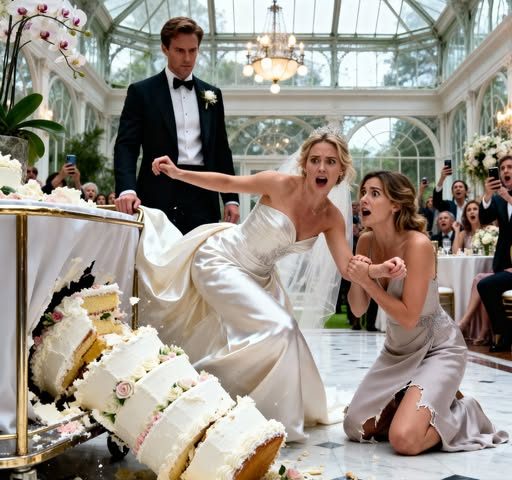
Before I could lose my nerve, I shifted my weight and slammed my hip into the table.
The cake stand skidded.
The towering masterpiece tilted in slow motion.
Then six perfect tiers of white frosting and sugar flowers crashed to the marble floor.
The room erupted in gasps. Someone dropped a glass. A few people instinctively stepped back to avoid the mess.
I didn’t look at the cake.
I looked at Cole.
The mask slipped.
Gone was the charming, steady groom.
In its place was something sharp, cold, and furious that he couldn’t hide fast enough.
“What did you do?” he hissed under his breath, his fingers digging into my arm.
Before I could speak, Natalie grabbed me.
“Run,” she said. “Now.”
And I listened.

Running in a Wedding Dress
We jumped off the low platform, my satin dress snagging on the edge. Voices rose around us. Some guests called our names. Others just stared. Phones lifted, recording.
Behind us, Cole’s voice cut through the noise—quiet but controlled:
“Don’t let them leave the building.”
He wasn’t shouting.
He wasn’t panicking.
He was issuing an order.
Somehow, that calm tone scared me more than if he’d screamed.
“Move!” Natalie urged, dragging me through a side aisle lined with tables. We pushed past confused relatives and startled friends. I heard someone whisper, “Is this part of the program?”
We burst through a side door and into a service corridor that smelled like dish soap and metal trays. Cooks and waiters froze as two women in dresses flew past them—one in a ruined white gown, the other barefoot and wild-eyed.
“Sorry!” Natalie yelled over her shoulder, pulling me toward the glowing red EXIT sign at the back.
“Nat, please,” I panted. “Tell me what is happening!”
“Not here,” she said. “Keep going.”
We shoved open the door and stumbled into the employee parking lot. The night air hit my face like ice. Natalie’s old silver sedan sat at the far edge of the lot.
“Get in,” she ordered.
I obeyed.
Her hands shook as she started the engine, but once the car moved, her focus snapped into place. Gravel sprayed. The conservatory shrank in the rearview mirror until it was just a glass box full of light and confusion.
The File on the Passenger Seat
For a few minutes, the only sound inside the car was my breathing and the low hum of the engine. My dress felt too tight, heavy with frosting and fear.
“Natalie,” I whispered, “please. I just walked out of my own wedding. Tell me why.”
She swallowed, eyes fixed on the road. Then she reached back, grabbed a thick beige folder and a small recording device, and dropped them in my lap.
“I went to his office this morning,” she said. “I heard something. I wasn’t going to say anything unless I had proof.”
“Proof of what?”
“That he’s not who he says he is.”
My fingers trembled as she clicked play.
Cole’s voice filled the car—calm, smooth, professional.
“…She’ll sign the documents tonight. We’ll present them as a natural step in merging assets. Newlyweds sign things all the time.”
Another male voice responded, “And if she hesitates?”
Cole chuckled softly.
“She won’t. She trusts me. And if there’s any sign of emotional strain afterward, the evaluation team will step in. Once she’s relocated, no one close to her can interfere with the process. By then, everything important will already be in my control.”
Relocated.
Evaluation team.
Control.
My hands went numb.
Natalie turned off the recording.
“He’s been planning this for months,” she said quietly. “It’s a legal strategy some people use to take over everything—money, property, even decisions. It’s rare, but it happens. He had drafts prepared, calendar entries, notes to his assistant. Tonight was the final step.”
I stared at the dark highway, the world outside the windshield blurring.
“He was going to say I wasn’t stable,” I whispered. “Use how emotional I am against me.”
Natalie’s voice softened.
“He chose you because you feel deeply, Lys. That’s what makes you an artist. He was going to turn that into a weapon and call it evidence.”
My chest ached.
“Was I really that blind?”
She shook her head.
“No. You were in love. He counted on that.”
The Precinct Under Harsh Lights
Natalie pulled into the lot of the nearest police precinct and turned off the car. The building looked plain and solid, nothing like the glittering glass world I’d just left.
“Come on,” she said. “We’re not running. We’re reporting.”
Inside, the fluorescent lights felt unforgiving. I walked up to the desk in a torn wedding dress, barefoot, with streaks of frosting still on the hem. Natalie stood beside me, holding the folder and the recorder like a shield.
We sat down with officers and laid everything out:
-
The recording.
-
Draft financial documents Natalie had printed from his office files.
-
Screenshots of calendar entries mentioning “evaluation” and “adjustments.”
-
A small container holding a smear of frosting from the top tier of the cake—just in case it turned out to be more than sugar.
They didn’t roll their eyes.
They didn’t tell us to calm down and go home.
They listened.
They took notes.
They called in a supervisor.
They asked clear, careful questions.
One of them finally said, “You did the right thing by coming here before signing anything. There’s enough here for us to investigate him immediately.”
For the first time that night, I felt like I could breathe.
Returning to the Scene
Police cars followed us back to the conservatory. When we stepped inside, the reception hall looked nothing like the room we’d left.
The cake was gone, leaving only a smear of frosting and scattered sugar flowers on the floor. Guests clustered in uneasy groups, whispering. Some of them looked irritated, others worried.
Cole stood near the stage on a chair, his tie loosened, his expression carefully shaped into concern.
“She’s overwhelmed,” he was saying. “You know how creative people are. The pressure, the expectations… she just needs time. Please don’t judge her.”
A few guests nodded sympathetically. Some looked doubtful.
Then the officers stepped in behind us.
Cole’s eyes landed on the uniforms first, then on me. For a moment, surprise flickered across his face. It wasn’t the look of a man relieved to see help.
It was the look of someone recalculating.
He stepped down and started toward me, hands raised as if he were walking toward a frightened animal.
“Alyssa,” he said smoothly, “you’re upset. That’s okay. Let’s talk in private. Everyone here understands—”
An officer moved between us.
“Sir, I’m going to ask you to stay where you are.”
The room quieted. Phones came up again, recording. A few older guests exchanged glances, whispering, “Something’s wrong,” and “Look at his face.”
Cole’s jaw flexed.
“This is a misunderstanding,” he insisted. “My fiancée is having an episode. Everyone here saw how she—”
I stepped forward before he could finish. My hands were still shaking, but my voice wasn’t.
“No,” I said. “They’re about to see how you behave when someone doesn’t follow your script.”
For a second, the charm drained from his eyes, leaving something empty and cold behind.
“Alyssa,” he said quietly, “you’re making this worse for yourself.”
Natalie moved to stand at my side.
“I’m making it honest,” I replied. “No more pretending.”
The officers didn’t argue with me. They turned to him instead, asking him to answer questions. His voice rose and fell in practiced waves—denials, explanations, little half-smiles thrown at guests like confetti.
But the mood in the room had shifted.
People weren’t clapping anymore.
They were watching.
And I realized something important: for the first time since I met him, I wasn’t performing for his version of my life.
I was telling the truth for mine.
The Dress That Needed to Burn
When the officers had what they needed and the guests started to leave in small, uneasy groups, Natalie drove us away from the city.
We ended up on a quiet stretch of beach just as the first pale hints of sunrise touched the water. The air was cold but clean. It didn’t smell like orchids or champagne or lies.
I stepped out of the car in my ruined wedding dress. The skirt dragged through sand and ashes of sugar roses.
Natalie gathered driftwood and built a small fire near the waterline. Neither of us spoke for a while. The crackle of the flames and the soft rush of the waves did the talking.
She looked at me, her eyes tired but gentle.
“You don’t have to do this,” she said.
“I think I do,” I answered.
I unzipped the dress and slipped out of it, folding it slowly, carefully, like it still mattered. For a second, I hesitated. This was the dress I’d thought I would wear into my new life.
Then I remembered his smile at the cake.
His voice on that recording.
The way he said, “She trusts me.”
I placed the folded dress on the fire.
The satin caught, curling and shrinking as the flame climbed. It felt like watching a version of myself disappear into the smoke—the woman who believed that a perfect man in a perfect suit meant a safe future.
Natalie walked over and wrapped a blanket around my shoulders. Her hands were warm against my cold skin.
“You’re okay now,” she said quietly. “You’re out.”
I leaned into her, my body exhausted in a way that had nothing to do with the hour.
“I thought you hated my happiness,” I whispered. “Every time you questioned him, it felt like you were trying to pull me back down.”
She shook her head, tears shining in her eyes.
“I never hated your happiness, Lys,” she said. “I hated the way he was building it. I didn’t want you to wake up one day and realize the whole thing was a cage.”
I let her words settle between us, warm and heavy.
“Emotions are not a weakness,” she added. “You feel deeply. That’s your gift. You just needed someone next to you who wouldn’t turn that into a tool.”
The fire burned lower. The dress turned to blackened shapes and then to gray.
Sisters in the Sunrise
We stood there until the sun finally broke the horizon, spilling soft light over the water. The lake looked calm and endless. Seagulls called somewhere in the distance.
I didn’t have a husband.
I didn’t have the storybook ending people had clapped for hours earlier.
But I was standing.
And I wasn’t standing alone.
I looked at my sister—the woman I had accused of jealousy, the one who had run barefoot through a crowded hall, whispered “Run,” and dragged me out of a future I never wanted to see up close.
“I lost a lot tonight,” I said quietly.
Natalie squeezed my hand.
“You lost a lie,” she answered. “You kept your life.”
A wave rolled in, smoothing the sand where the ashes had fallen. The world didn’t look perfect. It looked real.
I realized then that love doesn’t always show up in the shape we expect. It isn’t always a flawless smile, a perfect ring, and a glass building full of applause.
Sometimes love looks like a sister who hears something behind a half-closed office door and refuses to stay quiet.
Sometimes it sounds like a whisper at your ear:
“Don’t cut the cake. Push it. Run.”
Sometimes it’s the pair of arms that catch you when the life you thought you wanted collapses, and the voice that stays beside you until the sun comes up, reminding you that you are still here.
That morning, barefoot on the sand with a blanket around my shoulders and ash at my feet, I finally understood:
I hadn’t lost everything.
I had gained the one thing that mattered most—
the truth,
and a sister who would tear her way through a room full of people
just to pull me back into the light.