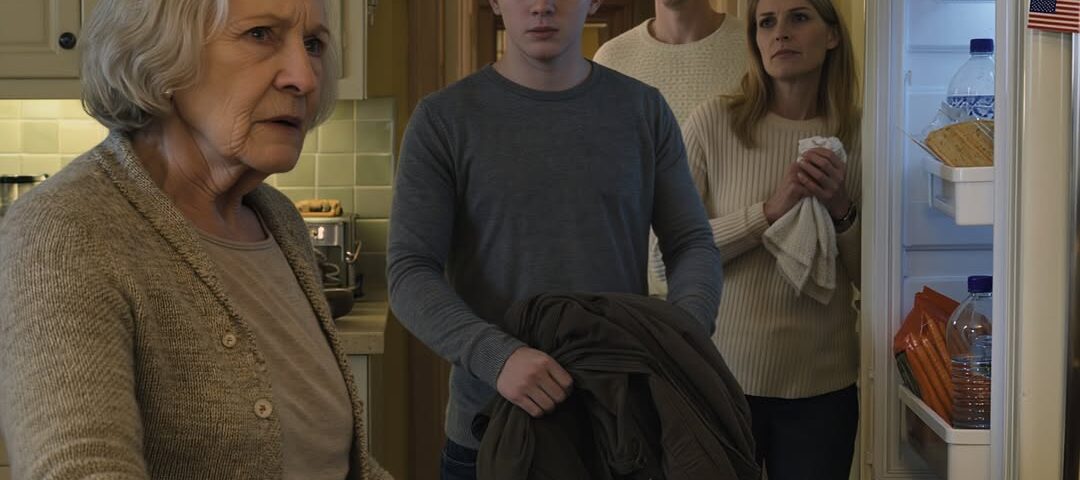
My grandson came to visit me and saw the empty fridge.
“Grandma, why are you starving if you received Grandpa’s inheritance?”
At that moment, my son came out of the room and proudly said, “I gave her money to my mother-in-law to buy her a new house!”
Then my grandson slowly took off his coat…
…and did something that made me love him deeply.
“Why are you starving if you got Grandpa’s inheritance?” my grandson Liam’s voice echoed in the kitchen that Saturday afternoon. He had just opened the refrigerator and frozen in front of the empty shelves. There was only a half-full bottle of water and a piece of stale bread wrapped in a napkin.
He turned to me with wide eyes, waiting for an answer I did not know how to give. The words got stuck in my throat like stones. My mouth opened, but no sound came out.
Before I could try to explain anything, I heard footsteps coming from the hallway. My son Julian appeared in the doorway of the living room, where all the guests were gathered for the dinner Sophia had organized. And then he said it—he said it in front of everyone, with a smile on his face, his chest puffed out with pride as if he were announcing the most wonderful thing in the world.
“I gave her money to my mother-in-law, Carol, to buy her new house. She deserved it more. She raised my wife all by herself. She worked her whole life.”
The world stopped in that instant. The murmurs of the guests died down suddenly. Everyone looked at me. I felt the floor disappear beneath my feet, felt the walls of my own home closing in on me.
Liam took off his coat slowly with a calmness I had never seen in him before. His movements were deliberate, controlled, as if every gesture had a purpose. Something in his eyes had changed. He was no longer the boy who used to run through these halls. He was a man facing a horrible truth.
But let me tell you how I got to this moment—how a seventy-year-old woman who worked her entire life, who raised her son alone, who buried the love of her life just two years ago, ended up with an empty refrigerator while her own money bought luxuries for strangers.
My name is Eleanor. For forty-five years, I was married to Arthur, the best man who ever walked this earth. He worked in construction since he was seventeen years old—big, calloused hands always stained with cement, hands that held me on cold nights, that carried our son Julian when he was a baby, that built this house brick by brick.
I worked, too. I cleaned houses during the day, ironed clothes in the afternoons, did sewing at night. Nothing was too much for us. We wanted Julian to have what we never had: an education, opportunities, a better future.
When Julian was twelve years old, Arthur had an accident on the job site. He fell from scaffolding. He was in the hospital for three months, and I worked double—triple. I sold the few pieces of jewelry I had. I borrowed money. I begged. But we got through it. We always did.
Together, we were invincible.
The years passed and Julian grew up. He got a business degree. He got an office job. He married Sophia, a girl who seemed sweet and polite. I was so proud. My son had achieved what we dreamed for him.
But then Arthur got sick.
Cancer—the word no one wants to hear.
Two years of fighting. Two years of watching him waste away, of holding his hand while the pain destroyed him, of promising him that everything would be okay when we both knew it was not true.
He died two years ago, on a Tuesday morning. The sun was streaming through the hospital window, and he looked at me with those tired eyes.
“Eleanor, my love… take care of yourself. Promise me you’ll take care of yourself.”
Those were his last words.
I promised him, but I did not know that promise would be so hard to keep.
After the funeral, I discovered Arthur had been more careful than I imagined. There was a life insurance policy, a worker’s compensation settlement the company finally agreed to pay after years of legal battles, and a small pension I would receive monthly.
In total, there was almost $150,000—for us, who never had anything.
It was a fortune. It was the result of forty-five years of work, of sacrifice, of Arthur’s broken body. It was the future he wanted to secure for me.
I cried when I saw those numbers in the bank account. I cried because Arthur was no longer here to enjoy it. I cried because that money had the bitter taste of his absence.
Julian was by my side during the whole process. He helped me with the paperwork, with the lawyers, with the bank. He seemed so worried about me, so attentive.
After the funeral, he started visiting more often. He would bring food, stay to talk, ask me how I was feeling. I was so lonely in this big house. Every corner reminded me of Arthur: his empty chair at the table, his side of the bed cold, his tools in the garage waiting for hands that would never return.
Having Julian around made me feel less lost. I thought that, finally, in my old age, I would have my son present—that after so many years of seeing him busy with his job, his wife, his life, he would now make time for his widowed mother.
How naive I was.
One day, three months after I received the money, Julian arrived with Sophia. They sat with me in the living room on this very sofa where the guests were now looking at us with pity.
“Mom, we’ve been thinking,” Julian said in a soft voice. “You don’t know how to manage that much money. You’ve never had to worry about investments, about accounts, about any of that. What if someone scams you? What if you lose everything?”
Sophia nodded beside him with that smile I believed was sincere.
“Mom, we’re saying this because we love you,” she said. “Let us help you. Julian can manage your finances—make sure the money is safe.”
I hesitated. Something inside me told me it was not a good idea. But I looked at my son—at those eyes that looked so much like Arthur’s—and I thought about all the times he had helped me with the insurance papers. I thought about how lonely I felt. I thought maybe they were right.
“I don’t know, son,” I said. “It’s the money your father left for me.”
“Exactly, Mom,” Julian said. “And Dad would want you to be protected—for no one to take advantage of you. I just need you to give me power of attorney to manage the account. You’ll still get your monthly money. Don’t worry. I’ll make sure it’s well invested, that it grows.”
I signed the papers a week later. The notary explained everything, but I was barely listening. I trusted my son. He was my own flesh and blood—the child I had carried in my womb, whom I had nursed, whom I had raised with so much love.
How was I to know I was signing my own sentence?
At first, everything seemed normal. I received my monthly pension, about $1,200. It was not much, but it was enough to live with dignity. I bought food, paid the bills, treated myself to something small every now and then.
But after a few months, things started to change.
Julian began to come by more often, but he no longer brought food or stayed to talk. He would check my purchases, open the grocery bags, look at the receipts with a frown.
“Mom, why did you buy these cookies? They’re too expensive. There are cheaper brands.”
“Three types of soap? One is enough at your age.”
“Meat every day? You should eat more vegetables. It’s better for your health.”
At first, I thought it was genuine concern. Maybe he was right. Maybe I was overspending. After all, I had lived so many years counting every penny that now, with some money, maybe I was going overboard.
But the criticisms became more frequent—harsher.
Sophia started to chime in, too.
“Mom, why do you need the heater on all day? A sweater keeps you just as warm. You’re wasting electricity.”
“Brand-name medicine? The generics are the same and cost half as much.”
I started to feel guilty for everything I bought, for every dollar I spent of the money Arthur had left for me. I started buying less, turning off the heat even when it was cold, making do with the bare minimum.
And then the day came when I went to the bank to get some money, and the teller looked at me strangely.
“Mrs. Rivas, your account is almost empty. You only have $300.”
I thought there was a mistake. My monthly pension should have come in a week ago, plus the savings I had in there. I called Julian immediately.
“Son, there’s a problem with the account. The bank says I have almost no money.”
There was a silence on the other end of the line. Then his voice—casual, unconcerned.
“Oh yeah. I had to make some moves. Investments. Mom, don’t worry. The money is safe.”
“But what about my pension for this month?”
“I already used it to pay for some pending things. I’ll deposit something for you next week.”
He hung up before I could ask more.
I just stood there, phone in hand, feeling that something was terribly wrong.
Next week came and there was no deposit, nor the next. I called Julian one, two, five times. He always had an excuse.
“I’m busy, Mom. I already told you the money is invested. Why are you so insistent? You sound like a spoiled child.”
That last phrase hurt me more than all the others combined. I was not being spoiled. I was asking for my own money—the money Arthur had left for me to live my last years with dignity.
Two months passed. I started rationing food. I bought only the cheapest things: bread, rice, beans. Sometimes I would go the whole day with just a cup of tea and a piece of bread.
The neighbors started to notice.
Mrs. Holly, who lived next door, knocked on my door one day with a container of soup.
“Eleanor, you look very thin. Are you eating well?”
I smiled and told her, “Yes. I was just on a diet.”
But she did not believe me. No one who knew me would believe that I—who always had a good appetite—would suddenly decide to go on a diet at seventy years old.
The cold got worse. It was winter, and I could not turn on the heat because the power bill was late. I wrapped myself in all the blankets I had. I went to bed early so I would not feel the cold so much. I got up late so I would not have to spend so many hours awake and hungry.
I called Julian crying one night.
“Son, please. I need my money. I have nothing to eat. I have nothing to pay the power bill.”
“Mom, again with this?” he snapped. “I already explained the money is well invested. You know what? I think you’re getting senile. These worries are not normal.”
Senile. My own son was calling me senile because I asked for my money.
“I’m not senile, Julian,” I said. “I’m starving.”
“You’re exaggerating. You’ve always been dramatic. I’ll bring you some things tomorrow.”
But tomorrow came and no one came. Not the next day. Not the day after.
One afternoon, desperate, I walked to his house. It was almost three miles. My knees hurt horribly, but I did not even have money for the bus.
When I arrived, I was sweating and shaking from the effort. I rang the doorbell. Sophia opened the door. She looked me up and down with an expression I could not decipher.
“Mom, what are you doing here?”
“I need to talk to Julian.”
“He’s busy.”
“Please, Sophia. It’s important.”
She sighed and let me in.
The house was beautiful—new furniture, a huge television. In the kitchen, I saw grocery bags full of food. Expensive food. Cuts of meat that I had not been able to buy in months.
Julian came down the stairs frowning.
“Mom, what are you doing here? Why didn’t you call first?”
“I did call. Many times. You never answer.”
“I’m busy working. I can’t be watching over you all the time.”
“I just need you to explain where my money is.”
He exchanged a look with Sophia. Something passed between them—something I could not understand, but that gave me chills.
“I already told you it’s invested.”
“In what? Where? I want to see it.”
“You wouldn’t understand even if I explained it,” he said. “It’s complicated stuff, Mom—finances, stocks, things you know nothing about.”
He spoke to me as if I were a fool, as if all those years of working, saving, raising a family meant nothing, as if I did not even have the right to ask about my own money.
“That money is mine, Julian. Your father left it for me.”
“And I’m taking care of it for you. Don’t you trust your own son?”
That question disarmed me because I had always trusted him. I had given him everything. My entire life had revolved around giving him a better future, and now he was using that trust as a weapon against me.
“I trust you,” I whispered, “but I need to eat. I need to pay my bills.”
“I’ll give you some money,” he said, “but you have to learn to manage it better. You can’t be calling me every week asking for more.”
He gave me $200 in cash—as if he were doing me a favor, as if it were not my own money I was receiving.
I walked back home with those bills in my pocket, crying silently. Something inside me had broken: the image I had of my son, the illusion that he would take care of me in my old age as I had cared for him in his childhood.
The $200 lasted three weeks. Then I was back at zero. I called again. I begged again. And each time it was worse.
“Mom, you’re smothering me. Can’t you solve your problems on your own? At your age, you should have learned how to handle money.”
Every sentence was a slap in the face. Every call made me feel smaller, more useless, more invisible.
I stopped calling. I stopped asking.
I gave up.
I sold some things from the house: a watch Arthur had given me, some gold earrings that were my mother’s. Each sale was like tearing out a piece of my heart, but I needed to eat. I needed to survive.
The neighbors kept helping me in secret. Holly brought me food. Mr. Robert from across the street paid my power bill one month. I was dying of shame. All my life I had been a dignified, hard-working woman who had never asked anyone for anything, and now I depended on the charity of my neighbors while my own son had my money.
One night, lying in my cold bed, staring at the ceiling, I thought of Arthur—of how he had worked until he destroyed his body to leave us something, of his last words asking me to take care of myself.
“Forgive me, my love,” I whispered in the dark. “I couldn’t keep my promise.”
Because I was not taking care of myself anymore. I was just surviving—barely.
And then, two weeks before Liam arrived, I heard a conversation I was never supposed to hear.
Julian and Sophia had come to the house. They said they were just stopping by, but I knew it was not true. They never came without a reason.
I was in my bedroom lying down because I did not have the strength to get up. I had eaten only a piece of bread all day. They thought I was asleep. They were talking in the living room, but the walls of this old house are thin, and every word reached me with painful clarity.
“I don’t know why you keep worrying about her,” Sophia said. Her voice sounded annoyed. “You already have the money. You already helped my mom with the house. Everything worked out perfectly.”
My heart stopped.
“Helped your mom with the house?”
“I know,” Julian replied, “but she calls me all the time. She smothers me, always wanting more money.”
“Well, she can get used to it. Your mom lived her whole life poor, right? She can keep living like that. My mom, on the other hand, raised five kids alone. She deserves that new house. She deserves to enjoy life.”
“You’re right,” Julian said. “Carol has suffered a lot more than my mom. My mom at least had Dad for years.”
I was frozen in bed. I could not move a muscle. The words spun in my head like a whirlwind.
My money. Arthur’s money. The inheritance he had worked forty-five years for.
It had bought a house—for Carol, for Sophia’s mother, a woman I barely knew.
“How much did the house cost?” Sophia asked.
“120,000,” Julian said. “I used almost everything that was in my mom’s account. There’s about 15,000 left for emergencies, but I’m going to need that, too, to finish furnishing your mom’s house.”
$120,000. Almost my entire inheritance.
It was gone on a house for a stranger.
“You’re the best husband in the world,” Sophia said. I heard the sound of a kiss. “My mom is so happy. She says it’s the first time in her life she’s had something of her own.”
“I’m glad,” Julian said. “She deserves it.”
And I don’t.
I, who worked until my hands bled. I, who raised that man who now spoke of me as if I were a burden. I, who stayed awake whole nights when he had a fever, when he needed help with homework, when he cried over a broken heart.
“What if your mom finds out?” Sophia asked.
Julian laughed—a laugh that cut through me like broken glass.
“She won’t find out. She’s a senile old woman. She barely understands how an ATM works. I tell her the money is invested and she believes me. It’s easy.”
Senile old woman.
That is what my son called me when I could not hear him.
“Besides,” he continued, “if she gets too difficult, we can put her in a home. I’ve seen some that aren’t too bad and are cheap.”
A home.
They wanted to get rid of me—put me in a place where I could die alone, far away, forgotten, so I would not cause them any more problems, so I would not remind them of the money they had stolen.
Because that is what it was: theft.
It did not matter that I had signed those papers. I had trusted my son. I had given him power over my money because I believed he would take care of me, and he had used that trust to take everything from me.
I heard their footsteps fading. The front door closed. The car drove away.
And I just lay there in that cold bed, in that dark room, feeling like my life had become a nightmare I could not wake up from.
I cried. I cried like I had not even cried when Arthur died. Because this was worse. Death is natural. It is part of life.
But this was betrayal—the deliberate destruction of everything I had built.
My own son—the person who had come from my body, to whom I had given everything—had robbed me. He had called me senile. He had planned to lock me in a home to get rid of me.
The following days were the darkest of my life.
I stopped eating almost completely. Not because I did not have food, but because I had no desire for anything. Why go on? Why get up every morning if the person I loved most in the world had shattered me like this?
Holly knocked on my door several times. I did not open it. I did not want anyone to see me like this. I did not want to answer questions. I did not want anyone’s pity.
I thought about Arthur constantly—about how he had worked to his last day, about how he had asked me to take care of myself, about how that money was his way of making sure I would be okay when he was gone.
And I had failed. I had trusted the wrong person. I had lost everything.
I thought about calling the police, but what would I tell them? I myself had signed the papers giving Julian power. Technically, he had the legal right to manage my money, even if morally he was a monster.
I thought about talking to a lawyer, but I had no money to pay one. I had no money for anything. I felt trapped—useless, invisible—until Liam arrived that Saturday.
My grandson, Julian’s son, the twenty-two-year-old young man who was in law school in another city. He came as a surprise. He said he had a few days off and wanted to spend time with his grandmother.
I tried to fix myself up, to look presentable, to smile as if everything was fine. But Liam had always been perceptive. Even as a child, he noticed things others did not see.
“Grandma, you look really thin,” he said as soon as he walked in. “Are you eating okay?”
“Yes, my love,” I lied. “Just a little flu.”
He did not seem convinced, but he did not push it.
We sat down to talk. I asked him about college, about his classes, about his friends. He told me everything with that enthusiasm that always warmed my heart.
“I’m hungry,” he said after a while. “Do you have anything to snack on, Grandma?”
My stomach clenched. The refrigerator was empty. I only had that piece of bread and the bottle of water.
“Let me see, my love,” I said, getting up, trying to hide how dizzy I felt.
Liam followed me to the kitchen, and then he did it.
He opened the refrigerator.
The silence that followed was the longest of my life. Liam stared at the empty shelves one by one, as if he could not believe what he was seeing. His hand was still holding the door open. The yellowish light from inside illuminated his face, which went from surprise to confusion and then to something that looked like horror.
He turned to me slowly. His eyes—so much like Arthur’s—looked at me with an intensity that made me want to disappear.
“Grandma,” he said, “why are you starving if you got Grandpa’s inheritance?”
There it was—the question I had feared, the question I did not know how to answer without destroying the image Liam had of his father.
“Me? It’s just… I haven’t been very hungry lately, my love.”
“Don’t lie to me,” he said. His voice was soft but firm. “I’ve known you since I was born. You never waste food. You always have a full fridge. What is going on?”
The tears started rolling down my cheeks without permission. I could not hold them back anymore. I could not pretend anymore.
“It’s complicated, Liam.”
“Complicated how? Grandpa left money. I know he did. I was at the funeral. I heard people talking about the insurance, the settlement. Where is that money, Grandma?”
Before I could answer, we heard the front door open—footsteps in the hall, Julian’s voice calling for me.
“Mom! I brought some friends to introduce them to you.”
Liam closed the refrigerator slowly. Something in his expression changed. He became alert, like an animal sensing danger. He took my hand gently.
“Let’s go to the living room,” he whispered. “Don’t say anything yet.”
We left the kitchen.
In the living room were Julian and Sophia along with three other couples I did not know, all dressed elegantly, with expensive bottles of wine and boxes of what looked like fine desserts.
“Mom,” Julian exclaimed with a huge smile, “we organized a dinner here. I hope you don’t mind. I wanted to show off the house where I grew up.”
Show off.
Show off what? The peeling walls, the old furniture, the kitchen with the empty refrigerator.
“Hi, Dad,” Liam said. His voice sounded strange—controlled.
“Liam, I didn’t know you were here. Perfect. This way you can meet my colleagues from the office.”
Sophia was already in the kitchen getting plates, as if this were her house, as if I did not exist. The guests settled in the living room, chatting animatedly, pouring wine. I sat in my usual chair, feeling like a ghost in my own home.
Liam stood next to me with a hand on my shoulder. I could feel the tension in his body.
The conversation flowed—laughter, stories from work. Sophia brought out appetizers. She had bought expensive snacks that looked delicious. My stomach growled, but no one except Liam noticed. He squeezed my shoulder gently.
Then one of the guests, an older man in a gray suit, looked at Julian with admiration.
“Julian, I have to congratulate you again. What you did for your mother-in-law was incredible. Not many sons-in-law would do something like that.”
My heart started to beat faster. I felt Liam’s hand tense on my shoulder.
“Oh yeah?” Julian asked with false modesty. “Well, you do what you can for family.”
“What are you talking about?” another woman asked curiously.
Sophia laughed, clearly proud.
“My husband bought my mom a house—a beautiful three-bedroom house in a lovely neighborhood. My mom cried with happiness when he gave her the keys.”
“How generous,” someone else commented.
I felt like the world was moving in slow motion. This was happening. It was really happening. They were going to talk about this in front of me—in front of Liam.
“And how could you afford that on your salary?” the man in the gray suit asked. “Houses are so expensive right now.”
There was a second of silence.
Julian looked at Sophia. She gave him a knowing look. Then he stood up, poured himself more wine, and with his chest puffed out with pride, he said the words that would change everything.
“I gave her money to my mother-in-law, Carol, to buy her new house.”
The air left my lungs. The room spun. The guests looked at him, confused at first, processing what he had just said.
“Her money?” someone asked.
“Yes,” Julian continued, taking a long drink of wine. “My mom’s money. The inheritance my dad left. She doesn’t need it. What does a seventy-year-old woman want with that much money?”
He shrugged as if it were obvious.
“On the other hand, Carol raised five kids alone. She worked her whole life cleaning houses. She deserved to have something of her own for the first time.”
The guests exchanged uncomfortable glances. Some looked over to where I was sitting. I could not move. I could not speak. It was as if my body had turned to stone.
“Julian,” Sophia tried to say, realizing too late that maybe this was not something to brag about.
But he did not stop. The wine had loosened his tongue—or maybe he had always wanted to say it. Maybe he needed everyone to know how noble he had been.
“My mother-in-law deserved it more. My mom had a good marriage. She had a house. She had help. Carol had none of that. So yes, I used my mom’s money to give a better life to someone who really needed it.”
The silence in the room was deafening now.
Everyone was looking at me. I could see the pity in their eyes—the secondhand embarrassment. One of the women opened her mouth as if to say something, but closed it again.
And then Liam moved.
He took off his coat slowly. He folded it carefully. He placed it on the back of a chair. Every movement was deliberate, controlled, as if he were holding something very large inside him.
“Dad,” he said in a voice I had never heard from him—cold, hard as steel, “you just said you stole from your mother.”
“I didn’t steal,” Julian answered, annoyed. “I manage her money. I decide how it’s used. It’s for her own good.”
“For her good?” Liam took a step forward. “For her good that the refrigerator is empty? For her good that she’s starving? For her good that she looks like she hasn’t eaten in weeks?”
The guests looked from one to the other as if they were watching a tennis match. Sophia had turned pale.
“You’re exaggerating,” she said. “Your grandmother is fine.”
“She’s malnourished. Anyone with eyes can see that.” Liam turned to the guests. “Do you see it? Look at her.”
All eyes fixed on me. I wanted to disappear, to sink into the floor, but Liam would not let me escape. He needed them to see—to be witnesses to what Julian had done.
“Liam, don’t make a scene,” Julian said through gritted teeth. “This is a family matter.”
“No,” Liam said. “This stopped being a family matter when you decided to steal your mother’s inheritance to buy a house for your mother-in-law. When you let your own mother starve.”
One of the women stood up uncomfortably.
“I think we should go. This is very private.”
“No,” Liam said firmly. “You stay. I need witnesses for what I’m about to do now.”
He pulled his phone from his pocket. His fingers moved over the screen with precision. The silence in the room was so thick you could hear the sound of each tap.
“What are you doing?” Julian asked, and for the first time, I heard nervousness in his voice.
“Calling the police.”
“What?” Sophia stepped forward. “You can’t do that.”
“Of course I can. And I’m doing it.” Liam put the phone to his ear. “Hello. I need to report a case of financial abuse of an elderly person. Misappropriation of funds. Yes, the victim is here with me—my grandmother, Eleanor Rivas.”
“Hang up that phone!” Julian shouted. He tried to grab it, but Liam moved away—faster, younger.
“The address is—”
“Liam, please,” Sophia begged now. “Think about your father. Think about our family.”
Liam looked at her with a coldness that surprised me. My grandson—who had always been sweet and kind—had the eyes of someone who had just discovered a terrible truth.
“Family?” he said. “Do you even know what that word means?”
He finished giving the information to the police and hung up. But he did not put the phone away. He dialed another number.
“Who are you calling now?” Julian asked. He was sweating. He had taken off his jacket.
“The family lawyer,” Liam said. “The one who helped Grandpa with the life insurance. The one who knows all the documents.”
The guests were petrified in their seats. One of the men had his wine glass suspended in the air, forgotten. It was as if we were all in a play, but no one had given us the script.
“Mr. Davis? This is Liam Rivas, Eleanor’s grandson. Forgive me for calling at this hour, but I have an emergency.” A pause. “Yes. It has to do with my grandfather Arthur’s inheritance.” Another pause, longer. “I need you to review the movements in my grandmother’s account. I believe there has been embezzlement by my father, who has power of attorney.”
Julian sank onto the sofa. His face had gone from red with indignation to white with panic.
“He can’t prove anything,” he muttered. “I have legal authorization.”
Liam looked at him while continuing to speak with the lawyer. “Yes, I’m with her now. She’s malnourished. The house has no food. And he just confessed in front of multiple witnesses that he used her money to buy a property for his mother-in-law.”
The guests shifted uncomfortably. They knew they had just become part of something serious—something legal, something that could end up in court.
“I understand,” Liam continued. “Yes, we can meet tomorrow, but tonight I need to make sure my grandmother is safe.”
He hung up and looked his father directly in the eyes.
“Mr. Davis says what you did is misappropriation—that even if you have power of attorney, you have a fiduciary duty to use the money for her benefit, not for third parties.”
“I—I thought I was helping,” Julian stammered.
“Liar,” Liam said, his voice cutting like glass. “I heard you a few minutes ago. You were bragging about what you did. You said it with pride. It wasn’t a mistake. It was deliberate.”
Sophia started to cry—big, dramatic tears that moved no one in that room.
“Please, Liam,” she pleaded. “Your father just wanted to help my mom. She suffered so much.”
“And my grandmother hasn’t?” Liam said. “The woman who raised my father alone after she was widowed. The one who worked three jobs to give him an education. She doesn’t deserve the money her own husband left her?”
There was no answer for that. Sophia just cried harder.
Liam turned to the guests. “I need your names and phone numbers. The police will want to talk to you. You are witnesses to a confession.”
“Wait—we don’t want any trouble,” said the man in the gray suit.
“You’re not in trouble,” Liam said. “You just heard the truth. And the truth is that my father stole over $120,000 from his elderly mother to buy a house for someone else.”
When he put it like that, in those exact words, it sounded exactly like what it was: a crime.
The guests began to exchange their contact information with Liam quickly, wanting to be done with this.
“You’re going to ruin my life,” Julian said. His voice sounded broken. “My job, my reputation—everything.”
Liam crouched down until he was at his father’s eye level.
“You ruined your life the moment you decided to steal from your own mother,” he said. “You destroyed your reputation when you let her starve.” His voice broke for the first time. “And worst of all—you destroyed the image I had of you. My hero. The man I wanted to be when I grew up.”
Those words were the most devastating of all.
I saw something break in Julian’s eyes—the realization of what he had lost. Not just the money, not just his potential freedom, but the respect and love of his own son.
“I just wanted Carol to have something,” he whispered. “Sophia asked me for it all the time. She told me my mom had already had her chance in life—that now it was her mother’s turn.”
“No,” Liam said firmly. “You decided. No one forced you. You’re an adult. You made the decision to steal.”
Outside, we heard sirens. Red and blue lights began to flash through the living room windows. The guests jumped to their feet, clearly terrified to be there when the police entered.
“Please,” Liam said, indicating the door. “You can go. I have your contacts. Thank you for your time.”
They stampeded out, murmuring apologies, leaving behind half-finished glasses of wine and untouched plates.
The door opened. Two officers entered.
“Who reported the financial abuse?”
Liam raised his hand. “I did. I’m the victim’s grandson. This is Eleanor Rivas.”
The officers approached me carefully as if I were a piece of crystal about to break. Maybe I was.
“Mrs. Rivas,” one of them asked gently, “are you all right? Do you need medical attention?”
I nodded, unable to speak.
Liam answered for me. “She’s malnourished. She hasn’t eaten properly in months. Her son has control of her finances and has left her without resources.”
The officers looked at Julian, who was still slumped on the sofa. One of them took out a notebook.
“Sir, are you the lady’s son?”
“Yes,” Julian muttered.
“And is it true you have power over her finances?”
“Yes, but I—”
“And is it true you used your mother’s funds to purchase a property for a third party?”
Julian looked at Sophia desperately, searching for help. She had gone silent, the tears drying on her face.
“I had legal authorization,” he finally said. “I have a power of attorney.”
“A power of attorney does not give you the right to use funds for personal benefit or for third parties,” the officer explained patiently. “Only for the benefit of the person who granted the power. Do you understand the difference?”
“I—I thought—”
“You thought what?” the officer snapped. “You thought you could steal from your elderly mother and there would be no consequences?”
The other officer approached me.
“Mrs. Rivas, did your son explain to you what he would use your money for?”
I shook my head.
“Did you authorize the purchase of a property for your daughter-in-law or her mother?”
“No.” My voice came out hoarse, barely a whisper. “I didn’t know anything.”
“When was the last time you ate a full meal?”
I could not answer. I could not remember. The days had become a blur.
Liam took my hand. “She’s lost at least thirty pounds in the last few months, officer. I’ve seen her—she’s skin and bones.”
The officer talking to Julian took out a pair of handcuffs.
“Sir, I’m going to have to ask you to come with us to the station. There are more serious charges to investigate.”
“You’re going to arrest me?” Julian stood up abruptly. “You can’t arrest me. I have work tomorrow. I have responsibilities.”
“You should have thought of that before you committed a crime.”
Sophia finally reacted, scrambling for her purse, her fingers trembling as she looked for her phone.
“Wait,” I said.
My voice sounded stronger this time. Everyone turned to look at me.
“I don’t want him to be arrested.”
“Grandma, no,” Liam whispered, squeezing my hand. “He has to pay for what he did.”
“He’s my son,” I said, and tears ran down my cheeks. “He’s my son, and I don’t want to see him in jail. I just want my money back. I just want to be able to eat—to be able to live.”
The officers exchanged glances.
“Ma’am, we understand this is difficult, but this is a crime. We can’t just ignore it.”
“I’m not asking you to ignore it,” I said. “Just give me a moment to speak with him.”
I stood up with difficulty. Liam helped me. I walked over to where Julian stood, handcuffed, his face distraught. For a moment—just a moment—I saw the boy he had been again, the little boy who cried when he had nightmares and I would hold him until he fell asleep.
“Mom, I’m sorry,” he choked out. “I’m so, so sorry.”
“Are you sorry because you got caught,” I asked softly, “or because you really understand what you did to me?”
He looked down. He did not answer.
And in that silence, I found my answer.
“For months,” I said, my voice trembling, “I asked myself what I did wrong. I wondered why my own son was treating me like this—if I had been a bad mother, if I had failed you in some way. I blamed myself every night.”
“You weren’t a bad mother,” he whispered.
“Then why?” I asked. “Why did you do this to me?”
“I… Sophia wanted to help her mom, and I wanted to make my wife happy.”
“And what about me?” I said. “Didn’t I deserve for you to make me happy? Didn’t I deserve to eat? Didn’t I deserve to live with dignity for the years I have left?”
“I thought… I thought you would be fine,” he said, voice shaking. “That you didn’t need that much money.”
“You let me starve, Julian,” I said. “Starve your own mother—the woman who sold even her wedding rings to pay for your college when your father had his accident, the one who worked until her hands bled so you would have clean clothes and hot food.”
Every word was a wound opening anew, but I needed to say them. I needed him to hear them.
“I know,” he sobbed. “I know. And I’m unforgivable.”
“No,” I said, standing up as straight as I could. “But I’m not going to destroy you—not because you deserve it, but because I am not like you. I can’t watch my son suffer, even after everything you did to me.”
I turned to the officers. “What if he returns the money? If he signs papers giving up the power over my finances, can we get a temporary restraining order?”
“We could consider reduced charges,” one officer said, “but the investigation has to continue. There are laws that protect the elderly specifically for situations like this.”
“I understand,” I said. “But please—don’t take him away tonight. Give me time to resolve this another way.”
The officers consulted with each other in low voices. Finally, they nodded.
“All right,” one said. “But he has to report to the station tomorrow at nine in the morning without fail, and the investigation will continue. If we find there are other victims or a pattern of behavior, the charges will proceed regardless.”
“Other victims?” Liam asked, eyes wide.
“It’s common,” the officer said carefully, “for those who commit this type of financial abuse against family members to have done it before or to do it to others. We’ll look into it.”
They took the handcuffs off Julian. He rubbed his wrists, staring at the floor.
Sophia approached him, but Liam stepped between them.
“No,” my grandson said. “You two are leaving now. My grandmother needs to rest, and you’ve done enough damage.”
“This is my house as much as it is hers,” Sophia protested weakly.
“No,” Liam said, “this is my grandmother’s house, and you are no longer welcome here.”
Julian and Sophia gathered their things in silence—the expensive bottles of wine they had brought, the plates of food no one had touched. Every movement was loaded with shame. The officers watched them, making sure they actually left.
Before leaving, Julian stopped at the door. He looked at me one last time.
“Mom, I—”
“Go,” I said with a firmness I did not know I had. “Tomorrow at nine at the station. Don’t be late.”
The door closed behind them. The sound echoed in the now-empty house.
The officers stayed a few more minutes taking notes, explaining the next steps of the legal process to Liam. I was barely listening. I was exhausted—physically and emotionally destroyed.
“Mrs. Rivas,” one of the officers asked, “do you have someone who can stay with you tonight?”
“I’m staying,” Liam answered immediately. “I’m not leaving her alone.”
“Good,” the officer said, handing him a card. “If you need anything, or if he tries to contact you, call us immediately.”
When they finally left, the house fell into a heavy silence.
Liam helped me sit down again. He looked at the food Sophia had left on the table—plates of fancy cheeses, cold cuts, artisan breads, food that cost more than I had eaten in weeks.
“Grandma, you have to eat something.”
“I’m not hungry.”
“Please. Just a little.”
He fixed me a small plate. The first bite tasted like ash. But Liam insisted with such gentleness, with so much love, that I kept eating. Every bite was difficult. My stomach had gotten used to being empty.
“Why didn’t you tell me?” he asked after a while. His voice was broken. “Why didn’t you call me? I could have helped.”
“I didn’t want to worry you,” I whispered. “You’re in school. You have your own life.”
“You’re my grandmother,” he said fiercely. “You’re more important than any class, than any exam.”
He wiped his eyes with the back of his hand.
“When I saw that empty refrigerator—when I saw you so thin—I thought you were going to die. I thought I’d gotten here too late.”
“I’m here,” I said softly. “I’m okay.”
“You’re not okay,” he said, voice cracking. “But you’re going to be. I promise you.”
That night, Liam slept on the sofa. He insisted I go to my room, to my bed.
But before I lay down, there was a knock on the door. It was Mrs. Holly with a pot of hot soup.
“I saw the police,” she said with tears in her eyes. “I figured out what was happening. I should have done something sooner. I should have called someone.”
“It’s not your fault, Holly,” I said.
“That son of yours is a disgrace,” she blurted, then flinched. “Forgive me for saying it, but it’s the truth. How can he do this to his own mother?”
Liam took the pot gratefully. “Thank you, ma’am. My grandmother needs to eat well. Anything you can share will be much appreciated.”
“I’ll come by tomorrow with more food,” Holly said, wiping her eyes. “And I’m going to talk to the other neighbors. We’re all going to help.”
After she left, Liam heated the soup. It was chicken and vegetable, thick and aromatic. The smell filled the kitchen, and for the first time in months, I felt real hunger—a hunger to live, a hunger to keep going.
I ate slowly, savoring every spoonful. Liam sat across from me, watching me eat as if it were the most important thing in the world.
“Tomorrow, we’re going to the lawyer,” he said. “We’re going to get your money back. We’re going to make this right.”
“And what if we can’t?” I asked. “What if he already spent it all?”
“Then he’ll sell that house he bought for Carol,” Liam said. “He’ll sell it and he’ll give you back every last cent. I swear it, Grandma.”
I slept better that night than I had in months—knowing Liam was in the living room, knowing I was no longer alone, knowing someone was fighting for me.
The next morning, Liam made breakfast with what little was left from the night before. I ate more than my stomach could handle, but he insisted.
Afterward, we got dressed and went to Mr. Davis’s office.
The lawyer was an older man with gray hair and a serious expression. He had worked with Arthur for years on labor issues. When he saw my condition, his expression hardened.
“Eleanor,” he said quietly, “I am so sorry for what you’re going through. Arthur was a good man, and you don’t deserve this.”
We sat in his office. Liam explained everything from the beginning. Mr. Davis took notes, asked questions, reviewed documents. When we finished, he leaned back in his chair with a sigh.
“It’s a clear-cut case of financial abuse,” he said. “The power of attorney did not give him the right to use the funds for third parties. We have multiple legal options.”
“What are they?” Liam asked.
“We can revoke the power of attorney immediately. We can sue civilly for the return of the funds plus damages, and the criminal charges are already in process with the police.”
“I want to revoke the power,” I said firmly. “I want my money back, but I don’t want to destroy my son.”
The lawyer looked at me with understanding.
“I get it,” he said. “A mother’s love is complicated. But you have to protect yourself, Eleanor. And if he did this once, he might try to do it again.”
“He won’t get the chance,” Liam said. “I’m going to make sure of that.”
We spent three hours in that office. I signed papers revoking the power of attorney, authorizing the lawyer to recover the funds, establishing a temporary restraining order that prevented Julian from coming near me or my money.
“How long will it take to get the money back?” I asked.
“It depends,” Mr. Davis said. “If he cooperates, we can resolve this in weeks. If he resists, it could take months. But you will get it back, Eleanor. I promise you.”
When we left the office, Liam took me straight to the grocery store. We filled the cart with food—fruits, vegetables, meat, chicken, fresh bread, milk, eggs—everything I had not been able to buy in months.
“It’s too much, Liam,” I said. “You’re spending your money.”
“It’s not too much,” he said. “And I don’t mind spending it on you. You’re my grandma. I love you.”
In the checkout line, an older lady looked at us tenderly.
“How nice to see a grandson taking care of his grandmother like that,” she said. “That’s true love.”
Liam smiled. “She took care of me my whole life. Now it’s my turn.”
Back at home, we filled the refrigerator together—every shelf, every drawer. When we finished, Liam opened the door and we just looked.
“See that, Grandma?” he said. “This is how it should always look. Full. Because you deserve to eat. You deserve to live well.”
I burst into tears. All the emotions I had held in for months came flooding out. Liam held me and he cried with me.
“It’s over,” he whispered. “The worst is over now. We’re going to get your life back.”
The following days were a strange mix of relief and tension. Liam stayed with me that whole week. He canceled his classes, spoke with his professors, explained the situation. They were understanding.
He took care of me as if I were made of glass. He prepared the meals, made sure I ate, and took me to the doctor’s appointments he scheduled.
The doctor confirmed what we all already knew: severe malnutrition, anemia, dangerously low blood pressure. He gave me vitamins, supplements, a strict eating plan. He scolded me gently.
“Mrs. Rivas, your body has been through a lot. At your age, this could have been fatal. You’re lucky your grandson found you in time.”
Lucky.
That word resonated in my mind. Was it luck, or was it something more? Maybe it was justice. Maybe it was Arthur from somewhere, making sure I would be okay.
Julian reported to the station as ordered. Liam went with Mr. Davis to make sure everything was handled correctly. When they returned, my grandson had a serious expression.
“What happened?” I asked.
“Dad signed documents agreeing to return the money,” Liam said. “They have thirty days to sell Carol’s house and repay the full amount.”
“And the criminal charges?”
“They’re still under investigation,” Liam said. “But if he complies with the repayment, and you don’t file further complaints, he’ll likely just get probation and community service.”
I felt a mix of relief and sadness. Part of me wanted him to pay more—to feel even a fraction of the pain he had caused me—but another part, that part that had carried him as a baby, that had raised him, just wanted this to be over.
“Did he say anything?” I asked.
Liam hesitated. “He asked if he could see you. I told him no. That you need space. That the lawyer will handle everything from now on.”
“How did he look?”
“Broken,” Liam said. “As he should be.”
There was no forgiveness in his voice. The respect he had held for his father had completely evaporated.
The neighbors kept their word. Holly organized a kind of help chain. Every day, someone different brought food. The lady on the corner brought freshly baked bread. Mr. Robert brought vegetables from his garden. A young couple who had just moved into the neighborhood brought a cake, saying they had heard what happened and wanted to help.
“This is too much,” I told Holly one afternoon. “I can’t accept so much charity.”
“It’s not charity, Eleanor,” she said. “It’s community. It’s what we do for each other. You’ve lived here for forty years. You’ve helped everyone in this neighborhood at some point. Now it’s our turn.”
She was right.
I remembered all the times I had watched neighbors’ kids when their parents worked, all the times I had shared food when I had it, all the afternoons sewing clothes for whoever needed it without charging a cent. The community had not forgotten me, and that healed something inside me that Julian had broken.
Two weeks passed. Liam had to go back to college. I insisted, even though he did not want to leave.
“What if something happens to you?” he asked. “What if he tries to contact you?”
“I’ll be fine,” I said. “The neighbors are watching. I have Mr. Davis’s number, and I’ll call you every day.”
“Every day,” he repeated. “And if you don’t answer, I’m coming right back.”
I hugged him at the door the day he left. That hug lasted an eternity. When we finally separated, we both had tears in our eyes.
“Thank you, my love,” I whispered. “You saved my life.”
“You saved mine first,” he said. “When I was a kid and you watched me while Dad worked. When you taught me to read. When you told me I could do anything I wanted in life. This is just giving back a little bit of everything you gave me.”
I watched him drive away in his old car until he disappeared around the corner.
The house felt empty without him, but it was a different kind of loneliness than what I had felt before. This time, I knew I was not really alone.
A week later, Mr. Davis called.
“Eleanor, I have news. The house was sold. The funds have been transferred to a new bank account in your name—an account that only you can control.”
My heart sped up.
“How much did I get back?”
“$115,000,” he said. “We lost $5,000 in the costs of the quick sale and legal fees, but we recovered the vast majority.”
I cried with relief. It was not everything, but it was enough. It was my security. It was Arthur’s promise fulfilled after all.
“And Julian,” Mr. Davis added, “he complied. He put up no resistance. I think he finally understands the magnitude of what he did.”
That afternoon, I went to the bank with Holly, who insisted on coming with me. The teller handed me a new card. We checked the balance together on the screen.
There it was—my money, my future, my dignity restored.
“What are you going to do now?” Holly asked as we walked back home.
“Live,” I said. “Just live. Buy food without guilt. Turn on the heat when I’m cold. Buy my medicine. All those simple things I used to take for granted.”
“And Julian?” she asked.
I stopped. That question had haunted me for days.
“I don’t know,” I admitted. “Part of me wants to forgive him. He’s my son. But another part… another part can’t forget the hunger, the cold, the night spent crying. I don’t know if I’ll ever be able to trust him again.”
“You don’t have to decide today,” Holly said. “Give yourself time.”
That night, alone in my house, I cooked a full meal for the first time in months—roast chicken with vegetables, rice, a fresh salad, even dessert, a pudding I bought at the bakery.
I set the table as I used to when Arthur was alive, with a tablecloth, napkins, and silverware set just right. I sat down and looked at the full plate in front of me.
For a moment, I imagined Arthur was sitting across the table, smiling at me with that smile of his that lit up the whole room.
“We did it, my love,” I whispered. “Your money served its purpose. It kept me alive until help arrived.”
I ate slowly, savoring every bite—not just the food, but the freedom, the security, the recovered dignity.
The next day, Julian knocked on my door.
I saw him through the window before deciding whether to open it. He looked different—older, more tired, smaller somehow.
I hesitated, my hand on the knob. Finally, I opened it, but just a crack, with the security chain still on.
“Mom,” Julian said, his voice unsteady. “Can I… can I come in? Can we talk?”
I looked into his eyes, searching for something I did not know how to name: genuine remorse, real understanding, the son I had raised still hidden somewhere inside the man who had betrayed me.
“I’m not ready for that yet,” I said.
“Please,” he begged. “Just five minutes. I need to tell you something.”
I took a deep breath. I opened the door, but I did not let him in. We stood there in the doorway with the cold October air between us.
“Say what you came to say,” I told him.
Julian looked at his shoes. His hands were trembling slightly. When he finally spoke, his voice was barely a whisper.
“There aren’t enough words to apologize for what I did to you. I know saying I’m sorry doesn’t change anything. It doesn’t bring back the months you starved. It doesn’t erase the pain.”
I waited. I was not going to make this easy for him.
“I’ve had a lot of time to think,” he continued, “to really see what I did. I didn’t just take your money, Mom. I took your dignity, your security, your peace—the things Dad worked his whole life to give you.”
His voice broke. Tears began to roll down his cheeks.
“When I was a kid and Dad had his accident, you sold your jewelry to pay for the hospital. I remember those nights you worked late sewing to earn extra money. I remember how you always made sure I ate, even if you only had tea. And I… I made you go through that again. But this time, I was the one who took everything from you.”
“Why?” I asked. I needed to hear him say the truth. “Why did you do it?”
“Because I was selfish,” he said. “Because I wanted to be the hero for Sophia. Because she pressured me constantly about her mom, and I wanted her to see me as a good husband. Because I convinced myself you’d be fine with less. I lied to myself, saying I was protecting you by investing your money.”
“You left me with an empty refrigerator, Julian,” I said. “You saw me getting thinner and you did nothing.”
“I know,” he whispered. “And that’s what tortures me the most. Every night I see your face when you opened the fridge in front of Liam. I see how thin you were. I see the pain in your eyes when I confessed in front of everyone. That image will never leave me.”
“And Sophia?” I asked. “Where is she?”
“We separated,” he said. “Her mom had to move out of the house when we sold it. Sophia blames me for ruining her mother’s chance. I blame her for pressuring me. But in the end… the fault is mine. I made the decisions. I signed the papers. I stole from you.”
A heavy silence fell between us. The cold October wind moved the dry leaves in the yard. Some blew between us like silent witnesses to this conversation.
“Liam won’t speak to me,” Julian said finally. “He sees me as a monster. And he’s right. I lost my son. I lost my wife. I lost my reputation. My job is at risk because the news leaked. But none of that matters compared to what I really lost.”
“What did you lose?” I asked, though I already knew.
“You,” he said, voice cracking. “I lost my mom. I lost the right to call myself your son. I lost the chance to take care of you as you took care of me. And that’s something I can never get back.”
I looked at this man in front of me—my son, the baby I had carried, the boy I had raised with so much love, the man who had betrayed me in the worst possible way.
“I don’t know,” I answered honestly. “I don’t know if I can ever forgive you completely. I don’t know if I can ever trust you again. What you did didn’t just hurt me physically. It destroyed something inside me.”
“I understand,” he whispered.
“But,” I continued, feeling the words form before I knew exactly what I was going to say, “I also don’t know if I can live the rest of my life with this hate in my heart. Your father never would have wanted that for me. He loved peace. He loved forgiveness.”
“Dad would have hated me for what I did to you,” Julian said, shaking his head.
“Probably,” I said, “but he also loved you. You were his son just as you are mine.”
Julian covered his face with his hands and wept—deep sobs that shook his whole body. I watched him, feeling torn between the urge to comfort him and the need to protect myself.
“I don’t expect you to forgive me,” he said finally. “I just needed you to know that I’m sorry—that I would do anything to be able to turn back time—that I understand if you never want to see me again.”
“I need time, Julian,” I said. “A lot of time. I need to heal. I need to recover—not just my money, but myself.”
“I’ll give you all the time in the world,” he said. “But please… if someday, if someday you can find even a little forgiveness in your heart, I’d like to try to be the son you deserve to have.”
“Maybe someday,” I said. “But not today.”
He nodded. He wiped his tears. He took a step back.
“Thank you for listening,” he whispered. “I love you, Mom. I’ve always loved you. I’m just sorry it took losing you to realize how much.”
He walked away down the path. This time, I did not stop him. I let him go.
I closed the door and leaned against it, breathing deeply.
The following months were about healing. Slow but steady, I gained weight. The color returned to my cheeks. The strength returned to my legs.
I started cooking again—not out of necessity, but for pleasure. I invited Holly over for tea. Mr. Robert came by on Sundays to play cards. Liam visited me every two weeks. He brought stories from college, pictures of his friends, plans for the future.
We talked about everything except Julian. It was a topic we both avoided, like a wound still too fresh to touch.
One spring afternoon, six months after everything, I was in the garden planting roses when I saw Julian standing on the other side of the fence. He did not say anything. He just watched me.
I kept planting, aware of his presence, but not acknowledging it. After a while, he left.
But he came back the next week. And the next—always keeping his distance, never coming closer, just watching.
The fourth week, when I finished watering the plants, I walked to the fence.
“What are you doing here?” I asked.
“I just wanted to see that you were okay,” he said quietly. “You look… you look healthy.”
“I am,” I said. “Finally.”
“I’m glad,” he whispered.
We stood in silence. It was not a comfortable silence, but it was not hostile either. It was something in between—a space of possibility.
“The roses look beautiful,” Julian said at last, almost to himself, “like the ones Dad used to plant. He always said, ‘Roses need patience. You can’t rush them. They have to grow at their own pace.’”
“Wise words,” I said. “Yes. They were.”
Julian understood the message. He said goodbye with a nod and left.
But something had changed—a tiny crack in the wall I had built around my heart. It was not forgiveness. Not yet. Maybe it would never be complete forgiveness, but it was a start, a possibility, a small light at the end of a very dark tunnel.
That evening, I sat in my favorite chair with a hot cup of tea. I looked out the window at the starry sky. The house was warm. The refrigerator was full. My body was healed. My money was safe.
“I made it, Arthur,” I whispered to the air. “I survived. Your money served its purpose. It kept me alive until help arrived. Liam grew into the wonderful man we always knew he would be. And I… I’m learning to live again.”
A soft breeze came through the open window, moving the curtains like a caress. For a moment, I could have sworn I smelled Arthur’s cologne—earth and honest sweat after a day’s work, love and sacrifice and promises kept.
I closed my eyes and smiled.
For the first time in a long time, the future was not scary. It was uncertain, yes. It was full of unanswered questions, but it was also full of possibilities.
I was seventy years old. I had a second chance. I had a grandson who loved me. I had a community that supported me. I had my dignity restored. And I had time—time to heal, time to grow, time to decide if forgiveness was possible.
Like the roses in my garden, I could not rush the process. I could only give it time, care, and patience, and hope that something beautiful would grow from all this sadness.
The sun would set soon, painting the sky in oranges and pinks. But tomorrow it would rise again, and I would be here to see it—alive, strong, free.
And that after all was…