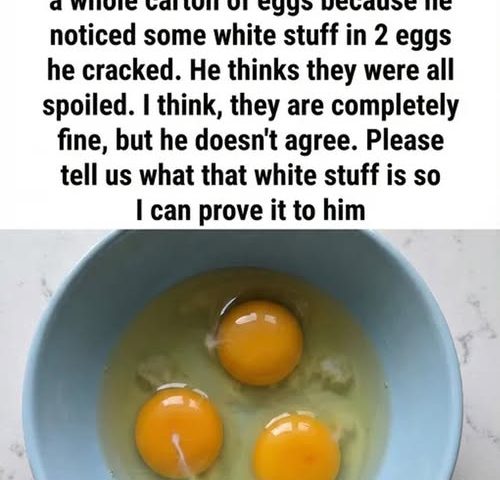
When you crack an egg, you might notice a thin, white, stringy strand attached to the yolk.
At first glance, it can look odd or even a little alarming. Many people assume it’s a sign the egg has gone bad or is somehow defective and choose to remove it before cooking.
In truth, this strand is completely normal and harmless—and it often signals that the egg is fresh and properly stored.
This white string is known as the chalaza, a naturally occurring protein structure inside the egg. Its role is to hold the yolk in place, keeping it centered within the egg white.
Acting like a stabilizer, the chalaza prevents the yolk from hitting the shell as the egg moves. Most eggs contain two chalazae, one on either side of the yolk, although only one may be clearly visible once the shell is cracked.
The chalaza can also tell you something about the egg’s freshness.

In fresher eggs, it appears thicker and more defined, while in older eggs it becomes faint and less noticeable. So spotting a firm, rope-like strand is usually a good sign. Nutritionally, the chalaza is made of the same proteins found in egg whites, meaning it is perfectly safe to eat.
During cooking—whether frying, scrambling, or baking—it blends right in and essentially disappears.
There’s no need to remove the chalaza unless you’re making dishes that require an exceptionally smooth consistency, such as custards or delicate sauces.
Otherwise, leaving it in won’t affect the flavor or quality of your food.
Knowing what the chalaza is can make cooking feel easier and more reassuring, turning something that looks unusual into a reminder of how naturally and efficiently food is formed.
The next time you see that white strand in an egg, you’ll recognize it not as a defect, but as a sign of freshness and thoughtful design.