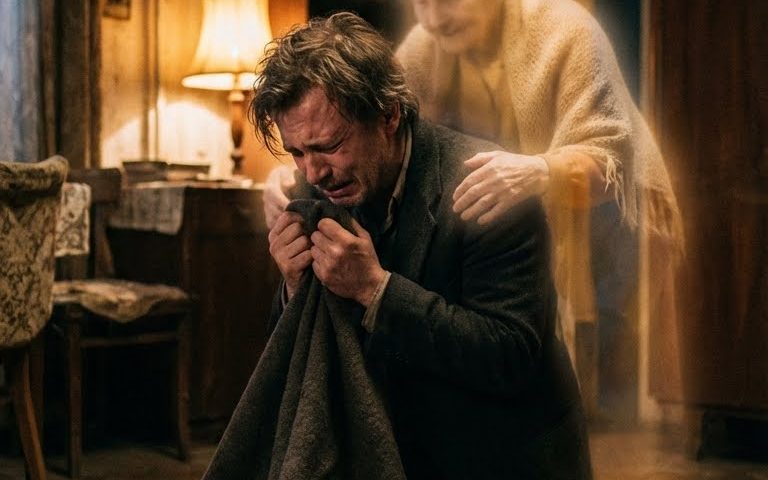
My mother passed away one cold morning in late autumn—quietly, gently, like an old oil lamp slowly dimming until the flame vanished.
She left behind no savings account, no house full of valuables. Just a crumbling little home on the edge of town… and a few worn-out belongings she’d guarded her entire life.
The funeral was simple. No grand wreaths, no long speeches. Just a small crowd, some fading flowers, and three children sitting together—my two older brothers and me.
That evening, we gathered in her tiny bedroom to divide what remained.
The room felt even smaller without her in it. The old wooden wardrobe stood against the wall, its doors slightly warped with age. There was no jewelry box, no hidden safe. Only a neat stack of three faded wool blankets on the bed, folded with a care that made my throat tighten.
I stared at them for a long time.
To my brothers, they looked like trash.
To me, they were my whole childhood.
I saw us again—three little kids huddling under those blankets on freezing winter nights, while Mom, wearing a thin patched coat, quietly tucked the corners around our feet. I remembered her sitting by the window, rubbing her hands together for warmth, pretending she wasn’t cold so we wouldn’t insist she share our cover.
My oldest brother snorted, breaking the silence.
“Why keep these rags? They should go straight in the trash.”
The second brother nodded, shrugging.
“Exactly. They’re not worth a cent. Whoever wants them can take them. I’m not carrying that junk.”
His words stung more than I expected. It wasn’t about the blankets—it was about how easily they dismissed the pieces of her life.
I swallowed and said quietly:
“If you don’t want them… I’ll take them.”
The eldest waved a hand as if flicking away a fly.
“Suit yourself. Trash is still trash.”
I didn’t argue. I just picked them up carefully, as if they could still feel it.
The Secret in the Blankets
The next day, I brought the blankets back to my tiny apartment. My plan was simple: wash them, dry them in the sun, and keep them as the last physical trace of my mother’s warmth.
I shook out the first blanket over the floor, ready to toss it into the laundry basket, when something hard thudded onto the tiles.
Clack.
I froze.
At first, I thought it was a loose button or a fallen clothes pin. But when I bent down, my fingers brushed against a small, lumpy brown cloth bag, hand-stitched and worn at the seams.
My heart suddenly pounded in my ears.
With trembling hands, I untied the string and opened it.
Inside were old savings passbooks and a few small, carefully wrapped gold coins. I sat down heavily on the edge of the bed as I flipped through the pages.
When I added up the numbers, my breath caught.
Over one hundred thousand dollars.
From a woman who never bought herself new shoes unless the old ones had completely fallen apart.
Tears blurred my vision.
I saw her again at the market, standing behind a small stall of vegetables, fingers red from the cold. I saw her hunched over the table late at night, counting crumpled bills, then quietly tucking them away. I remembered all the times I thought, Mom has nothing, and yet every time I needed school money, she somehow “found” it.
All those years, I thought her pockets were empty.
All those years, she was filling these blankets instead.
My hands shook as I checked the second and third blankets. Hidden within the torn linings, I found two more little sacks, just like the first.
In total: nearly three hundred thousand dollars.
I sat there and sobbed—deep, ugly sobs that came from somewhere far beyond my chest. It wasn’t just the money. It was the realization of just how much she had silently carried for us, while we all thought she had nothing.
The Conflict
News travels fast in families—especially when money is involved.
It didn’t take long for my brothers to show up at my apartment. They stood in my doorway that night, faces tight, voices already sharp.
“Are you planning to keep it all?” my eldest demanded. “That money is Mom’s inheritance. Why didn’t you tell us right away?”
“I didn’t hide it,” I said, trying to stay calm. “I was going to talk to you on her death anniversary. But remember… you two didn’t want the blankets. If I hadn’t brought them home, everything would’ve ended up in the trash.”
The second brother scoffed.
“Doesn’t matter. It’s still Mom’s money. It belongs to all three of us. Don’t get greedy.”
I bit my tongue.
They had forgotten, or chosen to forget, so many things.
How they only visited her on holidays—if at all.
How they always had an excuse when she needed help paying for medicine.
How, when she was too weak to get out of bed, I was the one changing her sheets, cooking her meals, watching her drift in and out of sleep.
I wasn’t perfect. I wasn’t rich. But even when my own life was hard, I sent her a little money every month. Sometimes just enough for her to buy a warm coat or good food for a few days. It was never much, but it was always from the heart.
Now, those same brothers—who had called her blankets “trash”—were pounding on my table, demanding their “fair share.”
The arguments dragged on for days.
“If you don’t split it, I’ll take this to court,” my eldest snapped.
“It’s not your money,” the second added. “Don’t act like you’re some kind of saint.”
Their words cut me, but I stayed quiet. Something inside me told me to wait, to go through everything again—carefully.
That’s when I found it.
The Last Letter
At the bottom of one of the cloth bags, tangled beneath the passbooks, was a small, folded piece of paper.
My mother’s handwriting stared back at me—shaky, slightly crooked, but familiar enough to make my heart twist.
I sat down and read:
“These three blankets are for my three children.
Whoever truly loves me and remembers my sacrifice
will recognize their value.
The money is not much,
but I want you to live with kindness and unity.
Don’t let my soul be sad in the afterlife.”
I pressed the paper to my chest and cried like a child.
She had known.
She’d known our tempers, our weaknesses, our greed.
She had wrapped her final lesson in wool and silence.
The next day, I called my brothers over.
When they arrived, still bristling with suspicion, I didn’t argue. I didn’t shout. I simply placed the letter on the table between us.
“Read it,” I said softly.
They leaned in. As their eyes moved across the page, the anger slowly drained from their faces. My eldest brother’s lips parted slightly. The second swallowed hard, blinking too fast.
For a long moment, no one spoke. The only sound in the room was the quiet ticking of the clock on the wall.
Finally, my eldest wiped at his eyes with the back of his hand.
“I… I was wrong,” he muttered hoarsely. “I only saw the money. I forgot who Mom really was.”
The second brother stared at the floor.
“She struggled her whole life,” he whispered. “And we never really… thanked her.”
My Decision
I took a deep breath.
“Mom left this for all three of us,” I said gently. “I won’t keep it for myself. We’ll divide the money equally—one part for each child. But please… don’t forget what she wrote. If we start fighting now, everything she saved will lose its meaning.”
Their shoulders slumped.
For the first time in a long time, we weren’t talking like enemies… but like siblings.
We agreed to split the money into three equal shares. No tricks. No hidden conditions.
Each of us took our part—along with the weight of what it represented.
What Happened to Each of Us
My eldest brother
He had always been tight-fisted, counting every coin twice. But something in him softened after reading that letter.
He used his share to pay for his children’s education and began visiting our mother’s grave every month—rain or shine. He would stand there quietly, talking to her under his breath, as if trying to make up for all the conversations they never had.
My second brother
Impulsive and hot-tempered for as long as I could remember. Yet he was the one who surprised me the most.
One day he told me he had donated part of his money to help poor families in our hometown.
“Maybe if I help them,” he said, eyes glistening, “Mom will be less disappointed in me… wherever she is.”
And me
I didn’t rush to spend my share.
Instead, I created a small scholarship fund in the village—“The Mother’s Blanket Scholarship”—for children from low-income families. Every time a child receives their school fees from that fund, I feel as though a little piece of my mother is still walking through the market, still putting a few crumpled bills in a tiny hand and saying, “Go study, child. Don’t worry about the rest.”
Epilogue
Those three old blankets, which my brothers once called trash, turned out to be more than just fabric and hidden gold.
They were a test.
A message.
A final lesson from a woman who had given everything and asked for almost nothing in return.
Now, whenever winter comes and the nights turn bitterly cold, I take one of those blankets out of the wardrobe. I gently cover my own child with it.
He doesn’t know the full story yet. He just knows it’s “Grandma’s blanket” and that it’s warm.
One day, I’ll tell him everything.
I’ll tell him about the market, the sacrifices, the hidden gold, the letter stained with tears.
I’ll tell him that the real legacy she left behind wasn’t the money tucked between woolen folds—
It was the reminder that love, kindness, and unity are worth more than any inheritance.
Because only when we truly know how to cherish one another…
are we worthy of calling ourselves our mother’s children.