The Night My Grief Broke
The glass hit the hardwood and exploded into pieces before I even realized I had let it fall.
I had come home from the cemetery, from staring at a stone with my daughter’s name on it, and walked straight into my study like I had done every night for the past three months. I didn’t turn on the overhead lights. I liked the room half–dark, lit only by the brass desk lamp and the strip of moonlight leaking in through the balcony doors.
In one hand, I still held the small silver locket I had left on the grave and then taken back, unable to part with it. In the other, apparently, I had been holding a tumbler of water. The locket stayed. The glass didn’t.
My hand shook so badly I had to sit down.
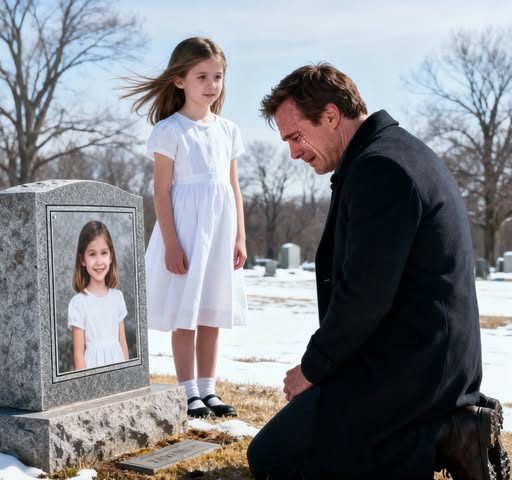
People in Burlington said I was “drowning in grief,” that I was “not myself” since the fire. The house at the edge of town—the one where my daughter, Chloe, had been staying with friends for the weekend—had gone up in flames in the middle of the night. By the time the trucks arrived, there was nothing left but black beams and smoke. They told me there were remains. They told me there was no doubt.
There had been a service. A closed casket. A polished stone with her name.
Everyone told me I had to accept it.
So I tried. I drank the herbal tea my wife, Vanessa, brought to my bedside each evening.
“For your nerves, Marcus,” she would say softly, her hand lingering on my shoulder. “You haven’t been sleeping.”
I swallowed the pills my brother, Colby, pressed into my palm in the mornings.
“From Dr. Harris,” he told me. “Just to help your mind rest.”
Day by day, I felt heavier, slower, more confused. I forgot appointments. I stared at walls. I lost time. People said it was grief. I believed them.
Until that night.
The Child in the Moonlight
I heard it before I saw it—a thin, chattering sound, like teeth hitting together in the cold.
I looked up, and there, near the balcony doors, huddled in a corner where the moonlight pooled on the floor, was a small figure wrapped in a dirty blanket.
For a moment, my mind did exactly what it had been trained to do for months: it rejected what it saw.
“No,” I whispered.
The word felt like a prayer and a denial at the same time.
“You’re not real,” I said, my voice cracking. “You can’t be here. You’re…”
I stopped myself before the word I had been saying for months could form.
The figure flinched at my voice. A soft sound escaped from under the blanket. A whimper. Then a word.
“Dad…?”
My heart didn’t just skip a beat. It seemed to stop and then slam back into my chest so hard I had to grab the edge of the desk.
I stood up slowly. My legs felt like they were made of stone. The room tilted, and for a second I was sure this was another one of those strange moments where the world went soft around the edges and I woke up later without remembering what had happened.
But the closer I got, the more details I saw.
The blanket was stained, the fabric worn out in places. Bare feet peeked out from underneath, scraped and raw. Mud streaked skinny ankles. Tangled hair clung to a face striped with dirt and dried tears.
And the eyes—those eyes—looked up at me.
I knew those eyes.
I had seen them the first time I held her, blinking up at me through scrunched lids. I had seen them light up when she scored a winning goal in middle school soccer, when she opened her acceptance letter to the art program she wanted, when she ran down the stairs on Christmas morning in fuzzy socks.
I would have recognized them in any country, in any life.
“Chloe?” I breathed.
The girl flinched and pulled back against the glass, like I might hit her.
“Please,” she whispered, her voice rough and thin. “Please don’t let them hear me. They’ll find me if they know I came.”
What Chloe Saw
I stopped a few feet from her, afraid that if I reached out too fast she would disappear like smoke.
“Who?” I asked, my voice hoarse. “Chloe, who are you hiding from? What happened?”
Her eyes darted to the door, then to the hallway, listening for footsteps only she could hear.
“Vanessa,” she said, the name barely audible. “And Uncle Colby.”
I froze.
My wife. My brother.
The two people who had held me up while everything else fell apart. The ones who arranged the service, who stood beside me at the front of the chapel, who greeted every guest with tears in their eyes and hands folded over their hearts. The ones who told me, over and over, that I had to let her go.
“That doesn’t make sense,” I said, shaking my head. “They’ve been here every day. They’ve been the ones taking care of me, of everything. They arranged—”
“The service,” Chloe whispered, her voice suddenly sharp, like broken glass. “It wasn’t real, Dad. They planned all of it. The fire. The story. Everything.”
I stared at her.
“They told me you were gone,” I said slowly, the words scraping my throat on the way out. “They said you never made it out of the house. They said—”
She squeezed her eyes shut, fighting tears.
“They paid men to grab me after school,” she said in a rush, like if she didn’t say it fast it would catch fire in her mouth. “They put me in a van. They kept me in a small house near the woods, near the old lake place Uncle Colby likes. I heard them talking. I heard your name. They said you worked too hard, that you would never hand over the company, that you would ‘drive it into the ground out of pride’ before you let anyone else lead.”
Her thin shoulders shook.
“They talked about me as if I were a number,” she whispered. “A detail to solve.”
I wanted to tell her to stop. I wanted to cover my ears. Instead, I knelt down, slow and careful, until we were almost at the same height.
“What about the fire?” I asked quietly. “The house?”
“They set it later,” she answered, her voice trembling. “They put something there, something that would burn the right way so it looked like… like someone had been there.”
She swallowed. My stomach twisted.
“I escaped because the men they hired got careless,” she said. “One of them left the back door unlocked when he went out to talk on the phone. I ran. I stayed in the woods. I watched the smoke. I heard the sirens.”
She lifted her eyes to mine, desperation and pain swimming in them.
“I watched them hold a service for me, Dad,” she choked. “Today, I watched you stand by a stone with my name on it.”
Her voice broke.
“I wanted to run to you, but they were there too. After you left, they drove out to the lake house. I followed, staying in the trees. I heard them talking on the deck. They were laughing.”
My chest burned.
“Laughing?” I repeated.
“They said the first part of the plan was done,” she said. “They said now they just had to ‘handle you.’”

The Bitter Taste
The words hung in the air between us.
“Handle me how?” I asked quietly, afraid of the answer.
Chloe’s hands twisted the edge of the blanket until her knuckles turned white.
“They said you were lost in your sadness,” she whispered. “That you were already fading. That all they had to do was keep you ‘just sick enough’ and people would accept anything they said about you. That if you got worse, everyone would believe it was because you couldn’t recover from losing me.”
There it was again—that phrase that had followed me for months—“lost in grief,” “not himself,” “not thinking clearly.”
I thought of the way I stumbled sometimes going up the stairs. The mornings when the light hurt my eyes so much I had to stay in bed. The days that slipped away in fog, when I couldn’t remember if I had eaten, showered, spoken to anyone. The nights my heart raced for no reason and then dropped into a slow, heavy thud that made it hard to breathe.
“They’re giving you too much,” Chloe said, her voice shaking. “Too much tea. Too many pills. They said you trusted them. They joked that the more you trusted them, the easier it would be to ‘take over everything’ when people finally accepted that you were too fragile to run the company.”
The herbal blend Vanessa stirred for me every night. The small white tablets Colby pressed into my palm in the morning.
“For your nerves.”
“For your mind.”
My skin went cold.
I had believed it was what grief did to a person. That grief blurred the edges of your days, made your body feel too heavy to carry. Now, sitting on that study floor with my daughter half-hidden in a dirty blanket, I could suddenly see another possibility.
It wasn’t just sorrow.
Someone had been helping it along.
“They don’t just want the company,” Chloe said softly, as if reading my thoughts. “They want you out of the way. Completely.”
The Decision Not to Run
“Okay,” I said finally, my voice low, almost calm. “We’re leaving. We’ll go to the police. We’ll show them you’re alive. We’ll tell them what you heard.”
Chloe shook her head so fast it made her dizzy.
“They’ve already laid the groundwork,” she said. “I heard them talk about it. They’ve been meeting with lawyers, with doctors. They’ve collected papers that say you’re not thinking clearly. They’ve told everyone you refuse help, that you see me ‘everywhere’—that you’re having visions because you can’t accept what happened.”
She drew her knees up to her chest, her small body folding in on itself.
“If we walk into a station right now,” she whispered, “they’ll say I’m someone pretending to be your daughter. They’ll say you’re confused. They’ll say you’re not well.”
I could see it, suddenly, as clearly as if it were already happening. Vanessa, eyes full of tears, telling a detective that she knew this day might come, that grief could make a person see what they wanted to see. Colby, solid and calm, explaining that I had been mixing my medications, that my judgment had been “off” for months.
“They’ve been guiding the story from the beginning,” I murmured.
Chloe nodded.
“So we don’t play into their story,” I said slowly. “We don’t walk into it. We change it.”
Chloe looked up, confused.
“They want a tale about a man who lost everything and slipped away,” I said. “They want people to believe I couldn’t handle my pain. They expect me to keep drifting until I collapse in front of everyone, and they can say, ‘We did everything we could. It was just too much for him.’”
I looked at my shaking hand, still clutching the locket.
“Fine,” I said. “If they want a story, we’ll give them one. Just not the one they wrote.”
Becoming the Man They Wanted
There is something cold that moves in once grief burns itself out. A different kind of fire. Focus.
For the first time in months, my thoughts lined up instead of chasing each other in circles.
The first step was simple and terrible: I had to keep pretending to be exactly what they said I was.
Over the next three days, I let Vanessa see me stumble more. I let her guide me to my room like she was leading a much older man. I let Colby take over more decisions at Ellington Dynamics, signing whatever he put in front of me with a slow, shaky hand.
“Maybe you should step back for a while,” he told me gently on Tuesday, his expression full of practiced concern. “Let me handle things until you feel stronger.”
I stared at the contracts he slid across the table. If I had been the man I used to be, I would have read every line twice. Now, I just signed. To them, it must have looked like defeat. To me, it was time.
At night, I still took the mug from Vanessa’s hand, nodding when she told me it would soothe me.
“You’ve barely eaten,” she murmured. “You have to keep up your strength.”
I brought the mug to my mouth, let the steam touch my face, then spilled most of the contents into a glass bottle I had tucked into the pocket of my robe the moment she turned away. The same with the pills. I learned to make them sit on my tongue until I could spit them into a tissue when no one was looking.
My weakness became a role I was playing.
Chloe stayed hidden in the only place in the house I knew they could not reach without me knowing—a small, reinforced room behind a panel in the back hallway, built years ago when I had convinced myself that extra security was a wise investment. Friends had joked about my “paranoia.” Now, that paranoia was the only reason my daughter had a safe place to sleep.
Inside the hidden room, a small monitor flickered with images from the cameras placed around the property. Chloe watched them, her thin face pale in the glow.
Every night, I slipped away under the excuse of needing to rest and locked myself in my study. From there, I made the call I had been thinking about since the moment Chloe said their names.
Not to the police.
To Frank Monroe.
Frank had worked for my father before me, the kind of security chief who noticed everything and said very little. He had been watching Vanessa and Colby with quiet, controlled suspicion for months, but he never approached me directly. Maybe he felt it wasn’t his place. Maybe he knew I wasn’t ready to hear it.
When he stepped into the study through the side entrance and saw Chloe step out from the hidden door, he didn’t faint or gasp. His eyes narrowed. He crossed himself once, then looked straight at me.
“What do you need me to do, sir?” he asked.
Just like that, we had a team.

The Collapse
The “collapse” happened on a Thursday.
Vanessa and Colby were in the dining room, pretending to argue over quarterly reports. Their raised voices floated down the hallway in a performance that sounded practiced and hollow.
I stepped out of my study, walked halfway down the corridor—and let my legs give out.
The floor rushed up to meet me. I heard the thud of my body, the clatter of the locket as it flew from my hand. A second later, Vanessa’s scream sliced through the house.
“Marcus! Marcus!”
Footsteps pounded against the hardwood. Colby appeared above me, his face arranged in the perfect mix of fear and control.
“Call emergency,” he barked, then dropped to his knees and pressed two fingers to my neck.
His hand was warm. His fingers trembled, but not from grief.
“I don’t… I don’t feel anything,” he said loudly, just as Frank came in from the side door in his role as head of security, already on the phone with a private medical team we kept on retainer.
Moments later, two men and a woman in discreet uniforms hurried into the house with a stretcher. They looked like paramedics from a private clinic. In reality, they were Frank’s most trusted people.
Vanessa’s sobs filled the hallway as they lifted me.
“Please,” she cried. “Please do everything you can. He’s been so fragile. He hasn’t recovered since we lost Chloe.”
As they carried me out, I heard Colby’s voice, steady and low.
“If the worst happens,” he said to one of the staff, “we’ll need to handle things quietly. No need to involve too many people. He always said he wanted privacy.”
The door closed behind us.
They did not take me to a hospital.
They took me to a small apartment in the city, one of the safe places my father had set up years ago “in case of emergencies.” I had laughed when he showed it to me, never imagining I would one day lie on the narrow bed inside it, listening to the city hum outside while the world believed I had taken my last breath out of pure sorrow.
When Frank unzipped the black transport bag, I sat up, gasping.
A moment later, Chloe rushed forward from the corner where she had been waiting, her eyes wide and wet. We held on to each other as if the floor might open up beneath us.
This time, our embrace was not about relief. It was about resolve.
We had made it to phase two.
Setting the Stage
With the samples of tea and tablets Frank had collected from the house, a friendly lab technician quietly confirmed what we had suspected: the blend of herbs and medication I had been given for weeks would leave anyone exhausted, confused, and physically weak if taken in those doses over time.
It was enough to raise serious questions.
Meanwhile, Frank’s team tracked down the men who had been hired months earlier to “take care of a situation” at the edge of town. Faced with the possibility of serious prison time, they were more than willing to talk. Their statements, given under recording, painted a picture of money changing hands, of orders passed down through intermediaries, of a fire started to “erase an inconvenience.”
We collected everything. Documents. Audio. Video from hidden cameras I hadn’t even realized were still active in parts of the old lake house. On one of the recordings, Vanessa’s voice floated through the speakers, light and almost cheerful as she clinked a glass against Colby’s.
“First part done,” she said. “Now we just have to let Marcus crumble.”
The final piece was legal.
I trusted very few people at that point, but my attorney, Richard Davenport, had been with my family long enough to see patterns that made him uneasy. When he met us in the safe apartment and saw Chloe standing there, very much alive, he went pale and had to sit down.
Once he read the lab reports and listened to the recordings, his expression changed from disbelief to something sharp and steady.
“They’ve scheduled a reading of your will already,” he said, almost in disbelief. “They insisted. I told them it was too soon. They said they wanted to honor your wishes as quickly as possible.”
“Let them,” I said.
He frowned.
“Use it,” I added. “As the stage.”
So we did.
Richard arranged the reading for the following Monday in the main library of the Ellington house, the room where my father once negotiated deals that shaped half the businesses in Vermont.
On paper, I was gone.
In reality, I was about to walk into my own memorial.
The Man They Thought They Buried
The library smelled like polished wood and old paper. It had always been my favorite room.
From the small antechamber behind the sliding shelves, I watched through a narrow gap as people filed in—board members, family friends, a few key staff. At the front of the room, Vanessa sat in a black dress that probably cost more than my first car. A veil covered half her face. Colby took a seat beside her, his jaw set in a careful line, his tie perfectly straight.
If you didn’t know what they had done, you might have felt sorry for them.
Richard stood by the long table, a stack of documents before him, a large screen mounted on the wall behind him.
“Thank you all for coming,” he began. “We’re here to review the last will and testament of Mr. Marcus Ellington.”
Vanessa dabbed at her eyes with a tissue. Colby stared straight ahead.
“As some of you know,” Richard continued, “Mr. Ellington asked to make a few updates recently. Given the circumstances, I felt it was my duty to honor that request.”
At the word “updates,” Vanessa’s head lifted slightly. Colby’s eyes narrowed for a moment.
“The revised document comes with a recorded message,” Richard said. “Mr. Ellington wanted a few things to be heard in his own voice.”
He pressed a button. The lights dimmed just enough for the screen to glow.
My face appeared—pale, tired, filmed a few days earlier in the safe apartment, where I had leaned heavily on the back of a chair to make the fatigue look real.
“Vanessa,” the recorded version of me said, my voice low and slow. “My dear wife. And Colby, my brother. If you’re seeing this, it means my sadness finally finished what you helped along.”
Vanessa shot to her feet.
“What is this?” she snapped, the polished softness gone from her tone. “This is inappropriate. Marcus wasn’t thinking straight. He—”
“Oh, he was very clear,” a new voice said.
Richard had not spoken.
I stepped out from behind the sliding shelves and walked into the library.
The Girl They Tried to Erase
It is a strange feeling, walking into a room full of people who believe they will never see you again.
For a moment, silence crashed down so hard it buzzed in my ears. A few people gasped. Someone’s pen dropped and rolled across the table.
Vanessa’s face lost all its color. She didn’t scream. She just made a small, strangled sound and gripped the edge of her chair.
Colby stood so fast his chair tipped backward and hit the floor. He stared at me like I was something that had crawled out of his worst dream.
“This isn’t real,” he said, his voice breaking. “This is some kind of trick. Marcus is gone. We saw—”
“What you saw,” I cut in, “was exactly what you planned for everyone else to see. A man who had been pushed just far enough that his body finally gave out.”
I stepped closer.
“You counted on my sadness,” I said quietly. “You thought you could turn it into a tool. You thought if you kept me weak enough, confused enough, nobody would question anything you signed in my name.”
“That’s ridiculous,” Vanessa said, finding her voice again. “You’ve been in pieces since the tragedy. You’ve been seeing Chloe everywhere. You insisted on making a recording when you weren’t thinking clearly. This is proof of your condition, not ours.”
“Is it?” I asked.
I lifted my hand.
Frank opened the double doors at the far end of the library.
Chloe walked in.
She was no longer wrapped in a dirty blanket. Her hair was clean, pulled back in a simple braid. She wore a plain white dress and flat shoes. She looked small in the big room, but she held herself straight.
Every eye turned to her.
Someone at the back of the room whispered her name.
Vanessa’s knees buckled. She sank back into her chair, her face drained. Colby took a step backward, then another, his gaze fixed on Chloe as if she were a ghost come to collect a debt.
“You tried to erase me,” Chloe said, her voice steady. It echoed in the high ceiling. “You tried to write a story where I was just… gone. But I’m not.”
She took one more step forward.
“And he’s not broken,” she added, nodding toward me. “You just misjudged how much we can survive.”
Behind her, two men in plain suits walked in. They weren’t part of my staff. They were detectives from the state, men Richard trusted and Frank had briefed.
On the table, Richard spread out a neat row of evidence bags—vials, tablets, printed reports. A laptop screen showed a paused video of Vanessa and Colby on the lake house deck, glasses raised as they discussed “letting Marcus crumble.”
The room saw all of it. So did Vanessa and Colby.
“Colby Ellington,” one of the detectives said, stepping forward. “Vanessa Ellington. We need you to come with us.”
The arrests were not dramatic. There were no loud protests, no grand speeches. Just the soft click of cuffs, the rustle of expensive fabric, and the stunned silence of people who were suddenly realizing they had been watching the wrong story all along.
As they were led away, Vanessa looked back at me, eyes wide, not with guilt, but with disbelief that the script she had written for my life had been torn up in front of a room full of witnesses.
For the first time in months, I did not feel weak.
I felt present.
I felt awake.
Our Own Ending
Reporters came. Trials were held. Words like “conspiracy,” “fraud,” and “abuse of trust” appeared in headlines and legal documents. I attended when I could, but I didn’t let the courtroom become the center of our lives.
The verdicts were firm. The sentences long.
Afterward, the house felt too big. The city felt too loud. Chloe and I both needed space, and not the kind created by high ceilings and silent hallways.
We left Burlington a few months later, driving north until the air smelled like pine and salt. We rented a small cottage on a quiet stretch of coast where the waves were the only constant sound.
One evening, as the sun slid toward the water, turning it the color of melted copper, we walked out to the end of a weathered pier.
I held two silver lockets in my hand.
One carried a tiny photo of Chloe at eight years old, missing her front teeth and holding a soccer trophy half her size. The other held a picture of me and my father on the day I took over the company, both of us younger, both of us believing that hard work alone could protect a family from everything.
Chloe looked at them, then at me.
“Are you sure?” she asked.
I nodded.
“We spent months living inside a story other people wrote for us,” I said. “I think it’s time we write our own.”
Together, we opened our fingers and let the lockets fall. They flashed once in the fading light, then slipped beneath the surface and disappeared.
We stood there a long time without talking.
We are not the people we were before the fire, before the lies, before the night a girl wrapped in a blanket whispered, “Dad, please don’t let them find me.”
There are still nights when I wake up breathing hard, my hands searching for a zipper that isn’t there. There are days when Chloe goes quiet and stares at the horizon for so long the sky changes color around her.
But there is also laughter now, small and careful at first, then louder. There are pancakes on Saturday mornings that burn on one side because I get distracted telling her stories about her grandfather. There are walks on the beach where we talk about nothing important at all.
It isn’t a perfect ending.
It isn’t even what most people would call a happy one.
But it is ours.
For the first time in a very long time, I am not afraid of what comes next.
Whatever it is, we’ll face it side by side—not as a grieving father and a memory, but as two people who walked through the fire and came out holding on to each other.