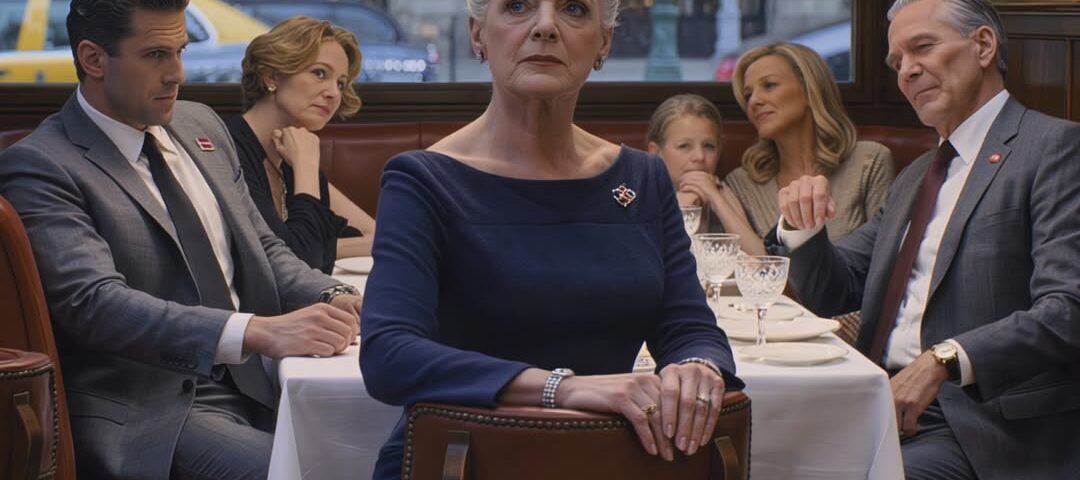
That night at dinner, a man called my son a broke loser.
I stayed silent.
But a mother’s silence is not weakness.
It is strategy.
My name is Florence Carter. I am 57 years old. This story began in an elegant steakhouse downtown, under the soft light of chandeliers and the murmur of other people’s conversations.
That night, my son Michael was formally introducing me to the parents of Emily, his fiancée. It was their engagement dinner. Everything was supposed to be perfect.
We arrived on time. I wore a navy-blue dress, discreet but elegant. Michael looked nervous in his gray suit—the same one he wore when he got promoted at the company where he works. He squeezed my hand before we walked in.
“Mom, everything is going to be okay,” he told me.
I nodded. But there was something in my chest—an unease I could not name at that moment.
Robert Miller was already waiting for us at the main table. He was a man in his 60s, heavyset, with gray hair slicked back and a gold watch that shined too brightly on his wrist. His wife, Linda, smiled nervously beside him. Emily looked radiant, holding Michael’s arm.
We sat down. We ordered wine. The first conversations were polite, trivial. We talked about the weather, the restaurant, the wedding. Robert ordered the most expensive steak on the menu without looking at the price. I ordered the baked fish. Michael ordered pasta.
Then, while we waited for the food, Robert leaned back in his chair. He took his glass of wine and looked at Michael with that kind of smile that never reaches the eyes.
“Tell me, Michael,” he said, “what do you do for work exactly?”
My son swallowed hard.
“I’m a financial analyst at the Sterling Group, Mr. Miller.”
Robert raised an eyebrow.
“Analyst,” he repeated, as if the word left a bad taste in his mouth. “And how much does an analyst make?”
There was an uncomfortable silence. Linda looked down. Emily squeezed Michael’s hand under the table.
“Enough to live well.”
“Dad,” Emily intervened softly, but Robert was not listening to her. His eyes were locked on my son.
“Because look, Michael,” he continued, pouring himself more wine, “my daughter has grown up with certain comforts—trips to Europe, private schools, piano lessons. I do not know if you understand the level she is accustomed to.”
Michael nodded, trying to keep his composure.
“I understand, sir, and that is why I work hard every day. I want to give her the best.”
Robert let out a short laugh, humorless.
“The best with an analyst’s salary.”
He set the glass on the table with a sharp thud.
“Let’s be honest, kid. That broke loser is not good enough for my daughter. She deserves someone on her level, not someone who can barely afford a decent restaurant.”
The entire restaurant seemed to stop. The words hung in the air like slow poison.
I felt the skin on my arms prickle. I felt the blood rise to my cheeks.
But I said nothing.
Not yet.
Michael lowered his head. I saw his hands trembling slightly on the table. I saw how he clenched his jaw to keep from crying. Emily turned pale.
“Dad, please,” she whispered.
But Robert was already standing up, throwing his napkin on the plate.
“I’m just telling the truth. And if my daughter is going to marry anyone, it has to be someone of value, not just anybody.”
I stood up slowly. I grabbed my purse. I looked at Michael and touched his shoulder.
“Let’s go, son.”
He nodded without looking at me. Emily tried to stop him, but Michael was already walking toward the exit. I followed him in silence, head held high, heartbroken.
Outside under the streetlights, Michael stopped and took a deep breath. His eyes were shining.
“I’m sorry, Mom,” he said with a broken voice. “I should have answered him. I should have.”
“No,” I interrupted, taking his face in my hands. “You did good. Dignity is not defended by shouting, Michael. It is defended by living.”
He nodded, although it still hurt.
We got into the car and drove home in silence.
But that night, while Michael slept, I stayed awake in the living room with a cup of coffee in my hands and my gaze lost in the window. I thought about that man, Robert Miller. I thought about his words, his arrogance, his poison.
And then I remembered something.
A name on a report. A face in a corporate photo.
Robert Miller worked at the Sterling Group.
At my company.
And he did not know it.
I smiled barely, without joy.
A mother’s silence is not weakness. It is patience.
And patience sometimes is the cruelest justice.
Sometimes we trust too much in people we should not.
“Have you ever been disappointed by someone you loved? Tell me your story in the comments. I want to read it.”
The days that followed that dinner were strange. Michael went out every morning to work with the same punctuality as always, but something in him had changed. He no longer whistled while making coffee. He no longer told me funny stories about his co-workers during breakfast. He ate in silence, looking at his plate as if searching for answers at the bottom of the bowl.
I did not talk much either. I did not know what to say.
How do you comfort a son when the words that hurt him do not come from an enemy, but from the father of the woman he loves?
One afternoon while I was making dinner, I heard the door open. Michael walked in looking exhausted, loosening his tie. He dropped onto the sofa and closed his eyes.
“How was your day, son?” I asked from the kitchen.
“Same as always, Mom,” he answered without opening his eyes.
That was a lie.
I knew that tone. It was the tone of someone carrying a weight they cannot name.
I sat beside him and offered him a cup of chamomile tea, the same one I made him when he was a child and could not sleep.
“Thanks,” he murmured, taking the cup in his hands.
“Have you talked to Emily?” I asked gently.
He nodded.
“Yes, every day.”
“And her?”
“She is very ashamed of what happened. She has apologized a thousand times. She says her dad is not normally like that, that he was stressed about work, that…”
“That she seeks to justify the unjustifiable,” I interrupted calmly.
Michael looked at me.
“I do not want this to ruin us, Mom. I love Emily and she loves me. Her father… well, her father is another story.”
I nodded. I was not going to argue with him. It was not the moment.
But in my chest, there was a certainty growing every day. Robert Miller did not know the woman whose son he had humiliated.
That night, after Michael went to sleep, I turned on my computer and opened the human resources archive of the Sterling Group. I typed the name Robert Miller.
There he was.
Operations manager. Twenty-three years in the company. Considerable salary. Clean record. No reported incidents. An exemplary employee according to the numbers.
But numbers do not tell the whole story.
Do they?
I closed the laptop and stared at the dark screen, seeing my own reflection in the black glass.
I remembered how I came to own the Sterling Group. It had not been easy. It had not been fast. But it had been fair.
I let my mind travel years back to when it all began.
I was 25 when I met John—Michael’s father. He was a hard-working man, honest, with the calloused hands of someone who does not fear effort. We got married in a simple ceremony with flowers from my mother’s garden and a dress she sewed herself.
John worked at a small logistics company. I was an administrative assistant at a government office back then. We earned little, but we were happy. We rented a two-bedroom apartment in a quiet neighborhood.
We ate dinner together every night.
When Michael was born, the world became smaller and bigger at the same time. Smaller because my entire universe fit into that baby crying in my arms. Bigger because suddenly I understood the dimension of love a mother can feel.
John was a present father. He changed diapers. He rocked him to sleep. He sang made-up songs that had neither rhythm nor sense.
Michael laughed anyway.
But life sometimes does not ask if you are ready.
Michael was six when John died.
It was a traffic accident. A truck that did not brake in time. A curve calculated wrong. A second that changed everything.
I remember the day of the funeral. I remember the rain hitting the black umbrella. I remember Michael holding my hand, asking me when Daddy was coming back.
I had no answer.
Only tears.
We were left alone—him and me.
No savings. No insurance. Only the month’s rent paid and a half-empty pantry.
That night, after putting Michael to bed, I sat at the kitchen table with a notebook and a pencil. I did the math. I added. I subtracted.
The math was cruel.
It was not enough.
But I was not going to give up. Not for me—for him.
The next day, I knocked on doors. I looked for work everywhere—offices, stores, restaurants. Finally, I got a position as an accounting assistant at a medium-sized company called the Sterling Group. It was an import-and-export business with offices in three states. The owner, Mr. Sterling, was an older man—serious but fair.
I worked like never before. I arrived early. I left late. I learned every process, every system, every detail.
Mr. Sterling noticed.
“Florence,” he told me one day, “you have vision. You do not just do your job. You understand the business.”
He promoted me to general accountant, then to finance manager, then to director of operations. Each promotion was earned with sweat, sleepless nights, and difficult decisions.
Michael grew up watching me work—watching me fight.
Mr. Sterling had no children. His wife had died years ago. The company was his legacy, but he had no one to leave it to.
When he turned 75, he called me to his office.
“Florence, I want you to buy the company,” he said bluntly.
I was speechless.
“Mr. Sterling, I do not have that capital.”
“I know,” he smiled. “That is why we are going to make a payment plan. You run the company, make it grow, and pay me with the profits. I trust you more than any outside investor.”
I accepted.
How could I not?
It was the chance of a lifetime. The chance to give Michael a secure future.
For ten years, I worked day and night. I expanded the company, opened new trade routes, hired the best talent, paid every dollar I owed Mr. Sterling. When he died at 86, he left a clear will.
The Sterling Group was officially mine.
I had completed the full payment three years before his death.
The company that today employed more than 300 people, with offices in five cities, was mine.
But I never bragged. I never showed off. I remained the same Florence who rented apartments and counted pennies.
Michael grew up seeing my example.
He studied finance. Graduated with honors.
When he asked me for a job at the Sterling Group, I said yes—but on one condition.
“You enter as an analyst. No privileges. No last name. If you want to grow, you earn it.”
And he did.
Nobody in the company knew he was my son. He used his father’s last name: Michael Lewis.
I was still Florence Carter, the discreet president who rarely appeared in general meetings.
Robert Miller had worked at the company since before I bought it. He was efficient, compliant, but we never crossed paths personally. I knew his name on reports, on annual evaluations. I knew he existed.
But he did not know who I was.
Until now.
I turned off the living room light and went up to my room. I lay down staring at the ceiling, remembering everything I had built, everything I had protected.
And I thought about Robert Miller sitting in his manager’s office, oblivious to the storm that was coming—because tomorrow he would receive a call, a summons to the president’s office, and I would be waiting for him.
“While I tell all this, I think about where you might be listening. Write the name of your city in the comments.”
The next morning dawned gray—one of those mornings where the sky seems loaded with unanswered questions. I got up early as always. I made coffee in the same old coffee maker I had used for 20 years. The aroma filled the kitchen and for a moment everything seemed normal.
But nothing was normal.
Michael came down the stairs later than usual. He had his suit on. Tie well-knotted, but his eyes had that opacity of someone who did not sleep well.
“Good morning, Mom,” he greeted, trying to sound cheerful.
“Good morning, son. Do you want eggs?”
“No thanks. Just coffee.”
He sat across from me and took the cup I offered.
For a while, only the sound of the spoon against the porcelain was heard, and the distant murmur of cars on the street.
“Today I’m going to talk to Emily about the wedding date,” he said finally without looking at me. “I want us to move forward. I’m not going to let what happened ruin our future.”
I nodded slowly.
“And her father,” I said.
Michael clenched his jaw.
“Emily says she is going to talk to him, that she is going to ask him to apologize.”
“And do you believe her?”
He looked up, surprised by my tone.
“Mom, she is not to blame for how her father is.”
“I know, son. I did not say that. I only asked if you believe he is going to change.”
Michael looked down again.
“I do not know,” he admitted quietly. “But I have to try—for her, for us.”
I did not insist. Sometimes the hardest lessons are learned by living, not listening.
I had already made my decision. Now I just had to wait.
I said goodbye to Michael at the door. I watched him get into his car and drive away down the street.
Then I left too.
But I did not take my personal car. I took the black sedan with a driver that I used only for special occasions.
Today was one of them.
During the ride to the Sterling Group headquarters, I mentally reviewed what I was going to say. I could not be emotional. I could not be vengeful. I had to be exactly what I had always been: professional, serene, relentless when necessary.
The Sterling Group building rose on one of the main avenues downtown—twelve floors of glass and steel. In the lobby, employees greeted me with respect as I passed. Some new ones did not recognize me. Others lowered their heads with an almost imperceptible bow.
I went straight up to the 12th floor.
My office occupied the entire east wing—wide windows overlooking the city, a solid wood desk, shelves full of finance books and international trade, and hidden among them, some poetry books that no one knew I read.
My assistant Claudia was waiting for me with the day’s agenda.
“Good morning, Mrs. Carter. You have a meeting with the logistics director at 10:00, lunch with the legal team at 1:00, and—”
“Claudia,” I interrupted her calmly, “I need you to send a summons.”
She took out her notebook, ready to write.
“To Mr. Robert Miller, operations manager. Tell him I need to see him today at 11:00 sharp, here in my office.”
Claudia blinked, surprised. It was unusual for me to directly summon area managers. Normally I work through the directors.
“Any reason I should mention, ma’am?”
“No. Just tell him it is urgent.”
“Understood.”
Claudia left the office and closed the door behind her.
I sat in my chair and looked out the window. From there, I could see the whole city—thousands of people walking, working, living their lives without knowing that, in this moment, in this office, a woman was about to face the man who had humiliated her son.
Not with screams.
Not with threats.
With something much more powerful.
The truth.
At five to eleven, Claudia notified me through the intercom.
“Mrs. Carter, Mr. Miller is already here.”
“Send him in.”
I took a deep breath. I stood up and walked toward the window.
Turning my back to the door, I heard the sound of footsteps entering—the creak of leather soles against the wooden floor.
“Mrs. Carter?” a male voice asked, confused. “Excuse me, I think there was a mistake. I was summoned to see the president.”
I turned slowly.
Robert Miller was in front of me with his impeccable gray suit and his gold watch shining under the office light. But on his face, in that moment, there was something I had never seen at dinner.
Uncertainty.
“There was no mistake, Mr. Miller,” I said with a calm voice. “I am the president.”
I saw the color disappear from his face—how his eyes widened slowly, how his mouth parted without finding words.
“You?” he stammered.
“Yes,” I nodded. “Me. Florence Carter. Owner and president of the Sterling Group.”
I held his gaze.
“And also, in case you do not remember, the mother of the broke loser who, according to you, is not good enough for your daughter.”
Robert took a step back as if my words were a physical blow. His face went from white to red. He opened his mouth to speak, but I raised a hand.
“Sit down, Mr. Miller.”
He obeyed, almost tripping over the chair. He sat with his hands on his knees, sweating.
I went back to my desk and sat across from him, hands clasped on the polished surface.
“You have been working at this company for 23 years,” I began, looking directly into his eyes. “Your performance evaluation has always been good. You meet your goals. You haven’t had serious incidents. You are, on paper, an exemplary employee.”
Robert nodded nervously.
“Mrs. Carter, I… I didn’t know.”
“I know,” I interrupted him. “You didn’t know who I was. And precisely because of that, you said what you said. Because you thought you could humiliate my son without consequences. Because you believed your arrogance would not have a price.”
“I… it was a misunderstanding. Ma’am, I was stressed.”
“Stressed,” I repeated with irony. “Tired. Worried. What is the excuse you are going to use today, Mr. Miller?”
He lowered his head.
“I have no excuse,” he murmured.
There was a long silence. Outside, the hum of the city continued. Inside, it was just him and me, and the weight of his own words.
“Michael,” I said finally, “is my only son. I raised him alone since he was six. I worked three jobs to pay for his school. I stayed up late helping him with homework. I watched him grow, study, strive.”
I leaned in slightly.
“He entered this company without a last name, without privileges, without anyone knowing who his mother was. And he earned his position with work, with dedication, with honesty.”
Robert looked up with wet eyes.
“Mrs. Carter, please.”
“And you,” I continued, without raising my voice, but with every word sharp as a knife, “you called him a broke loser. You humiliated him in front of his fiancée, in front of his family, in front of me. You told him he wasn’t good enough for your daughter.”
“It was a terrible mistake,” he whispered. “A mistake I can’t undo.”
“No,” I nodded. “You can’t. Words, Mr. Miller, do not erase. They stay. They stick.”
He nodded, hands trembling.
I leaned back in my chair and observed him for a long moment. I saw a man who all his life had believed that money, status, and last names were the only things that mattered.
And now he was in front of someone who had built all that from scratch—without showing off, without humiliating anyone.
“Do you know what is the saddest part of all this, Mr. Miller?” I asked calmly. “That you didn’t humiliate my son because he was bad or irresponsible or dishonest. You humiliated him because you believed he didn’t have enough money—as if a man’s value were measured by his bank account.”
Robert said nothing. He just kept his head down, hands clenched on his knees.
“I could fire you right now,” I continued. “I could make sure your name never appears in any serious company in this city again. I have the power to do it. You know that.”
He nodded almost imperceptibly.
“But I am not going to do it.”
Robert looked up, surprised.
“Because I am not like you,” I said firmly. “I do not measure people by their bank account. I measure them by their character. And your character, Mr. Miller, has a lot of work to do.”
I stood up.
He stood up too, clumsily.
“You may go,” I said. “And think very carefully about the kind of man you want to be from now on.”
Robert nodded, not daring to look me in the eyes. He walked toward the door, but before leaving, he stopped.
“Mrs. Carter,” he said with a broken voice, “I am sorry. I really am sorry.”
I did not answer.
I only watched him until he left and closed the door behind him.
When I was alone, I sat down again and looked out the window.
I did not feel triumph.
I did not feel joy.
Only a quiet certainty.
I had defended my son without screaming, without threatening, without stooping to his level.
Dignity is not begged for.
It is worn.
That afternoon when Michael came home, he found me in the kitchen making vegetable soup.
“How was your day, Mom?” he asked, leaving his briefcase on the table.
“Quiet,” I replied, stirring the pot. “And yours?”
“Quiet, too… although something strange happened.”
“What thing?”
“Robert. Emily’s dad. He works at my company. Today I saw him in the hallway and… I don’t know. Mom, he looked weird—pale, sweating. He nodded at me and kept walking fast as if he was in a hurry.”
I said nothing.
Just kept stirring the soup.
“Do you think he is sick?” Michael asked.
“I do not know, son,” I replied. “Sometimes people get sick in the soul before the body.”
Michael looked at me curiously, but asked no more. He sat at the table and started checking his phone.
I served the soup in two deep bowls and sat across from him.
“Emily and I talked today,” Michael said while blowing on his spoon. “We are going to go ahead with the wedding. She says her dad is regretful, that he has been very quiet these days.”
“And how do you feel about that?”
Michael shrugged.
“I do not know. I guess if he changes, I can forgive… but I am not going to forget. Mom, I am never going to forget what he said.”
“You do not have to forget,” I said gently. “You just have to decide if what he said defines who you are. And the answer is no. You are worth what you do, not what others say about you.”
Michael smiled.
“You know, sometimes I think you are the wisest woman I know.”
“I am not wise, son. I am just old,” I joked.
He laughed.
And for a moment, everything was okay.
But I knew this was not over.
Robert Miller had received a lesson.
Now we had to see if he learned it.
Because life has a curious way of teaching—sometimes with words, sometimes with silences, and sometimes with a mother who knows how to wait for the exact moment to say:
“I was there too.”
“And I do not forget either.”
“Have you ever had to keep silent to protect someone you love? Tell me in the comments.”
The days began to pass with a strange normality. Michael kept going to work. Emily called him every night. And I watched—watched how my son tried to build a future on the rubble of a humiliation that still hurt.
One afternoon while preparing lunch, I heard the front door open earlier than usual. Michael walked in with a forced smile and a bouquet of flowers in his hands.
“Are those for me?” I asked, surprised.
“No, Mom,” he laughed. “They are for Emily. I am going to her house tonight. She wants us to talk about the wedding with her family.”
I felt a knot in my stomach.
“With her family? Is he going to be there, too?”
“Yes,” Michael answered, knowing exactly who I was referring to. “Robert is going to be there, but Emily says he wants to apologize formally. That he has been very different since that night.”
I dried my hands on my apron and walked over to him.
“Son, you do not have to do this. You do not have to expose yourself again.”
“Mom,” he said gently, taking my hands, “if I am going to marry Emily, I have to learn to live with her family. I cannot avoid them all my life.”
“But that does not mean I should subject you to another humiliation.”
“He won’t do it,” he assured. “But I am not going to deny Emily the chance to fix things either. She is not to blame for having a difficult father.”
I hugged him. He smelled like the cologne I had given him for his birthday. He smelled like my boy, even though he was already a man.
“Okay,” I sighed. “Go. But if anything goes wrong, call me. No matter the time.”
“I will, Mom. I promise.”
He left shortly after six. I saw him from the window getting into his car with the bouquet of flowers on the passenger seat and that naïve hope that only good people have.
I stayed alone in the house. The television was on, but I was not listening to it.
I was only thinking about Michael sitting in the living room of that family that had despised him. I was only thinking about how he was going to pretend everything was fine when his heart still bore the mark of those words.
That broke loser is not good enough for my daughter.
I closed my eyes and took a deep breath.
I could not protect him from everything.
But I could be ready to catch him if he fell.
Michael returned past eleven at night. I heard him enter slowly, trying not to make noise, but I was still awake in the living room with a cup of cold tea in my hands.
“Mom,” he asked, surprised to see me, “I thought you were already asleep.”
“I couldn’t,” I admitted. “How did it go?”
He sat next to me on the sofa and loosened his tie. His eyes looked tired.
“It was uncomfortable,” he said finally, “but not as terrible as I thought.”
“Was Robert there?”
“Yes… he apologized to me.”
I raised my eyebrows.
“Really?”
Michael nodded.
“Yes. In front of his whole family. He said he had been out of line that night. That he was worried about his daughter, but that he had no right to speak to me like that.”
“And what did you say?”
“I told him I accepted his apology,” he replied quietly, “because Emily was there looking at me with those pleading eyes. And… because I want this to work. Mom, I want to believe people can change.”
I said nothing—just observed him. I saw my son choosing peace over pride, choosing love over dignity, and I did not know whether to feel proud or worried.
“Did he seem sincere?” I asked carefully.
Michael shrugged.
“I do not know. He was nervous. He was sweating a lot. He didn’t look me directly in the eyes, but he said it. And that is something, right?”
“Yes,” I replied. “It is something.”
But in my chest, something told me Robert Miller’s apologies did not come from regret.
They came from fear.
From the fear of what I could do to him. From the fear of losing his position, his status, his comfort.
Men like him do not change overnight.
They just learn to hide their poison better.
“Did you talk about the wedding?” I asked, changing the subject.
Michael’s face lit up a little.
“Yes. Emily wants to get married in June, in the garden of an estate she saw on the internet. She says it will be something small, intimate—just close family and friends.”
“And is her father going to pay?”
Michael shook his head.
“He offered, but Emily and I decided we are going to pay for it between the two of us. We do not want to owe him anything.”
I smiled.
There was my son—proud, dignified.
“Sounds good to me,” I said.
“And if you need help—”
“Mom, no. You have already done enough for me. We are going to do this ourselves.”
I hugged him, and in that hug I tried to tell him everything I could not with words—that I was proud, that I loved him, that I would always be there for him.
But there was also something else. Something I could not share yet.
A truth growing in my chest like a dark seed.
Robert Miller had not apologized because he felt it.
He had apologized because he was afraid.
The following days passed in a deceptive routine. Michael went to work with renewed spirit. Emily came to dinner at home some nights—always polite, always affectionate with him. She was a sweet girl. I could not deny it.
But every time I looked at her, I saw the shadow of her father behind her.
One afternoon, Emily stayed to help me wash the dishes while Michael answered a work call in the living room.
“Mrs. Florence,” she said timidly, “I want you to know I am very sorry for what happened at that dinner.”
“You do not have to apologize, dear,” I replied, drying a plate. “You did not say anything.”
“I know. But my dad shouldn’t have spoken like that. I tried to stop him, but when he gets like that, it is impossible to make him listen to reason.”
“Does he get like that often?”
Emily looked down.
“Sometimes—when he is stressed, or when he feels things aren’t going his way. But deep down he is a good person, Mrs. Florence. Just… he has very firm ideas about how things should be.”
“Firm ideas are good,” I said calmly, “but not when they hurt others.”
She nodded with wet eyes.
“I love Michael,” she said softly. “And I know he doesn’t have as much money as my dad would like, but he is hard-working. He is honest. He is good to me. Shouldn’t that be what matters?”
I looked at her—really looked at her—and I saw a girl trapped between love for her father and love for her fiancée. I saw someone who had grown up with privileges, but who had also grown up with pressure, with expectations, with a father who measured people’s worth in numbers.
“Yes, dear,” I said finally. “That is what should matter. And if Michael makes you happy, then nothing else matters.”
She smiled, relieved.
“Thank you, Mrs. Florence. You are very understanding. Not all mothers-in-law are like that.”
“I am not a mother-in-law yet,” I joked. “But when I am, I just want to see you happy, and see my son happy.”
We finished washing the dishes. Michael returned to the kitchen, and they said goodbye with a kiss at the door.
I stayed at the window watching them drive away in Emily’s car, and I wondered how much longer Michael could live in that limbo—forgiving without forgetting, moving forward while carrying the weight of humiliation, building a future with a family that had rejected him.
That night, sitting in my bed with an open book I wasn’t reading, I received an email on my phone. It was from Claudia, my assistant.
Mrs. Carter, Mr. Robert Miller requested a meeting with you for tomorrow, first thing in the morning. He says it is urgent.
Did you confirm?
I stared at the message for a long time.
What would he want now?
More apologies, explanations, or maybe he thought he could negotiate with me.
I replied:
Confirm tomorrow at 9.
I turned off the light and lay down, but I did not sleep. I just thought about what I would say to him—how I would keep calm, how I would make him understand that he could not buy my forgiveness with empty words.
Because I was not like him.
I did not measure people by their bank account.
I measured them by their character.
And his character, so far, was a counterfeit coin.
The next morning, I arrived at the office early. Claudia was already there with the coffee ready and the day’s agenda printed.
“Mr. Miller arrived ten minutes ago,” she informed me. “He is waiting in the boardroom.”
“In the boardroom?” I asked, surprised. “Why not in the waiting room?”
“He asked for privacy. He said what he wanted to talk about was delicate.”
I nodded. I took my coffee and walked toward the boardroom. I opened the door without knocking.
Robert Miller was standing by the window, looking at the city. Upon hearing me enter, he turned quickly. He was wearing the same gray suit as always, but now he seemed smaller—more vulnerable.
“Mrs. Carter,” he greeted with a trembling voice. “Thank you for seeing me.”
“You have five minutes,” I said, sitting at the head of the table. “Speak.”
He swallowed and sat across from me.
“I… I wanted to thank you for not firing me. For giving me another chance.”
“I did not give you any chance, Mr. Miller,” I said. “I simply decided not to act based on emotions. That does not mean you are forgiven.”
He nodded nervously.
“I understand. And that is why I came. I wanted… I wanted to explain why I said what I said that night.”
“I am not interested,” I interrupted. “Reasons do not change the damage.”
“Please,” he pleaded. “Just let me explain. Afterwards, if you want to fire me, I will understand.”
I looked at him for a long moment.
Then I nodded.
“You have three minutes.”
Robert took a deep breath.
“I grew up poor, Mrs. Carter—very poor. My father was a bricklayer. My mother washed other people’s clothes. We lived in a two-room house with a dirt floor. I wore torn shoes and ate beans every day.”
He paused.
I said nothing.
“When I grew up, I swore I would never be poor again. I studied with scholarships. I worked nights. I graduated and got a job at this company 23 years ago. And since then, every dollar I have earned, I have saved. I have invested. I have multiplied. Because I did not want my daughter to live what I lived.”
“And that is why you turned her into someone who only values money?” I asked coldly.
“No,” he denied quickly. “Not me. I just wanted to protect her. I wanted her to have the best. And when I saw Michael, when I knew he was a simple analyst, I was afraid.”
“Afraid that she would suffer. Afraid that he couldn’t give her the life she deserves.”
“Michael is not a simple anything,” I said with a firm voice. “He is a hardworking man—honest and good. And if you cannot see that, then the problem is not my son. It is you.”
Robert lowered his head.
“I know. I know now. But that night… that night I only saw my past. I saw the poor boy I was. And I didn’t want that for my daughter.”
There was a silence.
Outside, the noise of the city continued.
Inside, it was just him and me and the weight of our stories.
“I understand your fear, Mr. Miller,” I said finally. “But fear does not justify cruelty. And what you did that night was cruel.”
“It was,” he admitted, “and I can’t undo it. I can only try to be better—for my daughter, for her future husband, for you.”
“Don’t do it for me,” I said, standing up. “Do it because it is the right thing. Now leave. I have work.”
Robert stood up, nodding, and walked toward the door. But before leaving, he stopped.
“Mrs. Carter, can I ask you something?”
“What?”
“Why didn’t you fire me? You had every right.”
I looked him directly in the eyes.
“Because I am not like you, Mr. Miller. I do not destroy people because I can. I give them the chance to destroy themselves—or to build themselves better.”
He left without saying anything else.
I stood by the window looking at the city and I thought about Michael—about how he had chosen to forgive, about how he had chosen to move forward.
But I was not my son.
I could not forget so easily.
Because I knew something Michael did not know yet: that the true test of Robert Miller would not be what he said.
It would be what he did when no one was looking.
“While I tell all this, I think about where you might be listening. Write the name of your city in the comments.”
The weeks passed as inevitable things pass—slowly at first, then all at once. Michael and Emily moved forward with wedding plans. They chose flowers, tasted cakes, argued whether the ceremony would be at sunset or noon.
I watched them plan their future and felt a strange mix of happiness and apprehension.
Robert, for his part, had become invisible—at least to me. Claudia informed me that he continued fulfilling his responsibilities in the company, that his reports arrived on time, that there was no problem with his performance.
But I knew that was just the surface.
What was happening underneath—in his conscience, in his wounded pride—was a mystery I was not interested in solving.
Or at least that is what I tried to believe.
One Thursday afternoon, Michael came home earlier than usual. He had a furrowed brow and a tension in his shoulders that I recognized immediately. It was the same tension I carried when something worried me, but I didn’t want to say it.
“Did something happen, son?” I asked while chopping vegetables for the salad.
He left his briefcase on the table and sat down with a sigh.
“I do not know, Mom. Maybe nothing. Maybe everything.”
I put the knife down and sat across from him.
“Tell me.”
Michael ran his hands through his hair—a gesture he had made since he was a child when he was nervous.
“It is Emily,” he said finally. “She has been distant, like… worried about something she doesn’t want to tell me.”
“Did you ask her?”
“Yes, several times. But every time she tells me she is fine, that she is just tired from work and wedding preparations. But I know her, Mom. Something is going on.”
I got up and made two cups of tea. I passed him one and sat down again.
“Sometimes people carry things they do not know how to share,” I said gently. “Give her time. If it is important, she will tell you.”
Michael nodded, but he did not look convinced.
“What if it has to do with her dad? What if he is putting ideas in her head again?”
“Like what ideas?”
“Like I am not enough. Like she deserves something better.”
“Michael,” I interrupted him, taking his hand, “if Emily loves you, nothing her father says is going to change that. And if what he says does make her doubt, then maybe it wasn’t as solid as you thought.”
He looked at me with those eyes that still held something of the boy I raised—the boy who believed love conquered all.
“I love her, Mom. I do not want to lose her.”
“I know, son. But love is not about holding on. It is about trusting.”
He drank his tea in silence.
I didn’t say more either.
Sometimes words are unnecessary.
And the only thing left is to keep company.
Two days later, a Saturday morning, the doorbell rang. It was barely nine. Michael was still sleeping. I was in the kitchen making sweet bread when I heard the sound.
I opened the door and found Emily.
But it wasn’t the smiling and polite Emily of always.
This Emily had red eyes, a pale face, and trembling hands.
“Emily? What happened?” I asked, alarmed, letting her in.
She collapsed on the living room sofa and began to cry—a deep cry, one of those that come from the stomach.
I sat beside her and hugged her without saying anything.
Sometimes that is the only thing a woman needs.
Someone to hold her while she falls apart.
Several minutes passed before she could speak.
“I’m sorry, Mrs. Florence,” she said between sobs. “I shouldn’t have come like this, but I didn’t know where else to go.”
“It is okay, dear. Breathe. Take your time.”
I handed her a tissue. She wiped her tears and took a deep breath.
“It is my dad,” she said finally.
I felt my chest tighten.
“What happened with him?”
Emily squeezed the tissue in her hands.
“Last night we had a terrible argument—the worst of my life. He… he told me I cannot marry Michael.”
“Why?”
“Because he says he found out something. Something about the company where they work. He says that… that Michael is never going to grow there. That he is just another employee. That he has no future.”
I stayed very still, very quiet, because I knew exactly what was happening.
Robert was sewing doubt.
He was using his position to make his daughter believe that Michael was less than he was.
“And what did you tell him?”
“I told him I didn’t care, that I loved Michael anyway. But he… he got furious. He told me I was making the biggest mistake of my life, that I was going to regret it.”
She broke down again, lips trembling.
“What else did he tell you, Emily?”
She looked at me with eyes full of tears.
“He told me that if I married Michael, he would disinherit me. That I wouldn’t see a dollar of his money. That I would have to manage on my own.”
There it was.
The true face of Robert Miller.
Not the regretful man who came to my office with explanations and apologies, but the man who used money as a weapon, as a chain.
“And what are you going to do?” I asked calmly.
Emily covered her face with her hands.
“I do not know. I do not know. I love Michael, Mrs. Florence. I love him with all my heart. But my dad… my dad is all I have. My mom died when I was 15. He raised me alone. He paid for college. He gave me everything. How can I turn my back on him?”
“You do not have to turn your back on him,” I said gently. “But you do not have to let him control your life either.”
“But the money—”
“Money is not love, Emily,” I interrupted her. “Money is just money. And if your father truly loves you, he wouldn’t condition you like that.”
She sobbed again.
“I do not know what to do. I am afraid. Afraid of choosing wrong. Afraid of regretting it.”
I took her hands in mine.
“Dear, the only mistake you can make is living the life someone else chose for you. If you love Michael, marry him. If you do not love him enough, then let him go. But do not do it out of fear. Do not do it for money. Do it for you.”
At that moment, we heard footsteps on the stairs. Michael came down in sweatpants and a wrinkled T-shirt with messy hair.
“Emily,” he said, surprised to see her, “what are you doing here so early?”
Emily quickly wiped her tears and forced a smile.
“I came to see your mom,” she said. “I wanted to ask her for advice about… about the wedding floral arrangements.”
Michael looked at me.
I nodded slightly, confirming the lie.
He wasn’t stupid. He knew something else was happening, but decided not to press.
“Do you want breakfast?” he offered. “Mom makes the best pancakes.”
Emily shook her head.
“No thanks. I have to go. My dad… my dad is waiting for me.”
She stood up.
I did too.
I walked her to the door while Michael went to the kitchen for a glass of water.
“Thank you, Mrs. Florence,” Emily whispered. “For listening to me.”
“You can always come, dear. Always.”
She nodded and left.
I watched her get into her car and drive away down the street, and in my chest grew a dark certainty.
Robert Miller had not changed.
He had just learned to hide his poison better.
That afternoon, while Michael watched television in the living room, I locked myself in my study and opened my computer.
I searched the company files. I reviewed Robert’s movements in the last few months—his emails, his meetings, his evaluations—and then I saw it.
An email he had sent two weeks ago to the director of human resources. In it, Robert suggested that Michael Lewis’s performance be evaluated because, according to him, he was not showing the expected level for his position.
It was a lie.
I had personally reviewed Michael’s file.
His performance was impeccable—better than that of many employees with more seniority.
But Robert was sewing doubt.
He was trying to sabotage my son’s career from the inside.
I closed the computer. I took a deep breath. I counted to ten, then to twenty.
And I made a decision.
On Monday morning, I called an extraordinary meeting with the human resources director and the finance director. Both arrived on time with faces full of curiosity and some nervousness.
“Mrs. Carter, how can we help you?” asked Paul, the human resources director.
“I want to review all performance evaluations for the finance department from the last six months,” I said calmly. “I need to ensure they are being fair and objective.”
“Of course,” Paul replied. “Is there a particular problem?”
“No,” I lied. “It is just a routine review.”
We spent the next two hours reviewing files. When we got to Michael Lewis’s file, Paul commented:
“This employee has been questioned recently by Manager Miller, but his numbers are excellent. I see no objective reason to doubt his performance.”
“Questioned for what reason?” I asked, pretending not to know.
Paul checked his notes.
“Mr. Miller suggested that the employee might not be committed to the company in the long term, but he presented no evidence. It was just a perception.”
“I see,” I said. “In that case, I want Michael Lewis’s file to be reviewed by an external evaluator—someone with no connection to the company. I need to make sure he is being treated fairly.”
“Of course, Mrs. Carter.”
“And one more thing,” I added. “I want a full audit of all recommendations Mr. Miller has made regarding personnel in the last year. I want to ensure he is evaluating with objectivity and not with personal biases.”
Paul and the finance director exchanged glances.
“Do you suspect something, ma’am?”
“I do not suspect,” I replied firmly. “I verify. There is a difference.”
Both nodded and left my office with their assigned tasks.
I stayed seated, looking out the window.
Outside, the city bustled with life.
Inside, I was fighting a silent war.
A war that Robert Miller did not even know had begun.
Because I was not going to allow him to destroy my son—not with words, not with lies, not with anything.
I had built an empire from scratch. I had faced poverty, widowhood, loneliness. I had raised my son with my own hands.
And no one—absolutely no one—was going to take him away from me.
That night, Michael found me in the kitchen making lentil soup.
“Mom, can I ask you something?”
“Sure, son.”
“Do you think Emily and I are going to be okay?”
I stopped. I put the wooden spoon aside. I turned and looked him directly in the eyes.
“Son, I think you are going to be okay—with Emily or without her. Because you are strong. Because you are good. Because you are worthy.”
He smiled sadly.
“Sometimes I do not feel that way.”
“I know,” I said, “but that does not mean it is not true.”
I hugged him, and in that hug I tried to pass him all my strength, all my love, all my certainty.
Because he did not know what I was doing for him.
He did not know that in the shadows his mother was moving pieces, protecting his future, making sure no one ever called him a broke loser again.
And that Robert Miller was about to discover he had underestimated the wrong woman.
“Have you ever had to defend someone you love without that person knowing? Tell me your story in the comments.”
The days that followed were like walking on thin ice—every step measured, every word calculated. Michael kept going to work without knowing his file was being reviewed by an external evaluator. Emily kept calling him every night, but the conversations were shorter, more forced.
And I kept watching from my office on the 12th floor like an eagle guarding its territory.
The audit I ordered on Robert Miller was underway.
Paul sent me daily reports, and what we found was disturbing.
During the last year, Robert had recommended layoffs or demotions for five employees—all young, all with good performance, all with something in common: they were children of working-class families, no important last names, no powerful connections.
In contrast, he had recommended promotions for three employees with mediocre performance, but with well-known last names in the industry—children of businessmen, nephews of politicians.
The pattern was clear.
Robert Miller did not evaluate talent.
He evaluated pedigree.
One afternoon, Paul walked into my office with a thick folder under his arm and a grave expression.
“Mrs. Carter, we finished the review.”
“Sit down,” I indicated.
He placed the folder on my desk and opened it. Inside were graphs, printed emails, evaluations marked with sticky notes.
“The numbers do not lie,” Paul began. “Mr. Miller has been using subjective and discriminatory criteria in his evaluations, and in the specific case of Michael Lewis, there is evidence that he tried to influence his evaluation without objective grounds.”
“How serious is this?” I asked, although I already knew the answer.
“It is grounds for dismissal. Ma’am, this violates our corporate code of ethics. We cannot allow a manager to use his position to harm employees for personal or classist reasons.”
I looked at the evidence and I felt something strange in my chest.
It was not triumph.
It was not satisfaction.
It was sadness.
Sadness for Emily, who loved a father who was not who she thought he was.
Sadness for Michael, who was trying to build a future with a family poisoned by prejudice.
“What do you recommend?” I asked Paul.
“Immediate dismissal. And a deeper investigation to see if there are other cases we haven’t detected.”
I closed the folder and slid it toward him.
“No.”
Paul blinked, surprised.
“Ma’am, we are not going to fire him yet.”
“But… the evidence is clear. If this leaks, there could be lawsuits. It could affect the company’s reputation.”
“I know,” I said calmly. “But I need you to give me two weeks. Two weeks to handle this another way.”
Paul looked at me with perplexity, but nodded.
“As you order, Mrs. Carter.”
When he left my office, I stared at the closed folder on the desk.
Robert Miller had two options.
Resign with dignity.
Or be exposed publicly.
I preferred the first.
Not for him.
For Emily.
For Michael.
Because sometimes the cruelest justice is not the one that destroys.
It is the one that forces someone to look in the mirror and recognize who they really are.
That night when I got home, I found Michael sitting in the living room with his face in his hands.
He was crying.
My heart stopped.
“Son, what happened?”
He looked up. His eyes were red, swollen.
“Emily broke up with me.”
The words fell like stones.
I sat beside him and hugged him while he fell apart.
“When? How?”
“An hour ago,” he said with a broken voice. “She called me. She told me she cannot marry me, that her dad is right, that we come from different worlds, that it is better this way.”
He nodded, sobbing.
“She said she loves me, but that love is not enough. That she needs to be with someone her family accepts. That she cannot live fighting with her dad.”
I clenched my fists. I felt rage rising up my throat like lava, but I breathed.
I counted to ten.
Because my son needed me whole.
Not furious.
“I am sorry, son. I am so sorry.”
“I love her, Mom,” he cried. “I love her so much. Why wasn’t I enough?”
“It is not that, Michael. It is not you. It is her. It is her fear. It is her family.”
“But I did everything right,” he sobbed. “I worked hard. I was honest. I was good to her. Why wasn’t it enough?”
I had no answer.
Because sometimes love is not enough when fear is bigger.
When the chains of money are stronger than the bonds of the heart.
I held him for hours until he stopped crying—until he fell asleep on the sofa with his head on my lap like when he was a child and had nightmares.
And while I watched him sleep with his face still wet with tears, I made a decision.
Robert Miller was going to pay.
Not with his job.
Not with his money.
With something much more valuable.
His pride.
The next day, I arrived at the office with a clear purpose. I summoned Robert Miller at ten in the morning.
He arrived on time with the same gray suit and the same gold watch, but this time his face had something different.
Satisfaction.
He thought he had won.
“Mrs. Carter,” he greeted with a barely contained smile. “Thank you for seeing me.”
“Sit down,” I ordered, without returning the greeting.
He sat down, crossing his legs with a confidence that turned my stomach.
“I assume you already heard,” he said. “My daughter and your son ended their relationship. I heard it was the best for both of them.”
He continued as if explaining a business decision.
“Emily deserves someone of her level. Someone with a future. Someone you approve of.”
“Someone you approve of,” I completed coldly.
“Exactly,” he nodded without shame. “She understood that I only want the best for her.”
“The best,” I repeated. “Or what you define as best.”
Robert frowned.
“With all due respect, Mrs. Carter, this is a family matter, not a company one.”
“You are right,” I nodded. “That is why I did not call you here for what you did to my son in his personal life.”
I opened the folder Paul had left me the day before and slid it toward him.
“I called you here for what you did to Michael Lewis in this company.”
I saw how his face changed—how the smile froze.
“Excuse me?”
“This,” I said, “is a complete audit of all your personnel evaluations and recommendations for the last year. And what we found is revealing.”
Robert opened the folder with trembling hands. His eyes scanned the pages. I saw how the color disappeared from his face, how his breathing accelerated.
“You tried to sabotage my son’s career,” I continued with a firm voice. “You sent emails questioning his performance without evidence. You suggested he had no future in this company—all for personal reasons.”
“I… I was just evaluating objectively.”
“Lie,” I interrupted him. “You evaluated last names, not talent. And we have evidence that you have been doing it for years.”
Robert slammed the folder shut.
“Are you going to fire me?” he asked with a trembling voice.
“I should,” I replied, “but I am not going to do it.”
He looked at me with confusion.
“Because you are going to resign this week.”
He blinked.
“You are going to submit your voluntary resignation citing personal reasons. You are going to thank the company for the years of service. And you are going to leave quietly.”
“But… I have worked here for 23 years. I have seniority. I have rights.”
“And I have evidence of workplace discrimination,” I said calmly. “Evidence that could ruin your reputation in the entire industry. Evidence that could lead to lawsuits—not only against you, but against your family.”
I held his gaze.
“Do you want to explain to Emily why her father is being sued for classism and abuse of power?”
Robert sank into his chair.
“You… you planned this from the beginning?”
“No,” I denied. “You planned it when you decided to humiliate my son at that dinner. I just documented the consequences of your own actions.”
There was a long silence.
Outside, the city kept its rhythm.
Inside, a man faced the ruin he himself had built.
“And if I refuse?” he asked weakly.
“Then tomorrow morning, this folder will be in the hands of the legal department. And next week, in the hands of a labor lawyer. And the following month, in every business newspaper in the city.”
“You decide what you prefer: a discreet exit, or a public fall.”
Robert lowered his head. I saw his shoulders slump, all the pride, all the arrogance crumbling like sand castles.
“Why?” he whispered. “Why don’t you simply fire me and be done with it?”
“Because I am not like you, Mr. Miller,” I said. “I do not destroy for pleasure. I do not humiliate because I can. I am giving you the chance to leave with some dignity—something you did not give my son.”
He stood up, swaying slightly.
“I will submit my resignation on Friday,” he said with a dull voice.
“Do it on Wednesday,” I ordered. “The sooner the better for everyone.”
He nodded and walked toward the door, but before leaving, he stopped without turning.
“Your son was good for my daughter,” he said quietly. “I… I just couldn’t see it.”
“I know,” I replied. “And that is your punishment—living knowing that you destroyed your daughter’s happiness because your pride was bigger than your love.”
He left without saying more.
I stayed sitting, looking at the closed door.
I did not feel victory.
I did not feel joy.
I only felt deep sadness for everyone involved.
For Michael, who lost the love of his life.
For Emily, who chose fear over love.
For Robert, who chose pride over humanity.
And for me, who had to use my power not to create, but to protect.
That night when I got home, Michael was in his room. He hadn’t eaten dinner. He hadn’t gone out all day.
I knocked on the door softly.
“Son, can I come in?”
“Yes, Mom.”
I entered. He was lying on the bed, staring at the ceiling.
“I brought you tea,” I said, leaving the cup on his nightstand.
“Thanks.”
I sat on the edge of the bed.
“How do you feel?”
“Like my heart has been ripped out,” he replied without emotion. “But I guess that passes, right?”
“It passes,” I lied.
Because I knew some pains never fully pass.
You just learn to live with them.
“Mom, why wasn’t I enough?”
“Because she chose the known cage over unknown freedom. And that is not your fault, son. It is her fear.”
Michael nodded with wet eyes.
“I am going to miss her.”
“I know. And it is okay to miss her. It is okay to hurt. But it is not okay to stay there forever.”
He looked at me.
“Do you miss Dad?”
“Every day,” I admitted. “But I also learned that the love that left does not make the love that will come less valid. Your life does not end here, Michael. It is just beginning.”
I hugged him, and I felt how he finally allowed himself to cry again—to cry for everything he had kept inside, to cry for the future that would not be, for the wedding that would not happen, for the family he would not form.
And I held him, because that is what mothers do.
They hold.
They protect.
And when necessary, they fight silent wars so their children can sleep in peace.
“I still wonder if I did the right thing. And you? What would you have done in my place?”
On Wednesday morning, just as I had ordered, Robert Miller submitted his resignation letter. Claudia handed it to me in a white envelope, sealed with the formality of someone who knows they have lost.
I didn’t open it immediately. I left it on my desk and looked out the window for a long time.
Outside, the city was waking up with its usual routine—thousands of people who did not know that, in this building, in this office, a man had just signed his defeat.
Finally, I opened the envelope.
The letter was brief, impersonal, correct.
For personal reasons, I submit my resignation effective as of today.
I thanked the Sterling Group for 23 years of opportunities.
The words were there, but the spirit had vanished. It was like reading the epitaph of someone who was still breathing.
I signed the acceptance of the resignation and returned it to Claudia.
“Process the exit documents. I want him to no longer have access to the building by Friday.”
“So fast, ma’am?”
“So fast.”
Claudia nodded and left.
I stayed alone with a strange feeling in my chest.
It was not satisfaction.
It was not relief.
It was something more like melancholy—like when you finish a sad book and know it was necessary, but it hurts anyway.
That afternoon, while reviewing financial reports, my personal phone vibrated. It was a message from an unknown number.
Mrs. Florence, it is Emily. Can I see you? I need to talk to you, please.
I looked at the message for several minutes.
Part of me wanted to ignore it.
Part of me wanted to protect Michael from more pain.
But another part—the part that had been young and in love once—understood that this girl was also suffering.
I replied:
Tomorrow at 6, at the coffee shop on the corner of Maine and First.
The answer came almost immediately.
Thank you. I will be there.
The next day, I arrived at the coffee shop five minutes before six. It was a small place with worn wooden tables and the constant aroma of freshly brewed coffee.
I sat by the window and ordered an Americano.
Emily arrived on time. She had her hair in a messy ponytail, deep dark circles, and trembling hands. She looked ten years older than the last time I had seen her.
“Mrs. Florence,” she said with a broken voice. “Thank you for coming.”
“Sit down, dear.”
She collapsed into the chair across from me and looked at her cup of tea without tasting it.
“My dad resigned,” she said without preamble. “From his job. After 23 years, he resigned just like that, out of nowhere.”
I said nothing.
I just waited.
“And I know why,” she continued, looking up at me. “You forced him, didn’t you?”
I took a sip of my coffee before answering.
“Your father made his own decisions, Emily. I just showed him the consequences.”
She closed her eyes. A tear rolled down her cheek.
“He told me everything. He told me what he did at that dinner. He told me how he tried to sabotage Michael at the company. He told me… he told me you are the owner of the Sterling Group.”
“And how do you feel, knowing that?”
“I feel betrayed,” she whispered. “By my dad, by myself, by everything.”
“Why betrayed by yourself?”
Emily wiped her tears with the back of her hand.
“Because I believed him. Because I let him convince me that Michael wasn’t enough. Because I broke up with the man I love for fear of disappointing my father. And now… now I realize my father is the one who disappointed me.”
“Emily,” I said gently, “your father is not a villain. He is a man with fear—fear that his daughter will suffer as he suffered. But that fear blinded him. It made him cruel.”
“Do you hate him?”
I shook my head.
“I do not hate him. I pity him. Because he built his entire life around money, believing that would protect him from pain. And now he realizes money protects from nothing. It only isolates.”
Emily sobbed.
“I love Michael, Mrs. Florence. I love him so much. But I was a coward. I chose my father’s approval over my own happiness. And now I lost him.”
“Why did you come to see me?” I asked directly.
She looked at me with pleading eyes.
“Because I need to know if Michael… if he still—”
“If he still loves you,” I completed.
She nodded, biting her lip.
I took a deep breath.
This was delicate.
“Emily, my son loved you with all his heart. He loved you enough to endure your father’s humiliation. He loved you enough to forgive. He loved you enough to move forward even when everything was against him.”
“And now,” I continued, “he is shattered. He is bleeding from a wound you opened when you chose fear over love.”
Emily covered her face with her hands and cried—a deep, heartbreaking cry.
“I am so sorry. I am so sorry.”
“Don’t tell me,” I said firmly. “Tell him. If you truly love him, fight for him. But do not come with empty words. Come with actions. Come willing to face your father, your family, your fears. Because Michael deserves more than crumbs of love. He deserves everything—or nothing.”
She nodded, trembling.
“Do you think… do you think he will forgive me?”
“I do not know, dear. That depends on him—and on you. On whether you are willing to prove to him that this time you are not going to run away.”
Emily wiped her tears and stood up.
“I am going to look for him today. I am going to tell him the truth. I am going to tell him I was a coward. That I am sorry—”
“Emily,” I interrupted her one more time.
She looked at me.
“If you go back to him, if he forgives you, and then you run away again… I won’t be there to pick up the pieces again. He is my only son, and I am not going to allow them to destroy him twice.”
She swallowed hard and nodded.
“I understand. And I won’t do it. I promise.”
She left the coffee shop with quick steps, almost running.
I stayed sitting, finishing my cold coffee and wondering if I had done the right thing.
Because love is not begged for.
But neither is it rejected when it is genuine.
That night, Michael arrived home later than usual. I was in the living room reading a book I wasn’t really reading.
“Mom,” he said from the door.
I looked up.
His face was different.
There was something in his eyes—something between confusion and hope.
“What happened, son?”
“Emily came to see me at the office. She waited for me in the parking lot for two hours.”
I felt my heart race.
“And… she told me everything. She told me you are the owner of the Sterling Group. She told me what her dad tried to do to me. She told me you forced him to resign. She told me… she told me everything.”
I stood up, preparing for his anger—for his accusation, for his pain upon discovering I had hidden the truth from him.
But instead, Michael walked toward me and hugged me.
“Thank you, Mom,” he whispered. “Thank you for protecting me.”
I felt tears beginning to well up—tears I had been holding back for weeks.
“I just wanted no one to hurt you again.”
“I know,” he said, “and I love you for that. But Mom… why did you never tell me you were the owner?”
I pulled away a little to look him in the eyes.
“Because I wanted you to earn your place. For no one to be able to say you got there because you were my son. For you to know, without any doubt, that your success was yours and no one else’s.”
He smiled sadly.
“Always so wise.”
“I am not wise, son. I am just a mother who would do anything for you.”
We sat on the sofa. Michael looked at his hands for a long time.
“Emily asked me for another chance,” he said finally.
“And what did you say?”
“I told her I needed time. That I couldn’t simply forget everything that happened. That it still hurts.”
“It still hurts a lot,” I completed.
“Yes,” he nodded.
“Do you still love her?”
He closed his eyes.
“Yes. I hate that it is like that, but yes, I love her.”
“Then you have to decide if that love is enough to forgive—and if her regret is enough to trust again.”
“How am I supposed to know that?”
“You don’t know,” I admitted. “You just feel it, and you act accordingly. But son… whatever your decision is, I’m going to support you.”
“If you decide to give her another chance, I will be there. If you decide to move on without her, I will also be there.”
Michael nodded. He leaned back on the sofa with his eyes closed.
“I am tired, Mom. Tired of all this.”
“I know, son. Me too.”
That night, we both fell asleep on the sofa—me with an open book on my lap, him with his head resting on my shoulder like when he was a child and the world seemed too big for him.
And I thought about Robert Miller in his house, probably facing his own daughter, probably looking in the mirror and seeing the man he could have been if he hadn’t let fear turn him into someone small.
I thought about Emily, alone in her room, waiting for an answer she didn’t know if would come.
And I thought about myself—about the woman who had built an empire but still didn’t know if she had done the right thing by using it to protect her son.
Because power is like a knife.
It can cut bread.
Or it can cut flesh.
And sometimes, even when you use it to protect, you end up cutting something else.
Two days later, a Saturday morning, Michael came down to breakfast with a determination in his eyes I hadn’t seen in weeks.
“I am going to talk to Emily,” he announced. “Today. I want to hear what she has to say. Really listen.”
“Are you sure?”
“No,” he admitted, “but I need to do it. I need to close this chapter—whatever happens.”
I hugged him.
“Then go. And remember—you deserve to be loved without conditions, without fears, without chains.”
He nodded and left the house.
I stayed in the kitchen with a cup of coffee in my hands, looking out the window.
And I prayed.
I prayed for my son—for his heart, for his future.
And I prayed that this time love would be stronger than fear.
“Have you had to let go of someone you love, knowing maybe it was the right thing, but it hurt anyway? Tell me in the comments.”
The hours that followed Michael’s departure were the longest of my life. I tried to distract myself. I cleaned the kitchen twice. I organized the linen closet. I read the same paragraph of a book four times without understanding anything.
But my mind was with him—with my son, facing the woman who had broken his heart, deciding if his love was stronger than his pain.
Around noon, the phone rang.
It was Michael.
“Mom, can you come? I am at Central Park. I need… I need to talk to you.”
“I am on my way, son.”
I grabbed my purse and left the house.
The trip seemed eternal.
When I arrived at the park, I saw him sitting on a bench under a tree. He was alone, staring lost at the lake.
I sat beside him without saying anything.
Sometimes silence says more than a thousand questions.
“We talked,” he said finally. “For three hours. She cried. I cried. We said things we needed to say.”
He swallowed.
“And… we are not getting back together, Mom.”
I felt a lump in my throat.
“Why?”
Michael took a deep breath, looking at the water.
“Because I realized something. Emily loves me. I am sure of that. But she doesn’t love me more than she fears her father. And I cannot live competing with that fear. I cannot build a life where every important decision has to pass through the approval of someone who does not respect me.”
“That is very mature of you, son.”
“I do not feel mature,” he laughed humorlessly. “I feel destroyed… but also… I feel liberated.”
“Liberated?”
“Yes. Liberated from the need to prove to someone that I am enough—because I am, Mom. I always was. I was just so in love, I forgot that.”
I hugged him.
And in that hug, I tried to pass him all my strength, all my pride, all my certainty—that he was worth more than any last name, than any bank account, than any external approval.
“Your father would be so proud of you,” I whispered.
“You think so?”
“I am sure. Because you became a man who chooses his dignity over his comfort, and that is the hardest thing there is.”
We stayed there for a long time, watching families walk—children running after pigeons, elderly couples strolling, holding hands.
“Mom,” Michael said, “can I ask you something?”
“Sure.”
“Why did you never get married again after Dad? I mean… you are beautiful, smart, successful. Surely you had opportunities.”
I smiled.
“I had them. But after your father, the bar was set very high. And besides… I had something more important to focus on.”
“You,” he said quietly.
I nodded.
“You do not regret having dedicated your life to me?”
“Not a second,” I replied firmly. “You have been my greatest achievement, Michael. Not the company, not the money. You—the man you are today.”
He rested his head on my shoulder like when he was a child.
“I love you, Mom.”
“And I love you, son—more than words can say.”
That night when we returned home, Michael seemed different—calmer, as if he had dropped a weight he had been carrying too long.
We ate dinner together—pasta with homemade tomato sauce, his favorite dish since childhood. We talked about simple things: work, a series he was watching, a book I was reading.
We didn’t mention Emily.
We didn’t mention Robert.
We didn’t mention pain.
We just existed in that moment.
Mother and son.
Survivors.
A storm that was finally beginning to calm.
After dinner, while we washed the dishes together, Michael told me something that surprised me.
“Mom, I want to resign from the Sterling Group.”
I almost dropped the plate I was drying.
“What? Why?”
“Because I need to know I can make it on my own—without your protection, without your name. I need to build something that is completely mine.”
I felt immense pride, mixed with unexpected sadness.
“Are you sure?”
“Completely. I have been looking at options. There is a financial consulting firm looking for senior analysts. They pay well, and no one there knows who I am.”
“When would you leave?”
“In two months. I want to close my current projects professionally. Leave everything in order.”
I nodded, because I understood.
Sometimes, to grow, you need to step out of the protective shadow and face the sun directly.
“I am proud of you, son. Scared—but proud.”
He smiled.
“You are going to be okay without me at the office.”
“It is not about the office,” I admitted. “It is just that I liked knowing you were there—close. Safe.”
“I am going to be okay, Mom. You taught me to be okay—even when everything crumbles.”
The days turned into weeks.
Michael submitted his formal resignation. I accepted it with a letter I wrote personally, recommending him without revealing our relationship—because that was his wish: to start from scratch.
No last names.
No connections.
Just his talent.
One afternoon, Claudia walked into my office with a manila envelope.
“Mrs. Carter, this arrived for you. Left at reception. No return address.”
I opened the envelope curiously.
Inside was a handwritten letter on fine paper.
I recognized the handwriting immediately.
It was from Robert Miller.
Mrs. Carter, I do not expect your forgiveness. I do not deserve it. But I need you to know something.
Since I resigned, I have been living with my daughter in a tense situation. She looks at me differently now, as if she just discovered who I really am.
And she is right.
For years, I built my identity around money—believing that made me valuable, believing that gave me the right to judge others.
I was wrong.
Your son is an extraordinary man. Not for his bank account, but for his character.
And I was too blind to see it, too arrogant to admit it, too cowardly to face my own fears.
I have lost my job. I have lost my daughter’s respect. I have lost peace.
But maybe somewhere in all this ruin, I can find something I never had:
Humility.
Thank you for not destroying me publicly. I know you could have, but you gave me the chance to leave with some dignity.
That is more than I gave your son.
With respect and genuine regret,
Robert Miller.
I read the letter three times.
Then I folded it carefully and put it in my desk drawer.
I didn’t reply.
Because there was nothing to say.
Apologies do not erase damage.
But sometimes they are the first step toward healing.
And if Robert Miller was finally learning to be human, then maybe all this had been worth it.
Michael’s last day at the Sterling Group was a sunny Friday. I didn’t go to the office. I didn’t want it to be uncomfortable for him. I didn’t want his colleagues to discover our relationship on his last day.
That night, he came home with a small box of his personal belongings from the office: a desk plant, a photo of me from when he was a child, a mug with the company logo.
“How did it go?” I asked.
“Good. Strange, but good. Several colleagues invited me to lunch. Wished me luck. It was nice.”
“Did you see—”
“No,” he interrupted. “I didn’t see Emily. I think she also knew it was better this way.”
That night, we ate dinner in silence—a comfortable silence, the kind only people who know each other deeply can share.
After dinner, Michael sat in the living room with a beer and me with my usual tea.
“Mom, can I confess something to you?”
“Always.”
“I am scared of starting over. Of being alone. Of not having your protection.”
“Son, you are never going to be alone. I am always going to be here.”
“But it is good that you are scared. Fear means you care. That you are alive. That you are growing.”
“And if I fail?”
“Then you get up. As your father taught me. As I taught you. The Carters don’t stay on the ground.”
He smiled.
“The Lewises neither.”
“That’s it,” I said. “The Lewises neither.”
That night before sleeping, I stayed at my bedroom window looking at the city lights and I thought about everything that had happened—about the humiliation of that dinner, about the silent war I fought, about the decisions I made.
Did I do the right thing?
I do not know.
Probably I will never know.
But I know this.
I protected my son.
I taught him that his value did not depend on anyone’s approval.
I showed him that dignity is defended without screams, without revenge—only with truth.
And at the end of the day, that was the only thing that mattered.
Three months later, I received an unexpected call on a Tuesday afternoon. It was from an unknown number.
“Mrs. Carter?”
“Yes. Who is speaking?”
“It is Linda Miller… Emily’s mom. Could we… could we talk?”
I hesitated a moment, then answered.
“Sure. When?”
“Tomorrow at the same coffee shop where you spoke with my daughter.”
“I will be there.”
I hung up the phone and stared at it for a long time.
Life, I thought, has a strange way of completing circles.
And sometimes those circles bring closure.
Sometimes they bring new beginnings.
And sometimes they simply bring peace.
“Have you ever had to let go of something so someone you love can grow? Share your experience in the comments.”
I arrived at the coffee shop ten minutes before the agreed time. The same place where I had spoken with Emily months ago—the same worn wooden tables, the same aroma of freshly brewed coffee.
But everything felt different now, as if time had transformed the meaning of that space.
I ordered my usual Americano and sat by the window.
I watched the street. People passed in a hurry, each carrying their own stories, their own pains, their own silent battles.
Linda Miller arrived exactly at six. I recognized her from the engagement dinner, although that night she had been so quiet I had almost not noticed her.
She was a woman in her mid-50s with brown hair in a low bun and tired eyes that spoke of sleepless nights.
“Mrs. Carter,” she greeted with a trembling voice. “Thank you for coming.”
“Sit down, Linda.”
She sat down and ordered a chamomile tea. Her hands trembled as she wrapped the cup with both palms, seeking warmth in something more than the drink.
“I do not know where to start,” she said finally.
“Start where you need to,” I replied gently.
Linda took a deep breath as if gathering courage.
“I want to ask your forgiveness for what my husband did to you and your son at that dinner—for what he did after—for everything.”
“You said nothing that night.”
“Linda, you have nothing to apologize for.”
“That is exactly the problem,” she said with a broken voice. “I said nothing. I stayed silent while my husband humiliated a good, honest, hard-working young man. I stayed silent.”
“Why?”
“Because I have always stayed silent.”
She took a sip of her tea, hands still trembling.
“Robert and I have been married for 32 years. And for 32 years, I have watched him obsess over money, over status, over proving to the world that he is no longer the poor boy who grew up in a house without a floor.”
“And I… I understood him, because I also grew up poor. I also know what it is to go hungry. What it is to wear mended clothes.”
“I understand,” I said.
“But somewhere along the way,” Linda continued, “Robert stopped just wanting security. He started wanting superiority. He started measuring people by their bank account.”
“And I let him do it. Because it was easier to be silent than to confront him.”
“Why are you telling me this, Linda?”
She looked me directly in the eyes, with tears falling down her cheeks.
“Because my family is falling apart—and it is my fault as much as Robert’s. Emily barely speaks to us. She lives in the house, but she treats us like ghosts.”
“Robert is depressed. Bitter. He has sent his résumé to twenty companies, and none have called him.”
“He says it is because you spoke badly of him. That you have him on a blacklist.”
“I did not do that,” I said firmly. “I do not sabotage careers. That is what he did. I simply let his actions speak for themselves.”
“I know,” Linda nodded. “Deep down, he knows it too. But it is easier to blame you than to face that he destroyed himself.”
I took a sip of my coffee, now lukewarm.
“What do you expect from me, Linda? That I help him get a job? That I erase what he did?”
“No,” she denied quickly. “I do not expect that. I just… I just wanted you to know there are consequences, that he is living the consequences… and that maybe that is exactly what he needed.”
“How is Emily?” I asked, changing the subject.
Linda sighed deeply.
“Destroyed. She lost the love of her life for fear of disappointing her father. And now she realizes the man she feared disappointing so much was not who she thought. She feels deceived, betrayed, and I do not know how to help her.”
“Does she try to contact Michael?”
“At first, yes. She sent him messages every day, but he never replied, and eventually she stopped trying. I think she finally understood she lost him forever.”
I felt a pang in my chest—not joy for her suffering, but sadness for all the unnecessary pain a proud man had caused.
“Linda, can I be honest with you?”
“Please.”
“I cannot fix your family. I cannot make Robert change. I cannot make Emily forgive. And I cannot make my son get back with your daughter.”
“Those are decisions each one must make.”
“I know,” she whispered.
“But what I can tell you is this: suffering only makes sense if it transforms us. If Robert is suffering but keeps blaming others, then he has learned nothing.”
“But if he is suffering and finally looking in the mirror, then maybe there is hope.”
Linda nodded slowly.
“He has changed. I do not know if it is enough, but he has changed. He no longer talks about money all the time. He no longer brags. He no longer judges.”
“He is just… there. Quiet. Thinking. As if he finally realized everything he lost by chasing things that do not matter.”
“That is a start,” I said gently.
Linda finished her tea and stood up.
“Thank you for listening to me, Mrs. Carter. I know you had no obligation to do so.”
“We are all mothers,” I replied. “We all want to protect our children. The difference is in how we choose to do it.”
She nodded and left the coffee shop with slow steps, carrying the weight of a fractured marriage and a broken daughter.
I stayed seated for a long time, looking out the window, and thought about justice—about how sometimes it does not come with thunder and lightning, but with silence, with natural consequences, with the inevitable weight of our own actions.
That night when I got home, Michael was in the living room working on his laptop. He had started his new job two months ago and was doing incredibly well. He told me about it every night at dinner—the projects, the clients, the challenges.
“How was your day, Mom?” he asked without looking up from the screen.
“Interesting,” I replied, leaving my purse in the hallway. “Linda Miller came to see me.”
That caught his attention. He closed the laptop and looked at me.
“Emily’s mom?”
“Yes.”
“What did she want?”
I sat beside him and told him everything—the conversation, the apologies, Robert’s suffering, Emily’s sadness.
Michael listened in silence, with an expression difficult to read.
“And how does that make you feel?” I asked when I finished.
He shrugged.
“I do not know. Part of me feels satisfaction—as if finally there was justice. But another part feels sad, because in the end we all lost something.”
“That is life, son. Rarely are there absolute winners or absolute losers. Just people trying to navigate the consequences of their decisions.”
“Do you ever think about Emily?” I asked carefully.
“Sometimes,” he admitted, “especially when I see couples on the street, or when I pass by some place we used to go.”
“But it doesn’t hurt like before anymore. Now it is more nostalgia—like remembering something nice that no longer exists.”
“That is healing, son. Slow, but real.”
He smiled.
“You know what is the craziest thing about all this, Mom?”
“What?”
“That Robert was right about something.”
I raised my eyebrows.
“I wasn’t enough for Emily—not because I didn’t have money, but because she wasn’t strong enough to choose me.”
“And that is not my fault. Nor my problem.”
I felt immense pride filling my chest.
“That’s it, son. Exactly that.”
The weeks passed. Autumn gave way to winter. The nights became longer and the mornings colder.
Michael continued to excel in his new job. I continued leading the Sterling Group with the same dedication as always.
And life went on.
One Saturday morning, while drinking coffee in my kitchen and reading the newspaper, my phone vibrated. It was a message from a saved number—but one that hadn’t appeared for months.
Emily.
Mrs. Florence, I know I have no right to ask this, but could you tell Michael I am okay? That I am finally learning to live with my decisions, and that I hope he is very happy.
That is all.
Thank you for everything, and sorry for everything.
I looked at the message for a long time.
Then I deleted it.
Not because I was cruel.
But because Michael needed to move forward without anchors from the past.
Sometimes the greatest love is letting go completely.
That same day in the afternoon, the doorbell rang. I opened it and found a courier holding a certified envelope.
“Florence Carter? It is me. Sign here, please.”
I signed and took the envelope.
Inside was a formal letter from the Association of Public Accountants. I opened it curiously. It was an invitation to give a keynote lecture on business leadership and ethics.
They wanted me to tell my story.
From administrative assistant to business owner.
From young widow to successful single mother.
From invisible woman to respected leader.
I smiled, because I realized something.
My story was not just mine.
It was every woman’s who was ever underestimated.
Every mother’s who fought alone.
Everyone’s who built empires without losing their humanity.
And if my story could inspire someone, then everything had been worth it.
The pain.
The sleepless nights.
The silent battles.
Everything.
That night during dinner, I told Michael about the conference.
“You are going to accept, right?” he asked, excited.
“I think so,” I admitted, “but I am scared of being vulnerable in front of so many people.”
“Mom,” he said seriously, “your story is powerful precisely because it is vulnerable. Because it is not perfect. Because it is real.”
“You think?”
“I am sure. And when you give that lecture, I am going to be in the front row, applauding louder than anyone.”
I hugged him.
My son.
My pride.
My reason for being.
“You know what, son?” I said.
“What?”
“In the end, Robert Miller did me a favor.”
“How so?”
“He reminded me that I have to tell my story. That I have to show the world that a person’s value is not in their bank account, but in their character. And that a mother who protects her son with dignity is more powerful than any man with money and arrogance.”
Michael raised his water glass.
“To powerful mothers.”
I raised mine.
“And to the sons who make them want to be.”
We toasted.
And in that toast, we sealed something more than a moment.
We sealed a legacy.
A truth.
A certainty.
That at the end of the day, karma does not need our help.
It just needs time.
Months later, I found out by chance that Robert Miller had finally gotten a job—not as a manager, but as a junior analyst in a small company, earning a fraction of what he earned before.
Some would say that was justice.
Others would say it was punishment.
I say it was simply balance.
Because life has a way of putting everyone in their place.
Not always fast.
Not always obvious.
But always, eventually, inevitable.
Robert Miller called my son a broke loser at an elegant dinner, believing money gave him that right.
And now he himself was starting from the bottom.
Learning humility.
Learning that respect is not bought.
It is earned.
He once called me the mother of someone who wasn’t good enough for his daughter.
Years later, he probably saw my photo in business magazines, in articles about female leadership, in invitations to keynote lectures, and he probably understood what it truly means to serve.
It is not having money.
It is having dignity.
Life always collects its debts.
And I didn’t have to do anything but wait.
If my story helps just one woman open her eyes, it will have been worth it.
Do you know someone who needs to hear this?
Share this story.
Two years have passed since that dinner. Two years that seemed like a lifetime.
My name is Florence Carter.
I am 59 years old.
And this is the story I finally decided to share.
I do not share it for revenge.
I do not share it for pride.
I share it because I believe there are lessons here—lessons that maybe someone somewhere needs to hear.
I am sitting in my office on the 12th floor of the Sterling Group.
It is Friday afternoon.
The city stretches before me like a carpet of lights beginning to turn on.
From here, I can see the park where Michael and I talked that day—where he decided his dignity was worth more than any love that required him to sacrifice it.
My son is now 29 years old. He works as a senior manager at the consulting firm.
Three weeks ago, he told me he is dating someone—a woman named Andrea, a civil engineer. He spoke of her with a light in his eyes I hadn’t seen since before Emily.
But this time is different.
This time there is no fear.
Only quiet joy.
It is different.
“Mom,” he told me during breakfast last Sunday, “with Emily I always felt I had to prove something—that I had to be enough. With Andrea, simply… I am. And that is enough.”
I took his hand across the table.
“That is real love, son. The one that does not ask you to become someone else. The one that celebrates you exactly as you are.”
He smiled.
And in that smile, I saw everything we had overcome—everything we had learned—everything we had survived.
Last week, I gave the keynote lecture the Association of Accountants had asked for. The auditorium was full—more than 500 people, mostly women. Women who had grown up like me: poor, underestimated, invisible.
I told my story without adornments, without filters. I talked about John. About widowhood. About sleepless nights counting pennies. I talked about how I built the Sterling Group from the position of assistant to owner. I talked about the dinner where they humiliated my son.
And I talked about how I chose to defend him without becoming what he was.
When I finished, there was a long silence.
A silence that scared me for a moment.
I thought I had spoken too much. That I had been too honest.
But then a woman in the third row stood up and started clapping.
Then another.
And another.
And in seconds, the whole auditorium was standing—applauding.
I saw tears on many faces.
I saw recognition.
I saw hope.
After the lecture, dozens of women approached to talk to me—each with her own story, her own battle, her own.
Robert Miller.
A young woman of about 25 hugged me, crying.
“Thank you,” she whispered. “My family says my boyfriend is not enough because he is a teacher, that I should look for someone with more future. But after listening to you, I know I am going to choose love. I am going to choose who makes me happy, not who makes them happy.”
I held her while she cried and I told her the same thing I would have told Emily if she had had the courage to choose differently.
The only future that matters is the one you build with your own hands—not the one others design for you.
A month ago, I found out by chance that Emily got engaged to a lawyer with an important last name—son of a partner at the firm where her father works now. The wedding will be in December at a luxury estate.
When Michael found out, he said nothing for a long time. Just looked out the kitchen window while drinking his coffee.
“Are you okay, son?” I asked.
“Yes, Mom. I am okay. I was just thinking… she chose her path, and I’m on mine, and it is okay like that.”
“Are you really okay?”
He looked at me with a maturity that filled me with pride.
“Really. I do not love her anymore, Mom. Maybe I still care for her. Maybe I always will. But it is not love anymore.”
“It is just a memory—like a song you liked a lot years ago but you do not listen to anymore.”
That is healing.
“Son, I know.”
“And you know what is strangest of all?”
“What?”
“That I thank her.”
“Because if she hadn’t broken up with me, I never would have met Andrea. I never would have learned what it means to be loved without conditions. I never would have understood my own value.”
I hugged him, and in that hug I felt gratitude for the pain that taught us, for the battles that strengthened us, for the losses that showed us what really matters.
Robert Miller is still working at that small company. I ran into him three months ago at an industry event. He was at the back of the room. I was at the main table as one of the guest speakers.
Our gazes crossed for a second.
I saw in his eyes something I hadn’t seen before.
Acceptance.
Not resignation.
Acceptance.
As if he had finally made peace with who he was and with the consequences of his decisions.
We didn’t speak.
It wasn’t necessary.
Some conversations are had in silence.
But when I left the event, I found a folded note in my purse. Someone had put it there without me noticing.
The handwriting was Robert’s.
Thank you for not destroying me.
You gave me time to rebuild myself.
I kept the note in my wallet.
Not because I wanted to forgive him.
But because I wanted to remember that even the people who hurt us most deeply are capable of change—if they choose to do so.
Linda Miller sends me a message every Christmas.
Just two lines.
Thank you for teaching my husband what I never could.
That money does not buy character.
I always reply the same.
Take care of yourself, and take care of your daughter.
Because in the end, we are all mothers trying to navigate a world that is not always fair.
We all do the best we can with the tools we have.
Today is Friday afternoon.
Michael is coming to dinner.
He is bringing Andrea.
It will be the first time she meets our house. The first time she sits at our table.
I have prepared his favorite dish—pasta with homemade tomato sauce.
The same one I made when he was a child.
The same one I made the night Emily left him.
The same one I will make every time I need to remind him that home is not a place.
It is a person waiting for you with open arms.
While I cook, I think about everything we have lived—about the battles, about the victories, about the losses—and I realize something.
I regret nothing.
I do not regret having used my power to protect my son.
I do not regret having forced Robert to face his actions.
I do not regret having given Emily a chance to choose differently.
Because I did what any mother would have done.
I protected my son.
I taught him his value.
I showed him that dignity is not negotiable.
And if that makes me tough, that is okay—because toughness is not cruelty.
It is strength.
It is the ability to stand firm when the world tries to bend you.
I hear the doorbell.
It is Michael.
I go to open it, and there they are—my son with his wide smile and his bright eyes, and Andrea, a woman with curly hair and a warm gaze.
“Mom, this is Andrea.”
“Nice to meet you, Mrs. Carter,” Andrea says with a genuine smile. “Michael talks about you all the time.”
“Only good things, I hope,” I joke.
“Only the best,” she replies.
We go in. We eat dinner. We laugh.
Andrea tells me about her work, about her family, about how she met Michael at a networking event where he spilled coffee on her white blouse and spent the next twenty minutes apologizing.
“I told him, ‘If you buy me dinner, I forgive you,’” Andrea says, laughing. “And here we are, eight months later.”
I look at my son. I look at how he looks at her—with tenderness, with respect, with that kind of love that does not ask, that simply gives.
And I know he is okay.
That he is finally where he should be.
When they leave, I stay at the door, watching them walk away. Michael turns and waves at me. I wave back.
I close the door and walk to my room.
On my nightstand, I keep an old photo—a photo of John, Michael at six years old, and me, taken one Sunday in the park. All smiling. All together. All happy.
I take the photo and look at it for a long time.
“We did good, my love,” I whisper. “Our son is okay. He is complete. He is happy.”
And I feel, for the first time in years, a deep peace—a quiet certainty, like when you finish a marathon and cross the finish line knowing you gave everything you had.
If you are listening to this story, I want you to know something.
Your value does not depend on anyone’s approval.
Your dignity is not measured in your bank account.
Your future is not written by the people who underestimate you.
You write it.
And if you are a mother, if you have ever had to defend your son against the world, I want you to know that you are not alone—that your strength is valid, that your love is powerful, that your strategic silence is as valuable as any scream.
I have learned that justice does not always arrive quickly, but it always arrives.
I have learned that the people who hurt us most deeply are often the ones who suffer most in the end—not because we punish them, but because life has a way of teaching the lessons we need to learn.
I have learned that true love does not ask you to make yourself small so someone else feels big.
True love celebrates you, holds you, tells you you are enough exactly as you are.
I have learned that being a mother is the hardest battle and the greatest privilege.
It is staying up worried.
It is fighting silent wars.
It is letting go when you want to hold on.
It is trusting when you are afraid.
But above all, I have learned that a mother’s silence is not weakness.
It is patience.
It is strategy.
It is the quiet certainty that when you protect someone you love with dignity—without revenge, without cruelty—the universe itself gets on your side.
That night at dinner, a man called my son a broke loser.
And I stayed silent.
But that silence was not surrender.
It was preparation.
Because I knew something he didn’t know—that I was the owner of his world, that I had the power to destroy him.
But I also had the wisdom to know that the best revenge is not to destroy.
It is simply to live well.
It is seeing your son healed, happy, complete.
It is sitting in your office on the 12th floor and knowing you built it all from scratch—without humiliating anyone, without becoming what you hated.
It is walking through life with your head held high, knowing your character is stronger than any bank account.
And when I look back—when I see the path traveled—I do not see bitterness.
I see lessons.
I see strength.
I see love.
And I know that if my story helps just one woman open her eyes—if it helps just one mother defend her son with dignity—if it helps just one person understand that their value does not depend on anyone’s opinion—then everything will have been worth it.
Every tear.
Every battle.
Every moment of pain.
Everything.
Because at the end of the day, what matters is not how much money you have.
It is how much dignity you keep.
And I kept mine.
And I taught my son to keep his.
And that, my dear listener, is the greatest victory of all.
Thank you for listening to me until the end.
If this story touched your heart, subscribe and hit the bell to hear more stories of women who transform their pain into wisdom.
Every day, a woman, a life lesson.
Share this story with someone you love.
Sometimes a story like this can change a whole day.
God bless you, and until next time.