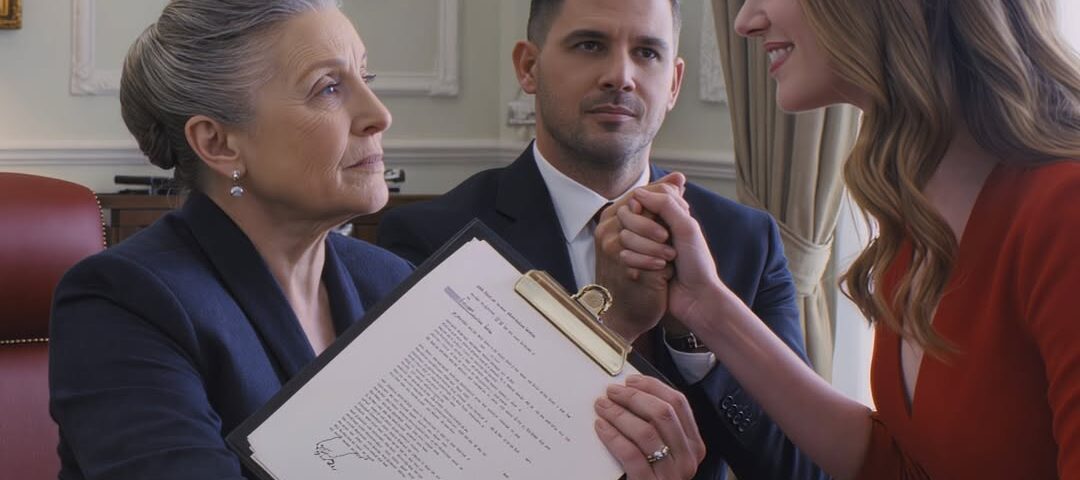
I never expected the reading of Frank’s will to be the day my own daughter would betray me.
“The family residence and all associated assets in Helena will go to my daughter, Sophia Reynolds Blackwell.”
Sophia clutched her husband Nathan’s hand as they exchanged smiles, not even trying to hide their satisfaction. I maintained my composure, as I always had during our forty-two years of marriage. Frank had been a practical man. Surely he had made appropriate provisions for me as well.
The lawyer cleared his throat and continued.
“And to my wife, Abigail Reynolds, I leave my recently acquired property in Montana near Glacier National Park.”
The silence in the room was deafening.
“That’s it?” Sophia finally asked, looking between the lawyer and me.
“The property includes approximately fifty acres of land and a…” The lawyer adjusted his glasses. “Cabin that Mr. Reynolds purchased five years ago.”
I remember feeling the weight of all eyes on me. Frank had never mentioned a property in Montana, not once in our four decades together.
“Mother can stay with us, of course,” Sophia announced with practiced generosity, squeezing Nathan’s hand as if seeking confirmation.
He nodded stiffly, his smile not reaching his eyes.
Two weeks later, I understood the true nature of their generosity. I had been relegated to the guest room of what had once been my own home, expected to cook, clean, and stay out of sight when they entertained. I was no longer the lady of the house, but an inconvenient appendage they’d inherited along with the property.
It was after one such dinner party that Nathan cornered me in the kitchen.
“This isn’t working, Abigail,” he said, swirling expensive whiskey in a crystal tumbler—my crystal from the set Frank and I had received as a wedding gift.
“I’m trying to stay out of your way,” I replied, continuing to load the dishwasher with plates still bearing the remains of the meal I’d prepared.
“That’s not enough.” Nathan’s voice hardened. “Frank knew what he was doing when he left you that place in Montana. He knew you were too weak to make it on your own after he was gone.”
I straightened up, dishcloth still in hand.
“Excuse me?”
“Let’s be honest,” he continued, emboldened by alcohol and arrogance. “You’ve been dependent your entire life. A housewife. You’ve never paid a bill, never held a real job. Frank carried you. And now we’re expected to do the same.”
Before I could respond, Sophia entered the kitchen. I looked to my daughter, expecting her to defend me against her husband’s cruelty.
Instead, she sighed.
“Mom, we’ve been talking, and we think it would be best if you went to see the Montana property. It’s yours after all. Maybe it’s time you learn to stand on your own two feet.”
The next morning, I found my suitcases in the hallway. Nathan didn’t even try to hide his satisfaction as he handed me an envelope containing directions to the property and the key.
“Don’t come back until you’ve figured out how to support yourself,” he said. “We’re not running a charity here.”
Sophia hugged me stiffly.
“It’s for your own good, Mom. You need to be independent.”
And just like that, at sixty-eight years old, I was homeless.
I loaded my belongings into my car, a modest sedan Frank had purchased for me three years earlier, and began the long drive from Helena to the remote property near Glacier National Park. Tears blurred my vision for the first hundred miles. How could Frank have left me so vulnerable? How could my own daughter discard me so easily?
The journey took almost nine hours, the last thirty minutes on unpaved roads that wound higher into the mountains. With each mile, my heart grew heavier.
What awaited me? A dilapidated shack where I was supposed to somehow rebuild my life.
When I finally reached the property, the sun was setting, casting long shadows across what appeared to be exactly what I’d feared. A neglected two-story cabin with a sagging porch, missing roof shingles, and windows that were either cracked or boarded up.
“Oh, Frank,” I whispered, parking in front of the sorry structure. “Why would you do this to me?”
Exhausted and heartsick, I gathered my courage and approached the door. The key turned in the lock with difficulty, the hinges protesting as I pushed the door open. I stepped inside, fumbling for a light switch.
What I saw when the lights flickered on left me frozen in the doorway, my suitcase dropping from nerveless fingers.
The interior bore no resemblance to the decrepit exterior. Modern furniture arranged tastefully in a spacious living room. A state-of-the-art kitchen gleaming with stainless steel appliances. Hardwood floors covered with plush area rugs.
But it wasn’t the unexpected luxury that stole my breath.
It was the dining table set for one, with a plate that still held the remains of a recently eaten meal. A coffee mug, half full, sat beside an open notebook.
Someone had been here recently. Perhaps still was.
I approached the table cautiously, my heart pounding. The notebook was filled with handwriting I recognized instantly—Frank’s precise, slanted script. I glanced at the date at the top of the page and felt the world tilt beneath my feet.
It was dated three days ago.
Frank had been dead for three weeks.
The entry began:
“Abigail will be arriving soon. Everything must be in place. God, I hope she understands why I had to do it this way.”
My hands trembling, I turned the page to find detailed diagrams of the house showing hidden passages behind walls, underground tunnels, and secret rooms.
A noise from deeper within the house sent me stumbling backward. I grabbed a heavy candlestick from the table, holding it like a weapon.
“Hello?” I called, my voice unsteady. “Is someone there?”
Silence answered me, broken only by the gentle hum of the refrigerator and my own ragged breathing.
Moving cautiously, I made my way down a hallway, passing rooms that looked lived in: a study with papers spread across a desk, a bedroom with rumpled sheets. Men’s clothing hung in the closet—Frank’s size—but styles I’d never seen him wear.
In the study, a bookshelf stood slightly ajar. When I pulled it, it swung outward on hidden hinges, revealing a narrow passageway.
Inside was a room that looked like something from a spy movie. Walls covered with photographs, newspaper clippings, and maps. At the center, a desk held multiple computer monitors. Corkboards displayed surveillance photos of people I recognized—politicians, business leaders from Helena—and prominently featured Nathan.
Pins and strings connected various documents, creating a web of relationships. Handwritten notes detailed financial transactions, offshore accounts, and what appeared to be evidence of money laundering on a massive scale.
On the desk sat a sealed envelope with my name written on it.
With shaking hands, I opened it and began to read.
“My dearest Abigail,
“If you’re reading this, then you found your way to the truth. I’m so sorry for the pain and confusion I’ve caused you. What I’m about to tell you will seem impossible, but I beg you to keep reading.
“I’m not dead. At least not in the way you think.
“Five years ago, while conducting an audit for Blackwell Development, I discovered irregularities that led me to a conspiracy involving Nathan, several state officials, and a network of shell companies. They were laundering money from government contracts, skimming millions that should have gone to public infrastructure.
“When I quietly began gathering evidence, I noticed I was being followed. Our home was bugged. Our phones were tapped. I realized the depth of what I’d stumbled into and the danger it represented.
“I purchased this property as a safe house disguised as an abandoned cabin to discourage visitors. Here, I’ve compiled everything needed to expose them.
“Three months ago, I learned they were planning to silence me permanently. I had to disappear before they acted, make them believe they’d succeeded. The heart attack was staged, the funeral a necessary deception.
“I couldn’t tell you beforehand. Your grief had to be genuine for them to believe I was truly gone. I’ve watched you suffer and it has broken my heart every day.
“Why leave you the cabin in my will? Because I knew they would force you out eventually. Nathan has always resented your presence.
“Sophia—I’m devastated to tell you—has known about her husband’s criminal activities for years. She’s involved.
“Abigail, our daughter chose money over morality long ago.
“This house contains everything needed to bring them to justice. But it also makes you a target. They’ll come looking for you. For these files.
“The house has defenses and escape routes I’ve prepared. Use them if you must.
“You have a choice now. You can take the evidence to Federal Agent Marcus Wilson in Kalispell. His contact information is in the desk drawer. Or you can leave. Use the cash and new identity I’ve left in the safe behind the painting in the master bedroom and disappear.
“Either way, don’t trust Sophia. Don’t return to Helena. It’s not safe.
“I hope to reveal myself to you soon once I’ve ensured it’s safe for us both. Until then, know that everything I’ve done, I’ve done for us.
“I’ve always known how strong you really are, Abigail. Much stronger than anyone—even you—has ever realized.
“With all my love,
“Frank.”
I read the letter twice, then sank into the desk chair, my mind struggling to process the impossible.
Frank alive?
Sophia complicit in criminal activities?
Our entire life together ending not with a death but an elaborate deception.
As shock gave way to understanding, I became aware of a sound outside.
Car tires on gravel.
I moved to the window and peered through the blinds to see headlights cutting through the darkness. Two black SUVs had pulled up in front of the cabin. Men in dark clothing emerged, moving with purpose toward the house.
“Don’t come back until you’ve figured out how to support yourself,” Nathan had said.
Now I understood.
They never expected me to stay here. They expected me to turn around and flee back to Helena after seeing the dilapidated exterior. Instead, I discovered their secret—and they had come to make sure it died with me.
I closed the secret room, heart pounding as I considered my options.
Run, hide, fight.
My whole life, I’d been underestimated: the quiet housewife, the supportive spouse, the doting mother. Even Frank, for all his professed faith in me, had kept me in the dark until now.
As I heard the front door handle being tested, a strange calm settled over me.
For the first time in my life, I held power in my hands: the truth that could destroy those who had betrayed and discarded me.
They thought I was weak.
It was time to show them just how wrong they were.
I moved quickly to the master bedroom, found the safe, and removed its contents. Then I slipped into one of the hidden passages Frank had mapped out, closing the entrance behind me—just as I heard the sound of breaking glass from the front of the house.
The hunt had begun.
But they didn’t realize that this supposedly helpless old woman now knew every secret of this house of lies.
I was no longer the prey.
I was the trap.
I navigated through the narrow passage, guided by dim emergency lights embedded in the floor. Frank had thought of everything. The passage sloped downward, leading deeper into the foundation of the house.
I could hear muffled voices above—at least three different men—methodically searching each room.
“She has to be here somewhere,” a voice growled. “Her car is outside. Check behind the furniture. Under the beds. The boss said she might have found something.”
The boss. Nathan, or someone higher up in whatever conspiracy Frank had uncovered.
The passage opened into a small concrete room filled with surveillance equipment. Multiple screens displayed different areas of the house, catching my pursuers in their search. The men wore dark clothing and moved with military precision, some carrying weapons that certainly weren’t legal for civilian use.
On the main console, a red button labeled EMERGENCY beckoned. Next to it, a handwritten note in Frank’s writing:
“Only in absolute crisis. 30 seconds to exit through tunnel.”
I didn’t know what it would trigger, but I kept it in mind as I assessed my situation.
The contents of the safe were now secured in a small backpack I’d found hanging on a hook: cash, passports with my photo but different names, a loaded handgun. Frank knew I’d gone shooting with him occasionally over the years, though I’d never owned a weapon. And several thumb drives labeled EVIDENCE.
A map on the wall showed the entire tunnel system. One route led to an exit half a mile away, emerging in a stand of trees near a small creek. Another connected to what appeared to be an old mining tunnel extending for several miles with multiple exit points.
I had no delusions about outrunning these men in the woods—especially in the dark. My best chance was to hide until they gave up the search.
Or… the thought struck me suddenly.
These men were here to find evidence and eliminate witnesses. But what if they succeeded in only one of those objectives? Frank’s meticulous planning gave me an idea. If they believed they’d destroyed everything, perhaps they’d report mission accomplished without confirming my demise.
On the surveillance screen, I watched as one man discovered the entrance to the secret room.
“I found something,” he called to the others.
They converged, pawing through the evidence Frank had compiled.
“This is everything,” one said, pulling out a phone. “Call it in.”
I couldn’t hear the other side of the conversation, but the man’s expression darkened.
“Understood. No traces.”
They began gathering the documents and hard drives.
“What about the old lady?” another asked.
“She’s here somewhere. Find her, then burn it all down.”
My blood ran cold.
They intended to destroy the house with me in it if necessary.
I glanced at the emergency button again, making my decision. Whatever Frank had rigged, it might be my only chance. But first, I needed a distraction.
Among the equipment was a small panel labeled HOUSE CONTROLS. I toggled several switches and watched with satisfaction as the house plunged into darkness, followed by the shriek of an alarm system activating. The men on the screen jerked in surprise, shouting to each other as emergency lights cast eerie shadows through the house.
I pressed the emergency button.
A recorded message in Frank’s voice spoke calmly through a speaker.
“Emergency protocol activated. Controlled demolition in thirty seconds. Proceed to safety immediately.”
My heart raced as I grabbed the backpack and hurried toward the tunnel marked as the primary escape route. Behind me, I could hear mechanical sounds—locks engaging, metal shutters descending.
I was twenty yards down the escape tunnel when the first explosion rocked the foundation. It wasn’t large, more controlled than destructive, but I heard concrete collapsing somewhere behind me.
Frank had designed it to seal the hidden rooms and passageways while leaving the house structure mostly intact. The men would be trapped in the main house, separated from both me and the evidence they’d been gathering.
I kept moving, the tunnel gradually transitioning from concrete to rough-hewn stone—part of the old mining system Frank had incorporated into his escape routes. The air grew cooler and damper as I pushed deeper into the mountain.
For nearly an hour, I followed the emergency lights, my mind churning with questions and revelations. My entire life had been upended in a single day. My husband wasn’t dead. My daughter was a criminal. And I was a fugitive.
When I finally emerged from the tunnel exit, I found myself on a wooded slope overlooking the property. In the distance, I could see flashing lights—police or fire vehicles responding to the explosion. The cabin appeared intact from the outside, though I knew its secrets were now sealed away.
Had the intruders escaped? Were they searching the woods for me now?
I couldn’t risk finding out.
According to the map, there was a small hunter’s cabin another two miles north that Frank had marked as Secure Location B. I oriented myself using the stars and began walking.
The Montana night enveloped me in its vastness—a blanket of stars overhead, the silhouettes of mountains against the horizon, the rustle of wildlife in the underbrush. In other circumstances, I might have found it beautiful.
As I walked, I thought about Nathan’s sneering face as he’d thrown me out.
“You’re too weak to make it on your own,” he’d said.
Perhaps he’d believed it. Perhaps I’d believed it too, after decades of comfortable dependence. But with each step through the wilderness, something long dormant awakened inside me.
Determination.
Resilience.
Anger.
By the time I reached the hunter’s cabin, my feet were blistered, my muscles ached, and my lungs burned from the elevation. But I had made it on my own.
Inside, I found basic provisions: canned food, bottled water, a first aid kit, and a satellite phone with a single programmed number. With trembling fingers, I dialed.
It rang three times before a man answered.
“Security protocol,” the voice demanded.
I recalled the phrase from Frank’s letter.
“Blue heron at midnight.”
A pause.
Then, “Abigail, is that you?”
My heart stopped.
“Frank,” I whispered.
“Thank God,” my not-dead husband breathed. “Are you safe? Did you make it out?”
Tears streamed down my face—relief, anger, the sheer absurdity of it all.
“I’m alive,” I said. “No thanks to our daughter and her husband.”
“I’m so sorry, Abby, for everything. Where are you?”
“I can’t tell you yet. Not over this line, but soon.”
“They came for me, Frank. Men with guns.”
“I was afraid of that.” His voice tightened. “Did you activate the emergency protocol?”
“Yes. They’re either trapped, or they’ve called for backup. Either way, you can’t stay there long.”
“In the bedroom, under the mattress, there’s a satellite tracking device. Activate it and I’ll have someone come for you within six hours.”
I should have been overwhelmed. I should have broken down.
Instead, I felt a strange clarity.
“No,” I said firmly.
“No, Abby, you’re in danger.”
“I’m going to Kalispell,” I interrupted. “To that federal agent you mentioned.”
“These people—including our daughter—tried to kill me tonight. I’m not running away. I’m going to make them pay.”
Silence stretched between us.
“You don’t have to do this,” Frank finally said. “We could disappear together, start fresh somewhere else.”
“Is that why you did all this?” I asked. “So we could spend our golden years looking over our shoulders?”
“No, Frank. I want justice. I want our life back.”
Another long pause.
“You always were stronger than I gave you credit for,” he said softly. “All right. I’ll make arrangements, but please be careful. These people won’t stop coming.”
As I ended the call, I sat in the small cabin, surrounded by wilderness, miles from everything familiar.
Nathan had cast me out, believing I would break.
Instead, he had set me free.
Come morning, I would begin my journey to Kalispell—not as a victim seeking help, but as a woman carrying the weapon that would destroy those who had underestimated her.
Let them keep hunting.
This time, I would be ready.
Dawn broke over the mountains, painting the sky in watercolor strokes of pink and gold. I had slept fitfully on the narrow cot, jolting awake at every creak and rustle from the surrounding forest. The satellite phone remained silent after my conversation with Frank—no further instructions, no warnings of approaching danger.
I took inventory of my resources: the backpack with cash and documents, a basic first aid kit, three days’ worth of canned food, and the handgun I kept within reach despite my limited experience with firearms.
According to the map, Kalispell was approximately forty miles away—an impossible journey on foot through mountainous terrain. The cabin’s single window faced east, providing a view of the valley below and, crucially, the road leading to Frank’s property.
Through a pair of binoculars I found on a shelf, I spotted activity. Several vehicles parked haphazardly. Men in dark uniform establishing a perimeter—not police. No marked cars or flashing lights. These were the same private forces from last night, now expanded in number. They were searching the woods methodically, working in a grid pattern outward from the house.
It wouldn’t take them long to discover the hunting cabin if they kept at it.
I needed transportation, and fast.
The map showed a small settlement eight miles north, little more than a cluster of homes and a general store serving the scattered ranches and vacation properties in the area. If I could reach it without being spotted, perhaps I could find help—or at least a ride to Kalispell.
I packed quickly, leaving no trace of my presence, and slipped out of the cabin. The morning air carried a bite of autumn chill as I oriented myself using the map and compass from my supplies.
The most direct route would keep me exposed on ridgelines. Instead, I opted for a longer path through denser forest and creek beds that would provide cover.
Hours passed as I picked my way through the wilderness, my city legs protesting every incline and rocky stretch. I hadn’t hiked in years, not since Frank and I had taken weekend trips to Yellowstone when Sophia was young. The memory of those happier times sent a pang through my chest.
How had my little girl grown into someone willing to see her own mother killed for money?
By midday, I reached a dirt service road that, according to the map, led toward the settlement. I followed it cautiously, ready to dive into the underbrush at the first sign of vehicles.
The road curved around a reservoir, and suddenly the settlement came into view: a dozen weathered buildings clustered around a crossroads, with mountains rising majestically behind them.
I adjusted my appearance as best I could—smoothing my hair, brushing dirt from my clothes—before approaching. A simple story formed in my mind: a tourist whose car had broken down, separated from my tour group, needing help.
Simple.
Believable.
Most importantly, unremarkable.
The general store’s screen door creaked as I entered. An older man looked up from behind the counter, his weathered face registering mild surprise at the sight of me.
“Morning, ma’am,” he greeted. “Don’t often get folks walking in. Everything all right?”
“Car trouble,” I explained, summoning a sheepish smile. “I was photographing wildlife when my rental died about five miles back. My phone has no service out here.”
He nodded sympathetically.
“That happens plenty. Where are you trying to get to?”
“Kalispell. I have friends expecting me.”
“Well, I’d offer to take a look at your car, but my knees ain’t what they used to be. My son runs the tow service, but he’s out on a call.” He checked his watch. “Mail truck comes through in about an hour headed that way. Margie might give you a lift at least part of the way.”
I thanked him and purchased a few supplies with cash: water, a packaged sandwich, a baseball cap that would help conceal my face.
As I waited, I perused the bulletin board near the entrance, plastered with local notices and advertisements. A freshly posted flyer caught my eye, and my blood ran cold.
My own face stared back at me alongside the word MISSING in bold letters.
The text described me as a sixty-eight-year-old woman with possible dementia who wandered away from her family’s Montana property. It listed Nathan as the contact person, claiming he was deeply concerned for his mother-in-law’s safety.
The store owner noticed my attention.
“Just came in this morning,” he commented. “Some fella in a fancy SUV put ’em up all over town. Said his poor mother-in-law got confused and wandered off. They’ve got search teams out looking.”
My mind raced.
They were covering their tracks, establishing a narrative that would explain my disappearance—or my death—if they found me. If I turned up dead in the wilderness, everyone would blame confusion and exposure, not foul play.
“Terrible thing,” I murmured, angling my face away.
“I hope they find her.”
“Said she might be distressed or paranoid,” the man continued. “Talking nonsense about people being after her. Alzheimer’s is a cruel business.”
The perfect setup.
If I approached authorities claiming a conspiracy, Nathan had already planted the seed that I was delusional. Who would believe an elderly woman over a respected businessman with political connections?
The bell above the door jingled. I tensed, then forced myself to relax as an elderly woman entered—no men in black SUVs.
“Morning, Earl,” she greeted the shopkeeper. “Any packages for me today?”
“Mail’s not in yet, Doris. Though Margie should be along soon.”
As they chatted, I weighed my options. Waiting for the mail truck now seemed risky. If Nathan’s men had been here distributing flyers, they might return—or the storekeeper might make the connection between the missing woman and the stranger in his shop.
Doris finished her business and headed back outside. On impulse, I followed her.
“Excuse me,” I called softly.
She turned, squinting at me in the sunlight.
“Yes, dear?”
“I couldn’t help overhearing. Do you live nearby?”
“Just up the road,” she replied, gesturing vaguely. “Why do you ask?”
I made a quick decision.
“I’m having car trouble, and I really need to get to Kalispell today. I’d be happy to pay for a ride if you’re heading that direction.”
Doris studied me for a moment.
“Not today, I’m afraid, but my son is dropping by this afternoon with supplies. He lives in Columbia Falls, just outside Kalispell. He could probably help you out.”
Relief washed through me.
“That would be wonderful. I’d be so grateful.”
“Come along then,” she said, heading toward an ancient pickup truck. “No sense waiting here in the sun. You can have some lunch while we wait for him.”
As we drove the short distance to her ranch house, I glanced nervously at every passing vehicle, expecting to see the black SUVs from Frank’s property. But the roads remained quiet, the mountains indifferent to my plight.
Doris chattered amiably about local history and her family as we bumped along the dirt road. I responded with appropriate interest while keeping my fabricated backstory consistent: a wildlife photographer from Minneapolis visiting Montana for the first time.
Her home was modest but comfortable, sitting on several acres with a barn and corral visible behind it.
As we pulled up, I noticed another vehicle already parked in front: a silver sedan with tinted windows.
“Looks like Tommy’s here early,” Doris remarked cheerfully.
But as we approached the house, the front door opened to reveal a woman whose appearance struck me like a physical blow.
Sophia.
My daughter stood on the porch, her expression shifting from pleasant to shocked as she recognized me.
For one frozen moment, we stared at each other—the daughter who had betrayed me, and the mother she believed she had sent to her death.
Then her hand moved to her purse.
And I knew with cold certainty what she was reaching for.
“Doris, get down!” I shouted, shoving the older woman aside as Sophia withdrew a pistol from her bag.
The first shot splintered the wood of the porch railing as I dragged Doris behind her truck for cover.
“What in God’s name?” Doris began, her voice shaking.
“That’s my daughter,” I explained breathlessly, the absurdity of the situation not lost on me. “And she’s trying to kill me.”
In the distance, I heard the rumble of approaching vehicles—reinforcements.
Undoubtedly, the trap was closing.
And this time, there would be no secret passageways to escape through.
“Your daughter?” Doris repeated, shock rendering her momentarily speechless as another bullet pinged off the truck’s hood. “Why would your daughter—”
“It’s complicated,” I gasped, my mind racing. “Is there another way out of here?”
Doris nodded, her initial shock hardening into surprising resolve.
“The barn connects to the back pasture. There’s an access road the ranch hands use.”
She fumbled in her pocket, producing a set of keys.
“My husband’s old Jeep is in the barn. Still runs.”
A voice called from the direction of the house—Sophia’s voice, sweet and reasonable, betraying nothing of her murderous intent.
“Mom, is that you? Thank God we found you. Everyone’s been so worried.”
The performance was chilling in its believability. If Doris had been alone, she would have certainly emerged, never suspecting the danger.
“We need to move,” I whispered to Doris. “When I say now, run for the back of the barn. Stay low.”
The rumble of engines grew louder. Through a gap beneath the truck, I glimpsed two black SUVs turning onto the property’s long driveway.
“Now!” I shouted.
We both scrambled to our feet. Another shot rang out as we fled, dirt kicking up at our heels. Doris was remarkably spry for her age, keeping pace as we zigzagged toward the barn’s rear entrance.
We burst through the door, startling chickens that had taken shelter in the shade. The barn was mercifully spacious, offering multiple hiding spots among stacked hay bales and equipment.
Doris pointed to a tarp-covered vehicle in the corner.
“That’s Harold’s Jeep. Keys should work, but it hasn’t been started in months.”
I ripped away the tarp to reveal a vintage Jeep Wrangler—dusty, but intact. While Doris barred the barn door with a beam of wood, I slid behind the wheel, inserted the key, and said a silent prayer.
The engine coughed, sputtered, then roared to life.
“Thank you, Harold,” Doris murmured, crossing herself before climbing into the passenger seat.
“You should stay,” I told her. “Tell them I forced you. They have no reason to hurt you.”
She fixed me with a steely glare.
“Young lady, I may not understand what’s happening, but I know wrong when I see it. Nobody shoots at people on my property.”
Then, as if that weren’t enough, she reached under the seat and withdrew a weathered shotgun.
“Besides,” she added, “I know these back roads better than anyone.”
Before I could respond, shouts erupted from the front of the barn. The doors rattled as someone tried to force them open against the barricade.
I threw the Jeep into gear and aimed for the rear doors, which hung slightly ajar.
We burst through them in a shower of splinters, fishtailing onto a dirt track that led away from the house toward the tree line that marked the property boundary.
In the rearview mirror, I glimpsed figures pouring out of the barn, Sophia among them, her face contorted with fury. The black SUVs were redirecting, attempting to cut us off.
“Left at the creek bed,” Doris instructed, bracing herself as we bounced over the uneven terrain. “These logging roads connect all through these mountains. They’ll never catch us if we stay off the main roads.”
I followed her directions, grateful for local knowledge, as we plunged into a labyrinth of unmarked dirt tracks that wound through dense forest. The Jeep handled the rough terrain admirably, though every bone in my body protested the jarring ride.
“Now,” Doris said once we’d put several miles between us and her ranch, “I think it’s time you told me why your daughter is trying to kill her own mother.”
As we navigated the backwoods of Montana, I gave Doris the condensed version: Frank’s discovery of corruption, his faked death, Nathan and Sophia’s involvement, and the evidence that could bring down their entire operation.
“So your husband isn’t actually dead?” she asked, her weathered face registering continued disbelief.
“Apparently not, though I’ve only heard his voice on the phone.”
She shook her head.
“And I thought the telenovelas I watch were far-fetched.”
Despite everything, I laughed—a sharp, surprised sound that felt foreign in my throat.
“Trust me,” I said, “I’m still struggling to accept it myself.”
“Where are we headed?” Doris asked as the forest began to thin, giving glimpses of a valley beyond.
“Kalispell. There’s a federal agent there who Frank said would help. A man named Marcus Wilson.”
Doris nodded thoughtfully.
“I know a back way that’ll get us close to town without using the main highway. They’ll have people watching those roads for sure.”
As we emerged from the forest onto a ridge overlooking a vast valley, Doris directed me to pull over beneath the cover of several large pine trees. From this vantage point, we could see for miles, including a plume of smoke rising in the distance back in the direction of Doris’s ranch.
“They’re burning it,” Doris said quietly, her voice thick with emotion. “My home.”
Guilt crashed over me.
“I’m so sorry. I never meant to bring this to your doorstep.”
She squared her shoulders, though her eyes remained fixed on the distant smoke.
“Been meaning to move closer to my grandkids anyway. Too many stairs in that old place.”
Then she turned to me, her expression hardening.
“But now I’m invested in seeing these bastards pay.”
We continued our journey through increasingly rough terrain, the old Jeep groaning in protest as we forded shallow streams and climbed steep embankments. According to Doris, these routes were used primarily by local hunters and the occasional logger— invisible to anyone not intimately familiar with the region.
By late afternoon, we began to see signs of civilization again: scattered houses, then small clusters of buildings as we approached the outskirts of Columbia Falls, just east of Kalispell.
“We should ditch the Jeep,” I suggested. “They’ll be looking for it by now.”
Doris agreed, directing me to a small diner with an attached motel on the edge of town.
“My nephew manages this place. He’s discreet and can give us a room to clean up and make some calls.”
The diner was nearly empty when we entered, just a few truckers nursing coffee at the counter. Doris’s nephew, a burly man in his forties named Pete, took one look at his aunt’s disheveled state and ushered us immediately into a back office.
“They burned down the ranch,” Doris told him without preamble. “I need a room. No paperwork. And a secure phone.”
To his credit, Pete asked no questions, simply producing a key and a cell phone.
“Room twelve around back. No one will bother you. You need anything else, Aunt D?”
“Some food wouldn’t hurt,” she replied. “And keep an eye out for men in black SUVs asking questions.”
While Doris explained the situation to her nephew, I used the phone to call the number Frank had given me for Agent Wilson. It rang several times before going to voicemail. I left a cryptic message mentioning Frank’s name and the cabin, providing the motel’s information, then ended the call.
In the small, dated motel room, I finally had a moment to properly assess my physical state. My reflection in the bathroom mirror was startling: a disheveled woman with wild gray hair, a dirt-streaked face, and eyes haunted by a day’s worth of life-or-death situations.
Hardly the proper suburban grandmother I’d been just days ago.
After a quick shower, I emptied the contents of the backpack onto the bed, examining each item more carefully now that I had proper light and time. Among the documents and cash was a small leather notebook I hadn’t noticed before, filled with Frank’s handwriting—names, dates, account numbers, and, most importantly, details of meetings between Nathan, Sophia, and various government officials. All meticulously documented with photographs taped to the pages.
The evidence was damning and comprehensive.
Frank had been thorough, as always.
A knock at the door sent my heart racing. I gestured for Doris to stand back as I approached cautiously, the handgun ready at my side.
“Who is it?” I called.
“Federal Agent Marcus Wilson,” came the reply. “I believe we have a mutual friend.”
I cracked the door cautiously, the chain still engaged. A man in his early fifties stood outside—athletic build, close-cropped gray hair, and the unmistakable posture of law enforcement. He held up a badge.
“Mrs. Reynolds, I’m Agent Wilson.”
“Frank contacted me.”
“Frank called you?” I asked, not yet releasing the chain.
“No, ma’am, but I received an alert when you activated the emergency protocol at the cabin. I’ve been working with your husband for months.”
I studied his face, searching for any sign of deception.
“Prove you know Frank.”
A hint of a smile touched his lips.
“He said you’d be cautious. Good.”
He reached into his jacket pocket slowly, producing a photograph.
“He wanted me to show you this if you questioned my identity.”
The photo showed Frank and me on our thirtieth anniversary trip to Santorini— a private moment on a cliffside at sunset that no one else would have had access to.
I finally unlatched the chain.
Agent Wilson entered, nodding respectfully to Doris before surveying our humble accommodations with a professional eye.
“You’ve been through quite an ordeal, Mrs. Reynolds. I’m impressed you made it this far.”
“I had help,” I said, gesturing to Doris. “And please call me Abigail.”
He sat at the small table near the window, positioning himself to keep watch on the parking lot.
“Frank has been feeding me information about Nathan Blackwell’s operation for almost a year. We were building a case carefully, methodically, until Frank’s death accelerated the timeline.”
“Why didn’t you arrest Nathan months ago?” I asked, unable to keep the edge from my voice.
“Blackwell is just one piece of a much larger network,” Wilson explained. “We needed to identify all the major players—the politicians, judges, business leaders. Moving too early would have allowed the bigger fish to slip away.”
“Meanwhile, I was left in the dark,” I noted bitterly, “grieving a husband who wasn’t dead.”
Wilson had the grace to look uncomfortable.
“That was Frank’s decision. He believed it was the only way to protect you.”
“By making me a target?” I challenged.
“By ensuring you weren’t complicit,” Wilson corrected. “If you’d known the truth—if you’d acted differently after his death—they would have suspected you immediately. Your genuine grief gave you protection until they realized what Frank had hidden at the cabin.”
I absorbed this explanation, not entirely satisfied, but understanding the cold logic behind it.
“So what happens now?”
“Now,” Wilson said, “we move you to a secure location while we prepare to take down the entire operation.” He nodded toward the backpack. “The evidence you recovered completes our case.”
“And Frank,” I demanded. “Where is he?”
“In protective custody at a safe house in northern Idaho.”
“We can arrange for you to join him once we’ve ensured the area is secure.”
A wave of emotion washed over me: relief, anger, longing, and something like grief for the time I’d lost.
But something else nagged at my conscience.
“What about Sophia?” I asked quietly. “My own daughter tried to kill me today.”
Wilson’s expression grew somber.
“Based on the evidence Frank provided, Sophia Blackwell is deeply involved in her husband’s criminal activities. She’ll face the same charges as the others—money laundering, conspiracy, attempted murder.”
The reality hit me anew.
My daughter would go to prison.
My beautiful, ambitious Sophia—who had once been a straight-A student with dreams of changing the world—had become someone willing to murder her own mother for money.
“I need to see the evidence against her,” I said finally. “All of it.”
Wilson hesitated, then nodded.
“That’s your right. But I should warn you—it’s comprehensive.”
“Frank was especially thorough documenting Sophia’s involvement, perhaps because he found it so difficult to accept.”
He produced a laptop from his briefcase, booting it up and entering several layers of passwords before turning it toward me.
“These files contain everything we have on Sophia Blackwell’s activities over the past three years.”
For the next hour, I sifted through a devastating archive of my daughter’s betrayal: emails discussing bribes to government officials, recordings of meetings where she calmly planned tax evasion strategies for clients engaged in illegal activities, photographs of her accepting envelopes of cash from known criminals.
Most damning were records of her involvement in planning Frank’s “accident”—the staged heart attack that had launched this entire nightmare.
My daughter had helped plot her own father’s death.
“She knew,” I whispered, my voice hollow. “She knew he wasn’t really dead.”
“Yes,” Wilson confirmed. “Our theory is that she suspected the heart attack was faked, which is why they accelerated their plans to find any evidence he might have hidden.”
Doris, who had maintained a respectful silence throughout, placed a weathered hand on my shoulder.
“I’m so sorry, Abigail.”
I closed the laptop, emotionally exhausted, but oddly clear-headed.
“When do you make the arrests?”
“We’re coordinating with multiple agencies for simultaneous operations,” Wilson said. “Tomorrow morning. Six a.m. We’ll take down all the major players at once—including your son-in-law and daughter.”
“I want to be there,” I said suddenly, surprising even myself.
“When you arrest Nathan and Sophia.”
Wilson shook his head immediately.
“Absolutely not. It’s too dangerous, and your presence could complicate the legal proceedings.”
“They tried to kill me,” I countered. “They burned down Doris’s home. They’ve destroyed lives without a second thought.”
I met his eyes steadily.
“I deserve to see justice done.”
Wilson studied me for a long moment.
“You’re a lot like Frank described—stronger than you appear.”
“I’m discovering that myself,” I replied.
After further discussion, we reached a compromise. I would be nearby during the arrests, observing from a secure vehicle with Agent Wilson, but would not directly participate in the operation.
As evening settled over the small motel, Wilson left to coordinate with his team, leaving an agent posted outside our door for protection. Doris and I shared a simple meal brought by her nephew, each lost in our own thoughts.
“What will you do after?” Doris asked eventually.
When this is all over.
I considered the question, realizing I had no clear vision of my future. The life I’d known was gone. My relationship with my daughter was irrevocably shattered.
Even reuniting with Frank would mean building something entirely new from the ashes of our former existence.
“I don’t know,” I admitted. “Start over somehow.”
“I suppose you could do worse than Montana,” Doris suggested. “Once you get past the people trying to kill you, it’s quite beautiful.”
The absurd understatement startled a laugh from me, a genuine laugh that felt like the first crack in the wall of tension I’d been carrying since this ordeal began.
“I’ll consider it,” I promised, “though perhaps a bit further from my current in-laws.”
As night fell, I lay awake in the unfamiliar bed, my mind replaying the events that had brought me here. Just days ago, I had been Abigail Reynolds—grieving widow and unwanted mother-in-law. A woman defined primarily by her relationships to others. Deemed too weak to stand on her own.
Now I had evaded professional killers, outsmarted my murderous daughter, and helped preserve evidence that would bring down a criminal empire.
The woman Nathan had dismissed as feeble had become the instrument of his destruction.
Tomorrow would bring its own challenges: the painful spectacle of Sophia’s arrest, the uncertain reunion with a husband returned from the dead, the daunting prospect of rebuilding a life at sixty-eight.
But for perhaps the first time in my adult life, I wasn’t afraid of the future.
Whatever came next, I would face it with newfound strength.
The house in Montana hadn’t been a cruel final joke from Frank, after all. It had been a crucible—one that had burned away my comfortable illusions and revealed something unexpected beneath.
A woman I’d never known existed.
A woman who could survive anything.
Dawn broke with military precision. At 5:30 a.m., Agent Wilson was at our door, accompanied by a female agent who introduced herself as Special Agent Rivera.
“Time to move,” Wilson said, his demeanor all business. “We have a secure vehicle waiting.”
I dressed quickly in clothes provided by the FBI: dark pants and a navy windbreaker that made me look somewhat official, though the matching baseball cap felt like an unnecessary touch.
Doris had arranged to stay with her nephew until it was safe to assess what remained of her property.
“Be careful,” she told me as we embraced. “And when this is all over, come back and visit. I make a mean apple pie.”
“I will,” I promised, surprised by how much I meant it.
In the chaos of the past days, I’d somehow found a friend.
Agent Rivera drove while Wilson briefed me in the backseat of an unmarked SUV— a bitter irony, considering similar vehicles had been hunting me just yesterday.
“We’re conducting simultaneous raids at multiple locations,” he explained, handing me a bulletproof vest that I reluctantly donned at his insistence. “Nathan and Sophia’s residence, their offices, several properties owned by their associates. Based on surveillance, we believe they’re both at home this morning.”
“Our home,” I corrected quietly. “The house Frank and I shared for thirty years.”
Wilson acknowledged this with a sympathetic nod.
“You’ll remain in the vehicle with Agent Rivera at a secure distance. I’ll be with the arrest team.”
He hesitated, then added, “I should warn you. These situations can be volatile. If Blackwell and your daughter resist arrest, you’ll do what’s necessary.”
“I understand,” I finished for him.
We drove through the quiet streets of Helena as the city began to stir. Every familiar landmark felt alien now, as if I were seeing my hometown through a stranger’s eyes: the grocery store where I’d shopped weekly for decades, the library where I’d volunteered after retirement, the park where I’d pushed Sophia on the swings as a child.
All settings from a life that now seemed to belong to someone else.
Wilson’s radio crackled with coded communications as we approached my neighborhood. Multiple vehicles were converging—agents preparing to execute the carefully orchestrated arrests that would dismantle Nathan’s network in a single coordinated strike.
We stopped two blocks from my former home, close enough to observe, but far enough to remain safely removed from any potential conflict. Agent Rivera positioned the SUV strategically, giving us a clear view of the street while maintaining a discreet profile.
“Team Alpha in position,” came a voice over the radio.
“All units ready.”
Wilson gave my shoulder a brief, reassuring squeeze before exiting the vehicle to join the arrest team.
Rivera handed me a pair of binoculars.
“Sometimes it helps to see things clearly,” she said, her expression suggesting she understood my need for closure.
Through the binoculars, I watched as FBI vehicles silently surrounded my home, agents taking position at all potential exits. The house looked exactly as I remembered: the carefully tended garden I’d planted, the porch swing Frank had built, the stained-glass side panels I’d installed beside the front door as an anniversary project.
It was surreal to see it transformed into a crime scene.
The radio crackled again.
“Execute. Execute. Execute.”
What followed happened with breathtaking speed. Agents rushed the property from all sides. The front door splintered under the force of a battering ram.
“FBI! Search warrant!” echoed across the once-quiet street.
Through the binoculars, I caught glimpses of movement inside: the blurry figures of agents securing each room, the startled faces of household staff being directed outside.
Then Nathan appeared in the doorway—barefoot and wearing a bathrobe—his hands secured behind his back as agents escorted him to a waiting vehicle. Even at this distance, the shock and indignation on his face were unmistakable.
The powerful man who had thrown me out of my own home now looked small and ordinary in the morning light.
I waited, breath held, for Sophia to appear.
Minutes passed.
The radio buzzed with status updates from various teams.
“Bedroom clear.”
“Kitchen clear.”
“Basement secure.”
Then, urgently:
“We have a runner. East side through the garden.”
I adjusted the binoculars just in time to see a figure in dark clothing scaling the back fence—Sophia moving with desperate speed through the neighbor’s yard.
“Suspect heading toward Franklin Street,” an agent called.
Rivera immediately started our engine.
“Hold on,” she warned as we pulled away from the curb, circling the block to intercept.
We rounded the corner just as Sophia emerged from between two houses, her panicked flight bringing her directly into our path. Rivera stopped the vehicle, blocking the street.
For one frozen moment, my daughter stood illuminated in our headlights—her eyes wild with fear and fury.
She looked nothing like the polished businesswoman who had built her career on charm and connections. Her hair was disheveled, her expression feral—a woman cornered and dangerous.
Then she saw me in the passenger seat.
Recognition dawned, followed by disbelief, then a hatred so pure it transformed her face into something unrecognizable.
In that moment, I truly understood. The daughter I had raised was gone, replaced by a stranger willing to sacrifice her own parents for wealth and power.
Sophia turned to flee in another direction, but agents were closing in from all sides. With nowhere left to run, she made a final, desperate choice, reaching into her jacket.
“Gun!” an agent shouted.
Time seemed to stretch and distort. I saw agents drawing their weapons, shouting commands. I saw Sophia’s hand emerging with something dark and metallic.
I heard Rivera beside me, telling me to get down.
In the chaotic seconds that followed, I closed my eyes, unwilling to witness what might happen next.
The crack of a gunshot tore through the morning air.
When I looked again, Sophia was on the ground, agents surrounding her.
But she was moving—alive.
The shot had been a warning fired into the air. The object in her hand clattered to the pavement.
Not a gun.
A phone—perhaps intended to look like a weapon in the heat of the moment.
As they handcuffed her, Sophia’s gaze found mine again through the windshield. No hatred now—just a hollow emptiness that somehow hurt worse than her anger.
They guided her into a waiting vehicle. Her head bowed, the fight gone out of her.
Rivera touched my arm gently.
“Are you all right?”
I wasn’t. Not remotely.
But I nodded anyway.
“It’s done,” she said simply.
Wilson returned to our vehicle minutes later, his expression grave but satisfied.
“Blackwell’s already demanding his lawyer. Your daughter hasn’t said a word.”
“Will the charges stick?” I asked, my voice steadier than I felt.
“With the evidence we have, absolutely. They’re looking at decades, Abigail.”
I absorbed this—the finality of it, the irrevocable consequences that would shape all our lives going forward.
My son-in-law would go to prison.
My daughter would go to prison.
And I would somehow have to rebuild a life from the wreckage.
“What about Frank?” I asked. “When can I see him?”
Wilson checked his watch.
“We have a plane waiting at the private airfield. If you’re ready, we can leave now. He’s anxious to see you.”
As we drove away from the neighborhood I’d called home for most of my adult life, I didn’t look back. Whatever future awaited me—with Frank, without Sophia, beyond the identity I’d carried for so long—it lay elsewhere.
The house in Montana that had seemed like a cruel joke had become, improbably, the first step toward my liberation. In losing everything familiar, I discovered a resilience I never knew I possessed.
“I’m ready,” I told Wilson, and found that despite everything, I meant it.
The private airfield operated by the FBI occupied a discreet location outside Helena, surrounded by high fences and security checkpoints. As we approached, I caught sight of a small jet with government markings waiting on the tarmac, its engines already running.
“Standard protocol for protected witnesses,” Wilson explained as we passed through a final security checkpoint. “We move quickly, quietly, and leave no trail.”
The morning’s events had left me emotionally drained, yet I felt oddly alert—my senses cataloging every detail as if to anchor myself in this new reality: the vibration of the tarmac beneath our vehicle, the crisp mountain air when Rivera opened my door, the distant rumble of the jet’s engines preparing for departure.
“This way, Mrs. Reynolds,” a young agent directed, guiding me toward the waiting aircraft.
I paused at the foot of the boarding stairs, suddenly overwhelmed by the magnitude of what awaited me above. Frank—my husband of forty-two years—the man I had mourned and buried, whose absence had reshaped my entire existence—was alive, breathing, waiting.
“Take your time,” Wilson said quietly beside me. “This isn’t easy for anyone.”
I squared my shoulders and ascended the stairs with deliberate steps. At the top, I hesitated just a moment before stepping inside.
The jet’s interior was utilitarian but comfortable, with leather seats arranged in small groupings rather than rows.
And there, rising from a seat near the back, was Frank.
He looked thinner than I remembered, his face more lined, his hair grayer. He wore clothes I didn’t recognize—casual attire that seemed at odds with the meticulous dresser I had known.
But his eyes—those were unchanged, watching me with the same mixture of affection and uncertainty that had characterized our first meeting nearly half a century ago.
“Abby,” he said, his voice breaking slightly on the familiar diminutive that only he had ever used.
I stood frozen.
A storm of emotions rendered me momentarily incapable of speech: relief at seeing him alive, anger at his deception, joy at our reunion, grief for the daughter we had both lost in different ways.
“You look well,” he offered awkwardly when I didn’t respond.
A laugh escaped me—sharp, bordering on hysterical.
“Do I? After believing you were dead? After being thrown out of my home? After discovering our daughter tried to have us both killed?”
He flinched as if struck.
“I deserve that. All of it. But please sit. Let me explain.”
The agents discreetly moved to the front of the aircraft, giving us as much privacy as the confined space allowed.
I sank into a seat opposite Frank, maintaining a deliberate distance between us.
“I’m listening,” I said.
Frank took a deep breath.
“It started three years ago with an audit I was conducting for the state infrastructure fund. Numbers that didn’t add up. Contracts awarded to companies that barely existed. I traced the discrepancies to Nathan’s firm—then to Nathan himself…”
He paused, pain flashing across his features.
“And eventually to Sophia.”
“Our daughter,” I said. “The one we raised to know right from wrong.”
“I couldn’t believe it either. Not at first. I thought she must be an unwitting participant manipulated by Nathan. I gathered evidence quietly, planning to confront her privately, give her a chance to extricate herself before going to authorities.”
His expression darkened.
“Then I found emails between them, discussing how to silence potential whistleblowers, how to arrange accidents that wouldn’t attract investigation.”
“And you decided to fake your own death rather than come to me,” I said, the hurt evident in my voice.
“They were watching me by then. Our phones, our computers—even our house—all monitored. I couldn’t risk telling you.”
He reached across the space between us, not quite touching me.
“I wanted to, Abby. Every day without you has been torture.”
“While I grieved,” I noted bitterly. “While I cried myself to sleep, believing I’d lost you forever.”
“It was the only way to protect you,” he insisted. “If they believed I was dead, you’d be safe while I gathered the remaining evidence. I never imagined they would force you out—that you’d end up at the Montana property so soon. The plan was to complete the federal case first, then bring you into protection before you ever had to face danger.”
The engines increased their pitch as the pilot prepared for takeoff. An agent approached briefly to ensure our seat belts were fastened, then retreated again.
“Where are we going?” I asked, suddenly realizing I had no idea of our destination.
“A safe house in northern Idaho near Coeur d’Alene,” Frank replied. “Just until the immediate legal proceedings are complete.”
After that, he hesitated.
“After that, we have options.”
“Options,” I repeated.
“Witness protection, new identities, starting over at sixty-eight if necessary,” he acknowledged. “Though Wilson believes once the case is fully prosecuted, we might eventually return to some version of our former lives. Not in Helena, perhaps, but somewhere we could be ourselves again.”
The aircraft began to move, taxiing toward the runway. I watched the landscape of Montana sliding past the small window, wondering if I would ever see it again.
“You should have trusted me,” I said finally, returning to the core of my hurt. “After forty-two years of marriage, you should have found a way to tell me the truth.”
Frank’s eyes shimmered with unshed tears.
“You’re right. I made a terrible mistake, thinking I was protecting you by keeping you in the dark. I underestimated you, Abby. I won’t make that mistake again.”
The plane accelerated down the runway, pressing us back into our seats as it lifted into the clear morning sky. Below, Helena grew smaller, the familiar landmarks of my life diminishing to miniature versions of themselves before disappearing altogether beneath a bank of clouds.
“I saw her arrested,” I said after a long silence. “Our daughter. She looked at me with such hatred.”
Frank closed his eyes briefly, absorbing this fresh pain.
“I’ve spent months trying to understand how she became this person, where we went wrong.”
“Maybe we didn’t,” I suggested. “Maybe she made her own choices, just as we made ours.”
“Does that make it easier?”
“No,” I admitted. “Nothing about this is easy.”
As the plane leveled off, a strange calm settled over me—not peace exactly, but a kind of exhausted acceptance.
The worst had happened.
My life had been destroyed and remade in the span of a few days.
Yet here I was, still breathing, still moving forward.
“Tell me about the cabin,” I said, changing subjects abruptly. “Why Montana? Why that specific property?”
A small smile touched Frank’s lips.
“Remember our honeymoon? That road trip through Glacier National Park? You wanted to see every waterfall in the guidebook.”
“I recall,” I said, the memory unexpectedly vivid after all these years. “We got lost and ended up in that tiny town with one restaurant and a post office.”
“Evergreen,” he supplied. “When I needed a place that Nathan and Sophia wouldn’t connect to us, I remembered how much you loved that valley. How you said it was the most peaceful place you’d ever seen.”
The thoughtfulness of this— that even in his deception, Frank had chosen a place with meaning to us—touched me in a way his explanations hadn’t.
“The exterior disguise was necessary,” he continued. “But I tried to make the interior something you would love. The kitchen layout like the one you always wanted, bookshelves for your collection, even a small art studio in the back room. I remember how you used to paint before life got too busy.”
I hadn’t discovered that room in my brief, chaotic time at the cabin. The idea that Frank had created a space specifically for a passion I’d long abandoned revealed a depth of attention I hadn’t fully appreciated during our marriage.
“I’d like to see it again,” I said softly. “Properly this time. Without men with guns chasing me through the woods.”
Frank’s expression brightened with cautious hope.
“You would? Even after everything?”
“I don’t know what our future holds, Frank. I don’t know if I can forgive the decisions you made without me. But I do know that cabin is the only property we still have, and it’s the one place in the world that isn’t tainted by Sophia’s betrayal.”
He nodded, understanding the complicated truth in my words.
“Then we’ll go back when it’s safe. Make it a real home, if that’s what you want.”
The plane continued its journey westward, carrying us toward an uncertain future. Between us, the space remained—filled with hurt, regret, unresolved pain—but also, perhaps, the fragile possibility of reconstruction.
Not of the life we had lost, because that was gone forever.
But of something new, built from the hard-won wisdom of survival.
The safe house in Idaho was a modest lakeside cabin, secluded enough to ensure privacy, yet close enough to civilization for necessary amenities. Unlike the Montana property with its deliberate façade of neglect, this place was well maintained, with a dock extending into the clear waters of Coeur d’Alene and mountains rising majestically in the distance.
“You’ll be comfortable here,” Agent Wilson assured us as we toured the two-bedroom structure. “We maintain several properties like this for protected witnesses. There’s a panic button in each room and agents stationed nearby around the clock.”
The precautions were necessary, he explained, because despite the arrests, Nathan’s network was extensive. Some associates remained at large, and until all the principal defendants were securely behind bars awaiting trial, we would remain under protection.
For three weeks, Frank and I existed in a strange limbo—physically together, yet emotionally distant. Sharing space, but navigating around the chasm that had opened between us.
We established careful routines that allowed for privacy and independence. I took morning walks along the lakeshore while Frank prepared breakfast. He worked on his testimony with federal prosecutors in the afternoons while I read books from the well-worn shelves.
We shared dinner in polite conversation that carefully avoided our most painful topics: Sophia, our future, the breach of trust that still festered between us.
At night, Frank slept in the second bedroom without discussion or complaint, respecting the boundaries I had not explicitly stated, but clearly needed.
The news from Helena arrived in carefully filtered doses through Agent Wilson. Nathan was being held without bail, deemed a flight risk due to his international connections. Several politicians implicated in the scandal had resigned. The investigation had expanded to include additional charges as new evidence emerged from seized documents and cooperative witnesses.
Sophia had maintained her silence, refusing to speak even to the high-priced attorney Nathan had arranged for her. This detail, when Wilson shared it, pierced me unexpectedly. Even in her criminal alliance, my daughter remained the stubborn, determined person I had raised, using silence as resistance—just as she had during teenage disagreements decades earlier.
On our twenty-fifth day at the safe house, Wilson arrived with news that shattered our careful equilibrium.
“The preliminary hearing is scheduled for next week,” he announced during his regular briefing. “The prosecution wants both of you to testify.”
Frank nodded, having expected this.
“Of course. Whatever they need.”
“Both of us?” I asked, the implications sinking in slowly. “You mean I would have to testify against Sophia?”
Wilson’s expression was sympathetic, but firm.
“Your testimony about the events at the Montana property and Doris’s ranch would establish clear intent. It’s crucial evidence of attempted murder.”
“She’s my daughter,” I said. The words carried the weight of a lifetime of memories: Sophia’s first steps, school plays, college graduation, her wedding day.
“She tried to kill you,” Frank reminded me gently.
“I know what she did,” I snapped, surprising both of them with my vehemence. “I was there, remember? While you were safely hidden away, I was the one being shot at, the one watching our daughter transform into someone I didn’t recognize.”
The outburst released something that had been building in me for weeks—not just about Sophia, but about everything that had happened.
“I need some air,” I said, rising abruptly and heading for the door.
Outside, the afternoon sun sparkled on the lake’s surface, the beauty a stark contrast to my inner turmoil. I walked to the end of the dock and sat, letting my feet dangle above the clear water.
Frank approached cautiously minutes later, giving me ample opportunity to send him away. When I didn’t, he settled beside me, maintaining a respectful distance.
“I won’t pretend to understand what you’re feeling,” he said after a long silence. “My experience of all this has been entirely different from yours.”
“Yes,” I agreed. “It has.”
“For what it’s worth, I don’t think anyone would blame you for not wanting to testify against your own child.”
I turned to study his profile—the man I had loved for most of my life, the father of the daughter who had tried to kill us both.
“Wouldn’t you blame me?” I asked. “I mean—”
He shook his head firmly.
“Never. This isn’t a test of loyalty, Abby. There’s no right answer.”
“But there are consequences,” I noted. “If I don’t testify, Sophia might face lesser charges. She might someday go free despite what she’s done.”
“True,” he said, “but that’s the prosecutor’s problem, not yours.”
I considered this perspective—the idea that I could separate myself from responsibility for the legal outcome, that my only obligation was to my own conscience, my own healing.
“What would you do?” I asked finally. “If our positions were reversed?”
Frank gazed out over the water, considering the question with characteristic thoughtfulness.
“I honestly don’t know. I’d like to believe I would do whatever protected the most people from harm, but when that harm comes from your own child…” He shook his head. “There’s no playbook for this, Abby.”
The simple acknowledgement of the impossible position I faced loosened something in my chest—not a resolution, but perhaps the beginning of acceptance that there were no perfect choices left.
“I need time to think,” I said.
“Of course,” Wilson said. “We have until Monday to decide.”
We sat in companionable silence as the sun began its descent toward the mountains, casting long shadows across the lake.
For the first time since our reunion, the space between us felt less like a barrier and more like necessary breathing room—two people carrying their own versions of the same grief, finding ways to coexist with it.
That evening, I called Wilson and asked for access to all the evidence against Sophia—not just the attempted murder charges, but everything documenting her involvement in the larger conspiracy.
If I was to make this impossible choice, I needed to understand the full scope of what my daughter had become.
The files arrived the next morning: boxes of financial records, surveillance photographs, transcripts of recorded conversations.
I sequestered myself in my bedroom and began the painful process of truly knowing the daughter I thought I had understood.
What emerged from those pages was a portrait of a woman I barely recognized: calculating, coldly ambitious, willing to sacrifice anything and anyone for wealth and status.
The transformation hadn’t happened overnight. The evidence showed a progression over years, beginning with small ethical compromises that gradually evolved into full criminal complicity.
Most devastating were the transcripts of conversations about Frank and me—the casual way Sophia had discussed her father’s removal, her irritation at my continuing presence in her house, her explicit approval of plans to ensure I never returned from Montana.
In one recording, Nathan had asked if she was certain.
“And taking care of your mother?”
“She’s always been weak,” Sophia had replied. “Just a housewife who never accomplished anything on her own. Dad carried her their entire marriage. She won’t be missed.”
The words cut deeper than any physical attack could have—not just the callousness toward my life, but the fundamental misunderstanding of who I was.
Had I truly raised a daughter who saw me as nothing more than an appendage to her father?
Had I somehow failed to show her my own strength, my own value?
By the time I emerged from my room the following evening, my decision was made.
I found Frank on the porch watching the sunset with a cup of tea in hand.
“I’ll testify,” I said without preamble.
Not out of vengeance or betrayal, but because it was necessary. Because the truth mattered—even when it broke your heart to speak it.
Frank nodded, understanding the weight of the choice.
“You’re the strongest person I know, Abigail. You always have been—even when neither of us realized it.”
For the first time since our reunion, I reached for his hand, bridging the physical distance we had maintained.
“The prosecutor arrives tomorrow to prepare us,” I said. “After that, we face whatever comes next together.”
His fingers tightened around mine— a silent promise, a tentative step toward rebuilding.
The sunset painted the mountains in gold and crimson as we sat quietly, two survivors contemplating the long road ahead: painful testimony, public scrutiny, and the slow, difficult work of reconstructing a marriage from its foundations.
But for that moment, at least, we were no longer alone in our separate griefs.
And that, perhaps, was the beginning of healing.
The Helena Federal Courthouse loomed before us, its stone façade austere against the autumn sky. Six weeks had passed since our arrival at the safe house—six weeks of preparation, deposition, and the meticulous construction of the government’s case against Nathan, Sophia, and their co-conspirators.
“Ready?” Frank asked as our escort vehicle pulled to a stop at the building’s secured entrance.
I smoothed the fabric of the navy suit the prosecution team had selected for me—conservative, dignified attire meant to project credibility to the jury.
“As ready as I’ll ever be.”
We were ushered through security and into a private room where the lead prosecutor, a razor-sharp woman named Elaine Martinez, waited with her team.
“Mrs. Reynolds,” she greeted me, “we’re scheduled to call you after the lunch recess. Mr. Reynolds will testify tomorrow morning.”
“Remember what we practiced. Stick to the facts, maintain eye contact with me or the jury, and don’t let defense counsel provoke emotional responses.”
“And Sophia?” I asked. “Will she be present during my testimony?”
“Yes,” Martinez said. “All defendants are entitled to face their accusers.”
Her expression softened slightly.
“I understand how difficult this is. If you need a moment at any point, just say so.”
The morning passed in a blur of preliminary court proceedings: motions from defense attorneys, arguments about admissible evidence, the judge’s measured responses to each point of contention.
Frank and I sat in a witness room, separated from the main courtroom, receiving periodic updates from a junior prosecutor assigned to keep us informed.
“The jury seems engaged,” she reported, “especially during Agent Wilson’s testimony about the Montana property and the evidence recovered there.”
At precisely 1:15 p.m., a court officer appeared to escort me into the courtroom.
I rose on legs that felt suddenly unsteady, my heart accelerating despite weeks of preparation for this moment.
“You’ll be magnificent,” Frank whispered as I passed, his hand briefly touching mine.
The courtroom fell silent as I entered, all eyes following my progress to the witness stand.
I forced myself to look straight ahead, not searching for Sophia among the defendants seated at the defense table.
The oath was administered, and I took my seat.
Finally, I allowed myself to survey the room.
Nathan sat between two expensive-looking attorneys, his expression impassive—almost bored.
Beside him, separated by another lawyer, was Sophia.
My breath caught at the sight of her: thinner than I remembered, her complexion sallow under harsh fluorescent lighting. Her eyes were downcast until she sensed my gaze.
When she looked up, her expression revealed nothing. No remorse. No anger. Nothing of the daughter I had raised.
“Mrs. Reynolds,” Prosecutor Martinez began, approaching the stand, “could you please tell the court about the events following your husband’s apparent death?”
I recounted the story chronologically: the reading of the will, Nathan’s cruel dismissal, my journey to Montana, the discovery of the cabin’s true nature, and the subsequent attempts on my life.
My voice remained steady even as I described Sophia pointing a gun in my direction at Doris’s ranch.
“And you have no doubt it was your daughter who fired at you?” Martinez asked.
“None whatsoever,” I confirmed. “We were no more than thirty feet apart. I saw her face clearly as she pulled the trigger.”
Throughout my testimony, I maintained eye contact with Martinez or the jury, just as we had practiced. But I was acutely aware of Sophia’s gaze boring into me. I could feel it like a physical presence, though I deliberately avoided meeting her eyes again.
After nearly two hours, Martinez concluded her direct examination.
“Your witness,” she said to the defense.
Nathan’s attorney rose: a silver-haired man whose custom suit and manicured appearance spoke of fees that likely exceeded most people’s annual income.
“Mrs. Reynolds,” he began smoothly, “you’ve given us quite a tale today. Fake deaths, secret cabins, elaborate conspiracies. It’s all very dramatic, isn’t it?”
“I didn’t find it dramatic at the time,” I replied evenly. “Terrifying would be a more accurate description.”
A few jurors nodded, and the attorney adjusted his approach.
“You testified that your husband kept you completely in the dark about his suspicions, his evidence gathering, even his faked death. Is that correct?”
“Yes.”
“Wouldn’t you agree that demonstrates a fundamental lack of trust in you?”
Martinez objected, but the judge allowed the question.
“My husband believed he was protecting me,” I answered.
“Or perhaps,” the attorney suggested, “he knew you wouldn’t be a credible ally. After all, you were, by your own admission, financially dependent on him. You had no career, no income of your own. Correct?”
“I was a homemaker by mutual agreement,” I clarified. “I raised our daughter and supported my husband’s career.”
“And now that daughter sits accused of trying to kill you,” he said, “a claim that conveniently emerged after you were— as you characterized it—thrown out of what you believed should have been your home.”
He raised an eyebrow.
“Might this testimony be colored by resentment? Mrs. Reynolds, a desire for revenge against the daughter who had what you wanted.”
“Objection,” Martinez called sharply. “Badgering the witness.”
“Sustained,” the judge agreed. “Counsel will refrain from editorializing.”
The attorney shifted tactics, spending the next hour attempting to undermine specific details of my testimony—questioning my memory, suggesting alternative explanations for events, implying that stress and age might have affected my perceptions.
Through it all, I maintained the calm dignity Martinez had coached me to project. When asked if I might have misinterpreted Sophia’s actions at the ranch, I simply described again what I had seen with my own eyes. When questioned about my emotional state after Frank’s death, I acknowledged my grief without allowing it to diminish the credibility of my observations.
“One final question, Mrs. Reynolds,” the attorney said eventually. “Given your admitted unfamiliarity with firearms, is it possible that what you perceived as your daughter shooting at you was actually a warning shot meant to protect herself from what she believed was an unstable relative trespassing on private property?”
I paused, considering my answer carefully.
This was the moment to look at Sophia directly.
And I did, meeting her gaze fully for the first time since entering the courtroom.
“My daughter aimed a gun at my chest from thirty feet away,” I said clearly. “The bullet hit the truck beside me at approximately the height of my heart. If I hadn’t moved at that precise moment, we wouldn’t be having this conversation.”
“Those aren’t the actions of someone firing a warning shot.”
Sophia’s expression finally cracked—not with remorse or shame, but with a flash of frustrated anger, quickly controlled, but unmistakable to anyone watching closely.
In that brief, unguarded moment, the jury glimpsed what I had already accepted: the calculating person beneath the polished exterior.
“No further questions,” the attorney concluded, recognizing the damage Sophia’s reaction might have caused.
The judge dismissed me from the stand.
As I walked past the defense table, I felt—rather than saw—Sophia turn to follow my progress.
For the first time, I registered not just the anger in her attention, but something else: a grudging reassessment.
She had underestimated me, just as Nathan had. Just as Frank had, in his own way.
The elderly mother she had dismissed as weak had withstood professional killers, wilderness survival, and now a calculated legal attack—emerging not broken, but formidable.
Whatever else Sophia might feel toward me, I sensed she would never again mistake my kindness for weakness.
In the witness room, Frank waited with undisguised pride.
“You were magnificent,” he said.
“It was the truth,” I replied simply. “Nothing more or less.”
That evening, back at the secure hotel where we were staying during the trial, Frank and I shared a quiet dinner in our suite. The day’s testimony had drained me, leaving a bone-deep exhaustion that even a hot shower couldn’t dispel.
“The prosecutor says you made a powerful impression on the jury,” Frank told me as we ate. “Especially when you looked directly at Sophia during that last question.”
I set down my fork, the food suddenly tasteless.
“I didn’t do it for dramatic effect. I needed to see her—to know if anything of my daughter remained in the person sitting at that table.”
“And?” Frank asked gently.
“She’s gone,” I said. The finality settled over me like a physical weight. “The child we raised, the person we thought we knew—that Sophia doesn’t exist anymore. If she ever truly did.”
Frank reached across the table, taking my hand in his.
“We did our best, Abby. Whatever choices she made afterward were hers alone.”
For the first time since this ordeal began, I allowed myself to cry. Not the desperate tears of fear or shock I had shed in Montana, but the deeper grief of true loss.
Frank moved to the chair beside me, his arm around my shoulders as the sobs shook my frame.
“I testified against my own child,” I managed between ragged breaths. “What kind of mother does that make me?”
“A mother who values truth,” he answered softly. “A mother who couldn’t save her daughter from her own choices, but who might save countless others from the consequences of those choices.”
We sat together as my tears gradually subsided, the shared grief creating a different kind of intimacy than we had known before. Not the comfortable partnership of our previous life, but something forged in fire—tempered by shared trauma and survival.
“Tomorrow is your turn,” I said finally, straightening up and wiping my eyes. “Are you prepared?”
Frank nodded solemnly.
“As much as anyone can be to testify against their child.”
He hesitated, then added, “I’d like you to be in the courtroom if you feel up to it. Having you there would matter to me.”
It was the first time since our reunion that he had explicitly asked for my support—not assuming, not expecting, simply asking.
The request, in its vulnerability, bridged something of the distance between us.
“I’ll be there,” I promised. “Whatever comes next, we face it together.”
Outside our window, the lights of Helena glimmered—the city that had been our home for decades, now rendered foreign by all that had transpired.
Tomorrow would bring another day of painful testimony, another step in the long process of justice. Beyond that lay an uncertain future we had yet to define.
But for now, this moment of connection—of shared grief and mutual support—felt like the first true healing in a wound that had seemed beyond repair.
Winter settled over Montana as the trial stretched from weeks into months. Frank’s testimony, followed by a parade of financial experts, former employees, and federal agents, painted a comprehensive picture of corruption that extended far beyond what I had initially understood.
The conspiracy had tentacles in state infrastructure contracts, international banking, even defense procurement—a sprawling criminal enterprise disguised as legitimate business and politics.
Through it all, Nathan maintained a façade of injured innocence, his attorneys arguing that he had been manipulated by unscrupulous associates, kept in the dark about the true nature of the transactions.
Sophia’s defense took a different approach, portraying her as a devoted wife who trusted her husband’s business acumen without questioning the details.
Neither strategy gained traction with the jury, who deliberated for just three days before returning guilty verdicts on all major counts.
I sat in the courtroom as the verdicts were read, Frank’s hand gripping mine tightly.
When the judge announced Sophia’s sentence—twenty-seven years without possibility of parole—I felt nothing. No vindication, no relief, not even sorrow. Just a vast emptiness where maternal feeling had once resided.
As the defendants were led away, Sophia turned, her eyes finding mine in the gallery.
For one suspended moment, I thought I glimpsed something—regret perhaps, or simple recognition of what had been lost.
Then her attorney touched her arm. She looked away, and the moment passed, leaving me to wonder if I had imagined it entirely.
With the trial concluded, the immediate threat to our safety diminished significantly. Nathan’s network had been largely dismantled, its key members imprisoned or cooperating with ongoing investigations.
After consultation with federal authorities, we were released from protective custody with certain provisions: regular check-ins with Agent Wilson, security systems for any permanent residence, and the understanding that we would notify authorities before any major travel.
“What now?” I asked Frank as we stood in the federal building after our final debriefing, abruptly facing a future neither of us had planned for.
“That’s entirely up to us,” he replied. “For the first time in years, we’re truly free to choose.”
Our options were surprisingly numerous. The federal government had frozen rather than seized our personal assets once it became clear we were victims rather than participants in the conspiracy. The proceeds from the sale of our Helena home—which neither of us could bear to reclaim—provided substantial financial resources.
We could relocate anywhere, start over in whatever fashion we wished.
“I’d like to see the cabin again,” I said, surprising us both. “The real cabin, not just the façade I glimpsed while running for my life.”
And so, as February blanketed the mountains in pristine snow, we returned to the property that had changed everything—the place where I had discovered both betrayal and my own unexpected strength.
The cabin’s exterior had been repaired, no longer presenting the deliberate appearance of neglect that had served as camouflage.
Inside, with time to truly explore, I discovered the thoughtful touches Frank had mentioned: the kitchen designed to my preferences, the library stocked with my favorite authors, the art studio equipped with professional-grade supplies.
“You really did plan for me to join you here eventually,” I observed as we toured the rooms together.
“It was always the endgame,” Frank admitted. “Complete the investigation, ensure Nathan and his associates face justice, then bring you here where we could be safe together while the legal process unfolded.”
He sighed.
“Obviously, things didn’t go according to plan.”
“They rarely do,” I noted, running my fingers along a bookshelf. “But sometimes what happens instead is exactly what needed to happen.”
We spent a week at the cabin, settling into its rhythms, learning its quirks, discussing potential modifications that would make it truly ours rather than just Frank’s vision of what I might want.
The hidden rooms and security features remained, though hopefully never to be needed again—reminders of our extraordinary journey rather than active necessities.
On our final evening before returning to Coeur d’Alene, where we had temporarily based ourselves, we sat on the porch despite the cold, bundled in blankets, watching snow fall gently among the pines.
“I think I could be happy here,” I said, my breath forming clouds in the crisp air. “Not immediately, perhaps, but eventually.”
Frank looked at me with cautious hope.
“You’d consider making this our home after everything that happened?”
“Strangely,” I said, “this is the one place that feels untainted.”
“Our house in Helena is lost to us—not just physically, but emotionally. It’s where Sophia betrayed us, where Nathan humiliated me, where decades of memories are now overshadowed by deception.”
I gestured to the snowy landscape before us.
“But this place… this is where I found myself again. Where I discovered strengths I never knew I possessed. It seems fitting to build a new life here on that foundation.”
He nodded, understanding.
“What would that life look like, do you think?”
The question was gentle, open-ended—not pushing for reconciliation, not assuming we would simply resume our marriage as it had been before.
In the months since our reunion, we had gradually reconstructed a relationship built on mutual respect and shared experience, but we had carefully avoided defining what that relationship would become.
“Different,” I said honestly. “I’m not the woman I was before all this happened.”
“Frank, I can’t go back to being solely defined as wife and mother, content to operate in the background of my own life.”
“I wouldn’t want you to,” he replied. “I fell in love with that woman forty-five years ago, but I admire the woman you are now even more.”
The simple sincerity of his words warmed me more than the blanket around my shoulders.
“I think,” I said carefully, “that I’d like to use that art studio. Really use it—not just dabble occasionally. I’ve been sketching again during the trial. It helps clear my mind.”
“You always had talent,” Frank encouraged. “I remember those landscapes you did when we were first married.”
“And I think I’d like to reach out to Doris,” I continued. “See how she’s doing with the rebuilding of her ranch.”
A smile touched my lips.
“Maybe even learn to bake that apple pie she mentioned.”
“A painter and a baker,” Frank mused. “What else?”
I considered the question seriously.
“I want to feel useful again—but on my own terms. Perhaps volunteering with literacy programs at the library in the nearest town, or mentoring women starting over after difficult circumstances.”
I shrugged.
“I have experience with that now.”
“You’d be wonderful at it,” he said, and I could hear the pride in his voice. Not condescension. Not patronizing approval. Genuine appreciation of who I had become.
We lapsed into comfortable silence, watching darkness settle over the mountains.
The future remained uncertain in many ways. The legal aftermath of the trial would continue for years. The emotional scars of Sophia’s betrayal would never fully heal, and the journey of rebuilding trust between Frank and me had only begun.
But as snowflakes danced in the porch light, I felt something I had not expected to feel again.
Hope.
Not the naive optimism of youth, nor the comfortable security of my previous life, but something harder won—and more valuable.
The quiet confidence of a woman who had faced the worst and survived, who had discovered her own resilience when it mattered most.
I reached for Frank’s hand beneath our blankets.
“Together?”
The question contained multitudes—asking for forgiveness, offering a future, acknowledging that the choice was mine to make.
“Together,” I confirmed, not as we were, but as we are now: two people who lost everything and found themselves in the process.
Around us, snow continued to fall, covering the landscape in a pristine blanket—nature’s way of offering a clean slate, a fresh canvas on which to create whatever came next.
I was ready to begin.