A sticky note can weigh more than luggage.
It was taped to the refrigerator door in our quiet American kitchen like it belonged there—like it was just another reminder to buy milk, like it wasn’t a sentence being handed down. White paper, my mother’s elegant cursive, the kind of handwriting teachers praise because it looks “graceful.” It read: Stay at a friend’s. Back in a week. Love you. No signature. No explanation. Just my mother’s ink—polite, tidy, and cold.
I turned thirteen that morning.
Outside, our street looked like every other suburban street in the United States—neat lawns, mailboxes aligned like little sentries, a flag in someone’s yard that always fluttered on holidays and never on ordinary days. It was early enough that the sun had that pale, hazy glow that makes everything feel like it could still be fixed. I stood on the porch with my backpack balanced on my knees, telling myself the note was only the beginning of a plan I didn’t understand yet. Someone would come. An aunt. A neighbor. A family friend. A miracle in the shape of a minivan.
No one did.
The day dragged. The streetlights flickered on one by one. A dog barked at me like I was trespassing on my own front steps. I kept checking the road like my gaze could pull a car toward me, like wanting hard enough could reverse whatever had already been decided. Eventually, hunger pushed me inside. I warmed a burrito I didn’t even like and ate it at the counter, pretending the microwave’s buzz counted as conversation.
By the second day, I kept insisting it was a mistake. By the fourth, another thought started whispering—soft at first, then louder. One I tried to shove away because it made my chest feel hollow.
Maybe it wasn’t an accident.
Being the middle child had always meant I existed in the spaces between. Jasmine, my older sister, was the star act. She collected awards and varsity letters and the kind of compliments adults gave in full sentences. Lily, my little sister, was the finale—dance recitals, braces, parties with color-matched cupcakes and attention that came naturally, like sunlight. And me? I had “responsible.” Adults said it like it was praise, but it always meant the same thing: unseen.
Still, being forgotten on purpose introduced a whole new kind of silence. It wasn’t just quiet. It was the absence of being considered.
Six days in, I walked to the library because the library was the only place in town where you could sit for hours without anyone asking why you were alone. I checked out a tower of books and carried them home like armor. The heat shimmered so hard it blurred even my shadow. That’s when a glossy black car slowed to the curb, windows sliding down like something from someone else’s life.
“Alma?”
The voice carried surprise—and something else, something sharp, like a question he’d been holding for years.
I turned and saw him: Uncle Richard. The rich one. The one who had drifted away from family holidays before I could even multiply double digits. My mother always called him conceited. Back then, I thought it meant he liked looking in mirrors. Later, I understood it was her code for: he keeps boundaries.
His eyes swept me: the backpack, the sweat-stuck hair, the tight smile I used as a shield. He looked like money in human form—clean lines, pressed shirt, a watch that didn’t need to shout because it didn’t have to.
“Why are you out here alone?” he asked. “Where are your parents?”
“Florida,” I said.
The word felt absurd, like telling him they’d flown to another planet.
“And you’re here,” he said under his breath. The rest sounded like a comment I wasn’t meant to catch—something about “unbelievable” and “again,” maybe. Then he looked back at me and said the words that changed the direction of my life.
“Get in. You’re not walking anywhere tonight.”
Every safety lecture I’d ever heard about strangers echoed through my head. But hunger has its own volume. After three nights of instant noodles and one of dry cereal, my body offered a louder logic: hunger counts as danger, too.
I got in.
The car smelled like leather and something sharp and new. Not citrus. Not perfume. The smell of money that hadn’t gone stale. He didn’t drive to my house. He drove to a diner with cracked red booths and pies trapped beneath glass domes. It looked like a postcard of America that had been left on a counter too long—worn, familiar, stubbornly alive.
When the burger and milkshake arrived, I stared at them like they might vanish if I blinked too long. Richard didn’t push me to talk. He let me eat first, like he understood that questions can wait but hunger can’t.
When I finally slowed down, he asked about school, about friends, about what I cared about.
“History,” I said, though mainly the parts everyone misremembers.
That made his mouth tilt, just slightly, as if he’d discovered a small secret about me. Like I wasn’t just a neglected kid—like I was a person.
When we reached my street, he didn’t bother to park. He idled by the curb and told me to pack a bag.
I blinked. “What?”
“You’re not staying alone on a sofa in a dark house while your parents shop for sunscreen,” he said. “Pack, Alma.”
Some moments open the world like it has hidden hinges.
His home felt like another planet entirely. The guest bed looked too soft to touch. I perched carefully on its edge, afraid even to wrinkle the blanket. He leaned against the doorframe and raised an eyebrow like he could read my thoughts.
“I don’t want to mess up your sheets,” I whispered.
“They can be washed,” he said with a half smile that held warmth instead of mockery. “Things exist to be used, not feared.”
Morning came with orange juice poured into a real glass. At home, our cups were sun-faded souvenirs that still smelled faintly of plastic. I held Richard’s glass as if it might break from being looked at wrong.
“It’s just juice,” he teased. “Not a legal agreement. Drink.”
When my teacher asked who would attend my meeting that week, Richard didn’t hesitate.
“I will.”
The calm weight of those two words loosened something inside me that had been clenched for months. I didn’t know what to do with generosity. When he bought jeans and a sweater, I hid the tags, convinced he’d want to take them back. When he handed me lunch money, I saved it and ate crackers, because spending felt like trespassing.
It took twelve days before he found me in the kitchen at midnight, crouched over a cereal box like an animal.
“Why?” he asked from the doorway. “Are you rehearsing to be a raccoon?”
I told him I didn’t want to take too much.
He opened the fridge, scooped pasta into a bowl, warmed it, and pushed it toward me.
“If it’s in this house,” he said, “it belongs to everyone who lives here. That means you, too.”
I nodded, swallowing against the sting in my throat, determined not to let tears fall into the pasta. Crying felt extravagant. And I didn’t want to feel indebted.
I kept expecting the front door to shake with my parents’ arrival, for them to demand I come back like something borrowed too long. But the days kept passing. Then weeks. No knock. No call.
Meanwhile, my sisters were living their beach-story life. Jasmine filled her feed with photos of Florida sunshine and captions about “family time.” Lily followed with palm tree emojis and selfies with seashells pressed to her cheek. My name never appeared beneath any of it. Not once. If you didn’t know better, you’d think they had only ever been two daughters.
Richard didn’t rant about them. He didn’t try to poison me against anyone. He just quietly did what my parents were supposed to do. He came to the school conference where the counselor perched on a metal chair and said phrases like “quiet,” “potential,” and “underengaged.” Richard didn’t argue. He took notes. Afterward, he bought me a desk so I’d have a place to study that wasn’t the floor.
He arranged an eye appointment I didn’t know I needed. Then came dentist. Doctor. Haircut. Routine care I didn’t realize was routine because I’d grown up thinking you only went to the doctor when something had already gone wrong. Richard called it “maintenance,” as though I was something worth keeping in working order.
At thirteen, I still pushed limits because I didn’t know where they were. One Saturday, I stayed out late with a friend, forgetting to text because no one had ever cared enough to require it. When I tiptoed in around midnight, waiting for an explosion, Richard handed me a sandwich.
“Glad you’re alive,” he said. “Next time, send a text. Otherwise, I’ll assume you’re in a ditch and go buy a shovel.”
He said it like a joke, but the even tone was more disarming than anger. It sounded like care—with structure.
Sometimes he brought me to his office, not to show off, but to teach me to observe. His building had a lobby that smelled like polished stone and quiet ambition. People there moved differently—like time respected them.
“Half of success is tone and handshake,” he murmured once, clasping a client’s hand. “The rest is showing up when everyone else invents excuses.”
He tossed it off lightly, like it wasn’t a philosophy. But it stayed with me like a map.
That first holiday under his roof, I expected a token card and a polite smile. Instead, he handed me a leather-bound journal with my initials pressed in gold.
“Write down what you notice,” he said. “Even the silly things. Especially those.”
I traced the cover’s texture, half afraid it might bite. I wasn’t used to owning something permanent.
Later that night my phone buzzed with a photo. My parents, Jasmine, and Lily in identical pajamas beside a flawless tree. The caption read: Mountain Traditions. No tag. No message. Not even a “we miss you.” I stared until the picture blurred into color and light. Then I glanced down at the journal resting on my lap and flipped open to the first blank sheet.
I wrote: Things here are meant to be used, not feared.
Then: If something is inside this house, it belongs to everyone who lives within it.
Finally: I am in this house.
The words looked too assertive, like I’d borrowed someone else’s courage. Still, when I shut the cover and traced my initials again, something faint stirred inside me. Unfamiliar, but warm.
By the time I hit fourteen, Richard had reached two conclusions about me. First, my posture was atrocious. Second, under that slouch, I carried promise.
He’d tap my shoulder whenever I folded inward. “Stand tall, Alma. You’re not punctuation.”
People believe you more when you look like you already believe yourself.
At first, it sounded like a line from a poster. Then I started catching myself mid-hunch, straightening up, pretending confidence until it began to feel real.
Teachers noticed. I began speaking up, raising my hand. I joined debate club after Richard bribed me with pizza. At my first competition, my voice wobbled like bad speakers, but I still won, arguing that cats made better pets. When the judge announced it, I spotted Richard in the back, grinning the quiet kind of grin that said: See. Told you.
At home, he wasn’t just a caretaker. He was a collection of lessons disguised as daily life. He never preached about drive or gratitude. He lived them.
When I asked for a new phone, he said, “Sounds great. How much have you saved?”
I blinked. “None.”
“Then you’ll appreciate it twice as much once you’ve earned it.”
So I got my first job bagging groceries. The fluorescent lights made everyone look tired. My feet ached. My first paycheck was small and sacred. I waved it at Richard like a trophy.
He didn’t take it. He drove me to the bank instead.
“Two-part rule,” he said. “Save half, spend half. That way you can enjoy today without robbing tomorrow.”
I rolled my eyes then. Later I realized that one sentence was the spine of everything I built.
Holidays used to be theater productions I’d never auditioned for. Under Richard’s roof, Christmas carried a quieter rhythm, but it was full in a truer way. His gifts weren’t extravagant—just chosen with care. A gently used copy of To Kill a Mockingbird. A fountain pen that felt substantial in my hand. A scarf he claimed matched my “debate face.”
Meanwhile, my phone still buzzed with photos from the Mountains. My parents, Jasmine and Lily posing beside palm trees and staged tables. No one ever wrote: Wish you were here.
The hurt still stung, but it no longer emptied me out the way it used to. It reminded me instead that I was learning what family could look like when it wasn’t performed for an audience.
One Christmas, Richard handed me a small box. Inside was a silver keychain engraved with a mountain and the word Carlton.
“A work in progress,” he said.
“A work in progress?” I echoed.
He smiled. “Because that’s what both of us are. You’re learning to build. I’m learning not to do it alone.”
Words failed, so I hugged him. It was clumsy, like two people trying to remember an old language, but he didn’t let go first.
That night in my journal I wrote: You don’t need shared blood to share a home.
By sixteen, he started taking me to his office in the summers. I was terrified—surrounded by pressed suits, shining desks, and people who carried themselves like gravity worked differently for them.
During introductions, he leaned close and whispered, “Relax. They put their pants on one leg at a time. Some even fall over doing it.”
I laughed and the fear dissolved.
That became our running joke whenever I felt small. One leg at a time, kid.
He taught me things no classroom ever touched. How to listen before answering. How to see what people meant instead of what they said. How to grip a hand like you meant it. How to enter a room without apologizing for existing.
“Half the world bluffs,” he told me once. “The other half apologizes for existing. Learn to do neither.”
That was the first time I believed I could build something beyond survival.
At seventeen, the contrast between where I’d come from and where I was now felt sharp enough to draw blood. Jasmine posted college acceptance photos tagging everyone but me. Lily posed beside a new car with a caption: Thanks, Mom and Dad. Her grin was as glossy as the paint.
I stared at that photo while Richard brewed tea and murmured, almost to himself, “They don’t even check in. Not a single text. Not even a happy birthday.”
He didn’t glance up from his mug when he asked, “How long do you plan to wait for them to remember you?”
The question cracked through the quiet like thunder in a closed room. I didn’t answer, and he didn’t expect me to.
That night, I stopped waiting for the Mountains to turn around. Instead, I began the long work of remembering myself.
During senior year, before prom, Richard handed me a small box. Inside lay a slender silver bracelet with a tiny engraved A.
“Don’t chase approval,” he said. “Chase peace. Approval is borrowed. Peace is something you keep.”
I told him he sounded like a fortune cookie. He laughed and said, “Then make sure you open it before it’s stale.”
That night beneath strings of lights and a DJ who loved volume more than rhythm, I laughed without checking if anyone noticed. No invisible leash pulling me back. No note taped to a fridge. Just me—Alma Mountain, unfinished but real, finally learning what it felt like to be seen.
College had never been part of the script my parents wrote for me. Jasmine was the prodigy with scholarships. Lily the golden child with trophies and tiaras. And me—the one expected to be “realistic,” family shorthand for don’t hope too high.
If not for Richard, I might have stayed inside that limitation.
He didn’t simply hand me tuition. He made me fight for every piece. We sat at the kitchen table surrounded by scholarship forms, financial aid guides, and spreadsheets until numbers swam.
“Scholarships first,” he insisted. “Grants second. My help fills the gaps, not the base.”
So I hunted. I chased every opportunity like it was a lifeboat. I wrote essays until my fingers cramped. I learned to package my pain into something admissions committees could understand without flinching. When the envelope from Western Summit University arrived, Richard examined it like a deal he’d personally brokered.
“Congratulations,” he said, voice steady but proud. His eyes were bright when he added, “Now go prove them right.”
Move-in day was chaos—parents juggling boxes, balloons bobbing, everyone crying in doorways. Mine didn’t come. Not a message. Not even a good luck.
Richard carried everything up three flights in August heat, shirt sticking to his back, refusing to let me take the heavy boxes.
“This counts as my annual workout,” he joked. “Don’t tell my trainer I actually broke a sweat.”
When the room was finally set—mismatched sheets, thrift-store lamp, faint bleach smell—I stood there and felt a pang twist deep inside. He must have noticed because his voice softened.
“Don’t look for them here, Alma,” he said. “Look forward. That’s the direction you’re headed.”
Before leaving, he handed me a small envelope. Inside was a note in his neat block handwriting: If you ever doubt you belong, check your reflection. You got here without them.
I taped it inside my planner and kept it there all four years.
Those first months were rough. I felt like an intruder in every class. The girl in secondhand shoes surrounded by students with glossy laptops and parents who visited on weekends. But Richard called every Sunday without fail, sometimes just to tease.
“So, Miss Dean’s List,” he’d say. “Still living on ramen and determination?”
“Barely,” I’d reply.
“Good,” he’d say. “Struggle keeps you sharp.”
His voice became a kind of gravity.
In sophomore year, I met Ethan Cole. We met volunteering at a community garden. He was actually planting things. I was pretending I knew what the shovel was for.
He offered to show me and I rolled my eyes but let him.
We started seeing each other months later—slowly, carefully. Ethan wasn’t the type who tried to save me. He respected me. That meant more than I ever expected.
During finals one night he asked, “Why do you double-check everything, even the tiniest stuff?”
I hesitated, then told the truth. “Because for a long time, I was the mistake nobody fixed.”
He didn’t offer clichés. He just took my hand and said, “Then let’s make sure no one overlooks you again.”
That was the moment I realized he truly saw me—not as the forgotten middle child, but as someone who’d carved out her own light.
By junior year, an old ghost surfaced: Sabrina, Ethan’s ex, the kind of woman who could turn remorse into theater. She started showing up at campus gatherings again—polished charm, compliments for my clothes, eyes sweeping the room for an audience.
At first, I told myself I was imagining it. But one night she let it slip that Ethan had met her for coffee to help with a business plan.
Later, when I asked, Ethan told me the truth. “She reached out,” he said. “She said she needed advice. I didn’t think it was a big deal.”
It shouldn’t have been, but that old sting—being replaced and forgotten—rushed back like a reflex I couldn’t control. Richard’s voice replayed in my head: Half the world bluffs. The other half apologizes for existing. Do neither.
So I didn’t accuse Ethan and I didn’t plead. I just said, “Next time, let her find someone else’s generosity.”
Ethan nodded. No protest. No defensiveness. That quiet acceptance told me more than any speech could.
By senior year, everything aligned like a long-delayed sunrise. I earned my degree in civil engineering, the field Richard once described as “the art of creating what endures.” He sat in the front row at graduation and clapped so loud the dean actually paused to look up.
Afterward he handed me a modest silver pen.
“Use this to sign contracts you’ll be proud of,” he said.
I smiled. “Not my autograph?”
He chuckled. “One day. Build first. Brag later.”
That night, while others celebrated, I stayed in my dorm rereading the journal he’d given me when I was thirteen. The pages were full now—lessons, tiny victories, gratitude scribbled in the margins. One line stood out like a heartbeat: If it’s in this house, it belongs to the people in this house.
That house wasn’t a structure anymore. It was my life. And for the first time, I truly felt like I lived inside it.
After graduation, I joined a small engineering firm. It wasn’t glamorous, but it was solid, and it was mine. Ethan found work in the same city. We built a rhythm—work, dinner, weekends that didn’t feel like recovery. Every Friday, Richard and I met for dinner. He’d lift his whiskey and tease, “Look at you, Miss Mountain. Scaling the ladder without tripping.”
“Give it time,” I’d laugh. “I still might.”
What I didn’t want to see were the changes: fatigue in his voice, the way he rubbed his shoulder after lifting grocery bags, the slight pause before remembering a familiar place. I told myself it was just age creeping in.
I didn’t know it was the quiet overture to everything about to break.
It began subtly, the kind of change you talk yourself out of analyzing. Richard started canceling our Friday dinners, claiming work was brutal lately—words I’d never heard him use before. Then one evening I stopped by without calling and found him asleep in his armchair at eight. The TV murmured an infomercial to no one.
When I touched his shoulder, he startled awake and forced a smile that came too quickly.
“Long day,” he said, voice thin. “Guess I blinked too long.”
But the smile stopped short of his eyes.
The signs multiplied. Prescription bottles on the counter. A slight tremor in his hand when he poured coffee. A story repeated twice in one evening. I noticed. He noticed me noticing. And together, we slipped into a quiet pact of denial.
He still checked in on me with the same steadiness he’d always had.
“You’re doing well at work,” he told me once after I vented about a difficult client. “Just remember—jobs replace you in a week. People won’t if you choose the right ones.”
That line struck deeper than any performance review. I didn’t realize it was his way of preparing me for a world where he might not be there to say it.
Then one Tuesday, my phone rang.
“Ms. Mountain?” The voice trembled. “This is Grace from Mr. Carlton’s office. He collapsed during a meeting. They’ve taken him to St. Luke’s.”
The drive blurred—streaks of red lights, my heartbeat drumming in my hands. When I reached his hospital room, he looked impossibly small against all that white. Still, when he saw me, he managed a crooked grin.
“Don’t look so grim,” he rasped. “Told them I wanted a free night’s stay. Five-star if you ignore the food.”
I tried to laugh, but my throat burned. “You scared me,” I whispered.
He shrugged faintly. “First time for everything.”
Then, softer: “Sit, kid.”
We waited until the room settled into quiet—the pulse of machines, the shuffle of footsteps beyond the door.
“You know,” he said, voice raspier than I’d ever heard it, “I always thought your dad would be the one teaching you these things. How to stand tall. Manage money. Argue without raising your voice. But I’m glad it turned out to be me.”
“Don’t talk like that,” I whispered.
“Like what?”
“Like you’re…” I couldn’t finish.
He gave that half smile again, the one that carried more comfort than words ever could. He took my hand—a rare gesture from him.
“You’ve exceeded every expectation anyone ever had for you, Alma,” he said. “Just remember one thing.”
“What’s that?”
“You’re not the extra piece,” he said. “You never were.”
My vision blurred. I blinked fast, unwilling to let tears win. He caught the effort and smirked faintly.
“If you get these sheets wet,” he murmured, “you’re paying the dry cleaning bill.”
I laughed and the sound cracked halfway through. For a heartbeat it felt like the world returned to normal.
He stayed in the hospital a few nights, then came home slower, quieter, still pretending nothing had changed. We didn’t bring up the scare again, but both of us knew something invisible had shifted between us.
That Christmas, he gave me a box wrapped in gold. Inside was another leather journal. Only this one wasn’t blank. Every page was filled—short notes, advice, jokes, rough sketches, even taped restaurant receipts with scribbles like: Best burger of 2014. Still not worth the calories.
The last page made me stop breathing for a second. His handwriting trembled but stayed legible:
If they ever try to erase you again, remember this: you’ve already written your own chapter.
I looked up, throat tight. “You’ve been writing in this… all these years?”
He shrugged. “Couldn’t let you keep all the good lines for yourself.”
I hugged him—no carefulness, no restraint. A real hug. He chuckled, “Easy. You’ll break a rib,” but I held on longer than I ever had.
Because something in me knew it was the last time I’d hear that laugh in the same room.
Months later, the call came early, the world still half asleep. I didn’t pick up right away. The phone buzzed again, then a third time. When I answered, Grace’s voice cracked.
“Miss Mountain… I’m so sorry. Richard passed away in his sleep this morning.”
The world went soundless, like someone had turned life’s volume all the way down. I sat frozen on the edge of my bed, phone clutched in my hand, staring at the wall as if focus could force the world back into order.
He was supposed to be okay. He was supposed to keep cracking jokes about aging and cholesterol. He wasn’t supposed to disappear overnight.
The days after blurred—calls, documents, funeral arrangements. He’d named me executor. Naturally. Of course he had. No one else would know the details that mattered: which tie he called his “serious one,” which songs made him grimace, how much he despised lilies and preferred simple white roses.
The service was small and elegant, the kind of gathering where grief wore quiet suits and spoke softly. I stood near his photo, nodding through condolences that felt muffled, like I was underwater.
And then they appeared.
My parents. Jasmine. Lily.
They walked into the chapel as if it were a red-carpet event. My mother hid behind oversized black sunglasses big enough to conceal both her eyes and her conscience. My father shook hands with strangers and offered solemn lines about “what a loss this is to the family” despite not speaking to Richard in over fifteen years.
When they noticed me, their faces flashed through a storm of emotions—shock, guilt, calculation.
“Alma,” my mother gasped, clutching my hand. “We had no idea you and Richard were so close.”
I pulled away gently. “You never asked.”
My father cleared his throat, slipping into the practiced tone he used for church speeches and business deals. “Your uncle was an extraordinary man. Generous. Successful. Always a part of the family.”
That last word almost made me laugh out loud. Family.
Jasmine’s voice chimed in, sugar over steel. “So… do you know when the will reading is? I mean, Uncle Richard was comfortable.”
Lily adjusted her pearl earrings and sighed like grief was inconvenient. “I just hope he wanted us to keep the family legacy together. The house, the cars… all that.”
For a second I wondered if I was dreaming or trapped in a cruel play. He hadn’t even been buried and they were already circling the inheritance like scavengers scenting fresh spoil.
I didn’t respond. I turned and walked away.
Within a week, the flood began. Texts. Voicemails. Social media friend requests like they were sending invitations to a party I’d never wanted to attend.
“Honey, we really should reconnect,” my mother cooed in one voicemail. “Family is all we have.”
Then a message from Jasmine: We should talk about estate matters soon.
Lily sent an emoji like she could make grief look cute.
Not long after, Richard’s attorney called. “The will reading is scheduled for Monday morning,” Mr. Halpern said. “It may be… eventful. Your uncle was very specific.”
I smiled faintly and ran my fingertips along the worn edge of the journal Richard had filled for me. That last line echoed in my head: If they ever try to erase you again…
They were about to find out what happens when you confuse quiet with weakness.
Monday came cold and bright, the kind of morning where the sky looks too clean for what’s about to happen. Halpern’s office smelled like leather, old money, and the faint satisfaction of justice. Heavy curtains. Dark wood. Chairs that forced perfect posture. The air carried a hush where every breath felt like testimony.
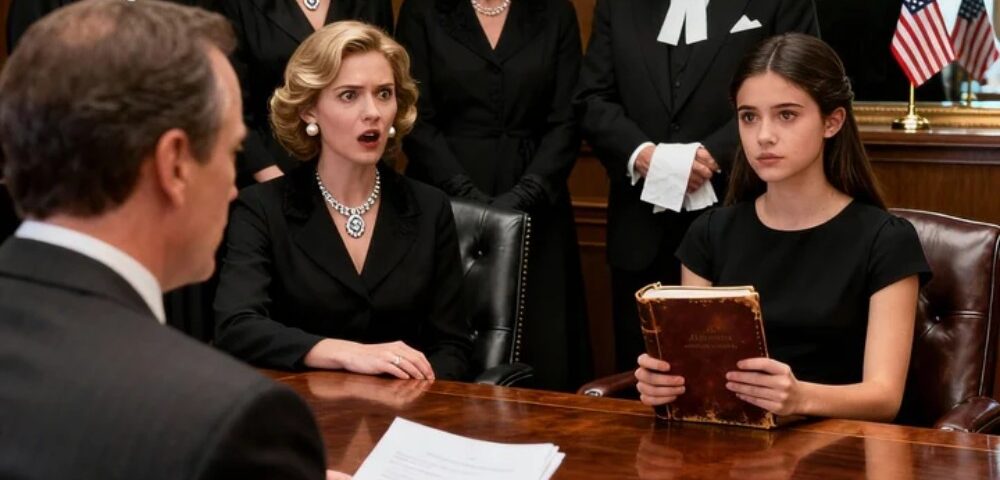
Mr. Halpern sat at the head of a long mahogany table. My family lined the opposite side—my parents, Jasmine, Lily—dressed in expensive black, wearing grief like an accessory. My mother dabbed at invisible tears with a designer tissue. My father folded his hands like a preacher ready for donations. Jasmine’s phone kept glowing beneath the table. Lily leaned close to whisper, “Do you think he left us the house?”
I sat across from them with the journal on my lap. Plain black dress. No statement jewelry. No armor. I didn’t need any.
Halpern cleared his throat. “We are here to review the last will and testament of Richard Carlton.”
He started with the usual. Debts. Small donations to charity. Gifts to long-term staff. My family fidgeted, pretending patience, practically vibrating with greed.
Then Halpern turned a page.
“Regarding the remainder of Mr. Carlton’s estate,” he said.
Jasmine leaned forward, diamonds catching light. Lily clasped her hands like she was waiting for divine favor. My father glanced at me with a smirk that flickered between pity and warning.
Halpern read slowly, each word crisp as glass.
“To my estranged relatives who remembered me only when my bank balance suited their needs,” he read, “I leave nothing.”
Silence split the room.
My mother gasped. Jasmine’s mouth fell open. Lily blinked like her brain was buffering.
“He’s joking, right?” Lily whispered.
Halpern didn’t pause. He turned another page.
“To my niece, Alma Mountain,” he read, “abandoned at thirteen, but never absent since… I leave the entirety of my estate. All assets, properties, accounts, and holdings.”
For one suspended moment, no one breathed. And then—like a single movement—four pairs of eyes locked on me.
Jasmine was the first to speak, voice sharp and shaking. “That’s impossible. He barely even knew her.”
I kept my tone steady. “He knew me for fifteen years. You just stopped paying attention.”
My father’s face flushed crimson. “You manipulated him. You poisoned him against his family.”
I rested my palm on the journal. “No,” I said quietly. “You did that yourselves. The day you left me with a note on the fridge.”
My mother’s lips tightened. “Alma, sweetheart—”
Lily tried her practiced sweetness. “Come on, Alma. You’re not really planning to keep everything, are you? We’re family.”
That word again. Family.
I let out a slow breath and smiled—not cruel, not smug. Just tired.
“Funny,” I said. “Fifteen years of silence doesn’t sound much like family. But sure. Now that there’s money on the table, suddenly we’re related again.”
Mr. Halpern closed the folder with a soft, final snap. “The will is airtight,” he said. “Mr. Carlton was very specific. Any contest will be dismissed immediately.”
The disbelief on their faces curdled into anger—the same look they’d worn years ago when they realized I no longer needed their permission to exist.
I stood, smoothed the front of my dress, and looked at them one last time.
“If you’ll excuse me,” I said, “I have things to take care of.”
Jasmine hissed, “This isn’t over.”
I met her gaze evenly. “It was over when you stopped calling me your sister.”
Then I turned and walked out.
Outside, the air felt new—sharper, cleaner—as if the world had been holding its breath and finally exhaled for me. Sunlight bounced off the building’s glass façade and for a moment it blinded me. In that flash I saw myself—not the thirteen-year-old with a backpack waiting for someone who never came, but a woman standing on her own ground, exactly where she chose to be.
I pulled out my phone, opened my messages, and found the contact I still wished existed.
Wish you were here to see their faces, old man, I typed.
Then, after a pause: You were right. I wrote my own chapter.
I hit send to nowhere and everywhere.
Later that week I stood on the balcony of Richard’s house—my house now—watching city lights shimmer like a heartbeat. I held the journal and flipped to his final page again. The ink had faded a little, but the words still burned bright.
If they ever try to erase you again, remember this: you’ve already written your own chapter.
“I did,” I whispered. “And I’ll keep writing.”
Ethan stepped onto the balcony and wrapped an arm around my shoulders. “You okay?”
I leaned into him. “Yeah. It just… feels like full circle.”
He looked out at the city. “He’d be proud, you know.”
I tilted my face toward the sky—soft blue above the skyline, open and endless. “I think he already is.”
Below us, the lights glittered like turning pages.
And for the first time, the story belonged entirely—and irrevocably—to me.
The first night I slept in Richard’s house as its legal owner, I didn’t sleep at all.
I lay in the master bedroom that still smelled faintly like his cologne and clean linen, staring at the ceiling as if it might blink back. The silence here wasn’t the silence of abandonment. It wasn’t the hollow, punishing quiet of that suburban kitchen when I was thirteen, listening to the microwave beep and pretending it counted as company. This silence was heavier, like the pause after a closing argument—final, settled, and irreversible.
I got up around 3:17 a.m. because grief doesn’t follow a bedtime, and wandered barefoot down the hallway. The floors were cool, polished wood that carried a soft echo. In the living room, city light leaked through the windows and painted the walls in slow-moving silver. Somewhere in the distance a siren slid by, the familiar American soundtrack of a city that never fully rests.
I stopped at Richard’s study.
The door creaked as if it resented being opened without him. Inside, everything was exactly as he’d left it: the heavy desk, the green banker’s lamp, the leather chair molded to the shape of his habits, the shelves lined with legal volumes and biographies and the kind of books people buy when they want to understand how power works. A small American flag sat in a brass base near the corner of the desk, subtle and almost ironic. Richard wasn’t a man who needed symbols. He’d kept it anyway, like a nod to the country that had given him a ladder and dared him to climb.
On the desk, beside a neatly stacked pile of folders, was a single envelope. My name was written on it in his blocky handwriting.
I didn’t tear it open right away. That was the strange thing about losing someone who anchored you—everything they left behind felt sacred, even paper. I carried the envelope to the desk, sat in his chair for the first time without asking permission, and exhaled.
Inside was one sheet of paper. No long speech. No dramatic confession. Just Richard being Richard.
Alma,
If you’re reading this, it means you’re standing in the part of the story where people stop whispering and start demanding.
You’ll be tempted to explain yourself. Don’t.
You don’t owe anyone clarity who never offered you care.
The estate is yours. Keep it that way. Protect it like you protected yourself.
And kid—eat real food. Grief will try to make you live on air and caffeine. Don’t let it.
—R.C.
I pressed the note flat against the desk with my palm, like I could pin him to the world. A laugh tried to form and failed. Even now, even from beyond whatever line separates here from gone, he was still giving me instructions like he’d caught me doing something ridiculous. Eat real food. As if that was the most urgent crisis.
I folded the note back into the envelope and held it against my chest until the tightness in my throat softened into something manageable.
By morning, my phone was already lighting up with messages. Some were from people I hadn’t heard from in years: old neighbors, distant cousins, acquaintances who had once nodded at me in a grocery store aisle and now apparently remembered I existed. Condolences with a hint of curiosity. Warm words that felt rehearsed. A few asked outright how I was “handling everything,” which was code for how much did he leave you.
Ethan showed up before sunrise with coffee in one hand and a paper bag in the other. When I opened the door, he didn’t speak immediately. He just looked at me—really looked—and his expression changed in a way that made my chest crack.
“You didn’t sleep,” he said.
“I did,” I lied.
He lifted an eyebrow, the way Richard used to. Then he held up the bag. “Bagel and egg. Real food.”
I managed a small smile. “He would approve.”
“I’m trying to stay alive,” Ethan said, stepping inside and pulling me into a hug. “And I’m trying to keep you alive too.”
I stood there, forehead against his shoulder, and let myself accept the comfort without calculating what it cost. That was the new lesson grief forced on you: you can’t budget love the way you budget money. You either let it in or you drown.
For about forty-eight hours, I thought maybe the will reading had been the storm and now the weather would clear.
I forgot who my family was.
On Wednesday afternoon, a courier delivered a thick envelope. Inside was a letter from a law firm with a Manhattan address, the kind with polished language and sharp edges. My parents were contesting the will—not because they had a case, but because they had entitlement and money for attorneys and a lifetime habit of treating consequences as something for other people.
Ethan watched my face as I read.
“Are they serious?” he asked.
I set the letter down gently, as if it might bite. “They’re desperate.”
He swore under his breath. “That lawyer said it was airtight.”
“It is,” I said, though my stomach still knotted. “But airtight doesn’t stop people from trying to pry.”
I heard Richard in my head: You’ll be tempted to explain yourself. Don’t.
Still, the old reflex flared—the thirteen-year-old part of me that wanted to prove I deserved space. The teenager who kept her shoulders hunched, thinking maybe if she took up less room, people would stop pushing her out of it.
I walked into Richard’s study again, sat at the desk, and opened the folder Halpern had sent home with me. Everything was organized with Richard’s precision. Copies of the will. Medical evaluations verifying his competence. Witness statements. Documentation of his intent. It was as if he’d anticipated this exact move and built a wall before anyone even reached for bricks.
I called Halpern.
He answered on the second ring. “Miss Mountain.”
“They’re contesting,” I said.
“I assumed they would,” he replied, calm as a metronome. “Mr. Carlton assumed they would too. We’re prepared.”
“Will it get ugly?”
Halpern paused. “Not in court. In court it will be boring for them. But outside court—expect theatrics. They may try to shame you. They may try to pressure you. If any media catches wind, they may attempt to paint themselves as victims.”
A bitter laugh slipped out. “Victims of what? Not getting rewarded for abandoning their kid?”
Halpern’s voice softened slightly. “Your uncle used to say that some people would rather rewrite history than apologize for it.”
I swallowed. “What do I do?”
“You do nothing publicly,” he said. “Let me handle the legal. You focus on the estate. And please—do not meet them alone.”
After I hung up, I stared at the small American flag on Richard’s desk. It looked harmless, almost decorative. But it reminded me of something else too: in this country, people could sue you for anything. People could weaponize language, twist it, stretch it until it fit the story they wanted. And the truth—real truth—often moved slower than lies.
The first time my mother showed up at the gate, she didn’t come alone.
Richard’s house was in a neighborhood where the hedges were trimmed like geometry and security cameras were as common as porch lights. A black SUV idled at the curb. My mother stepped out wearing a cream trench coat that looked like it had never met a wrinkle. My father followed, jaw tight, as if he was preparing for a negotiation. Jasmine emerged last, sunglasses on despite the cloudy sky, phone already raised like she might capture proof of her suffering for later.
They walked up the front path like they belonged there.
The intercom buzzed.
I was in the kitchen making tea I didn’t want, because hands need something to do when grief has no place to go. The buzz startled me so hard I almost dropped the mug.
Ethan was in the living room reading through estate paperwork with me, playing the role of calm human anchor. He stood when the intercom sounded.
I pressed the button. “Yes?”
My mother’s voice poured through the speaker like honey warmed over heat. “Alma, sweetheart. It’s Mom.”
My throat tightened. I hated that one word still had power in it. Mom. As if she’d earned the title through anything other than biology.
Ethan moved closer, close enough that his shoulder brushed mine. Silent support.
I kept my voice level. “You can’t be here.”
My father cut in, sharp. “We need to talk.”
“You can talk to Mr. Halpern,” I said.
Jasmine’s voice chimed in, bright with fake concern. “Alma, don’t do this. We’re grieving too.”
I almost laughed. Not because it was funny—because it was obscene.
“You didn’t grieve him when he was alive,” I said. “You didn’t even call.”
A pause. Then my mother, softer, like she was trying a new angle. “We made mistakes. We know that. But we’re still your family.”
There it was again. That word like a crowbar.
I looked at Ethan, and he nodded slightly, reminding me: you don’t owe them a stage.
“I’m not opening the door,” I said. “Please leave.”
My father’s patience snapped. “You think you can just take everything and shut us out? Richard belonged to all of us.”
“No,” I said quietly. “He didn’t. He chose. And you don’t like his choice.”
Jasmine’s tone sharpened. “He was old. Sick. You were around him constantly. You influenced him.”
Ethan exhaled, a restrained anger. I could feel him wanting to step in, wanting to defend me in a way Richard used to—clean and direct. But this wasn’t a debate stage. This was my front yard, and the point wasn’t to win an argument. The point was to not be pulled into their gravity.
“I’m ending this,” I said. “If you don’t leave, I’m calling security.”
My mother let out a small, theatrical gasp. “Security? Against your own parents?”
I didn’t answer. Silence is a boundary when words are wasted.
They stayed another minute, hoping I’d crack. When I didn’t, my father grabbed my mother’s elbow and steered her back toward the SUV. Jasmine stood a second longer, staring at the house like she was measuring its value with her eyes. Then she turned too.
As the SUV pulled away, my legs started to shake. The delayed reaction. The old fear that conflict would end with me being punished, locked out, erased. My hands trembled around my mug.
Ethan took it from me and set it down before I spilled it. Then he guided me to the couch and sat beside me.
“You were amazing,” he said softly.
“I feel like I’m thirteen again,” I admitted. My voice cracked on the last word.
He took my hand. “You’re not. Thirteen-year-old you didn’t have a choice. You do.”
That night, I walked into Richard’s study and opened the journal he’d filled for me—the one he’d given me that last Christmas. I’d been afraid to read too far into it, like turning too many pages might make him disappear faster. But now my family had shown up at my door like a threat, and I needed his voice the way people need light in a dark hallway.
There were pages of short notes and blunt wisdom, scattered like he’d written them whenever he thought of them, on business trips, in waiting rooms, between meetings.
Some were practical:
If they ask for money, ask for receipts.
Don’t sign anything angry.
Don’t drink when you’re hurt. Drink when you’re happy.
Some were jokes:
If your future mother-in-law hates you, smile and offer her tea. If she accepts, she’s redeemable. If she refuses, she’s dangerous.
And then there were lines that felt like he was reaching through time and tapping my shoulder.
They will call you selfish when you stop feeding their entitlement. That doesn’t make them right.
A spine is not something you’re born with. It’s something you build after enough bending.
I closed the journal and stared at the desk. I thought about that note on the fridge. Love you. The way my mother wrote the words like decoration. The way she’d used love as a sticker to cover abandonment.
Richard’s love had never been a label. It had been action. A desk. An eye appointment. A sandwich at midnight. A phone call every Sunday. A pen after graduation. A journal full of proof that I was never an afterthought to him.
The lawsuit paperwork moved like slow machinery. Halpern filed motions, responded to claims, shut down their arguments one by one. My family’s lawyers tried to paint Richard as manipulated, confused, vulnerable. Halpern countered with clinical evaluations, witness testimony, written intent. It was like watching a professional dismantle a cheap illusion.
Meanwhile, my family tried a different approach: public narrative.
Jasmine posted on social media about “family betrayal” and “grief being exploited.” Lily reposted vague quotes about loyalty. My mother joined a church group and let it be known she was “praying for her lost daughter.” My father talked to relatives I barely remembered and made sure the story traveled ahead of me.
In certain circles, they became tragic. Heartbroken. Wronged.
I became the cold niece who “took everything.”
For a day, it made me sick. Not because I doubted myself—but because I realized how easy it was for people to believe the loudest story, not the truest one. America loved a good narrative. It loved a villain. It loved a headline. And my family, especially Jasmine, had always been good at performance.
Ethan suggested I log off for a while. He was right. So I did.
I focused on what I could control: the estate.
Richard’s wealth wasn’t just a house and a few accounts. It was investments, properties, holdings I didn’t fully understand yet. It was a network of responsibilities. Employees. Tenants. Contracts. A small philanthropic foundation Richard had quietly funded for years without ever bragging about it.
He’d left me a fortune, yes, but he’d also left me a machine. And machines require maintenance. Richard’s favorite word.
Halpern introduced me to Richard’s financial advisor, a woman named Marlene who wore tailored suits and spoke like she could slice bread with her vowels.
“I worked with Richard for twenty years,” she said, shaking my hand firmly. “He warned me you’d be overwhelmed.”
I tried to smile. “Sounds like him.”
Marlene glanced around Richard’s study, taking in the shelves, the desk, the flag, the quiet power in the room. “He also told me you’d be capable.”
That word landed in me differently now. Capable wasn’t a compliment to soothe. It was a statement of fact.
Over the next weeks, I learned more about Richard than I had known even while he was alive. Not the jokes, not the guidance—his decisions. The way he moved money like chess pieces. The way he protected certain assets and took risks with others. The way he built slow instead of flashy.
I also learned something else: Richard hadn’t just saved me. He’d positioned me.
He’d named me executor, yes, but he’d also ensured that everything was structured in a way that gave me leverage and stability. Trusts. Legal protections. Clauses that prevented relatives from siphoning funds. He’d anticipated greed like a weather forecast.
One afternoon, Marlene slid a folder across the desk. “There’s a note from Richard attached to this one,” she said.
I opened it. My stomach tightened.
It was about the foundation—the one that funded scholarships for kids in foster care and support programs for teens who’d been left behind by unstable families. Richard had never talked about it in detail. He’d just made donations quietly, as if generosity was supposed to be silent.
The note read:
You know what it’s like to be left. Use that knowledge like a compass. Not to hate them. To help others.
Not because you owe the world kindness. Because kindness is how you keep your own humanity.
—R.C.
I sat back and stared at the paper until my eyes burned.
Ethan’s hand touched my shoulder. “He really believed in you,” he said.
I swallowed. “He believed in what I could become if no one blocked the door.”
That line stayed with me.
Because the more I stepped into the estate, the more I realized this wasn’t just about money. It was about power—quiet, structural power. The kind that changes what’s possible. The kind Richard had used to remove obstacles from my path. The kind my family was now furious they couldn’t control.
The court date arrived on a bright morning that felt too cheerful for conflict. Outside the courthouse, people walked by sipping coffee like justice was just another errand. In America, legal battles happened alongside lunch breaks and parking tickets. The world didn’t pause for personal war.
Halpern met me at the entrance, crisp suit, calm expression. “They’re inside,” he said. “Remember: do not engage.”
Ethan squeezed my hand before we went in. “I’m right here,” he whispered.
Inside, my family sat together like a staged portrait. My mother wore pearl earrings—of course she did. My father looked stern and righteous. Jasmine had chosen a soft, innocent color that made her look like she’d wandered into court accidentally. Lily’s makeup was flawless, griefless.
When they saw me, my mother’s face softened dramatically, like she’d rehearsed the expression in a mirror.
“Alma,” she mouthed.
I didn’t answer. I kept walking.
The hearing was, as Halpern predicted, boring for them. Their arguments collapsed under documentation. The judge listened politely, asked a few questions, then looked at their attorney like he was disappointed by the waste of time.
When the judge ruled—upholding the will, dismissing their challenge—Jasmine’s composure cracked. Lily’s mouth tightened. My father’s face went rigid with humiliation. My mother’s eyes flashed something sharp behind her carefully constructed sadness.
Outside the courtroom, my father tried to step in front of me. “You’re enjoying this,” he snapped, voice low.
I stopped. Not because I owed him a conversation, but because I wanted to remember this moment clearly. The moment when the old power they held over me finally failed.
“No,” I said. “I’m surviving it.”
My mother stepped closer, voice trembling like a performance. “Alma, please. We can fix this. We can be a family again.”
The word hit me like stale air.
I looked at her—really looked. At the pearls, the coat, the practiced expression. At the woman who had once written “Love you” on a sticky note and believed it counted as motherhood.
“Family isn’t what you call people when you want something,” I said quietly. “Family is what you do when no one’s watching.”
Her face tightened. Jasmine hissed, “You think you’re better than us now.”
I almost smiled. Not because it was funny. Because it was predictable.
“I think I’m done,” I said.
And then I walked away.
That should have been the end. In some stories, it would have been. In the neat version, the villain slinks off and the heroine closes the door and life becomes calm.
But real life doesn’t stop just because you earned a victory. People who feel entitled don’t suddenly become reasonable. They get creative.
Two weeks later, I found out Jasmine had contacted one of Richard’s former employees and tried to convince him to testify that Richard had been “confused” in his final months. The employee—an older man named Paul—called Halpern immediately and reported it. Halpern forwarded me the message with a note: They are fishing. Ignore.
Then Lily tried a different tactic. She sent me a message late at night, a long paragraph filled with fake vulnerability.
I miss you. I miss us. I think we were kids and we didn’t understand. I think Mom and Dad were under stress. I think we all made mistakes. But we can move forward. We can start fresh. You don’t have to do this alone.
I stared at the screen for a long time. The words were polished, like she’d stolen them from a self-help book. There was no mention of what she’d done. No apology. No accountability. Just a soft attempt to slide back into my life now that my life had value.
Richard’s voice surfaced again: They will call you selfish when you stop feeding their entitlement.
I typed one sentence.
If you want to start fresh, start with the truth.
Then I blocked her.
That night, I cried—not because blocking her hurt, but because it confirmed something final. The part of me that had still hoped my sisters could be real, could be human, had to let go. Letting go of hope can feel like grief too.
Ethan found me on the couch with Richard’s journal open and my face wet. He sat beside me without speaking and pulled me into his chest.
“I hate them,” I whispered.
Ethan’s arms tightened. “You don’t have to hate them,” he said carefully. “You just don’t have to let them in.”
“I hate what they did,” I corrected.
“That makes sense,” he said. “And it’s allowed.”
In the weeks that followed, the estate stopped feeling like a storm and started feeling like a job. Meetings. Documents. Decisions. Richard’s life was now partly my responsibility. And in that responsibility, I found something unexpected: steadiness.
I started visiting the foundation offices. The staff was small, dedicated, the kind of people who didn’t care about glamour. A woman named Tessa ran operations. She was kind but direct.
“Richard didn’t want the foundation to become a monument to him,” she told me. “He wanted it to stay practical.”
That sounded exactly like him.
I asked to see the scholarship applications. Boxes of them—letters from teenagers, foster kids, students who’d been bounced between homes and schools and still managed to dream. Some wrote about wanting to be nurses, engineers, teachers. Some wrote about wanting a stable room and a door that locked.
I read them late into the night, my chest tightening with every page. Because their stories didn’t just remind me of my past. They reminded me of what could have happened if Richard hadn’t shown up. If I’d stayed alone on that couch in that dark house. If my life had continued as an exercise in not being noticed.
I approved more scholarships that year than Richard ever had.
Not because I was reckless. Because I was angry in a useful direction.
In between foundation work and estate management, I kept my day job at the engineering firm. People assumed I’d quit immediately once the inheritance became known. That assumption annoyed me more than it should have.
Money changes what you can do. It doesn’t change who you are, unless you let it.
At the firm, I was still Alma—the woman who showed up early, took notes, double-checked everything. The woman who didn’t bluff and didn’t apologize for existing. The woman who had been built, piece by piece, by a man who believed maintenance was love.
But it did change one thing: my fear.
I used to swallow frustration because I was afraid of losing my job. Afraid of being seen as difficult. Afraid of being disposable. Now, when a senior engineer talked over me in a meeting, I didn’t shrink. I waited, then spoke again, louder and clearer. When a client tried to pressure me into unsafe compromises to save money, I said no without flinching. When someone treated me like background scenery, I reminded them I wasn’t.
My manager noticed. “You’ve gotten… sharper,” he said one afternoon.
I smiled. “I’ve gotten freer.”
The house slowly became mine in small ways. I didn’t redecorate aggressively. I didn’t erase Richard. I couldn’t. But I started living in it instead of tiptoeing through it. I used the dishes. I cooked in the kitchen. I opened windows. I invited Ethan over for dinner more often. I let the place fill with normal sounds—music, laughter, the clink of forks.
One Saturday, I found myself cleaning out a closet in the hallway and discovered a small box tucked behind old coats. Inside was a stack of photographs. Not the formal ones. The candid ones.
Richard at a baseball game, wearing a cap, looking mildly annoyed by the sun. Richard holding a cheap paper cup of coffee, smiling at something off-camera. Richard standing beside a younger version of me at my high school debate competition—my posture still awkward, his grin quiet but proud.
At the bottom of the box was one photo that made my breath catch.
Me at thirteen.
I was sitting in the diner booth across from him, milkshake in front of me. My shoulders were hunched like I was trying to disappear into my hoodie, but my eyes were wide, focused on the food like it was a miracle. Richard was in the edge of the frame, blurred, but you could see his hand resting on the table—steady, present.
I stared at the photo until my eyes burned. He’d taken it without telling me. He’d kept it all these years.
Ethan came up behind me and looked over my shoulder. “That’s you.”
“I didn’t know he had this,” I whispered.
Ethan’s voice softened. “He wanted to remember the moment he found you.”
I held the photo carefully, like it could tear from being looked at too hard. Then I slipped it into a frame and placed it on Richard’s desk, beside his lamp and his little flag and the stack of legal volumes. Not as a shrine, but as truth.
He had found me.
And now, in a strange way, I was finding myself again too.
The first time I saw my mother after court, it was not at a gate or a law office. It was at a grocery store.
I was in a Whole Foods—because apparently inheritance comes with an unspoken expectation that you shop at places with organic fonts. I was buying apples I didn’t need, mostly trying to feel normal.
I turned down an aisle and there she was, standing by the fancy cheeses like she belonged in that world. She wore a soft sweater that made her look gentle. Her hair was styled perfectly. She looked like a woman who had never left a thirteen-year-old alone with a sticky note.
When she saw me, her face rearranged itself into sorrow. “Alma.”
I didn’t move. My hands tightened around the shopping basket handle.
People passed around us, carts squeaking, soft music playing overhead. In America, even confrontations happen under fluorescent lighting and product displays.
“I just want to talk,” she said.
“You’ve had years,” I replied.
Her eyes shimmered as if tears were on a schedule. “We didn’t know what we were doing.”
I laughed once, quietly. “You knew you were leaving.”
Her face tightened. “It wasn’t like that.”
“It was exactly like that,” I said. My voice stayed calm, but it felt like holding a blade flat—controlled and sharp. “You wrote a note and left me. You didn’t call. You didn’t check. You let my sisters post beach pictures while I ate cereal at midnight because I was afraid to take food.”
Her mouth opened, then closed. For once, she didn’t have a smooth reply.
“I’ve been watching you,” she said finally, and the words made my skin crawl. “I’ve seen how well you’re doing. We’re proud of you.”
I stared at her. Proud. That word tasted bitter. Pride without presence is just a costume.
“You don’t get to be proud of what you abandoned,” I said.
She flinched as if I’d slapped her.
“I’m your mother,” she whispered.
“No,” I said, and it wasn’t cruelty. It was clarity. “You’re the person who gave birth to me. Richard was the one who raised me.”
Her eyes flashed anger now, the real emotion slipping through. “He turned you against us.”
“No,” I said. “You did that.”
For a second, she looked like she might explode, like the polished mask might crack and something raw might spill out. Then she pulled it back together, glancing around as if remembering we were in public.
“We can still fix this,” she said, softer. “We can still be a family.”
I shook my head slowly. “I’m not your project. I’m not a PR cleanup. I’m not a storyline you can repair.”
She swallowed hard. “So that’s it? You’re cutting us off?”
“I’m choosing peace,” I said, and Richard’s voice echoed in the sentence. Approval is borrowed. Peace is something you keep.
I turned and walked away, leaving her standing by the cheese like a statue of consequences.
After that, something inside me unclenched. Not all the way. Grief doesn’t vanish. But the last thread of waiting snapped. The part of me that still braced for their approval, still hoped for their recognition, finally stopped working overtime.
I didn’t need them to understand. I needed them to stop having access.
A month later, Halpern called with a final update. “They’ve withdrawn,” he said. “Quietly.”
I exhaled a breath I didn’t realize I’d been holding. “Why?”
“Because their counsel finally convinced them they’re burning money for humiliation,” he said. “And because they’ve realized you won’t fold.”
I looked at Richard’s framed photo on the desk. The diner. Thirteen-year-old me. The beginning of everything.
“I won’t,” I said.
After I hung up, Ethan raised his eyebrows. “Good news?”
“It’s over,” I said.
He stepped closer. “How do you feel?”
I thought about it. Relief, yes. But something else too. A strange emptiness where conflict had been. When you spend years preparing for a fight, the end can feel like silence again. But this silence was different.
“I feel… clean,” I said finally. “Like I’m not dragging their weight anymore.”
Ethan smiled. “Richard would be proud.”
I rolled my eyes, because if I didn’t, I’d cry. “He’d tell me to eat real food.”
Ethan laughed. “I can do that.”
That summer, I did something I’d never done before: I took time off.
Not a weekend. Not a day squeezed between obligations. Real time. I went to the coast with Ethan—Cape Cod, because apparently American healing comes with ocean air and lobster rolls. We walked along the beach while families built sandcastles and kids ran with sticky hands. For the first time in my life, watching families didn’t feel like staring through glass at something I’d never touch. It just felt like… people. Imperfect and loud and sometimes real.
At sunset, Ethan and I sat on a bench overlooking the water. He handed me a small paper cup of ice cream, and I laughed because the cold made my teeth ache.
“You’re thinking,” he said.
“I’m remembering,” I admitted.
“Richard?”
“And me,” I said. “Thirteen-year-old me. She thought being left meant she was worthless.”
Ethan’s hand covered mine. “And now?”
I looked out at the water, the horizon line clean and endless. “Now I know being left meant they were broken. Not me.”
That night, in the hotel room, I opened Richard’s original journal—the one he’d given me at thirteen. I hadn’t written in it for months because life had been loud with grief and legal battles. But now, with the ocean outside and Ethan asleep beside me, the urge returned.
I wrote:
I used to think I had to earn the right to exist.
Now I know I exist first. Then I choose what to build.
I closed the journal and held it against my chest for a moment, letting the words settle into my bones.
When we returned home, I threw myself into building—not just maintaining what Richard left, but expanding it in ways that felt like mine. I met with the foundation team and created a mentorship program for scholarship recipients, pairing them with professionals who could guide them through college applications, internships, basic life skills that people with stable families take for granted.
“Why consider mentoring?” Tessa asked.
“Because money helps,” I said, “but being seen changes people.”
And I knew that because someone had once looked at a sweaty thirteen-year-old with a backpack and not turned away.
At the engineering firm, I took on a major project—an infrastructure redesign for a neighborhood that had been neglected for years. It wasn’t glamorous, but it mattered. It was the kind of work Richard would have respected: something that endures, something that makes life safer and better in quiet ways.
On a crisp fall morning, I stood on a site visit wearing a hard hat, wind whipping my hair. A worker called out, “Hey, boss—where do you want the survey markers?”
The word boss startled me. Not because it was wrong. Because it was new.
I pointed, clear and confident. “Start there. Then move east. And double-check the grade.”
The worker nodded and moved without question.
I felt something in me rise—not arrogance, not ego. Ownership. The kind Richard had tried to teach me from the beginning. Stand tall. You’re not punctuation.
That evening, I came home to the house and found Ethan on the balcony, looking out at the city lights like he was reading them.
“You look different,” he said when I stepped outside.
“How?” I asked.
“Like you’re not bracing anymore,” he said. “Like you’re… here.”
I leaned against the railing and looked at the skyline. The lights shimmered like turning pages.
“I think I’m finally living in the house,” I said, and I didn’t just mean the building.
Ethan slid his arm around my waist. “Good. Because I like you here.”
I smiled, then reached for Richard’s journal tucked under my arm. I’d started carrying it again, not as a crutch, but as a reminder. Not a tomb. A tool.
As winter approached, a letter arrived in the mail with no return address. My name on the front, written in a familiar cursive.
I stared at it for a long time before opening it.
Inside was a single sheet of paper. My mother’s handwriting again, graceful and infuriating.
Alma,
I don’t know how to fix what we broke. I don’t know if you’ll ever forgive us. But I need you to know I think about that day. I think about the note. I think about you sitting alone. I tell myself I had reasons, but reasons don’t undo consequences. I am sorry.
I read it twice. Three times. The apology was realer than anything she’d ever offered before. Or maybe it just sounded real because it was finally stripped of performance.
My hands shook slightly. Not with rage. With something more complicated.
Ethan watched my face. “What is it?”
I handed him the letter. He read it, then looked at me carefully. “How do you feel?”
“I don’t know,” I admitted.
Because forgiveness wasn’t a switch. It wasn’t a dramatic speech. It wasn’t a movie moment where a daughter collapses into her mother’s arms and everything heals.
Forgiveness, I was learning, could be quiet. It could be partial. It could even be separate from reconciliation.
I didn’t owe her access to me.
But I also didn’t want to carry poison in my body forever.
I went into Richard’s study, sat at his desk, and stared at the letter again. Then I opened my journal and wrote:
An apology doesn’t rewrite the past.
But it can be a sign that the past finally mattered to the person who caused it.
I folded my mother’s letter and placed it in the back of the journal—not as acceptance, not as rejection. As evidence. As something to remember without letting it steer me.
I didn’t respond.
Weeks later, another message arrived—this one from Jasmine, sent through an account she must have made after I blocked her. It was short and bitter.
Enjoy your stolen life.
I read it once and deleted it. I didn’t feel the old stab this time. I felt pity, which surprised me. Jasmine had spent her whole life performing for attention. When attention didn’t work, she tried cruelty. And when cruelty didn’t work, she would probably try something else.
But none of it could reach me if I didn’t open the door.
That was the difference now. I had choices.
On the anniversary of Richard’s death, I went to the cemetery alone. The sky was a clean winter blue, the kind that makes the cold feel honest. I brought white roses, simple, the way he’d wanted. No lilies.
I stood at his grave and let the quiet settle around me.
“I’m doing it,” I said aloud, voice small against the open air. “I’m building. I’m maintaining. I’m eating real food… mostly.”
A laugh escaped me, and the sound felt like a thread connecting the living to the dead.
“I miss you,” I added, and this time I didn’t try to swallow it down. “But I’m okay. You did that. You made me okay.”
The wind moved through the trees, and for a second it felt like an answer—not mystical, not magical. Just the ordinary sensation of the world continuing.
I knelt and brushed a bit of snow off the base of the headstone. My fingers went numb quickly. I didn’t mind. It felt like a ritual.
When I stood again, I realized something that would have shocked thirteen-year-old me.
I wasn’t empty without him.
I was full of him.
His lessons were in my posture, my voice, my decisions. His care had become a structure inside me—something that didn’t collapse just because he was gone.
I turned to leave and noticed a small object near the grave. A coin, maybe dropped by someone passing. It was a quarter, the kind kids used to put in machines for candy. Someone had left it there like a token, a tiny American superstition of respect.
I smiled faintly. “Even strangers show up,” I murmured.
And then I walked back to my car, my breath visible in the cold, my shoulders straight.
Because my story had started with a note on a fridge in a quiet American kitchen—thin paper pretending to be love.
But it didn’t end there.
It moved through a diner booth and a desk and a thousand ordinary acts of care. It moved through grief and courtrooms and people who tried to rewrite history. It moved into a house that had once felt like another planet and became, slowly, a home that didn’t treat me like a visitor.
And now, standing on the other side of everything, I understood the truth that took me years to learn.
I hadn’t been disposable.
I had been delayed.
And in a country that loves reinvention, where people cross state lines and start over every day, I had done what my family never expected.
I had taken the life they tried to erase, and I had written it in ink.