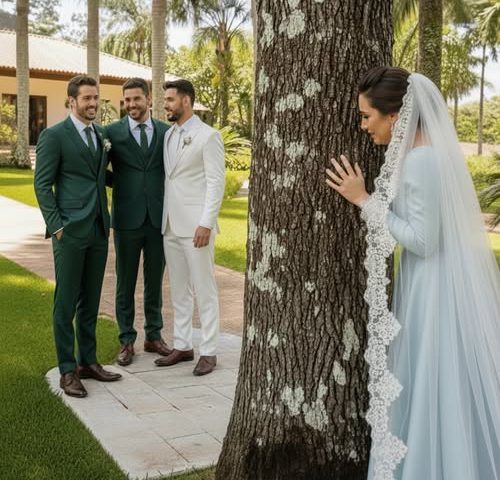
The ceremony was just minutes away when Camila Acevedo felt her legs tremble. Under a pergola draped in white bougainvillea and warm lights, in the garden of the family mansion in Valle Real, Zapopan, she adjusted her veil in front of a portable mirror. Her makeup was perfect. Her dress, impeccable. Soft music was already drifting from the open-air altar area.
In a matter of moments, she would walk toward Rafael Bravo, the man she had called “love” without hesitation for three years.
Destiny, however, decided to speak first.
Behind a group of decorative palm trees, she heard male laughter. She recognized Rafael’s voice immediately: confident, self-assured, the same voice that always calmed her… or so she thought. Curiosity drew her in with silent steps, almost breathless, her heart beating strangely.
And then… her world shattered.
“Look, buddy,” Rafael said, laughing, “this isn’t romance, it’s strategy. Don Eduardo’s company is a goldmine. As soon as I sign and they give me the authority… it’s over. I’m taking the wheel.”
Another voice responded with an admiring whistle.
“And Camila?”
Rafael let out a cold laugh.
“Camila is the door. I just need it to open.”
Camila stood motionless among the trees. The perfume of the flowers she herself had chosen for “the happiest day” mingled with a bitter, metallic taste. Her mouth went dry. Blood rushed to her ears. In her mind, like pieces of a puzzle, memories that had once seemed innocent began to fall into place: Rafael’s questions about contracts, suppliers, logistics routes; his excitement when he heard “Acevedo Transportes”; his exaggerated interest in “how the power of attorney works.”
It wasn’t love. It was a plan.
“Besides,” Rafael continued, “the old man’s getting on in years. With a little legal nudge, Camila won’t even notice. It’ll all stay ‘in the family.’”
Laughter echoed through the palm trees like applause. Camila felt that the dress, just moments before a symbol of hope, was now a lace cage.
She could run away. She could scream. She could stop everything. All she had to do was face the guests and tell the truth.
But something inside her, something new, colder and clearer, refused to give Rafael an easy way out.
Canceling the wedding would free him without consequences. And Camila understood, with a clarity that hurt, that this man wasn’t just a romantic disappointment: he was a real risk to anyone who trusted him.
She took a deep breath, straightened her shoulders, and touched her veil as if placing a crown on her head.
“If he thinks he’s won…” she told herself, “let him keep thinking that.”
She returned the same way, with firm steps, her expression never wavering. When she appeared in the petal-strewn aisle leading to the altar, no one noticed the transformation that had just taken place inside her.
To the guests, Camila was still the perfect bride: elegant, serene, a white figure framed by golden lights. But inside, she was no longer the same woman who, just minutes before, had been about to live a fairytale.
Rafael awaited her with a practiced smile. Camila held his gaze for a second longer than usual. For the first time, she didn’t see a future husband: she saw a man eager to close a business deal.
Her father, Eduardo Acevedo, offered her his arm. He was 58 years old and possessed that mixture of pride and tenderness of someone who had built everything from the ground up: a logistics company respected throughout western Mexico. When he took her arm, he whispered with emotion:
“Daughter… this is one of the happiest days of my life.”
Camila smiled, her expression unbroken.
“Me too, Dad”, I said, in a voice that betrayed nothing.
It wasn’t the time to break the heart of the man who had cared for her the most. Not yet.
The ceremony unfolded like a play Camila already knew by heart. The officiant’s words sounded ironic: commitment, truth, respect. Rafael responded to the vows with impeccable confidence, like someone signing a contract. He was a good actor. Too good.
When it was Camila’s turn, there was an emotional silence. She spoke carefully:
“I promise to walk with you… with honesty. I promise to choose what is right… even when it’s difficult.”
She didn’t lie. She simply left the phrases open, ready to take on a different meaning when the time came.
As they exchanged rings, Camila felt the weight of the gesture. It wasn’t “forever.” It was a key. And she was taking note of who wanted to use it.
After the customary kiss, applause erupted. White petals, cell phones held high, congratulations. “What a perfect couple!” they repeated.
During the photos, Rafael leaned in and whispered to her, satisfied:
“Everything is going better than I imagined.”
Camila nodded.
“Yes,” she replied. “Much better.”
And for the first time since she’d heard him among the palm trees, that wasn’t a lie.
At the reception, under a transparent tent, Camila moved among uncles, partners, and friends with almost surgical precision. She laughed, toasted, and expressed gratitude. Meanwhile, she watched Rafael from a distance: he wasn’t celebrating, he was inspecting. He approached his father’s executives, asked too many questions, analyzed routes, margins, “expansion possibilities.”
And Camila noticed something else: Rafael wasn’t just ambitious… he was in a hurry. The hurry of someone cornered.
That night, when the garden filled with music and people danced carefree, Camila made her final decision.
She wouldn’t confront him yet. First, she would understand everything: debts, lies, emergencies, accomplices. If Rafael believed he had married a naive woman, Camila would allow that illusion because, sometimes, the best time to act is when the other person is convinced they’ve already won.
The next morning, the mansion slept with an artificial silence. Camila got up before dawn and sought out the only person she trusted completely: her younger sister, Marina Acevedo, a law student, observant, sharp-witted.
In the kitchen, away from prying ears, Camila told her the essentials. No tears, no drama. Just facts.
Marina wasn’t surprised; she frowned as if confirming something that already smelled fishy.
“I also felt something was off,” she admitted. “He asks too many questions. He never speaks openly about his past. And he always avoids details when it comes to his work.”
That same day, Marina activated her contacts: internship colleagues, public databases, business registries. What she found was worse than Camila had imagined.
Rafael Bravo wasn’t “an ambitious guy.” He was a man with a history of financial problems in several cities: debt collection lawsuits, broken contracts, informal loans, suspicious transactions. The total, all told, was staggering.
And there was a pattern.
“Camila…” Marina said softly, “last year he was engaged to a girl in Aguascalientes. The wedding was called off days before. He disappeared afterward. Just like now: he approaches wealthy families, gains their trust, and when they find out… he runs.”
Camila felt a chill run down her spine. She wasn’t the exception. She was the next victim.
That night, Rafael walked around the house as if he’d always belonged there. But his cell phone vibrated constantly. He went to answer it in the hallway, lowered his voice, paced back and forth.
It wasn’t “newlywed stress.” It was fear.
Marina confirmed her suspicion: some of the creditors weren’t banks. They were people who didn’t negotiate patiently.
Camila went to bed with a painful clarity: it wasn’t just emotional or financial betrayal at stake. There was real risk to her family.
From then on, Camila became an actress… but a dangerous one: the kind who acts with purpose.
In front of Rafael, she was the understanding wife. She listened to him, validated him, made him feel powerful. And while he relaxed, she gently pushed him to reveal his own greed.
“If you feel pressured, love… tell me,” she would say. “We’re a team now.”
Rafael reacted exactly as she expected. He opened up. He admitted to “old commitments,” “unfinished business,” “things that can’t wait any longer.” His words were full of disguised urgency.
Camila took the first step: she transferred a moderate amount “so he could breathe.” It wasn’t a bailout: it was bait.
Rafael could barely hide his relief. The gratitude was excessive, the affection sudden, theatrical.
Camila’s intuition was confirmed: he was cornered. And cornered people make rash decisions.
Then came the insinuations.
“If your dad would let me sign certain papers… just small things,” Rafael said, “it would be more efficient. It’s for the family’s future.”
Camila pretended to think about it.
“I’ll talk to him,” she replied calmly.
Rafael’s anxiety grew. And with it, the possibility that he was wrong.
Meanwhile, Marina didn’t stop. She compiled a file with records, screenshots, dates, emails. Camila documented every conversation, every request, every transfer. Not to humiliate: to protect.
The downfall came one seemingly ordinary afternoon.
Rafael, with feigned calm, told Camila about an “urgent opportunity.” He needed to make a move without intermediaries. She looked at him and smiled as if she were finally giving in.
“My dad said he might delegate some operations to you… if everything is transparent,” she commented, dropping the word “delegate” like someone dropping a match.
Rafael’s face lit up. Not out of love. Out of access.
That same day, taking advantage of a limited authorization Eduardo had granted for specific transactions, Rafael executed a direct transfer from a company account to a personal account.
Too big. Too blatant. Too desperate.
Hours later, Eduardo called Camila, his voice tense.
“Daughter… there was a strange transaction. A big one.”
Camila closed her eyes for a moment. The pain didn’t surprise her. It confirmed her suspicions.
“I know, Dad,” she said softly. “I’ll take care of everything. But… promise me you won’t blame yourself.”
That same night, Marina activated the next step: formal complaint, internal audit, preservation of evidence. There was no immediate public scandal, only a firm procedure.
When Rafael realized he’d been caught, he tried calling Camila again and again. She didn’t answer.
For the first time, he let the silence speak.
Rafael was summoned and then arrested to give a statement. He tried to defend himself by saying that “everything was agreed upon.” But bank records don’t feel. Dates don’t forgive. Documents don’t fall in love.
And then, as if the dominoes had finally fallen, other voices emerged: people from previous cases, families who recognized the pattern, lawyers who remembered the name, debts that resurfaced.
Rafael wasn’t a man who “made a mistake.” He was a man who repeated it.
Weeks later, at a hearing, Camila saw him in front of her. He was no longer the confident boyfriend. He was someone exhausted, shrunken by his own haste. He looked at her with anger and surprise… as if he couldn’t understand how “a woman” had beaten him.
Camila didn’t look at him with hatred. She looked at him with something stronger: peace.
“You underestimated the wrong person,” she said, her voice calm. “And you put my family at risk. That can’t be forgiven with flowers.”
Rafael lowered his gaze. That was his real defeat: not the police, not the legal process, but the realization that his game was over.
Months passed. The company strengthened with new protocols. Eduardo, though hurt, recovered seeing his daughters united and strong. Marina graduated and started working at an asset protection firm, inspired by her experience.
Camila, for her part, could breathe again.
One afternoon, while walking through the company’s logistics center, a man approached her shyly: Julián Ríos, head of operations, someone who had always worked quietly, without seeking the spotlight.
“Miss Camila…” he said, “I just wanted to tell you something. You could have destroyed everything with a scandal… but you chose to protect your family intelligently. That… that is also love.”
Camila was surprised to feel a lump in her throat.
“Thank you, Julián.”
Over time, that “thank you” turned into conversations. Then into trust. And then, slowly, without masks, without hidden strategies, in something Camila hadn’t expected to recover so soon: faith.
One night, in the same garden where it all began, Camila stopped under the pergola. The bougainvillea was still there, but now it smelled different: no longer of betrayal, but of rebirth.
Julián approached, promising her no fairy tales, only truth.
“I don’t want to save you,” he told her. “I want to walk with you, if you want.”
Camila smiled, this time genuinely.
“That… that does sound like love.”
And so, the ending was good not because she “won” or because she “got revenge,” but because she recovered what was most precious: her dignity, her family, and the certainty that true love doesn’t need haste, hidden agreements, or cruel laughter from behind palm trees. It only needs one thing: character.
And Camila, at last, was surrounded by it.