Julián Castañeda slammed the door of his luxury SUV harder than necessary.
The anger from his last meeting still throbbed in his chest—three unpaid rents, three months of excuses. He told himself people were careless, irresponsible. That was easier than doubt.
The hallway of the old apartment building smelled of damp concrete and fatigue. A puddle stretched across the floor like it had given up trying to dry. Somewhere behind a thin wall, a blender groaned weakly, its uneven rhythm echoing the exhaustion of the place.
He stopped at 4B and knocked—hard, sharp, impatient.
Nothing.
He knocked again, louder, as if volume alone could force compliance. Then he heard movement: small, careful steps.
The door opened only a few inches.
A little girl stood there.
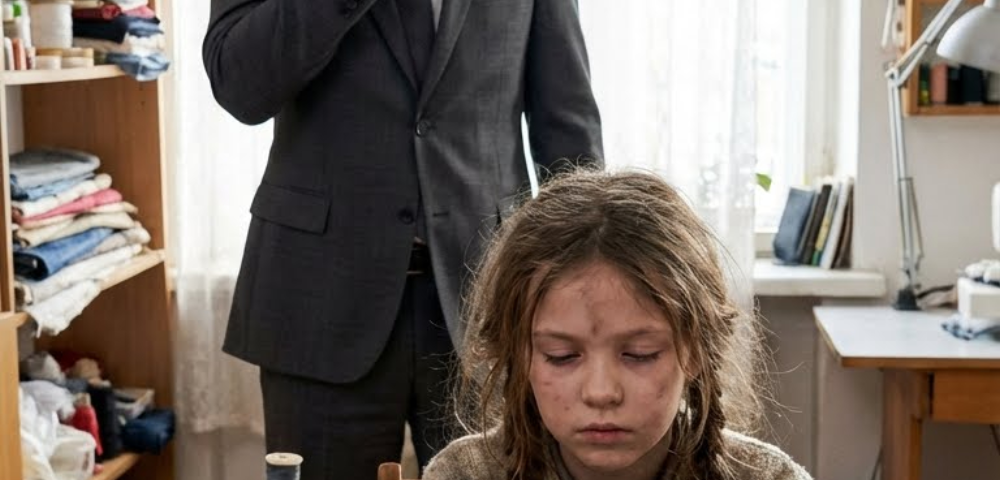
She couldn’t have been more than seven. Her eyes were enormous in a face too thin for her age. Her lips were cracked, her hair tangled into loose knots, and her blouse bore stains of bright thread. She didn’t speak. She only looked at him—quiet, alert, as if she had already learned that the safest thing in the world was silence.
Julián crouched slightly, caught off guard by the seriousness in her gaze.
“I’m looking for your mother,” he said.
The girl shook her head. No words. No attitude. Just a small, controlled movement that felt rehearsed.
Behind her, the apartment told the rest of the story.
An old hand-cranked sewing machine sat near the window. Fabric scraps were stacked everywhere—on chairs, on the floor, on the table. Spools of thread rolled loosely, needles scattered like hazards. A half-finished dress lay across the table. On the girl’s fingers, faint red marks—tiny wounds earned over time.
“Are you here alone?” Julián asked, surprised by how soft his own voice sounded.
She opened the door wider—not inviting him, just allowing him to see.
He didn’t step inside. He didn’t need to.
The room was dim, curtains drawn tight. A makeshift bed in the living room held thin sheets and a torn blanket. Empty medicine boxes sat beside the pillow like abandoned promises.
“Is your mom sick?” he asked, the question escaping before he could stop it.
The girl sat down at the machine. Only then did she speak, her voice so quiet it seemed borrowed.
“Her name is Teresa.”
Julián swallowed.
He asked for the rent. She stood up, still holding a needle, disappeared briefly, and returned with a wrinkled envelope. Inside were small bills—counted carefully, painfully earned.
He could have lectured. He could have recited rules and contracts. He had done it a hundred times before.
Instead, he stood there watching a child sew with crooked stitches, as if every thread were holding their world together.
“What’s your name?” he asked.
“Valeria,” she answered, already looking back at the fabric, as though survival didn’t allow distractions.
Julián pulled out his wallet and placed several bills on the table.
Valeria didn’t look at them.
She didn’t thank him. She didn’t react at all.
She just kept sewing.
And that—that was what broke him.
Not pride. Not defiance. Habit. The habit of urgency. The habit of children growing up too fast. The habit of hands that didn’t get to rest.
That night, Julián lay awake in his clean, silent bedroom. He couldn’t stop seeing Valeria nodding over the machine, wiping a drop of blood on her sleeve as if pain were just another task.
“She shouldn’t be alone,” he thought.
At dawn, without fully understanding why, he did something he had never done for a tenant before.
He changed his route.
He stopped at a small grocery store and bought bread, milk, cookies, rice, beans, fruit—nothing fancy. Just what kept a household standing.
He returned to 4B and knocked softly.
Valeria opened the door almost immediately, still cautious.
Julián lifted the bags slightly, unsure how to explain himself.
“I brought some things,” he said. “May I come in for a minute?”
She didn’t answer.
She stepped aside.
Inside, the air still smelled of medicine and quiet endurance. Julián set the bags on the table, feeling—for the first time in years—that something in his life had shifted.
Not a deal.
Not a contract.
A responsibility he could no longer ignore.
—Have you eaten yet?
—Tortillas with salt.
The phrase stuck in his head like a nail. Julián took a deep breath, carefully choosing each question so as not to sound like an adult trying to boss him around.
“Is your mother in the hospital?
” “Yes… for three days now.
” “What do you want?
” “Nothing. I’m fine.”
The bravest lie there is: “I’m fine,” when you’re just holding on. Valeria finally spoke a little more. She said she was sewing to deliver some pillowcases; a neighbor from the third floor, Mrs. Leti, taught her when Teresa got sick. And when Julián asked, “What’s wrong with your mother?” Valeria remained still, bit her lip, and stared at the door as if she feared that saying it would unleash another tragedy.
“Leukemia,” he whispered.
The word filled the room like smoke. Julián felt rage, but not toward Valeria or Teresa: rage toward everything that allows a girl to learn that word before “recess.” And the worst came when Valeria confessed, with brutal honesty:
—I didn’t tell you yesterday because I thought that if you knew… you were going to take me to the DIF (Family Services).
That’s when he understood real fear. Not of the unknown, but of the system that separates without asking. Julián leans forward, resolute.
—I’m not going to do that. I’m not going to take you anywhere without your permission. I just want to help you.
Valeria looked at him as if she wanted to believe him, but didn’t dare yet. She offered him a glass of water in a plastic cup: her purple way of saying, “You can stay a while.” And Julián saw a notebook with drawings: Valeria and a woman lying down with tubes, both with sad smiles, a heart between them, and a phrase written in crooked letters: “Everything will be alright, Mom.”
When he left, he walked straight to the apartment of Doña Chela, the neighbor who knew everything. She told him what was missing: Teresa was alone, without family, the little girl was left with no one, and sometimes she cried at night. The hospital was the General, downtown, oncology ward. Julián drove there. In the chaos of the public hospital, he found Teresa: pale, thin, with short hair, as if she had anticipated her fall. Julián sat beside her and spoke to her softly, as if the world had no right to hear.
—Your daughter is a warrior, Teresa. And I… I’m not going to look the other way.
That same night he decided that helping couldn’t be just a gesture; it had to be a real presence. The next day, he left groceries and an envelope of money outside apartment 4B, knocked twice, and ran off so Valeria wouldn’t reject it out of pride. Then he returned “as if nothing had happened” to check on her. Valeria seemed different: her hair a little neater, less downcast. She said someone had left bags outside. “Maybe the neighbors,” he thought. Julián feigned surprise, but inside he breathed a sigh of relief.
And then the inevitable clash occurred: Gabriela, the administrator. Heels, dark glasses, folder under her arm, sharp voice.
—Boss, that tenant hasn’t paid rent for three months. According to the contract, eviction is due this week.
Julian looked at her and felt the clash between two worlds.
“It’s not going to happen,” he said.
Gabriela didn’t understand the word “humanity” when it wasn’t written down. She investigated transfers, deposits, payments to a hospital, to a pharmacy. She didn’t see help: she saw opportunity. And the next day she went up to 4B with the coldness of someone who believes the law is always a sufficient excuse.
“You have three kias to vacate,” he told Valeria.
Valeria didn’t cry. She closed the door slowly. That stillness, instead of softening Gabriela, irritated her. Later, Gabriela called Julián and threatened him: either he signed the notice, or she would send the file to the partners. Julián hung up and felt that the war was no longer about an apartment, but about the kind of man he was going to be.
That afternoon, when she arrived at 4B, she found Valeria with the folded notice. She didn’t ask about money, or about justice. She asked what truly hurt her:
—If I go out… how will my mom know where I am?
Julian knelt in front of her.
—You’re not going anywhere. I promise you.
The next day, she took her to the hospital. Valeria hugged Teresa gently, as if love had to ask permission. And while they fought for a little peace, Gabriela made other moves: she got a warrant, sent people, opened the door to 4B with a borrowed key, and packed Valeria’s life into boxes. Drawings, notebooks, thread, a one-eyed stuffed animal. “Throw it away,” she ordered, as if the memories were trash.
When Julián and Valeria returned and saw the notice posted: “Eviction carried out,” the air turned to stone. Valeria froze, and in that stillness lay a complete fall. Julián took her to his house that night. He gave her soup, chocolate, a room for guests. Valeria ate without looking at anyone, hugging her knees as if her body were the only thing that still belonged to her.
At dawn, Julián woke up to find his bed empty. He felt the icy terror adults experience when they realize a child can vanish into a vast world. He searched the hospital. Nothing. They returned to the building. Doña Chela said she heard footsteps at three in the morning. Julián checked the security cameras: there was Valeria leaving, wearing a large jacket and carrying a backpack. And then he remembered the shelter near the hospital. He drove through the storm and knocked desperately. The woman in charge looked at him doubtfully, but finally pointed to a mattress: Valeria, wet, shivering, staring at the ceiling as if she had given up hope.
“Why did you leave like that?” he asked, sitting down next to her.
Valeria didn’t defend herself. She told the simple truth:
—I don’t have a home anymore. I didn’t want to bother him anymore. I just… wanted a permanent place. So my mom can wake up and I won’t be lost.
Julian hugged her tightly, like you hug someone you’re not going to let go of.
—You are not alone. Not anymore.
From that moment on, everything changed with actions, not speeches. Julián brought in lawyers, stopped any eviction, investigated forged signatures, and requested a warm nurse named Clara to provide support without being intrusive. He found a small, quiet house with a front garden, two bedrooms, and a clean kitchen. When Valeria crossed the threshold, she didn’t run, she didn’t scream, she didn’t make a scene. She walked slowly, touching the table and the chair, gazing out the window like someone who fears that peace is just a trap.
“Is this where we’re going to live?” he asked.
-Yes. It’s your house. I’ll come every day.
Valeria swallowed.
—I want to try… I want to see what it feels like to be at peace.
Teresa, for her part, received better treatment. It wasn’t a miracle; it was an opportunity. And that word, “opportunity,” became a breath of fresh air. Valeria went back to school. Recess returned. She got a new backpack. A small smile returned. But Gabriela remained in the shadows, building a case to ruin Julián in front of the partners. She summoned him to a meeting, accused him of misusing funds. Everything sounded “logical” coming from her.
In the conference room, Gabriela spoke about protocols, structure, and tax risks. Julián let her finish. When he took the floor, he didn’t apologize.
—Yes, I helped a sick mother and a little girl who was alone. I don’t apologize for that. I would do it again.
She showed receipts, personal accounts, clear dates. But then she pulled out something that wasn’t Knoberos: a crayon letter from Valeria. The project was on the screen. It read: “Thank you for not leaving me alone… when my mom gets better I want to invite you to my birthday.” The silence was long. A senior partner spoke of his sick daughter, of his regret. And the vote ended with one vote in favor of Julián. Gabriela clenched her jaw and left without saying goodbye, as if promising that this wouldn’t end.
That same night, Teresa had a crisis.
The doctors spoke of complications, of few guarantees. Julián decided to transfer her to a hospital where there was an experimental option. Expensive. Complicated. Urgent. He signed without hesitation. And while Teresa struggled, Doña Chela handed him a USB drive: a recording where Gabriela spoke of forging documents, of buying influence, of bringing down Julián “with or without evidence.” With a second testimony from Mrs. Leti, Julián managed to get her suspended while the investigation was conducted. It wasn’t the end, but for the first time, Valeria breathed without flinching.
And just when it seemed that calm was settling in, the most heartbreaking gesture of all appeared: Valeria, silently, began to embroider again. Not for pillowcases, but for hope. Secretly, she created a page: “Dreams of Thread.” She sold hearts, names, short phrases. She saved every peso in a small box under her mattress. She wanted to raise ten thousand. She didn’t know if it would be enough, but she wanted to contribute. She wanted to feel that she, too, could save her mother.
Julián discovered her one afternoon, asleep with the needle in her hand and the name “Teresa” embroidered in purple thread. He saw the little box with money, the notes, the ready envelopes.
“Why are you doing this?” she asked, her voice breaking.
“For the treatment,” she replied firmly. “I don’t want him to die for lack of money.”
Julian knelt in front of her and held her shoulders.
—You don’t have to carry that burden.
—Yes —said Valeria—. Because she did everything for me. Now it’s my turn.
Julián paid the remaining balance, but he let Valeria give her little box to the doctor. He wanted Teresa to know that her daughter was fighting too. Teresa wept silently, with pride and love.
Then came an unexpected truth. Gabriela showed up in a Kia without a suit, without a folder, carrying an old photo. She said she had known Teresa since she was a teenager, that they were estranged sisters. She said Valeria wasn’t Teresa’s biological daughter, that she had been adopted when she was three months old. And she hoped that this bombshell would break something.
But Valeria just looked at her, tired of other people’s blows.
“So what?” I asked. “She’s my mom. She hugged me when I was scared. Nothing else matters.”
Gabriela was unarmed for a moment. She left smaller than when she arrived, and Julian understood that hatred is also a form of loneliness.
Teresa improved enough to return home under supervision. The house became quieter, gentler. Valeria read her stories, embroidered small napkins for her, and told her about school. One afternoon, Teresa asked Julián to speak with her alone.
“If something happens to me…” he whispered, “don’t leave Valeria alone.”
Julian did not hesitate, even though his chest was trembling.
—She will never be alone.
Teresa looked at him peacefully.
—I’m entrusting it to you.
That night, Teresa passed away in her sleep. Silently. Without a struggle. As if her body were finally allowing itself to rest. Julián gently woke Valeria. The little girl entered the room, approached her mother, kissed her forehead, and simply said:
-Thank you.
I didn’t scream. She didn’t make a scene. She kept her head on Teresa’s chest, as if she could still hear her. The funeral was simple, the kind where the pain is unspoken. Valeria slipped a folded letter into her mother’s dress pocket. “Everything will be alright, Mom… now it’s my turn to watch over you from here.”
Months passed. Julián sorted out the paperwork, navigated the bureaucratic procedures, and became her legal guardian. Valeria continued attending school. She returned to her home, but no longer from fear: from memory. One day, she found a letter from Teresa, kept in an envelope with her name on it. It said that she was never her biological daughter, but her greatest love. That she shouldn’t be afraid. That life went on. That she knew how to fight because she had learned it on her own, and Teresa was only there to embrace her after each battle.
Valeria folded the letter carefully and went out to the patio. Julián was pruning some plants, as if caring for something living was his way of apologizing for all the things the world hadn’t cared for.
“Will you teach me how to drive?” she asked.
Julian looked up, confused.
—Drive what?
Valeria is exciting, with a small but complete smile, like someone who finally dares to believe.
—Life.
And they both laughed. Not because everything was perfect, but because after so long, they were still there. Together. And that, finally, was enough.