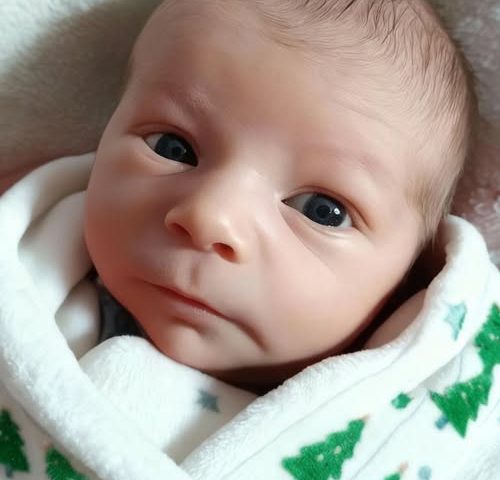
As Julia nearly d:ies during childbirth, she expects her husband to be her rock during recovery. Instead, he becomes distant and starts disappearing every night after seeing their newborn daughter’s face. What could possibly drive a new dad to abandon his family when they need him most?
I nearly lost my life giving birth to my daughter, and I truly believed that would be the most frightening part of becoming a mother. I was mistaken.
The labor dragged on for 18 agonizing hours, and nearly everything that could go wrong did. My blood pressure surged, then plummeted. The steady rhythm of the monitors turned into frantic alarms, and I caught the looks exchanged by the medical staff—the kind no patient ever wants to see.
“We need to deliver this baby immediately,” Dr. Martinez said, calm but urgent.
I remember clutching Ryan’s hand so hard I thought I might crush it. He kept whispering, “Stay with me, Julia. Stay with me. I can’t do this without you.”
Then everything went dark.
The pain vanished, the noise faded, and it felt like I was drifting away. Somehow, I pulled myself back—maybe Ryan’s voice kept me grounded, or maybe it was sheer determination to meet our baby.
When I woke up hours later, the first thing I saw was Ryan leaning over me, completely drained. His eyes were swollen from crying, his hair a mess, and he looked as though he’d aged a decade overnight.
“She’s here,” he whispered, his voice thick with emotion. “She’s perfect.”
That’s when the nurse brought our daughter over. Lily.
She weighed seven pounds, two ounces—pure perfection.
“Do you want to hold her?” I asked Ryan.
He nodded and carefully took Lily from the nurse. But as he looked down at her, something changed. The joy on his face faded into something I couldn’t quite place, like a shadow passing over him. After a long moment, he handed her back to me.
“She’s beautiful,” he said, though his voice sounded strained. “Just like her mom.”
In the hospital, I brushed off his odd behavior as exhaustion. We’d both been through something traumatic.
But once we were home, it only got worse.
Ryan avoided looking directly at Lily when he held her. He took care of her—feeding her, changing her—but his gaze hovered somewhere above her face, as if he couldn’t bring himself to meet her eyes.
When I tried to take the usual newborn photos everyone shares online, he always found a reason to leave the room.
“I need to check the mail,” or “I should start dinner,” he’d say.
The real warning sign appeared about two weeks after we got home. I started waking in the middle of the night to an empty bed and the soft click of the front door closing.
The first time, I told myself he just needed air or was checking something outside—new parent nerves, I assumed.
By the fifth night, I knew something was deeply wrong.
“Ryan, where were you last night?” I asked him over breakfast, trying to keep my voice casual.
“Couldn’t sleep,” he said, his gaze glued to his coffee. “Went for a drive.”
That was the moment I made a choice that changed everything. If my husband was slipping out every night while I stayed home alone with our newborn, I was going to learn exactly where he was going.
The following night, I pretended to fall asleep early. I lay completely still, listening to Ryan’s breathing beside me until it deepened into a steady rhythm.
Just after midnight, right on schedule, I felt him ease out of bed. The floor creaked softly as he padded down the hall.
My heart pounded as I waited for the front door to close. Once I was sure he was gone, I moved quickly.
I pulled on jeans and a hoodie, grabbed my keys, and slipped outside. Ryan’s car was already reversing out of the driveway.
I waited until he turned the corner before starting my own car and following from a distance.
He drove far longer than I expected—through our quiet suburban streets, past the shopping plaza where we used to grab ice cream on date nights, and beyond the city limits into areas I barely recognized.
After nearly an hour, Ryan finally turned into the parking lot of a worn-down building that looked like an old community center. The paint was peeling, and a flickering neon sign above the door read “Hope Recovery Center.”
A few cars were parked around the lot, and warm light glowed from the windows.
I pulled in behind a large truck and watched as Ryan sat in his car for several minutes, as if summoning the courage to move. Then he stepped out and headed toward the building, his shoulders slumped.
Questions raced through my mind. Was he sick? Was he having an affair? Every awful possibility flashed through my thoughts.
I waited another ten minutes before edging closer. Through a partially open window, I could hear voices—several people speaking in what sounded like a group.
“The hardest part,” a man’s voice said, “is looking at your child and only being able to think about how close you came to losing everything that matters.”
I froze. I knew that voice.
I moved closer to the window.
Inside, about a dozen people sat in folding chairs arranged in a circle. And there, directly in front of me, was Ryan—his head buried in his hands, his shoulders shaking.
“I keep having these nightmares,” he was saying to the group. “I see her in pain. I see the doctors rushing around. I see myself holding this perfect baby while my wife is dying right next to me. And I feel so angry and helpless that I can’t even look at my daughter without remembering that moment.”
A woman across the circle nodded sympathetically. “Trauma affects everyone differently, Ryan. What you’re experiencing is completely normal for partners who witness difficult births.”
Ryan lifted his head, and I could see tears streaming down his face. “I love my wife more than anything in this world. And I love my daughter. But every time I look at Lily, all I can see is how close I came to losing Julia. How I was completely powerless to help her. I’m terrified that if I get too attached to this beautiful life we’ve built, something will happen to destroy it again.”
The group leader, an older woman with kind eyes, leaned forward. “Fear of bonding after trauma is one of the most common responses we see here. You’re not broken, Ryan. You’re healing.”
I slid down beneath the window, tears streaming freely now.
This wasn’t about another woman. It wasn’t about him loving us any less. It was about a man so deeply shaken by nearly losing his wife that he couldn’t fully let himself step into the joy of welcoming his daughter.
While I had been quietly wondering whether Ryan regretted Lily, he had been seeking help in secret—trying to become the father she deserved. I stayed crouched there for another half hour, listening as my husband opened his heart to a room full of strangers.
He spoke about the nightmares that robbed him of sleep, about replaying those terrifying moments in the delivery room again and again. He even confessed that he’d been avoiding skin-to-skin contact with Lily because he was afraid his fear might somehow pass on to her.
“I don’t want her to sense my anxiety,” he told the group. “Babies can feel that stuff, right? I’d rather keep my distance until I can be the father she deserves.”
The group leader nodded knowingly. “What you’re doing takes incredible strength, Ryan. But healing isn’t something you have to do alone. Have you considered including Julia in this process?”
Ryan shook his head quickly. “She almost died because of this pregnancy. The last thing she needs is to worry about my mental health on top of everything else. She’s been through enough.”
My heart shattered right there in the parking lot. How had Ryan been carrying all of this on his own?
When the meeting ended, I hurried back to my car and drove home as quickly as I could. I had to be in bed before Ryan returned—but more than that, I needed time to absorb what I’d just discovered.
The next morning, once Ryan had gone to work and Lily was asleep, I made a choice. I picked up the phone and called the Hope Recovery Center.
“Hi,” I said when someone answered. “My name is Julia. I think my husband has been attending your support group meetings, and I’d like to know if there’s a way I can be involved.”
The receptionist was incredibly kind. “We have a partners’ support group that meets on Wednesday evenings. Would you be interested in attending?”
“Yes,” I said without hesitation. “I’ll be there.”
That Wednesday, I asked my sister to watch Lily and drove to the community center myself. My hands were slick with sweat as I stepped inside and headed to a different room than the one where Ryan attended his meetings.
Inside, about eight women were seated in a circle, and I instantly recognized the same hollow, haunted expression on their faces—the very one I’d been wearing for weeks.
“I’m Julia,” I said when it was my turn to introduce myself. “My husband has been coming here because our daughter’s birth was traumatic. But I think I need help too. I’ve been feeling so alone and confused.”
A woman named Sarah offered me a gentle smile. “Birth trauma affects both parents, Julia. You’re exactly where you need to be.”
Over the next hour, I learned that what Ryan and I were going through was classic post-traumatic stress. The nightmares, the avoidance, the emotional distance—it was all the mind’s way of trying to shield itself after experiencing something terrifying.
“The encouraging part,” the group leader said, “is that with the right support and honest communication, couples can face this together and come out stronger.”
When I left the meeting, I felt hopeful for the first time in weeks. I had a plan.
That evening, I waited for Ryan to come home from his support group. He looked startled to see me awake in the living room, holding Lily.
“We need to talk,” I said softly.
His face drained of color. “Julia, I—”
“I followed you,” I cut in gently. “I know about the therapy. I know about the trauma group.”
Ryan sank into the chair across from me, looking worn down. “I didn’t want you to worry,” he said. “You’ve already been through so much.” I sat beside him, still cradling our sleeping daughter. “Ryan, we’re a team. We can heal from this together.”
That’s when he finally looked straight at Lily.
“I was terrified of losing you both,” he said, brushing her tiny hand.
“You don’t have to carry that fear alone anymore,” I whispered.
Two months later, we’re both in couples counseling.
Ryan holds Lily every morning now, and when I see him gazing at her with love instead of fear, I know we’ll be alright.
Sometimes, the darkest nights truly do give way to the brightest mornings.