D*ed in childbirth, yet her coffin wouldn’t budge even with eight men. When the mother-in-law demanded it be opened, no one expected what was inside.
The mournful sound of funeral trumpets wound through the narrow alleyways, tangling with the soft, relentless drizzle that fell on the rusty tin roofs. In the center of the small courtyard, a gold-painted coffin rested on two worn wooden benches.
Dozens of people stood packed together, shoulders touching, heads bowed. Some clutched rosary beads, others wrung handkerchiefs in trembling fingers. All of them were crying for the same person: Isela.
Only twenty-five.
A daughter-in-law so gentle that even the neighbors called her “blessed.”
Since marrying into the Ramírez family, she had cared for her in-laws like her own parents. She rose before dawn to make coffee, helped with the shop, remembered everyone’s medicine, their favorite foods, their aches and worries.
Her mother-in-law, Doña Carmen, would often smile with pride and say,
“A home with a daughter-in-law like Isela is a home God has kissed.”
But a little over a year after the wedding, that blessing turned into a wound.
That terrible night, Isela had doubled over in pain, clutching her swollen belly, tears streaming down her cheeks as she gasped for breath. The family rushed her to the hospital, hearts pounding, prayers tumbling from their lips.
By the time they arrived, it was already too late.
The baby never cried.
And Isela… never opened her eyes again.
The news shattered the Ramírez household.
Carmen collapsed in the hospital corridor, her wails echoing off the cold white walls. Her husband, Don Rogelio, seemed to turn to stone, staring at nothing, his calloused hands hanging uselessly by his sides.
Now, in the courtyard, he stood motionless in front of the coffin, his red-rimmed eyes fixed on the framed photograph resting above it.
Isela smiled in that picture—hair falling softly over her shoulders, eyes bright, full of a life that had been stolen too soon.
When the time came to move the coffin to the hearse, eight strong young men stepped forward. They were used to heavy loads—farm work, construction, crates of bricks and lumber. They positioned themselves at the corners, exchanged a brief nod, and heaved.
Nothing.
They tried again, muscles straining, jaws clenched, veins standing out on their necks. The coffin didn’t move an inch. Sweat mixed with rain on their faces.
Murmurs rippled through the crowd.
“Is it stuck?”
“Did they nail it wrong?”
“Maybe the bench shifted?”
But the benches were firm. The ground was solid. The coffin felt as though it had been nailed to the earth itself.
An older woman wrapped in a black shawl crossed herself and whispered just loud enough for those near her to hear,
“She’s still grieving… she’s not ready to leave.”
The priest, who had been watching with furrowed brows, stepped closer. His voice, calm but grave, cut through the whispers.
“Open the coffin,” he said softly. “Her soul still has something to say.”
A hush fell over the courtyard.
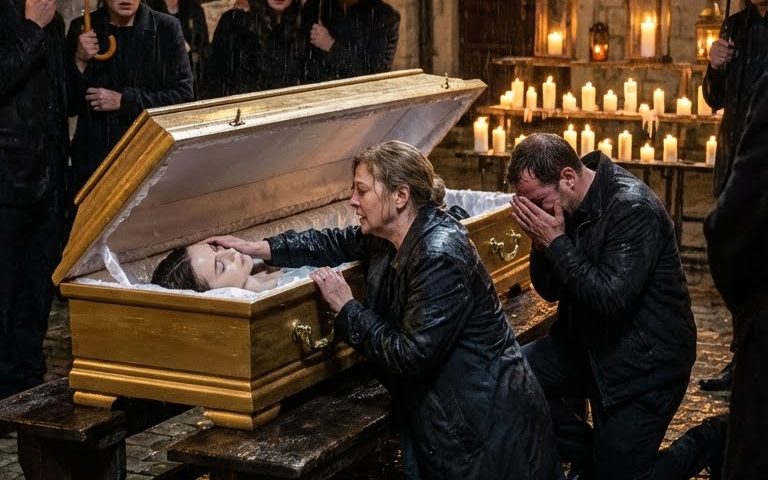
Carmen’s hands shook as she fumbled with the small lock. Rogelio stepped forward to help, his fingers clumsy with age and grief. Together, they lifted the lid.
Gasps broke from the crowd like a sudden gust of wind.
Isela lay there, dressed in white lace, a rosary wrapped around her delicate fingers. Her face looked peaceful at first glance—but then they saw it.
Tear tracks.
Faint, but undeniable. Pale streaks on her cheeks, as if she had still been crying even after death. Her eyes were closed, but her lashes clumped together, still damp.
The sight ripped through Carmen’s chest like a blade.
She let out a strangled cry and fell to her knees beside the coffin, clutching her daughter-in-law’s cold hand.
“Isela… mi niña…” her voice broke. “Don’t cry anymore, my child. If there’s anything left unsaid… if we failed you… tell me. Forgive us, hija. Forgive us…”
Silence pressed down on the courtyard, thick and suffocating. Even the rain seemed to soften, as if the sky itself held its breath.
Then, through that suffocating stillness, came a sound—
A choked, shuddering sob.
All eyes turned.
Luis.
Isela’s husband knelt a few steps away, hands buried in his wet hair, shoulders shaking with each breath. He had been quiet through the whole funeral, like a man carved from stone. Now, the stone was cracking.
“Luis…” Carmen’s voice trembled. “Mijo… what’s wrong? Did you hear her?”
Slowly, Luis lifted his head. His face was destroyed—eyes swollen, cheeks streaked with tears and rain. When he spoke, his voice was no more than a broken whisper.
“It was my fault…” he gasped. “I… I made her suffer.”
The courtyard went still.
The priest lowered his head.
Rogelio’s fingers gripped the edge of the coffin until his knuckles turned white.
“What are you saying?” Carmen’s voice was raw. “What did you do to her?”
Luis stared at his wife’s tear-stained face inside the coffin, and the truth tumbled out, jagged and ugly.
“That night… she found out about the other woman.”
The words fell like stones in water.
He swallowed hard, his chest heaving.
“She didn’t scream, she didn’t hit me, she didn’t curse. She just… sat at the edge of the bed, holding her belly, crying. All night. I told her it meant nothing. I swore I would end it. I begged her to believe me. But she was already so hurt. So broken.”
His voice cracked.
“By morning, she could barely stand. She fainted in my arms. I took her to the hospital but… it was too late. The baby… her…”
He covered his face with his hands. “I killed her with what I did. I put that weight on her heart. On her body. I did this.”
The crowd, moments ago full of whispers and judgment, now stood frozen, faces stricken. Some people began to cry openly. Others stared at the ground, unable to look at the coffin or the man breaking in front of it.
Carmen trembled so hard she could barely breathe. She leaned over the coffin, tears falling on Isela’s lifeless fingers.
“Daughter…” she sobbed, “why did you carry all that pain alone? Why didn’t you tell me? Why didn’t we protect you?”
Her voice rose in anguish. “Forgive him if you can… forgive us all…”
Luis lurched forward and gripped the wooden edge of the coffin until his nails dug into it. His forehead pressed against the cold gold paint.
“Isela,” he choked, “I know I don’t deserve anything from you. Not forgiveness, not a single tear. Hate me if you must. Curse my name. But please… please… let me take you to your rest. Don’t stay here because of me. Don’t let my sin chain you to this world.”
As his words faded into the sound of the rain and the quiet sobs of the mourners…
The coffin shifted.
Just a small movement, a faint tremor, as if an invisible weight had finally lifted.
The priest closed his eyes and nodded slowly.
“She has let go,” he said. “Her soul has heard. And she has chosen to release her pain.”
The eight pallbearers stepped forward once more, unsure, almost afraid. They slipped their shoulders beneath the handles and, with one careful motion, lifted.
This time, the coffin rose easily.
Light. As if all that had anchored it down wasn’t wood or bone… but sorrow.
The funeral trumpets wailed again, their sad notes slicing through the rain, leading the slow procession out of the courtyard and toward the cemetery.
Luis remained kneeling on the wet tiles, his clothes soaked, his heart shattered. His tears mixed with the muddy rainwater pooling around his knees.
In that moment, he understood something no priest needed to tell him:
Some apologies come too late.
Some wounds don’t heal with words.
And some regrets… stay with a man for the rest of his life.
From that day on, in every quiet night, in every distant echo of a trumpet, in every shadow at the edge of his dreams, he would see her—
Isela, with her gentle eyes and tear-streaked face—
Not to answer his “I’m sorry,”
but to remind him of the price of a heart broken in silence.